This afternoon, a public police disciplinary tribunal decided on the seriousness of misconduct by two Officers who had admitted breaching the standards of expected behaviour.
Sadly, my comments in the conclusion of the earlier post about a perception of bias have been borne out by today’s proceedings.
The disciplinary panel at today’s tribunal was made up of two senior police officers, Assistant Chief Constable Marcus Beale (Panel Chairman), Detective Superintendent Blackburn, and an independent lay individual, David Bowden.
Police Disciplinary Tribunal Finding
After consideration of the facts and on the basis of the Officers’ record, the disciplinary panel decided that their behaviour was misconduct only rather than gross misconduct.
I am dismayed by this verdict.
Is it right and proper that these two men, who admitted their disgraceful misconduct, continue to be employed as police officers for West Midlands Police?
After much publicity, certain changes have been introduced to the way that police officers are disciplined so as to create a “more robust, independent and transparent” police disciplinary system.
One of the changes introduced is holding misconduct hearings in public. As I have previously said, that’s a start.
Sadly for Ms Faragher and so many others, the system hasn’t changed materially in that the police continue to prosecute, defend, and sit in judgement on themselves.
Disciplinary Tribunal Punishment
Assistant Chief Constable Marcus Beale said the voicemail comments fell “substantially below what is expected of a West Midlands Police officer”.
However, he added: “The panel assess that the breach does not require the full range of sanctions, and that it amounts to misconduct.”
The punishment? Both Officers have been issued with written warnings.
My client, who attended both days of the police disciplinary tribunal, is extremely disappointed with not only the process, but also the findings, and result.
As a woman who was an alleged victim of domestic violence, all she wanted was to be treated with respect and professionalism. After being treated so badly by the two Officers she feels that the disciplinary tribunal has added insult to injury by letting the Officers off the hook.
She is also concerned that this sends a message about how West Midlands Police treat victims of crimes (in particular domestic violence against women) and that others might be put off reporting crime.
The panel at the police disciplinary tribunal had an opportunity to right a wrong and deal with these concerns. They failed.
Ms Faragher is now en route to ITV studios to be interviewed. The panel at the police disciplinary tribunal and two Officers may think that this matter is now settled. But for her, this story is not over.
To recap, my client Alex Faragher called West Midlands Police to lodge a complaint of domestic violence. The Officers assigned to her case, subsequently called her mobile to discuss the allegation. When the call went to answer phone, they inadvertently left an expletive ridden voice mail.
In the voice mail, you can hear these two men calling this victim of domestic violence a “f….. bitch” & a “f….. slag” before suggesting that they “go back, f.…… draft the statement out ourselves and then just get the bitch to sign it”.
Ms Faragher lodged a complaint about the voice mail and the Officers’ subsequent behaviour at the Police station as regards the preparation of her statement of evidence.
Police Misconduct Hearing
I am pleased to report that at a public hearing today, and despite the best efforts of the force’s Professional Standards Department during the course of the investigation to dilute the misconduct so that it related to the indisputable voice mail only, the Officers admitted all allegations of misconduct, i.e. in relation to the voice mail and conduct at the Police Station.
Apparently recognising the seriousness of the situation, one of the officers, PC Guest, repeatedly apologized, according to today’s newspaper reports.
Gross Misconduct in Police Matters
The issue for the tribunal (made up of two senior police officers and an independent lay person) to now decide is whether the Officers’ conduct amounts to just misconduct or whether their behaviour is so serious as to qualify for gross misconduct. So, what’s the difference?
Misconduct is defined as “a breach of the Standards of Professional Behaviour”.
Gross Misconduct is defined as “a breach of the Standards of Professional Behaviour that is so serious as to justify dismissal”.
But, when you recognize that this an employment matter at its heart, things become clearer.
Gross misconduct in that context is either deliberate wrongdoing or gross negligence by the employee (police officer) which is so serious that it fundamentally undermines the relationship of trust and confidence between the employee and employer (Chief Constable).
Today, barristers employed by both officers made representations to the panel that the admitted misconduct was simply that, misconduct. The problem for the Officers is that:
the eyes of the world (given that the hearing is in public) are upon them, and
in my opinion, the behaviour (as captured on voice mail) is so extreme that it has brought the force into disrepute.
A finding of gross misconduct and dismissal without further notice must be the only possible sanction.
We should know tomorrow.
Read my blog for more insights into matters involving the police.
At 11a.m. on Monday 26 October, two Police officers of West Midlands Police face a disciplinary hearing for gross police misconduct.
The hearing will take place in public. Police disciplinary hearings became public (subject to certain exceptions) on the 1 May 2015. That change, along with others, was aimed to create a “more robust, independent and transparent” police disciplinary system.
But have the reforms into investigations of police misconduct worked? Read on to find out why I think not.
Police Misconduct Allegation
The two West Midlands Police officers due to be brought to account on Monday face an allegation lodged by my client, Alex Faragher in January 2014. (Alex gave me permission to use her details.)
Ms Faragher’s complaint centered on an incident that happened during an enquiry into an alleged domestic violence assault.
Two male officers attended upon her shortly after the incident but Alex was too upset and distressed to provide full details. The officers subsequently tried to contact Alex on her mobile phone but were unable to get through. Accordingly, they left her a message but then failed to hang up properly. Their subsequent conversation was then mistakenly recorded.
In the two-minute recording (an extract of which you can listen to here) one officer allegedly says to the other, “F……. bitch, I specifically said, “you’re not going to give us the run around are you?” “No I want to press charges” she said. “F……. slag”.
A second officer then referred to writing their own version of her witness statement after her boyfriend had been arrested for assault. He can allegedly be heard saying, “Either that or the only other thing we do is go back, f….ing draft the statement out ourselves and then just get the bitch to sign it”.
Later that evening, unaware of the voice recording on her phone, Ms Faragher went to Sutton Coldfield Police Station to give her statement to the same two officers. Ms Faragher believes that her treatment at the Police Station was equally unprofessional because the officers did not take her dyslexia into account. They prepared a statement in her name and on her behalf and persuaded her to sign it without her first being permitted to read it and further because the officers then ignored her requests to amend particular parts of her statement.
It was only upon her return home later that evening that she both saw and heard the voicemail on her phone. After hearing it, she felt “victimised and humiliated”. She said, “They turned up after 6:30pm and tried to call me and mistakenly didn’t hang up. I picked up the conversation they then had in the police car that was recorded as a voicemail. I could not believe what I was hearing.” she said.
In line with the policy set by the Independent Police Complaints Commission (“IPCC”), one would assume that the resulting investigation would take a relatively short period of time. When Ms Faragher first complained she gave the police a copy of the recording along with a detailed account of what had happened. She has since co-operated fully with the investigators.
Despite this, it took an investigator from the Force’s Professional Standards Department six months to finalise their investigation and produce their Complaint Investigation Report.
The Report was inadequate, even after all that time and my client’s help. Although both officers were interviewed under caution on the 3 April 2014, the Report failed to identify the officers’ response to the recording and answer a crucial question: do they accept that it’s them?
Both officers did however provide an account of subsequent events at the Police Station. Both maintained that they had acted properly at all times and any allegation of misconduct (in this respect) was denied.
After consideration, the investigating officer decided to not uphold this aspect of the complaint on the basis that there was no evidence available to corroborate either Ms Faragher’s account or the officers’ account.
But the Investigating Officer concluded that the officers had a case to answer in relation to the allegation that they had spoken about Ms Faragher in a discourteous and disparaging manner. This part of the complaint was upheld and will be addressed at the misconduct hearing.
Complaint to the IPCC
Whilst Ms Faragher was pleased that the officers were to be brought to account in relation to the taped conversation, this was only part of her complaint and the fact remained that the officers’ treatment of her at the station was unprofessional.
The decision of the investigator was, in my opinion, perverse, and designed to protect the officers from further scrutiny and a form of damage limitation.
On my advice, she appealed to the IPCC, the independent police watchdog.
On review by the IPCC in December 2014, it was found that whilst there was no evidence available to corroborate either the officers’ account or Ms Farragaher’s account of events at the police station, the taped recording added weight to my client’s complaint, particularly the comment that the officers would “go back, f….. draft the statement out ourselves and then just get the bitch to sign it”.
Accordingly, the IPCC case worker found that on balance, Ms Faragher’s complaint held “more credibility” and therefore upheld the appeal and decided that there was a case to answer for gross misconduct for both the recording and what happened at the police station.
The police disagreed.
In March 2015, West Midlands Police told the IPCC that they did not accept its recommendation that the officers face a Gross Misconduct hearing about events at the Police station.
In May, the IPCC stated that their original decision held and that West Midlands Police should include the additional complaints.
As a result, both will be addressed at Monday’s hearing.
Justice Delayed
On the face of it, West Midlands Police are harbouring two delinquent employees who should be dealt with as soon as possible.
But it has taken nearly two years from when Ms Faragher lodged her complaint to get them to appear before a Gross Misconduct hearing. All the time those officers have continued to work, although they are now reported to be on restricted duties in “non-public facing” roles.
Natural Justice demands that investigations into alleged police misconduct are full and fair, and that disciplinary proceedings are finalised in an expeditious manner.
Maintaining a system where police investigations are undertaken by officers in the same force leads to a perception of bias. And because there is no limit on the extent of investigation process or the time allowed, the most that the IPCC can demand is that the investigation process “should be proportionate to the nature of the complaint”.
The biggest stumbling block in assuring public trust and accountability in the police is the sense that internal discipline is not implemented effectively.
Cases like Alex Faragher’s show that, while reforms like public hearings may help, there is much more to do.
Contact me for help with you police misconduct matter using the online form below or via my firm’s website.
The research shows the electric stun gun was drawn, aimed or fired 38,135 times in England and Wales over five years.
In more than 12% of cases Tasers were used against black people, who make up about 4% of the population.
I have long maintained that there is a growing trend for the unnecessary and unreasonable use of Tasers (see here, for example). Now, we have concrete evidence of their disproportionate use against a certain ethnic group.
But why?
One theory is that the police, like the rest of us, are subject to “confirmation bias” which is defined in Science Daily as the “tendency to search for or interpret information in a way that confirms one’s preconceptions”.
If police officers have the perception that black people are more likely to be involved in criminal behaviour, that they will attempt to evade capture, or forcibly resist arrest, they will consciously or unconsciously seek out proof. Using Tasers during an arrest is just one way of justifying their (unfounded) assumptions.
Taser Assault on Innocent Black Man
An example of police confirmation bias against black people is the case of my client Samuel Miller (name changed for privacy purposes).
Samuel is a young black man who had never been in trouble with the police. He was walking to his local gym on a sunny day in June 2010 when, unbeknown to him, local police were actively looking for a black suspect who had raped a student at knifepoint.
Mr Miller was stopped by an officer with a dog who told him that they were looking for someone with his profile. Samuel gave his name and address and told him he was heading to the gym. The Officer called for backup. Samuel understandably felt uneasy.
10-15 minutes after he had first been stopped, several police vehicles arrived and positioned themselves so as to box Samuel and the dog handler in. Seven white officers alighted. Mr Miller was extremely alarmed by developments.
Four of the officers approached. At this stage, Mr Miller had his thumbs in his back pockets with his arms hanging down. One officer told Samuel to “Give me your hands”. Samuel did so and as he did, the officer took hold of his forearm and suddenly said, “He’s going to attack”.
The officer grabbed Mr Miller’s wrist and tried to force his arm behind his back and handcuff him. Samuel could not believe what was happening and having done nothing wrong and having been given no explanation, resisted.
In response, other officers applied a succession of knee strikes and blows to his body and then five or six punches to his face. Eventually, Mr Miller felt his leg about to give way and as he began to fall to the ground, he was Tasered to the back. His body shuddered and he fell heavily onto his right shoulder.
Following his arrest, Samuel could see the officers in discussion. They were holding a picture up on a piece of paper. He could see that the picture was of a black man’s face. The officers held it up and were looking at Samuel and looking back at the photograph. One officer said, “We’ve got the wrong man.”
Despite this Samuel was arrested and taken to a local police station. Upon arrival, he still had two of the Taser barbs embedded in his back. A police nurse and Doctor tried to remove the Taser barb from his body but concluded that the barb was embedded so deeply that Mr Miller would have to attend hospital.
After a short while, Samuel was taken to hospital where with some difficulty, the barb was extracted and stitches applied.
Mr Miller was taken back to the police station where he was eventually interviewed.
The police told him that he had been stopped because he bore a strong resemblance to an armed man wanted for a serious offence but that because of how he had reacted, he had been arrested for a public order offence.
Samuel was eventually released on police bail having spent over 14 hours in custody. Several weeks later, he was advised that no further action was to be taken against him.
With my help, Mr Miller brought a civil action against the police. Liability was robustly denied. Notwithstanding this denial, Samuel’s claim settled for substantial damages plus costs together with an apology following the issue of court proceedings.
Addressing Confirmation Bias
It appears that the police’s confirmation bias that black men like Samuel are dangerous individuals led to this brutal and unjustified Taser assault.
Mr Miller’s only “crimes” were being black and in the wrong place at the wrong time. His understandable and perfectly reasonable resistance to an unlawful arrest led to the disproportionate use of force, and especially the unnecessary discharge of a Taser when he had already been subdued and was falling to the ground.
The police then showed their true colours by arresting Samuel for a (bogus) public order offence because of how he had reacted, convincing themselves that his conduct was unlawful, and fitting the confirmation bias narrative. (s.5 of the Public Order Act 1986 says that a person is guilty of an offence if he “uses threatening (or abusive) words or behaviour, or disorderly behaviour”.)
In light of today’s BBC report and Mr Miller’s case it seems to me that the police still have a long way to go to address what Sir William McPherson described as an “institutional racist” organisation in his 1999 report about the Stephen Lawrence inquiry. They need to address confirmation bias as well.
Contact me for help with your claim against the police using the online form below or via my firm’s website.
Update
I am pleased to confirm that at a Joint Settlement Meeting, Greater Manchester Police agreed an out-of-court settlement of £50,000 together with my client’s legal fees.
You’d expect that senior police officers would think about the law when authorising a person’s detention under the Police and Criminal Evidence Act after an arrest by a more junior officer. They are more experienced and have more training after all.
Unfortunately, as the two cases below show, the ability of custody officers and other senior officers to apply their minds varies greatly, which can lead to people being unlawfully arrested and detained. As I explain below, this lack of thought costs us all.
Getting the Police and Criminal Evidence Act Right- Dorset Police
The Police and Criminal Evidence Act 1984 (as amended) (“PACE”) introduced a number of safety checks to ensure that following an individual’s arrest, s/he is processed fairly and within the law. An individual’s arrest and detention should be reviewed on a regular basis, particularly given that the police must justify any detention minute-by-minute.
It is therefore heartening to come across a case where a custody officer does his job and objectively assesses the lawfulness of an arrest and grounds of detention. Step forward Sergeant Arnold of Dorset Police.
Sergeant Arnold was the custody officer on duty when my client John Warner arrived in handcuffs after his arrest for obstructing police.
Mr Warner had been out with a friend who, at the end of the evening, offered to give him a lift home. Neither man had been drinking. En route, the car was stopped by uniformed traffic police.
John’s friend, the driver, was requested by the traffic officers to switch off his engine and step out of the vehicle. He refused.
The doors of the vehicle had been locked and the traffic officers’ attempts to persuade the driver to step out of his vehicle proved unsuccessful. The officers therefore requested further assistance.
Two more police officers arrived at the scene.
One of them warned the driver that unless the door was opened voluntarily, he would use his baton to break into the vehicle. In the absence of any co-operation by the driver, the officer then struck the offside window of the vehicle on a number of occasions before the window shattered.
The act of breaking the window succeeded in persuading the driver to unlock and exit the vehicle. Upon doing so, both he and my client were arrested for obstructing a police officer in the execution of his duty.
Both men were taken to Bournemouth Police Station. There the arresting officer advised Sergeant Arnold, the custody officer, of the arrest circumstances.
The Law About Obstructing a Police Officer
Section 89(2) of the Police Act 1996 states it is an offence to wilfully obstruct a constable in the execution of his duty, or a person assisting a constable in the execution of his duty.
The legislation states that a person obstructs a constable if he prevents him from carrying out his duties or makes it more difficult for him to do so.
Crucially, the obstruction must be ‘wilful’, meaning the accused must act (or refuse to act) deliberately, knowing and intending his act will obstruct the constable.
There was no evidence that Mr Warner was ever asked to assist the officers in gaining the driver’s cooperation. He was never asked to:
disclose the driver’s name;
give an account; or
open his door.
John had simply sat passively in the vehicle at all times.
Applying the law correctly, the Sergeant refused to authorise Mr Warner’s detention on the basis that ‘no positive acts’ had been performed by my client to prevent the officers from doing their duty.
He was released from custody shortly thereafter.
Compensation for Unlawful Arrest
Imprisonment is from the moment someone’s liberty is interfered with (not, for example, when detention is authorised at the police station).
Even though my client was released by the custody sergeant within a few minutes of his arrival at the police station, he was entitled to be compensated from the time of his arrest to the time of his release, and for the force used against him (he was handcuffed as soon as he got out of the vehicle).
I recovered £2,000 plus costs for Mr Warner, which was more than reasonable in the circumstances.
Getting it Wrong- Kent Police
Compare the professionalism of Sergeant Arnold of Dorset Police with senior officers of Kent Police.
One evening in April 2014 my client Kyle Mathers had an argument with his wife. His wife called the police for support and because she had no one else to call. She was hoping the police would mediate. Upon arrival, officers spoke with both Mr Mathers and his wife.
My client’s wife told the police that she and Kyle had argued but that no violence had occurred. She did, however suggest that she had been assaulted by her husband over a year earlier after an argument about the children. The police told Mr Mathers he had to leave the home.
He refused, and at about 8 p.m. the officers arrested my client for common assault.
The Law to Justify Arrest in a Common Assault
An offence of common assault is committed when a person either assaults another person or commits a battery.
An assault is committed when a person intentionally or recklessly causes another to apprehend the immediate infliction of unlawful force.
A battery is committed when a person intentionally and recklessly applies unlawful force to another.
On the basis of my client’s wife’s report, it could be argued that the officer had reason to suspect my client had (on his wife’s account) committed a common assault a year before.
But, by reason of s.127 of the Magistrates Court Act, any prosecution for common assault must be brought within 6 months from the time when the offence was committed.
So, the offence was not made out, meaning that Mr Mathers’ arrest and detention would be unlawful. Unfortunately, the arresting officer did not consider this before proceeding.
Senior Officer Errors
Shortly after arrest, Kyle was taken to North Kent Police Station and put before Sergeant Cole.
Section 34(2) of PACE states that if a custody officer becomes aware that the grounds for holding a person no longer exist then he must order his release.
Only the custody officer has the authority to release a person from police detention.
Sergeant Cole was given the circumstances of arrest which he recorded as “common assault in February 2013” and, at approximately 8.30 p.m. he authorised detention. In doing so the custody officer also failed to identify the (obvious) time limit on prosecution.
Police and Criminal Evidence Act Protection
PACE doesn’t stop its guidance after the custody officer justifies initial detention.
Perhaps anticipating mistakes by senior officers, the lawmakers built in a number of safety nets to ensure that only people who should be in custody stay there.
Not later than 6 hours after detention is first authorised at the police station, an Inspector is obliged to carry out a review to determine that the grounds for detention remain.
Section 40 of PACE states that the review officer is responsible for periodically determining if a person’s detention, before or after charge, continues to be necessary. This requirement continues throughout the detention period.
Enter Inspector Kent who at 11:13 p.m. carried out the first custody review.
You would think that a senior officer with the rank of inspector would identify the historic nature of the “offence” and realise that it was too late to prosecute. Sadly, Inspector Kent raised no concerns and allowed Mr Mathers’ continued detention.
Later the custody officer, Sergeant Cole, was replaced by Sergeant Roach. Surely he would notice a problem? No, he too failed to spot that the alleged offence was time-barred because of the statutory time limit.
PACE ensured yet another custody review (not later than 9 hours after the first review). The senior officers dutifully ensured it was done.
Step forward Inspector Stephens. At 7.15 a.m. he too carried out a review and yes, he too failed to spot the time limit problem.
Mr Mathers asked for the services of a duty solicitor. Enter the heroine of this story: Ms Lewis of TBW Solicitors.
Ms Lewis considered the custody record and immediately spotted the problem: the alleged offence which the arresting officers relied upon was time-barred.
She immediately made representations and within minutes, Mr Mathers was released. In all, Mr Mathers spent approximately 19 hours in custody.
I am confident that he will receive significant compensation, as he should considering the appalling errors made by no fewer than five Kent Police officers which led to him being unlawfully arrested and detained.
Lip Service to the Police and Criminal Evidence Act
Mr Mathers’ case shows that no matter how many safeguards lawmakers introduce, they can’t legislate to make police officers think.
The Police and Criminal Evidence Act (as amended) isn’t some obscure law. It’s a cornerstone of criminal law as much of it deals with arrest and detention. Every police officer receives extensive training on it, and senior officers such as custody sergeants work within its rules every day.
But it’s one thing to follow the time-limits in the PACE guidelines and pay lip service to the process, it’s quite another to think about why the person in custody is there in the first place.
As comedian Ron White says, “you can’t fix stupid”.
If you want help claiming compensation against the police contact me using the form below or via my firm’s website.
I read on the BBC website today that Christopher Jeffries, the man wrongfully accused of the murder of Joanne Yeates in December 2010, has accepted a written apology and a small amount of compensation for damage to his home following the police search.
Nick Gargan, the Chief Constable of Avon & Somerset Police (shown below) has written to Mr. Jeffries and was interviewed on camera confirming that:
Mr. Jeffries is no longer a suspect in the case, and
that the police regret the suffering he experienced as a result of them not making it clear that Mr. Jeffries was no longer a suspect on his release from bail on 5 March 2011, and
inviting Mr. Jeffries to meet with him to ‘discuss any lessons’ the police could learn from his treatment and experience.
Nick Gargan, Chief Constable of Avon & Somerset Police
However, no compensation has been paid for Christopher Jeffries’ claimed ‘false imprisonment, breach of human rights, and trespass to person and property’.
False imprisonment and reasonable suspicion
As I outlined in a blog post I wrote for Charon QC last year, Mr. Jeffries’ case for false imprisonment was on thin ice from the beginning due to the very low threshold the police need to meet to justify an arrest. Having a ‘reasonable suspicion’ to arrest means merely something more than a hunch, but less than formal proof.
It would appear that, nearly three years on, Mr. Jeffries has accepted the strength of the police’s defence to his false imprisonment claim. No doubt this will be very disappointing for him.
Alternatives to compensation in an actions against the police claim
The failure of such a high-profile claim for false imprisonment shows how difficult actions against the police claims can be. Despite this, as a solicitor who specialises in actions against the police, I have successfully recovered compensation for many people against police forces throughout England & Wales, and continue to represent numerous clients in their false imprisonment claims. You can read some case reports of police claims I have successfully pursued here.
But these cases cannot be measured purely in financial terms. Often my clients seek not only compensation, but like Mr. Jeffries, they also seek an apology and assurance that lessons will be learned.
Despite the failure of his false imprisonment claim, Christopher Jeffries has had his name cleared. He has received a very public apology from the Chief Constable, libel damages from eight newspapers, and public sympathy and support from Lord Chief Justice Judge, who described his treatment at the hands of the tabloid newspapers as ‘vilification’.
No doubt he also feels that, after three years in which his life changed immeasurably, enough is enough.
If you believe you have a false imprisonment claim and want help, contact me, Iain Gould, using the online form below, on 0151 933 5525, or via my firm’s website. Alternatively, please read more about me here.
A Home Office report which was published yesterday confirms that Taser use more than doubled between 2009-2001, following the issue of 10,000 more Tasers to the police once the initial testing period ended in 2008.
The latest figures which cover the period 2009-2011, unsurprisingly show that as the police have been issued with more Tasers, the ‘stun-guns’ have been more extensively used. Figures for 2011-2013 are expected to show a further increase.
In 2011, 25.7% of the time the Taser was discharged, causing injury to the victim.
Police assault using a Taser
Naturally, the public should be concerned especially as the Independent Police Complaints Commission is currently investigating three deaths where Tasers were used.
On numerous occasions I have written about the police’s seemingly uncontrolled use of these potentially lethal weapons (you can read my previous posts here, here, here, and here).
I am being contacted on a regular basis by potential clients who have suffered a police assault by officers using their Tasers. We should not forget that these ‘statistics’ are actually people, some of whom have had their lives irreparably changed as a result.
Police assault by Taser causes serious injuries
In itself, 50,000 volts being shot through a person’s body is enough to cause serious injury, heart problems, and psychological upset. But for some unfortunate victims, the more serious injuries arise from the secondary impact caused by being Tasered.
Having been Tasered, the body freezes in temporary paralysis, causing the victim to become imbalanced and fall forward, giving rise to a risk of serious head injuries, including brain damage.
A client I am currently representing was shot in the back by the police with a Taser as he ran away. This caused him to fall forward and land, face-first, on the concrete ground below. He was unable to protect himself because he could not raise his arms due to the paralysis, and lost or damaged 5 teeth as well as sustaining facial and other injuries.
His injuries have already cost him thousands of pounds in dental treatment, he is now facially disfigured, and feels that his life will never be the same.
Today’s BBC Radio interview about Taser use
I was interviewed today by BBC Radio Merseyside to provide my thoughts.
You can hear the BBC Radio interview in full by clicking on the ‘play’ arrow below:
While I readily accept that, in certain situations, the use of a Taser may be appropriate, I am concerned that the training police officers receive should stress more strongly that Tasers should be a weapon of last resort, and should be used in extreme circumstances only.
The Association of Chief Police Officer’s guidelines state that a Taser can only be used where officers face violence or when the police are in a situation where the threat of violence is so severe they need to use force to protect the public, themselves, and/ or the person they are dealing with.
Certainly in many of my clients’ cases I would argue that:
they present no threat whatsoever, and
that the police have acted with undue haste, and
in some cases I have dealt with, the police have exaggerated the threat and fabricated an account to justify Taser use and excuse the police assault.
Hopefully the figures presented today will generate further public awareness and debate as to whether police officers should be routinely equipped with a Taser and in what circumstances such a weapon should be used.
If you have been injured as a result of a police assault using a Taser, contact me using the online form below, on 0151 933 5525, or via my firm’s website. Alternatively, read more about me, my website or blog for more information about actions against the police claims.
On 30 April 2005 an armed police officer of the London Metropolitan Police fatally shot Azelle Rodney (shown below), a passenger in a car believed to have armed criminals inside, in a bungled ‘hard stop’. Although weapons were subsequently found in the vehicle, Mr. Rodney was not holding a gun when killed by the police.
Investigations by both the Independent Police Complaints Commission and the Crown Prosecution Service found no reason to criticise the police’s conduct. No inquest was held, and eventually political pressure persuaded the Lord Chancellor to establish a Parliamentary Inquiry on 10 June 2010.
their handling of the aftermath of the shooting, and
concluded that there was no lawful justification for shooting Mr. Rodney so as to kill him.
Specifically, the report criticised the conduct of the ‘hard stop’, a tactic used by the police to ‘box in’ a suspect vehicle and use overwhelming force to shock the occupants into compliance. The report’s authors considered this ‘hard stop’ fell short of Police standards.
They found fault with:
the decision to ‘box in’ the vehicle directly outside a pub when better opportunities for the manoeuvre had previously presented themselves,
the deliberate ramming of the suspect vehicle on two separate occasions,
the officers who alighted from the police vehicles failed to wear caps so identifying themselves as police officers,
the officers fired a shotgun into the suspect vehicle’s tyres after it had been rammed and hemmed in when there was no likelihood of the vehicle escaping
the disproportionate force used by the police officer who shot Azelle Rodney, who opened fire only 0.06 seconds after his car stopped alongside the suspect vehicle with first six bullets, then followed up with two more shots. Shots 5-8 were found to have been directly to the head.
the evidence given by that officer was unreliable. The report found that the officer could not have seen or believed that Azelle Rodney had picked up a gun and was about to use it, despite his earlier statements. It considered that the policeman would be liable in civil and criminal law for the killing as there was no basis for firing the fatal fifth to eighth shots
the post-assault procedures, in which Mr. Rodney’s body was left on the pavement for more than 16 hours, his blood was not cleaned away prior to his family attending the scene, and unauthorised press reports were released.
The report recommends that the Metropolitan Police conduct a thorough review of their procedures.
Our modern police force has evolved to deal with changing threats. In particular, the risks caused by firearms and weapons means that the police have developed a tactic to create ‘shock and awe’ in the minds of their suspects. The police will now use the ‘hard stop’, expletives, physical force, ‘boxing in’ (where police vehicles are used to corner a suspect’s vehicle), and other aggressive behaviour to dominate and intimidate. They justify this by stating that they may have to deal with the threat of lethal force from potentially armed suspects.
The bungled ‘hard stop’ which tragically resulted in Azelle Rodney’s death was over eight years ago. Have the police learned from their mistakes? As two of my cases involving the London Metropolitan Police show, a pattern of unjustifiable police assaults is emerging that may suggest not.
Police assault, hard stops and ‘verbal stunning’
My clients Claire Clarke, James Barber, Nicholas Fairbairn and Ruth Fairbairn were on the receiving end of aggressive police assault tactics, described in an official response to their complaint as ‘verbal stunning’, when they were driving home from visiting friends on 19 April 2010. (You can read a case report here.)
The four friends in their late twenties were driving in Harrow when their car was boxed in by three marked Police cars while executing a ‘hard stop’.
A number of armed police officers surrounded them and trained their weapons on the car. James (the driver) had his car window was smashed, was roughly pulled out, thrown to the glass-covered ground and handcuffed. The armed police officers screamed expletives and contradictory instructions at the terrified friends. Nick and Ruth were also forcibly removed and handcuffed. The friends were separated. After 20 minutes the police explained they had made a mistake, and that they had stopped the wrong car.
All suffered physical and emotional distress as a result. As with Azelle Rodney’s case, the Independent Police Complaints Commission rejected their complaint saying there was no evidence of misconduct. I disagreed and instigated a civil action on their behalf and ultimately recovered compensation for my clients for this police assault on the basis that the police failed to conduct basic checks before executing the ‘hard stop’ on the friends’ car.
My client Mr. A had just walked into an underground car park on 04 September 2009 when he was set upon by five or six armed men, all dressed in plain clothes. One of the men approached him and without warning smashed the butt of his gun into the side of Mr. A’s right temple, causing him to fall to the ground.
Mr. A was dragged away from the car park doorway by his attacker.
When Mr. A asked ‘why are you beating me?’ the man said ‘keep your f**king mouth shut’ and struck Mr. A with the butt of his gun again in the right temple.
Mr. A adopted a foetal position on the ground. While defenceless he felt people pulling at his limbs, kicking his heels, ribs and left hip. He was stamped on by the men. Then he was struck with the butt of the gun a third time to the head by the same man, who shouted ‘F**king c*nt, move!’
Mr. A, who was bleeding heavily and in great pain by this time had no idea who was attacking him, or why.
The man with the gun was told to ‘back off’ by a colleague, who came over and said ‘it’s not even f**king him’. Despite this, Mr. A was told that he was being arrested.
It then dawned on Mr. A that he had been repeatedly assaulted by police officers, not gangland thugs. As with Azelle Rodney’s case, the officers had failed to wear caps or other identifying clothing.
Mr. A was arrested (even though the officers would not tell him why), taken to hospital and thereafter a London police station where he was held for over 24 hours before being released, even though the police had clearly arrested the wrong man.
Ultimately, no action was taken against him.
He has suffered serious injuries which have left him with permanent scars to his face and scalp, and emotional trauma. I am now pursuing an actions against the police claim for his police assault, wrongful arrest & false imprisonment. Mr. A seeks additional compensation for the police’s arbitrary, oppressive and unconstitutional conduct.
The police have denied liability and refused to apologise for their conduct. I have issued court proceedings on his behalf and the case is ongoing.
Police assault failures
There are chilling similarities between my clients’ cases and that of Azelle Rodney.
Eight years on, when faced with a potentially lethal threat, police officers are still failing to comply with proper procedures, using unnecessary force and mishandling the aftermath, knowing that they will be protected by the IPCC and their solicitors. We can only hope that the criticism of all involved in the Azelle Rodney case will convince the police to clean up their act.
If you are a victim of police assault and want to make a claim for compensation against the police, contact me using the online form below, on 0151 933 5525, or via the www.dpp-law.com website.
Despite the strict requirements of the Police and Criminal Evidence Act (PACE), it would appear that at least one police force, under pressure to increase the detection rate in relation to serious offences, admit to simply rounding up the ‘usual suspects’ without any evidence to suggest those individuals are responsible.
In a report commissioned by the Ministry of Justice, Vicky Kemp reviewed 5000 arrests made over a 3-month period in 2012 by Nottinghamshire Police. She found that ‘a significant minority’ involved suspects who were known to be prolific in the past but who had been wrongfully arrested with no evidence linking them to the crime for which they had been detained.
Such a policy has strong historical roots in British policing. It is a form of ‘social control’.
According to some police officers who were interviewed:
arresting persistent offenders;
detaining them for up to 24 hours;
confiscating their mobile phones and shoes for forensic examination;
imposing bail conditions; and
searching their homes
will all help reduce crime.
Police legal powers abused
While it is debatable if such an approach to ‘social control’ was ever in place, cultural and technological changes in the 1970’s introduced a more professional and tolerable model of policing reinforced by the provisions of s.24 of PACE (1984), which stresses that the police must have ‘reasonable grounds’ for arrest. The law states that –
24 Arrest without warrant: constables
(1) A constable may arrest without a warrant—
(a) anyone who is about to commit an offence;
(b) anyone who is in the act of committing an offence;
(c) anyone whom he has reasonable grounds for suspecting to be about to commit an offence;
(d) anyone whom he has reasonable grounds for suspecting to be committing an offence.
(2) If a constable has reasonable grounds for suspecting that an offence has been committed, he may arrest without a warrant anyone whom he has reasonable grounds to suspect of being guilty of it.
(3) If an offence has been committed, a constable may arrest without a warrant—
(a) anyone who is guilty of the offence;
(b) anyone whom he has reasonable grounds for suspecting to be guilty of it.
(4) But the power of summary arrest conferred by subsection (1), (2) or (3) is exercisable only if the constable has reasonable grounds for believing that for any of the reasons mentioned in subsection (5) it is necessary to arrest the person in question.
(5) The reasons are—
(a) to enable the name of the person in question to be ascertained (in the case where the constable does not know, and cannot readily ascertain, the person’s name, or has reasonable grounds for doubting whether a name given by the person as his name is his real name);
(b) correspondingly as regards the person’s address;
(c) to prevent the person in question—
(i) causing physical injury to himself or any other person;
(ii) suffering physical injury;
(iii) causing loss of or damage to property;
(iv) committing an offence against public decency (subject to subsection (6)); or
(v) causing an unlawful obstruction of the highway;
(d) to protect a child or other vulnerable person from the person in question;
(e) to allow the prompt and effective investigation of the offence or of the conduct of the person in question;
(f) to prevent any prosecution for the offence from being hindered by the disappearance of the person in question.
(6) Subsection (5)(c)(iv) applies only where members of the public going about their normal business cannot reasonably be expected to avoid the person in question.
So, aside from the very specific grounds detailed in the Act, the police do not have the power to arrest without a warrant. Any arrest outside of these terms is an abuse of police powers, and can lead to claims for wrongful arrest, false imprisonment and misfeasance in public office, especially if repeated as described in the Ministry of Justice report.
I am currently representing a 57-year-old man who wishes to sue Greater Manchester Police. Mr X will openly admit that he has a chequered past but has served his time and says his offending days are over. Despite this, he has been arrested for burglary at least nine times over the last 5 years and maintains that on each and every occasion, there has been no evidence linking him to any of the crimes (burglary or robbery). Certainly, no arrest has led to any successful prosecution.
Consequences when the police abuse their powers
Mr. X’s case highlights a policy that not only wastes police time and resources but also causes distress and yet further damage to the reputation of the police while the real offenders escape justice.
The classic film, Casablanca, ends with Humphrey Bogart’s character, Rick Blaine killing the Nazi, Major Strasser. Captain Renault saves Rick’s life by telling the investigating police to ’round up the usual suspects’. While that may have saved the hero in the famous wartime story, police officers in real-life England and Wales have no such excuse.
Advice for victims of police abuse
If you are a victim of police abuse and want advice about pursuing a compensation claim against the police, contact me using the online form below, on 0151 933 5525, or via my firm’s website.
It is a little-known fact that some actions against the police compensation claims (specifically cases involving claims for false imprisonment and/or malicious prosecution) can be decided by a jury.
The right to trial by jury in such cases was preserved for such claims against the police after it was abolished for most other civil actions in 1933.
Putting such a case before a Jury does not, however, come without complications.
I am currently representing Peter Garrigan who is suing British Transport Police for false imprisonment, assault, misfeasance in public office, and malicious prosecution. Although, there is some limited CCTV footage, Mr. Garrigan’s actions against the police compensation claim essentially rests on his word against two Police Officers. Last week, his case went to trial before a Jury.
On the fourth day, having heard the evidence, the jury of eight retired.
After a long and stressful week in court, Peter hoped for Judgment in his favour in his police compensation claim.
Unfortunately, the jury were unable to reach unanimity.
In the County Court (as in this case) after a reasonable period of deliberation, the Court can accept a majority verdict of 7-1.
In Mr. Garrigan’s case, after several hours, it was clear that the jury were unable to agree to that and, in the circumstances, the Judge ordered a re-trial.
As it now stands, he must ready himself for another week in court sometime in the next year, and I will have to prepare his case for trial yet again.
So why bother having a Jury?
Judicial guidance in police claims
By s.69 of the Supreme Courts Act 1981, a party wishing to claim the right to have their case heard before a jury has to apply for it within 28 days of the service of the Defence.
Should either party fail to make such an application, the case must be tried by a Judge alone unless the Court in its discretion orders trial by jury. As May LJ noted in Times Newspapers Ltd v Armstrong (2006),
‘the discretion is now rarely exercised, reflecting contemporary practice. Contemporary practice has an eye, among other things, to proportionality; the greater predictability of the decision of a professional Judge; and the fact that a Judge gives decisions.’
Reasons to keep jury trials in police abuse claims
Given ‘contemporary practice’, why then encourage (as I routinely do) a victim of police abuse to elect jury trial?
Because an individual’s belief in the rule of law is shaken when they are a victim of wrongdoing by the police.
The police are agents of the state. The courts can be considered the same way, and I often hear scepticism of judicial independence and the need to avoid the ‘involuntary bias towards those of their own rank and dignity’ (Frank Cook v Telegraph Media Group Ltd (2011)).
Some might query whether my faith and confidence in jury trials in cases involving police abuse has been knocked.
My answer is an unequivocal ‘no’.
Having taken many civil actions against the police to trial with a jury, I remain convinced that, win or lose, my clients are far more accepting of a judgment given by their peers rather than by a Judge who may be perceived as solitary, conservative and out of touch.
Certainly, Mr. Garrigan is un-phased and is keen to have his actions against the police case heard again, confident that a new jury will find in his favour.
For all of us, but especially those making actions against the police claims, it is important that this basic right is preserved.
If you have been a victim of police abuse and want to claim compensation, please click here to read more or contact me, Iain Gould, using the online form below, on 0151 933 5525, or via the contact form at dpp-law.com.
Update
I am pleased to confirm that following a 4 day trial before Judge and Jury, British Transport Police were ordered to pay my client £13,000 together with his legal fees. You can read about it here.
I read this week about the Metropolitan Police’s attitude to wrongful forced entry (‘police raid’) cases.
An article on the Londonlovesbusiness website states that the Metropolitan (or ‘Met’ for short) Police are directly responsible for around 1,000 mistaken raids on innocent peoples’ homes every year.
Defending the Met, Vice Chair of the Metropolitan Police Federation Gill Barratt is quoted as saying,
‘Often decisions to enter a property are made in fast-moving situations where the officer has to balance the welfare of the occupant against damage caused. Whilst any damage is regrettable, the welfare of the occupant must always be paramount.’
As a case I am currently pursuing shows, occupant welfare appears to be less important to both the police officers conducting the raids, and those dealing with subsequent compensation claims. Bungled police raid in London
I am currently representing Ish Malik, his wife and (at the time) 5 year-old daughter following a terrifying police raid at their home.
At 4.a.m in October 2011, Mr. Malik, a 29 year-old, 5’5” Asian male, was asleep in bed with his wife in their Hounslow, Middlesex flat. They were awoken by two loud bangs. He and his wife got up and rushed out of their bedroom. As they did so, there was another loud crash and the front door splintered and flew open. The couple was confronted by several large men who were wearing helmets and pointing guns at them.
Both Mr. and Mrs. Malik didn’t understand what was happening and believed they were being robbed.
The armed men shouted a succession of contradictory commands. One told Mr. and Mrs. Malik to freeze. Another told them to put up their hands. Only then did Ish realise that the intruders were police officers.
Mr Malik saw his daughter standing at her bedroom door and he took a step forwards to console her. An officer told him to ‘freeze’ or he would be ‘struck down’.
Several officers manhandled and handcuffed Ish and escorted him outside into the cold in his underwear. The officers were abusive to him, swearing at him and pushing him around.
While being held outside he could hear his daughter screaming.
After 10-15 minutes, the handcuffs were removed and Mr. Malik was allowed to return inside his flat to be re-united with his wife and daughter. The terrified family was then told by the Police that they had made a mistake in raiding the flat.
All three have been deeply traumatised by the police raid at their home.
As well as damages for the trauma he and his family have suffered, he wants answers.
I have established that the mistaken raid came about because the police were searching for a 17 year-old, “stocky” black man, about a suspected firearms offence.
They had an address recording the suspect at ‘Flat 1A…’.
Mr. Malik and his family live at Flat 1: there is no Flat 1A.
Knowing this, it defies logic to think that the police would raid Mr. Malik’s home in the first place, and then make matters worse by handcuffing and removing Ish, a man who bears no physical resemblance to the person they were searching for.
Despite the open-and-shut nature of this case, because of the Metropolitan Police’s conduct, I have had no alternative but to issue Court proceedings.
In response the Met Police have denied liability. The grounds in support of their denial were scant and so I have been obliged to raise formal questions to establish the full background. All this costs time and money which, if Mr. Malik is successful, will be paid by the taxpayer.
Occupant welfare paramount?
Gill Barratt claims that ‘the welfare of the occupant must always be paramount’.
If that is so, why didn’t the Met Police check the address before raiding Mr. Malik’s flat? Why was Ish (who looks nothing like the suspect) manhandled, handcuffed and removed from his home and family by armed officers? Why are the Met Police continuing to defend the family’s entirely proper claim for compensation?
As a result of the mistakes made in bungled police raids in and around London, the Met Police have paid out almost £1 million in compensation over the past three years, as well as the associated costs of repairing damage to property and dealing with litigation and compensation claims.
We should not forget that as well as the financial cost to the taxpayer there is also the considerable emotional cost and loss of trust experienced by the victims of the bungled raids, their families, friends and neighbours.
To continue to fight Mr. Malik’s claim only makes things worse for the Metropolitan Police. As Vice Chair, I can only hope that the authority of Ms. Barratt’s words will result in positive action for my client and future victims of police negligence.
If you have been a victim of a bungled police raid on your home, contact me, Iain Gould, using the online form below, on 0151 933 5525, or via my firm’s website.
On a regular basis, certain crimes are resolved at the Police Station shortly after arrest by way of a simple (a.k.a police) caution. Many observers view such a disposal as a slap on the wrist without serious consequences. They are wrong. Let me explain why accepting a police caution could be one of the most serious mistakes you ever make.
What is a police caution?
A police caution is a formal warning given to adults for minor offences. It is an alternative to prosecution in minor cases and is usually issued by the police, but can also be handled by other enforcement agencies, such as Local Authorities. Cautions cannot be issued in indictable-only (serious) offences, but otherwise the police retain a broad discretion to issue them.
The consequences of accepting a police caution
Although a caution is not a criminal conviction, if it is imposed for a recordable offence:
it will be entered on the Police National Computer and any subsequent court proceedings,
it may be used as evidence of previous misconduct where this is permitted,
it may prevent a further caution being offered in the future,
fingerprints and other identification data can be taken and retained,
in the case of a relevant sexual offence, the offender is placed on the Sex Offenders’ Register for two years,
if the person cautioned is in a notifiable occupation the police should disclose the caution to the employer. This may have especially serious consequences for people who work with children or vulnerable adults.
How the police issue cautions
In 2008, the Home Office issued Circular 016/2008 about ‘Simple cautioning of Adult Offenders’ to provide guidance on the use of the simple caution. It states that a simple caution ‘may be used for disposing of (low-level) offences when specified public interest and eligibility criteria are met’.
Relevant extracts of the circular are as follows:
The aims of the simple caution are to:
(a) deal quickly and simply with less serious offences where the offender has admitted the offence
(b) divert offenders where appropriate from appearing in the criminal courts
(c) record an individual’s criminal conduct for possible reference in future criminal proceedings or relevant security checks; and
(d) reduce the likelihood of re-offending.
When deciding when a Simple Caution is appropriate, a police officer must answer the following questions:
has the suspect made a clear and reliable admission for the offence either verbally or in writing?…
Is there a realistic prospect of conviction if the offender were to be prosecuted in line with the Code for Crown Prosecutors,
Is it in the public interest to use a Simple Caution as a means of disposal? Officers should take into account the public interest factors set out in the Code for Crown Prosecutors, in particular the seriousness of the offence…
Is the suspect 18 years or older?
Is a Simple Caution appropriate to the offence and the offender? (with reference to ACPO’s gravity Factors matrix and the suspect’s criminal history).
Other Considerations
Has the offender been made aware of the significance of a Simple Caution?
Under no circumstances should suspects be pressed or induced in any way to admit offences in order to receive a Simple Caution as an alternative to being charged.
Has the suspect given an informed consent to being cautioned.
“Informed consent” can be given when the suspect has received in writing an explanation of the implications of accepting a Simple Caution before he/she agrees to accept a Simple Caution. After receiving this, if the suspect does not give his/her consent, the police may choose to continue with the prosecution in accordance with the Directors Guidance on Charging. Officers must avoid any suggestion that accepting a Simple Caution is an “easy option”.
Making the decision
When considering the suitability of an offence for disposal by Simple Caution, the decision should be referred to an officer of at least Sergeant rank.
Consequences of receiving a Simple Caution
The significance of the admission of guilt in agreeing to accept a Simple Caution must be fully and clearly explained to the offender before they are cautioned.
Other legal guidance about police cautions
The Code for Crown Prosecutors
The Full Code test for deciding the appropriate disposal of a case has two stages:
the evidential stage, i.e. whether there is a realistic prospect of conviction, and
whether in all the circumstances, it is in the public’s interest for there to be a prosecution.
The ACPO Gravity Matrix
The Guidance requires an officer to apply the “ACPO Gravity Factors Matrix” when assessing the gravity of an offence.
All offences are given a gravity score (‘1’ for the most minor offences and ‘4’ for the most serious). Other factors, either aggravating or mitigating may raise or lower the score for a particular offence, by 1 point only.
So, for a total score of 1, the guidance states there should always be the minimum response applicable to the individual offender, i.e. No Further Action, Simple Caution or Penalty Notice for Disorder.
For a score of 4, the guidance states to always charge.
How the courts interpret the law on police cautions
It is apparent that police officers responsible for applying the Home Office Circular enjoy a wide margin of appreciation as to the nature of the case and whether the pre-conditions for a caution are satisfied.
As Lord Justice Schiemann put it in R v Metropolitan Police Commissioner ex parte Thompson [1997] I 1 WLR 1519
“it will be a rare case where a person who has been cautioned will succeed in showing that the decision was fatally flawed…”.
Cases where a police caution has been removed after the event:
How CCTV saved Mrs O’Reilly
In a case that I was involved in against West Yorkshire Police, I obtained CCTV footage of the Custody Suite that provided “clear evidence that a caution was not explained in full or correctly” to my client Mrs. O’Reilly, in breach of the Circular’s guidance.
The facts
Mrs O’Reilly was arrested for obstructing an officer in the execution of his duty. She was taken to Dewsbury Police Station where she was kept in overnight.
The following morning, she was advised that she was to be offered a police caution. She was given no explanation as to what it meant to have a caution, nor given a choice in the matter. She was told that she would not have to disclose it and was told to sign a piece of paper stating that she agreed to be cautioned.
But for the incontrovertible CCTV evidence, I have no doubt that West Yorkshire Police would have rejected her complaint and my client would still have a caution against her (otherwise) unblemished name.
Result: removal of the police caution
As a consequence of Mrs. O’Reilly’s reliance on CCTV evidence to support her insistence that she had been mistreated, West Yorkshire Police agreed to expunge the caution from their system/the Police National Computer.
2. Judicial review of the Metropolitan Police
In another recent case brought against the Metropolitan Police, a decision to caution and its subsequent confirmation was challenged in Judicial Review proceedings.
The Court found that the suspect had made a clear and reliable admission, but on review considered:
the circumstances of the offence and offender,
the investigating officer’s thought process when deciding how to resolve the case (i.e. to take no further action, to offer a caution, or to prosecute), and
determined that he should have concluded that a prosecution was inconceivable, and that the public interest did not warrant a caution.
Accordingly, the Court decided to intervene and the caution was expunged.
A cautionary tale
Given the clear Home Office guidance and judicial support described above, successful challenges to the imposition of police cautions are rare.
Careful consideration has to be given by the Police as to whether to offer a caution, the suspect as to whether to accept, and a Criminal Defence Lawyer, if engaged, to advise whether to accept or reject.
The fact remains that challenging a caution after the event will be exceptional and accordingly, for the vast majority who accept a caution at the Police Station this will be on their record for ever-more.
If you (or your clients) have been wrongly issued with a police caution, contact me for confidential advice and assistance using the online form below, via my firm’s website, or call me on 0151 933 5525.
According to Mr. Mitchell, other than swearing at a police officer under his breath in exasperation for the officer’s small mindedness for refusing to open the main gate of Downing Street, he did nothing wrong on the evening of 19 September 2012.
An extract from the log of the officer with whom Mr. Mitchell spoke states how Mr. Mitchell, in the presence of ‘several members of public’ said,
“Best you learn your f—— place…you don’t run this f—— government…You’re f—— plebs.”
The police officer’s log continued,
“The members of public looked visibly shocked and I was somewhat taken aback by the language used and the view expressed by a senior government official. I cannot say if this statement was aimed at me individually, or the officers present or the police service as a whole.”
Tellingly, it concluded,
‘I warned Mr. MITCHELL that he should not swear, and if he continued to do so I would have no option but to arrest him under the Public Order Act, saying “Please don’t swear at me Sir. If you continue to I will have no option but to arrest you under the public order act”. Mr. MITCHELL was then silent and left saying “you haven’t heard the last of this” as he cycled off.’
This account was corroborated by an email from an eyewitness, who claimed to be one of those members of the public looking on.
The police log and media storm that followed was enough to ensure that Mr. Mitchell’s position as Chief Whip was untenable and after a month, he relented to pressure and resigned.
Following a Channel 4 investigation, it now transpires that the independent eye-witness was in fact a serving police officer with Scotland Yard’s diplomatic protection group. Mr. Mitchell claims the man “was nowhere near Downing Street that night”.
Furthermore, CCTV footage allegedly vindicates Mr. Mitchell in that it shows him showing “no sign of any loss of temper or bodily aggression”, and given that the scene lasts only 16 seconds, “hardly time for…a full-on rant”.
And contrary to the police officer’s log, only one member of the public can be seen in the vicinity.
The Independent Police Complaints Commission is now investigating and two men have been arrested, one of whom is the serving officer who allegedly sent the email to his MP.
Similar actions against the police cases
I have previously blogged on how the police use s.5 Public Order Act to pursue unjustified prosecutions. In a recent case involving my client Robert, he was only accused of causing ‘harassment, alarm or distress’ when South Yorkshire Police found out that he had lodged a complaint after being attacked by a police dog.
In another actions against the police case I am pursuing to trial, Ivan Martin made a complaint about a police officer he saw shopping while on duty. His ‘reward’ for highlighting what he felt was a waste of police resources was to be prosecuted for using ‘threatening and abusive behaviour’, an allegation that appears to be totally unfounded in light of available CCTV footage.
And in a further matter I have, my client Mr. Wilson (name changed for privacy reasons) was accosted by police officers as he approached a cash machine. Without explanation they took his bank card, searched him and demanded his name and address. When he complained about his treatment he was arrested, detained and issued with a fixed penalty notice for ‘using words or behaviour likely to cause alarm or distress’. Mr. Wilson fought the charge and ultimately his prosecution was dismissed.
I am confident my clients will recover significant compensation for their actions against the policeclaims for malicious prosecution.
The law
Mr. Mitchell and my clients share being alleged to have acted contrary to the same section of the Public Order Act, S.5(1) which states:
‘A person is guilty of an offence if he: (a) uses threatening, abusive or insulting words or behaviour, or disorderly behaviour within the hearing or sight of a person likely to be caused harassment, alarm or distress thereby.’
As it is a two stage offence, for a conviction to stand, it has to be established that:
the person used threatening, abusive or insulting words or behaviour, and
that the said words or behaviour were within the hearing or sight of a person likely to be upset.
Andrew Mitchell has avoided (unlike many of my clients) a criminal prosecution. Had he been prosecuted however, he would no doubt have contested the allegation. Whilst he accepts swearing within earshot of the officer (muttering “I thought you guys were supposed to f—— help us” under his breath as he wheeled his bike into Whitehall), he would argue that such behaviour could never constitute an outrage against public decency and that the officer has deliberately exaggerated his account of misconduct.
Fortunately, he now has CCTV footage that he says discredits the officer’s version of events.
I am afraid that I routinely come across cases where police officers appear to have fabricated and or exaggerated their evidence. Police officers often take affront when their authority is challenged (legitimately or not) and are well aware that a Court is unlikely to deem behaviour as sufficient to amount to a breach of Section 5 when the conduct is said to have been in their presence only. In the circumstances, the words and behaviour used are deliberately ‘sexed up’ and mysterious members of the public are created so as to justify an arrest/ prosecution.
Too often, police officers get away with it. There are not many who can call on evidence to prove their innocence or who have the will to challenge such behaviour.
Mr. Mitchell maintains that his life-long confidence in the police has been misplaced. He said,
‘If you had told me on September 19 that the sort of experience I have had could have happened in the country today, I would not have believed you…If it can happen to me, it could surely happen to anyone.’
It appears I’m not the only one interested in Max Clifford’s arrest last week.
In my latest blog post (which you can read by clicking here), I queried whether the police really needed to arrest him and explained that the Police have to justify necessity in order to prove that an arrest is lawful.
Being arrested is no laughing matter but Mr. Clifford may be amused to read this article on satirical website ‘The Daily Mash’. It seems that the ‘dawn raid’ he was subjected to as part of Operation Yewtree would make great Christmas television!
Another day & yet another high-profile arrest for alleged historic sexual abuse. Yesterday, the well-known publicist, Max Clifford, was arrested by the Metropolitan Police on suspicion of sex offences that date back 35 years.
Mr Clifford, the self-styled ‘PR guru’, was arrested shortly after 7.30 am yesterday (Thursday 6 December) at his home in Hersham, Surrey and taken to a police station in Central London where he was detained and quizzed for 12 hours.
Following his arrest, police searched his house for several hours before emerging with sealed black evidence bags which were placed into the back of two vans.
Undoubtedly the arrest came like a bolt out of the blue for Mr Clifford, who spoke out only a few months ago about the police enquiry into the conduct of BBC DJ and TV presenter Jimmy Saville.
He said that he had been approached by celebrities from the 1960’s and 1970’s who were ‘frightened to death’ that they would be caught up in the scandal.
It is likely that the allegations of sexual abuse have been prompted by the Jimmy Saville enquiry. Indeed, the Metropolitan Police have confirmed that the arrest is part of Operation Yewtree, which is looking at three categories of alleged sexual offences: those involving Saville; those involving Saville and others; and those involving others. Mr Clifford’s arrest comes under the later group.
Mr Clifford has vehemently denied the allegations which led to his arrest, saying that they dated as far back as 1977 and that ‘these allegations are damaging and totally untrue’.
Justifying arrest- the necessity test
The burden of proof falls on the police to justify any arrest. This has proven to be so even during times of great duress or urgency, such as during the darkest days of World War II, when Lord Atkin stated,
“[I]n English law every imprisonment is prima facie unlawful and … it is for a person directing imprisonment to justify his act.” (Liversidge v Anderson (1942))
Historically, under Section 24 of the Police and Criminal Evidence Act (1984) (‘PACE’), an Officer can arrest where he honestly suspects the commission of an offence and he holds that suspicion on reasonable grounds. Those grounds need to be more than a hunch, but can be less than the standard for admissible evidence. I have recently written a guest blog post on the Charon QC website about another recent high-profile arrest, that of Christopher Jeffries, which expands on this.
In 2006, section 24 of PACE was amended to allow an officer to only arrest in the above circumstances, if s/he also had reasonable grounds for believing that it was necessary to arrest for any of the following reasons (emphasis added)
(a) to enable the name of the person in question to be ascertained (in the case where the constable does not know, and cannot readily ascertain, the person’s name, or has reasonable grounds for doubting whether a name given by the person as his name is his real name);
(b) correspondingly as regards the person’s address;
(c) to prevent the person in question –
(i) causing physical injury to himself or any other person;
(ii) suffering physical injury;
(iii)causing loss of or damage to property;
(iv) committing an offence against public decency (subject to subsection (6)); or
(v) causing an unlawful obstruction of the highway;
(d) to protect a child or other vulnerable person from the person in question;
(e) to allow the prompt and effective investigation of the offence or of the conduct of the person in question;
(f) to prevent any prosecution for the offence from being hindered by the disappearance of the person in question.
This was clarified in Hayes v Merseyside Police (2011), when the Court of Appeal established that the test was simply whether:
a. the officer actually believed that arrest was necessary, and for one of the reasons specified above; and
b. that objectively that belief was reasonable.
Common police claims
The consequence of the above statutory guidance and case-law is that I anticipate the Police will argue that the arrest of Mr Clifford was necessary for the purpose of ‘prompt and effective investigation’ by questioning at a formal interview.
But could the Police have simply invited Mr Clifford to attend the police station at a mutually convenient time to give a statement under caution (i.e. voluntary attendance), especially given the age of the allegations?
Was a dramatic ‘dawn raid’ formal arrest really necessary?
The Police would say that the mere fact of an arrest pre-interview will put more pressure on the arrested person during questioning. They may also point out that making a formal arrest prevents any interruption of having to make an arrest should the voluntary attender seek to leave.
They could also argue that arrest was justified due to the possible need to take certain protective measures that can only be taken following arrest, i.e. imposing bail conditions.
There has been limited litigation on this point but it is clear that the Courts will give the Police substantial leeway and that unless there appears to be compelling evidence that the officer knew or ought to have known that the suspect would co-operate fully on a voluntary basis, an arrest will be deemed lawful.
A former chief constable of South Yorkshire, Richard Wells, who took charge in the aftermath of the Hillsborough disaster in 1989, recently said that at the time police forces across Britain had ‘a culture of authoritarianism, defensiveness [and] excessive secrecy’.
Mr Wells statement followed publication of a report by the Hillsborough Independent Panel that found that senior police officers waged a concerted campaign, in the form of private briefings, redacted statements and stories fed to a Sheffield news agency, to “impugn the reputations of the dead” and save that of the South Yorkshire Police.
The current Chief Constable, David Crompton maintained in a BBC interview that “South Yorkshire Police is a very different place in 2012 from what it was 23 years ago”.
Is it? My client, Mr A would strongly disagree.
Attack by police dog
In February 2012, Robert, a 19 year-old football fan, was at Hillsborough to watch the derby between United and Sheffield Wednesday.
As he was walking home from the ground he passed a WPC with a police dog. Suddenly and without warning the police dog lunged at Robert, biting his right forearm, drawing blood and destroying his jacket, a recent Christmas present from his mum and dad.
Although he was shocked and in great pain, Robert asked the officer for her details as he intended to pursue a complaint about the assault by the police dog. She refused and a male police officer ushered him away.
Robert walked away and met up with some friends who advised him to return to the WPC to insist that she give him her details. Once again, she refused and once again, he was ushered away by the male police officer who belittled and laughed at him as he did so. At no time was it suggested that Robert had committed any criminal offence and at no time was Mr A obliged to give his details.
As he walked away, Robert saw another man receiving treatment in an ambulance. He had also been bitten by a police dog. Robert approached the paramedics, was treated and taken to hospital for dog bite injuries and shock.
Robert, a student has never been in trouble with the police before, complained to the police the next day and agreed to have the matter investigated by local resolution, an informal process I do not recommend.Before then, the police had no idea who he was.
Malicious Prosecution by the police
A couple of weeks later he was visited at home by two uniformed South Yorkshire Police officers. Rather than discuss his complaint, they served Mr A with a Fixed Penalty Notice for breach of s.5 of the Public Order Act on the day of the derby match, ie that he had caused ‘harassment, alarm or distress’.
Dilemma
Robert contacted me for advice. He knew that the s.5 charge was made-up nonsense, but that if he accepted the fixed penalty and paid the £60 fine it would be dealt with and he would not have a criminal record, something of crucial importance to a young man with the rest of his life ahead of him.
However, he also knew that South Yorkshire Police had issued the Fixed Penalty notice merely because he had the temerity to complain. They would not have known who he was, and so would not have served him with the Fixed Penalty Notice if he hadn’t approached them the following day to complain.
Ultimately, Robert decided to fight the allegation. He lodged the appeal and waited. It would appear that South Yorkshire Police then bungled their attempt to prosecute. They are now out of time to do so.
I am now representing him in a compensation claim against South Yorkshire Police.
No change
Although South Yorkshire Police’s Chief Constable David Crompton assured us that things had changed, my client was subjected to an entirely unjustified assault and prosecution. I am not re-assured by the Chief Constable’s words.
It appears to me that the s.5 Public Order Act prosecution was brought to put Robert in his place. Once again, we would hear the old line of the hooligan football fan being restrained by well-meaning police officers. In short; the same lie South Yorkshire Police peddled in the aftermath of the 1989 Hillsborough tragedy would be repeated following an attack by a police dog at the same football stadium 23 years later.
To put a 19-year-old in this position, where he had to decide between the principle of defending himself from trumped-up charges, or letting the matter lie, is nothing short of disgraceful and points to an institutional failing within South Yorkshire Police which has not been addressed. Unlike Chief Constable Crompton, I have no doubt that this leopard has not changed its spots.
Iain Gould is a solicitor who specialises in actions against the police compensation claims.
Update
I am pleased to confirm that South Yorkshire Police agreed to pay Robert, shortly before trial, substantial damages together with his legal fees. You can read more here.
I was disappointed to read yet another story of police officers using Tasers to restrain innocent people.
Tasers are stun guns used by the police to shoot 50,000 volts of electricity into a person’s body. This has the effect of temporarily paralysing them, and can cause nausea, loss of bowel and bladder control, vomiting and on rare occasions, a heart attack. The police can use these weapons to arrest someone provided they can show that such force is reasonable and proportionate.
Blind man Tasered
The Daily Mail reports how Colin Farmer, a 61-year-old blind man carrying his white stick, was walking slowly in Chorley, Lancashire (he has had two strokes and is partially paralysed) when he was Tasered in the back by a policeman looking for a man carrying a samurai sword. Even after shouting ‘I’m blind’ Mr. Farmer’s back was knelt upon by the policeman while he put handcuffs on with such force that they broke Mr. Farmer’s bracelet.
You can watch Mr. Farmer being interviewed here. I think you will agree he does not come across as a knife wielding threat to society.
Mr. Farmer describes the police officer who Tasered him as ‘a thug’ and is taking legal action against the police force for the assault.
Amazingly, no disciplinary action was taken at the time against the officer by Lancashire Constabulary. Perhaps because of the publicity the matter has now been referred to the Independent Police Complaints Commission.
I have previously blogged on this issue, as I am now routinely receiving enquiries from people who have been subject to this form of police assault.
Police assault
In one case I am currently pursuing, my client Ivan Martin, a 51-year-old heavy-set, bald black man, was at home when two police officers knocked on the door. They asked his name, which he confirmed, but said that he was not the person they were looking for. My client shares the same name as his son, but does not resemble him physically. His son is 20 years younger, of slim build, with an ‘afro’ haircut and of mixed race.
The police officers ignored Mr. Martin and disregarded the fact that he bears no resemblance to his son, whose photograph they had seen before going to Ivan’s house, and said they were there to arrest him for criminal damage.
Mr. Martin knew he had done nothing wrong and stepped back into his house. Echoing Mr. Farmer’s case, my client had his back to the police when he was Tasered, falling heavily to the floor where he was then handcuffed.
Even though Ivan was in great pain, he begged the officers to get his personal identification. Once checked, they acknowledged their mistake. Unlike Mr. Farmer however, they then added insult to injury by arresting Mr. Martin with assaulting police officers and obstructing a constable in the course of his duties.
Although there were no grounds for this, he was taken to a local police station, detained, interviewed, and eventually released after 17 hours with no further action to be taken.
Not unsurprisingly, Ivan is now pursuing a claim for police assault, unlawful arrest, trespass, false imprisonment and misfeasance in public office. I am confident he will be successful, resulting in thousands of pounds compensation being paid by the taxpayer as a result of the over-zealous use of a Taser by police officers, who then compounded the mistake by fabricating a story of assault to avoid blame.
Lack of police training
Both Colin Farmer’s and Mr. Martin’s case have striking similarities, not least being the lack of common sense being shown by the police officers. How can a white stick be confused for a samurai sword? How can a middle-aged, heavy-set man be confused for his son? Although the police are trained in the use of Tasers perhaps it is time a new chapter is added to the training manual: ‘How to use your brain’.
Update
I am pleased to confirm that following a 6 day trial before Judge and Jury, West Midlands Police were ordered to pay my client £26,500 together with his legal fees. You can read about it here.
The Tory Chief Whip, Andrew Mitchell is currently under significant pressure after a call for a formal inquiry following his outburst at two police officers on the evening of Wednesday 19 September.
Upon leaving Downing Street, it is alleged he asked officers to open the gates that lead on to Whitehall. When the officers refused and asked him to leave via a side gate, he allegedly shouted ‘You fxxxing plebs, I’ll have your jobs for this’, and ‘You don’t know who I am. I am the Chief Whip. You don’t run this fxxxing country’.
The officers recorded this outburst in their pocket notebooks and subsequently in a report and yet to date no action has been taken against the Minister.
This is surprising as swearing aggressively at a police officer constitutes a potential offence under the Public Order Act.
Mr Mitchell can count himself lucky. My client, George Jennings (name changed for privacy reasons) of Leicester was less fortunate.
Shopping in Morrisons Supermarket one day, he encountered a police officer in full uniform also doing his shopping. Mr Jennings approached him and said, ‘There is a 9.2 million pound deficit for the next 3 years and you are here shopping for bloody shoelaces and shoe polish. Do you think this is acceptable?’
The officer was taken aback. After a pause, the officer advised George that he needed new laces in order to enable him to chase criminals. The officer then warned Mr Jennings that his conduct amounted to a breach of Section 5 of the Public Order Act, i.e. that George had used threatening, abusive or insulting words or behaviour.
Mr Jennings advised the officer that he would lodge a complaint and promptly visited the nearby Police Station.
Some 2 months later, George was charged with breaching Section 5 of the Public Order Act and the case proceeded to trial.
The officer provided a statement and accused Mr Jennings of saying, ‘There is a 3 something million deficit for the tax payers and you’re in here, why aren’t you out in the street dealing with crime’ and ‘I’m going to report you for shopping on duty. You’re a bloody waste of money’. During this encounter, George was said to be aggressive and intimidating.
Somewhat remarkably, not only was Mr Jennings prosecuted for his ‘threatening and abusive behaviour’ but he was also convicted by the Magistrates! His defence was hindered by the Police or Crown Prosecution Service’s failure to disclose CCTV footage from the supermarket.
George appealed and the case proceeded to the Crown Court. In advance of the Appeal Hearing, the relevant CCTV footage was finally disclosed. Although there is no audio, no one could conclude from the actions of Mr Jennings that he was aggressive or intimidating in his encounter with the officer or, even more significantly, that the officer showed any signs of alarm or distress. At Court, the prosecution case collapsed and no evidence was offered.
The police officer in question was caught by my client doing something he shouldn’t have. He was embarrassed. Because Mr Jennings had the temerity to lodge a formal complaint, the officer then instigated a formal prosecution. But for the CCTV footage George could still have a conviction for breaching Section 5 of the Public Order Act. Instead, Mr Jennings ought to be compensated by Leicestershire Constabulary and the individual officer and force’s reputation questioned. If, like in the case of (the rich and powerful) Andrew Mitchell, the officer took the view that there had been no offence committed, (the considerably less well off) Mr Jennings and the police would have avoided all of this. In the meantime, I’m sure that the multi-million pound Leicestershire Police deficit is now even greater because of this ludicrous prosecution. Surely a man who claims to ‘run this fxxxing country’ would have something to say about that.
Custody CCTV footage can often be helpful in an actions against the police claim.
Every police station in the country has a CCTV system in place recording everything that happens in the custody suite. Not only does the footage produced by the system provide vital evidence about a Claimant’s general demeanor immediately post-arrest, but it can also confirm or disprove the arresting officer’s initial arrest account. Often it contradicts the stated position of the police in correspondence, for example if they deny allegations of assault, leading to compensation being paid for the police’s wrongdoing.
Consequently, it is vitally important that custody CCTV footage is retained and made available to the Claimant and his actions against the police solicitor as soon as possible.
Many police forces operate a system whereby their CCTV footage is deliberately wiped after 90 days. In these days of digital technology, I often wonder why.
Also, increasingly I am coming across situations where CCTV footage is being wiped, despite my request within time that relevant CCTV footage be preserved. Excuses I have received recently include:
‘The Custody suite footage whilst requested by yourselves prior to the expiry of the 90 day period was addressed to the incorrect staff…’;
‘Your letter was received but unfortunately not acted upon…’ and;
‘there is no CCTV footage available as data was not captured due to technical difficulties…’
I have no doubt that these excuses are tactical, as they prevent access to evidence which may assist the Claimant and harm the police’s defence.
We all have an interest in how public funds are spent. If CCTV evidence will assist in early settlement of a claim that is in everyone’s best interests, especially the police’s, who will save money and time. Equally, if it contradicts the Claimant’s version of events, that should be known by his solicitor as soon as possible, who may take a different view as to the prospects of success. In short: custody CCTV footage should be retained and produced in every actions against the police case. Failure to do so can only be viewed with suspicion.
I recently read with interest the Telegraph’s report that a 19-year-old man’s s.5 Public Order Act conviction was overturned by Mr. Justice Bean recently on the grounds that his use of swear words could not have caused the necessary ‘harassment, alarm or distress’ required to convict.
In response, Peter Smyth (chairman of the Metropolitan Police Federation) complained that ‘if judges are going to say you can swear at police then everyone is going to start doing it’.
In my opinion, Mr. Smyth has missed the point completely. I am presently dealing with a similar actions against the police case for a client who was stopped and searched by the police while going to the bank. My client suffers from panic attacks, for which he has received therapy. When approached by them, the police officers used demeaning, offensive and rude language, searched him and made him agitated. He was arrested for a breach of s.5 Public Order Act and forced to sit on the floor of the police transit van while they drove him to the police station. During the journey and at the station he suffered a full-blown panic attack. My client was detained and searched again, and only released once a fixed penalty notice had been issued.
The police say he used abusive language which justified the arrest and subsequent charge under s.5. I dispute this. My client’s alleged use of swear words was in the course of his everyday language (e.g. he is alleged to have said ‘why the f— do you pick on me I just want to go to the f—ing bank.’). He was not squaring up to or challenging the officers, quite the opposite as he was using distraction techniques to try to avoid having a panic attack.
It is the context of the swear words which is important, and the way in which they are used, that may give rise to the ‘harassment, alarm or distress’ necessary to secure a s.5 Public Order Act conviction. S.5 was never intended to allow easy prosecutions for those who use swear words in every day conversation, rather it was intended to deal with those who cause fear and upset; the type of people we would all try to avoid. The sooner the police recognise the difference the better.





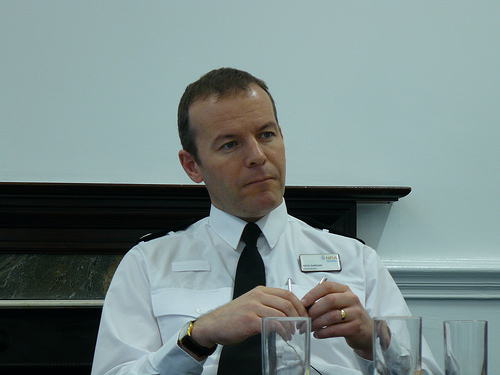








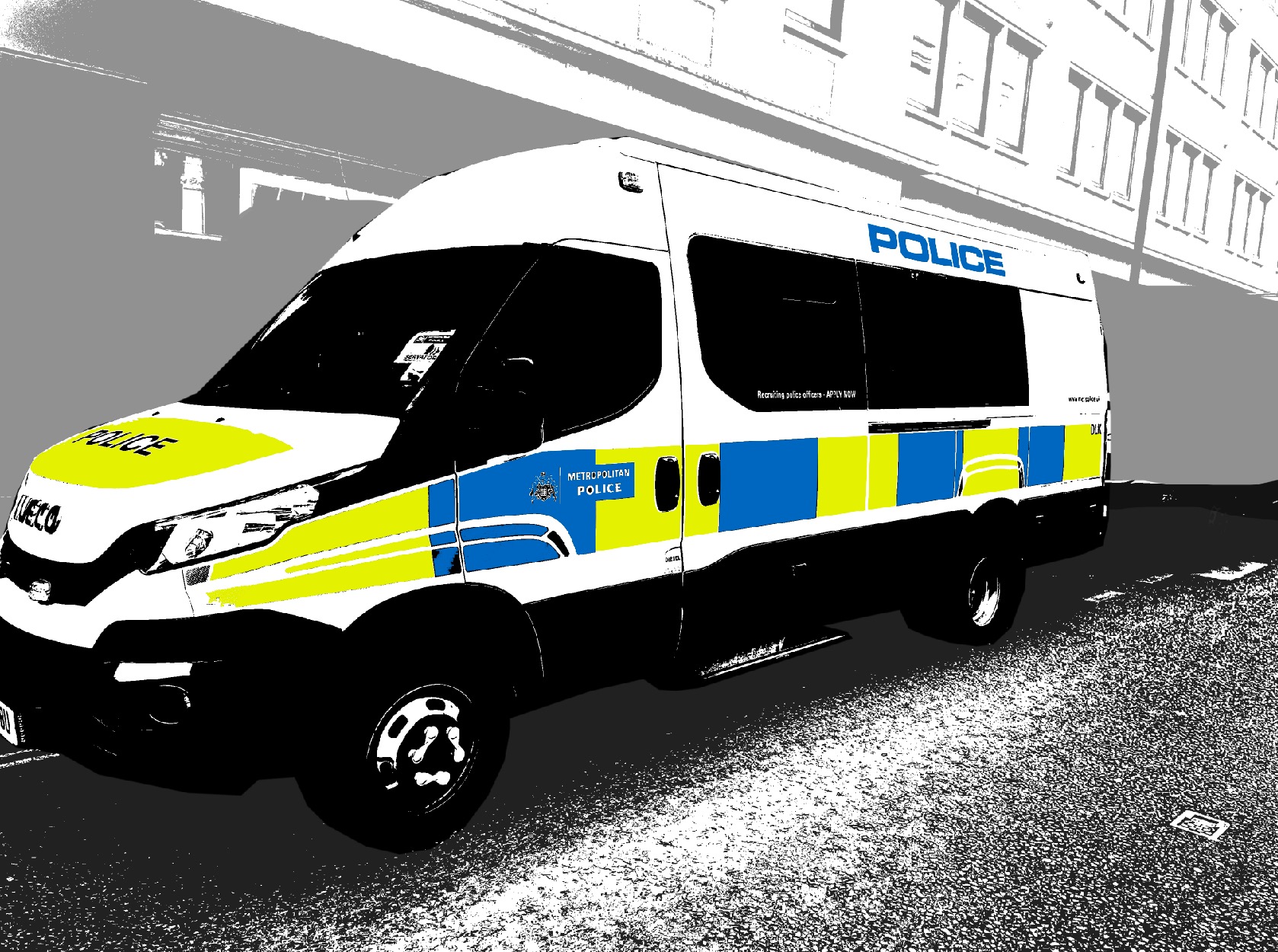

You must be logged in to post a comment.