
Blog

Is Police Taser Policy Working?

By Iain Gould, Solicitor

The relentless rise in the police use of Taser “stun guns” is confirmed by the latest Home Office figures. The statistics show that police in England and Wales drew their Tasers more than 10,300 times last year, an increase of 55% since 2010.

These statistics are, to a large extent, understandable, as more and more front-line officers are equipped with the devices. This trend seems set to continue as, if it were up to the Police Federation, all front-line police officers would have the opportunity to carry Tasers (confirmed in a unanimous vote on 09 February 2015).

It’s easy to see why the police are so keen on them. The Association of Chief Police Officers like that “Taser provides an additional option to resolve situations, including the threat of violence, which can come from any section of the public.” Senior officers tell us that “The Taser is low-level officer protection equipment that is both safer and more appropriate to be used in many circumstances than a baton or firearm.” (Humberside Police Chief Superintendent Steve Graham). And, According to the Association of Chief Police Officers, “The normal reaction to the discharge of a Taser is pain, coupled with loss of some voluntary muscle control… Recovery from these effects of the Taser should be almost instantaneous, once the discharge is complete.”

So, according to the police, it’s all good. Carry on. But really, should we be concerned?

Taser Risks Exposed

Notwithstanding police claims that Tasers are low-level and safe, police policy seems to reflect the reality that the use of Taser is in fact a relatively high level use of force (IPCC review of Taser complaints and incidents 2004-2013) and that arming all officers with Tasers is effecting “compliance by pain” rather than “policing by consent” (Amnesty International press release 24 November 2008).

For this reason, Steve White, Chair of the Police Federation, said that “Any officer authorised to carry Taser must be fully trained to do so and there are strict procedures and safeguards in place to ensure all officers are fully accountable.”

But is this just hollow propaganda? Are officers fully trained? Are procedures followed? Are police officers held to account?

Consider the ongoing case of my client Rob Sutherland (name changed for privacy reasons).

Police Taser a Peacemaker

On 21 June 2013, Mr Sutherland went to his son’s ex-girlfriend’s flat to mediate in a disagreement over access to their baby son.

Rob arrived at the same time as two police officers. His son’s ex-girlfriend’s mother allowed the officers entry but blocked Mr Sutherland and then sought to slam the door in his face. Rob accepts that he held his ground and may have gripped the door frame. At this, one officer pushed Mr Sutherland away and said, “go away”.

Rob accused the officer of assault and asked for his badge number. The officer replied, “I am the police” and shut the door.

Mr Sutherland felt that the officer’s conduct was unacceptable and thought about lodging a complaint. He approached the officers’ vehicle to look inside for details of the officer’s identity. He accepts that he may have accidentally caught the wing mirror of the car with his hip but he did not deliberately kick or punch it.

Rob returned home. A short while later, the same officers arrived.

One of them advised Mr Sutherland that he was under arrest for public disorder. Rob asked what he had done wrong. The policeman sought to handcuff Mr Sutherland who accepts that he resisted by stiffening and raising his arms in the air. There was a minor struggle for no more than 10 or 15 seconds.

Suddenly, Rob heard a pop, which he described as “like a firecracker” going off. He felt intense but short-lived pain. The right side of his body went into an involuntary spasm and convulsion. His body “felt like jelly”. He momentarily lost his balance but was caught by the officers who grabbed Mr Sutherland’s arms and handcuffed him to the rear.

Rob was put in the back of the officers’ patrol car. The handcuffs had been applied extremely tightly and he asked one of the officers if the handcuffs could be loosened. They refused.

The police drove him to the local Police Station where the handcuffs were finally removed.

At this stage, Mr Sutherland felt terrible. His chest hurt from where the barbs of the Taser had pierced his skin. The ends of his fingers were still trembling. He felt generally unwell. His wrists were sore and painful.

Despite his own situation, as Rob is a full-time carer for his mother, he thought only of her wellbeing. His priority was to get out of the police station as quickly as possible.

He spoke to a duty solicitor before his police interview. He was advised that he had been arrested for both a public order offence and resisting arrest.

The police told Mr Sutherland’s solicitor that if his client accepted a fixed penalty notice for the public order offence, no further action would be taken in relation to the allegation of resisting arrest. The solicitor said that accepting the notice and payment of the fine would not be an admission of guilt. Conscious of the proposed deal, when interviewed, he deliberately underplayed the officer’s unlawful conduct and excessive use of force.

A short time later, Rob was brought out of his cell and issued with a fixed penalty notice which he subsequently accepted and paid.

Police Complaint and Claim

Mr Sutherland was angry about the incident in which, he felt, the police deliberately injured and humiliated him. He lodged a formal complaint. In response, the police offered to resolve his complaints by local resolution.

Rob then researched instructing a solicitor to help. As I specialise in civil actions against the police he asked me to handle his complaint and bring a compensation claim for both wrongful arrest and assault.

After a lengthy investigation process involving no less than two appeals to the Independent Police Complaints Commission (“IPCC”), his local police force have finally admitted that the use of Taser and handcuffs was inappropriate.

This only came about after the IPCC’s extremely critical comments of both PC B (the officer who Tasered Mr Sutherland) and his police force.

In a review of Rob’s appeal, the IPCC caseworker said, 

“I would question whether PC B gave enough emphasis to the first element of the National Decision Model, which is to communicate. He does not appear to have made any attempt to communicate with Mr Sutherland beyond challenging him about hitting the police car then, when Mr Sutherland argued back, telling him he was under arrest. The matter then quickly escalated to the use of force. This is precisely why the National Decision Model places so much emphasis on good communication – in order to diffuse difficult situations, so that they use of force will not become necessary.”

Police officers are entitled to use force to make an arrest provided that it is reasonable and proportionate to the threats presented. But, the caseworker continued, “Mr Sutherland was not waving a weapon and he had not assaulted anyone. He was in his own house and not a danger to the public. He had not been violent, or threatened violence, towards the officers”.

In conclusion, the caseworker reported that “the situation should not have been allowed to develop to the point where the use of Taser became necessary. More effort should have been made, in line with the National Decision Model, to engage Mr Sutherland in dialogue about why his behaviour was not acceptable” and “in situations where the police are confronted with members of the public who are adamant that they have done no wrong, often the best approach to adopt is one of communication and dialogue. A skilled officer will make every attempt to defuse a potentially volatile situation, rather than, in this case, a quick escalation to the use of force.”

Irrespective of the police officer’s rash behaviour, what was even more concerning was his attitude to the use of Taser and his perception of its seriousness. In his interview, the officer said:

“… It’s worth raising that people’s perceptions of use of Taser is that it’s quite serious and it’s quite high up on the scale of things, and in actuality it isn’t, it’s quite low down, it comes in at the same level as just putting your hands on somebody. (my emphasis in bold)

He went on:

“….If you have to put hands on someone and you’re struggling with them it makes them angry and human nature is makes you angry as well, and Taser just eliminates that completely because there is no reason to get worked up about anything, it’s just an instant thing and straightaway it stops somebody and generally their response is quite positive, I’ve found… the control is immediate, there is no reason for anybody to get injured, and the person will then generally, you know, have a chat with you afterwards and sort of chat to you about the Taser, and you didn’t like that much and you can be friends about it.” (again, my emphasis in bold)

Quite clearly, just putting your hands on somebody is not the same as inserting barbs into their skin and discharging a 50,000 voltage electrical current through their body, causing extreme pain and loss of muscle control. The officer’s apparent naiveté about the physical and mental impact of being Tasered calls into question his training and fitness to carry a weapon.

Inadequate Taser Training

The officer’s comments led to the IPCC caseworker making a somewhat exceptional recommendation under paragraph 28A of Schedule 3 to the Police Reform Act 2002. The IPCC demanded that the police force concerned should review the training provided to officers to ensure that:

  1. The training conforms with national guidance about when, and for what purpose, a warning is given about Taser discharge, and
  2. Sufficient weight is given in training to the potentially harmful physical and psychological effects of discharging a Taser, and the benefits of using communication to defuse a difficult situation.

In addition, the caseworker criticised the police force’s handling of Mr Sutherland’s complaint. The caseworker said that, “it should never have been treated as a matter suitable for local resolution given that the complaint, if proven, could amount to gross misconduct. As such, it ought to have been subject to a full investigation from the start, with the IPCC, not the force, being the relevant appeal body. Moreover, the matter should have been referred to the IPCC at the outset in line with the requirement to refer all cases where Taser has been used and a complaint is made”. 

Last Resort

Mr Sutherland was traumatised by not only his wrongful arrest but also the excessive and disproportionate use of force against him.  He is currently undergoing counselling and in due course I will present full details of his physical and mental injuries and hopefully negotiate a settlement.

In view of inappropriate Taser use such as this incident, it is right that public concern about the increasingly routine deployment of police Taser should remain high. I accept that there are legitimate reasons for using Taser weapons in policing. Used correctly, it can be a valuable tool in assisting police officers to manage difficult and challenging situations.

But it is essential that officers are taught and understand that the device should be a last resort and not as, in Rob’s case, a default choice where other tactical options, including communication could be effective. And where police officers fall short, their forces should to act quickly to address officer failures and accept responsibility. Only then will the public have confidence in the police’s policy on the use of Tasers.

Contact me for help with your police Taser assault claim using the online form below.

Why “Driving While Black” Might Get Easier


By Iain Gould, Solicitor

By tackling the fictitious criminal offence of “driving while black” Home Secretary Theresa May might be about to make a real difference in many people’s lives.

Driving while black” is where police officers stop, question, and even search black and minority ethnic drivers who have committed no crime, based on the excuse of a road traffic offence.

The Home Secretary has ordered that the “best use of stop and search” code be extended to vehicle stops under the Road Traffic Act. The new rules will require police officers to record the driver’s ethnicity, the reason for the stop and the outcome.

She intends to make the changes because “One of the things I am very clear about is that I didn’t take action on stop-and-search to see the police using other things in a way that could be questioned.”

The rule change is intended to improve transparency and tackle the disproportionate targeting of black and minority ethnic drivers. It is hoped that such a move will restore relations between the police and public.

This is why we should be cautiously optimistic.

Stop and Search Circumvented

In 2014 police forces were encouraged to voluntarily sign up to the “best use of stop and search” scheme, which was intended to limit blanket Section 60 of the Criminal Justice and Public Order Act (1994) stops, keep better records, and publish them online.

At first glance, it appears to be working. The Home Office reported, “In the year ending March 2015, there were 541,000 stops and searches conducted by police in England and Wales, a fall of 40% compared with the previous year.”

But, as Mrs May pointed out, police forces are now using “other things”, including the Road Traffic Act.

Under section 163 of the Road Traffic Act 1988, a person driving a “mechanically propelled vehicle” or riding a cycle on a road must stop on being required to do so by a constable in uniform or a traffic officer.

Failure to stop is a criminal offence.

The Power to stop in section 163 is complimented by the powers in sections 164 and 165.

These provisions require the driver (and supervisor, if the driver is on a provisional licence) to produce certain documentation, such as a driving licence, certificate of insurance and MOT test certificate of roadworthiness where an officer “has reasonable cause to believe to have committed an offence in relation to the use on a road of a motor vehicle”.

The police can also demand names, addresses, and dates of birth of the driver, owner (if different), and supervisor of the driver (if on a provisional licence).

Again, failing to provide this information is a criminal offence.

These sections are so wide that the Road Traffic Act is open to abuse, allowing miscreant police officers to circumvent the stop and search rules which require a “reasonable suspicion” that the driver is carrying an unauthorised weapon or drugs.

Manipulating the law in this way can have serious consequences, as my client Darren Edmonds (name changed for privacy purposes) will confirm.

Stopped for “Driving While Black”

My client, Darren Edmonds, is a disabled black man from Dagenham who was the victim of a dubious Section 163 Road Traffic Act stop in April 2012.

On the day in question, he was driving his Vauxhall Astra to Dagenham Sunday market. He was with his friend and cousin, who are also black males.

Mr Edmonds maintains that he was driving within the 30mph speed limit along Wood Lane, when at about 7:50a.m., they passed a marked police car coming the other way. He made eye contact with one of the officers. As the police car passed, the driver put on his sirens and lights, turned and followed Darren’s car.

(We later found out why the police stopped Mr Edmonds. One officer recorded that the Astra “drove past us seemingly at high-speed”. In subsequent court papers, it was suggested that the officer considered a high-speed as any speed over the set speed limit in that area. So, perhaps 31 mph?)

Darren immediately pulled over, got out and spoke to one of the officers. The officer asked for Mr Edmondss full name and date of birth and returned to the police car so as to check his details on the Police National Computer. The officer’s colleague came out and asked for the same information. Again, Mr Edmonds gave his details.

Both officers told Darren that this was just a routine check. Accordingly, he was shocked when he felt someone grabbing him from behind. Darren turned to see the first officer trying to handcuff him and asked “Why are you arresting me? I haven’t done anything wrong.”

Disabled Man Assaulted

Mr Edmonds can only walk short distances with a stick and is otherwise wheel-chair bound due to avascular necrosis, a chronic degenerative disease which particularly affects his hips and legs. The disease cuts off blood supply to bones, eventually leading to their fracture and collapse. It can be accelerated by physical trauma. Darren is registered disabled because he is in constant pain similar to severe arthritis.

While the first officer attempted to handcuff him, Mr Edmonds struggled to stay on his feet. The second officer came over and performed a “leg sweep”, causing Darren to fall to the ground. The first officer told Mr Edmonds to stop resisting, that there was a warrant out for his arrest, and that he was now also under arrest for assaulting a police officer.

Darren felt himself being handcuffed to the rear.  He then felt pressure being exerted upon him by the officers through what felt like a knee in his back and a hand on the back of his head forcing him down. He had difficulty breathing, told the police repeatedly that he was disabled and begged to be let go.  Other officers arrived.

A number of officers took hold of Mr Edmonds’s legs, brought them up behind his back, and crossed them over. Darren says he nearly passed out with the pain.

By this time there was an audience of Mr Edmonds’s companions, 6-10 male and female police officers, and concerned onlookers.

Nudity Exposed

Darren said that during the struggle his jeans and underpants came down, exposing his buttocks and genitals.

As officers sought to escort him to a police van, they pulled his underpants up but his jeans remained around his ankles.  He was then forced to walk with his trousers around his ankles but was unable to keep up with the pace of the officers and so was effectively dragged to the van to be taken to Freshwharf Police Station.

Mr Edomnds’ nightmare did not end there.

At the station Darrendenied that he was wanted or that he had assaulted any officer. The Custody Sergeant advised Mr Edmonds that he would be kept in overnight, taken to court in the morning, and that anything he wanted to say could be said in interview later. Darren was then asked to provide the Custody Sergeant with his name, but he initially refused on the basis that he had already given it to the two officers who were standing with him.

Rather than simply asking his colleagues, the Custody Sergeant threatened Mr Edmonds that he would be “Tasered” if he did not co-operate.

Darren was then put in a cell and eventually interviewed without a solicitor.

After 6 hours in custody, Mr Edmonds was charged with assaulting both police officers causing actual bodily harm and released on bail.

By this stage, it was accepted that the outstanding warrant did not relate to Mr Edmonds. In fact, it was for a white man with the same details.

Failed Prosecution

Mr Edmonds pleaded not guilty and attended numerous court hearings before trial at Barkingside Magistrates’ Court.  At the trial on 30 July 2012 both officers gave evidence to support alleged false statements made in their notebooks about the incident.

At the end of the prosecution case Darren’s criminal defence solicitor successfully had the proceedings struck out on the basis that his client had “no case to answer”.

Following a search on the internet, Mr Edmonds contacted me given that I specialise in civil actions against the police, to investigate a compensation claim.

The officers claimed that they stopped my client for speeding, but Mr Edmonds was sure he was driving within the speed limit. My client is adamant that his only crime was “driving whilst black”.

Having stopped my client, the officers then aggravated matter by failing to carry out proper checks.

My client provided his full details immediately upon request. An officer then completed a name check via his police radio.  He was advised that a person with my client’s name was wanted for failing to attend court for minor traffic offences.

But rather than complete any further checks (which would have revealed that the suspect was a different skin colour) my client’s case was that the first officer approached him from the rear and took hold of his left arm.  My client instinctively reacted by turning and attempting to push away the person who had taken hold of him. The officers then sought to handcuff my client and a struggle ensued.

I pursued the case on the basis that, it is established law that if a police officer restrains a person but does not at that time arrest (or intend to arrest) him, the officer commits an assault even if an arrest would have been justified.

As such when the officer took hold of my client, he assaulted him and Mr Edmonds was well within his rights to resist.

Unfortunately, my client’s reaction then triggered an alleged overzealous and disproportionate response in that he was aggressively taken to the ground, unlawfully arrested and then prosecuted for an offence which if found guilty could have landed him in jail (the maximum sentence is 5 years).

Compensation Paid

Darren needed hospital treatment for the injuries sustained in the police assault, and a psychiatrist diagnosed him as suffering with post-traumatic stress disorder for which he underwent a course of counselling.

Having intimated a claim, the Metropolitan Police denied liability. I was obliged to issue court proceedings on behalf of my client. Notwithstanding the denial and after numerous offers, I was finally able to achieve an out-of-court settlement of £22,500 plus legal costs.

Caution

In Mr Edmonds’ case the police officers involved abused an existing law (the Road Traffic Act) to fulfil their aim (of effecting a stop and search).

This approach, while effective, has not gone unnoticed, leading to Theresa May’s announcement and a 2015 report by Her Majesty’s Inspectorate of Constabulary. The report’s authors said “it is certainly the case that many people assume that being stopped by a police officer when they are in their car has the same status as being stopped and searched (in the street) when, in fact, the level of scrutiny and accountability that the officer is under is significantly less than is the case for stop and search.”

HMIC added that it had “serious concerns about there being no requirement to record these stops” and “forces cannot demonstrate to us that they are using these powers effectively and fairly”.

I hope that the proposed reforms to this abuse of the Road Traffic Act will have a similar effect to the “best use of stop and search” code, which has led to dramatic reductions in the use of that tactic.

But experience shows that the police can be quite creative in manipulating the law. When they are limited in using one approach (stop and search) they quickly find another (abuse of the Road Traffic Act).

As ever, Government, local communities, and lawyers must remain cautious.

Contact me for help with your civil actions against the police using the online form below.

What You Need to Know About the Deletion of Records from National Police Systems

By Iain Gould, solicitor.

In my experience as a solicitor who specialises in actions against the police, when an individual has been wrongly arrested, their priority is not necessarily financial compensation. Instead, they often seek:

  • an acceptance of wrongdoing;
  • an apology; and
  • deletion of records and data from national police systems obtained as a result of the arrest.

Data held in police systems can include the record of arrest, fingerprints, DNA sample and custody photograph.

This issue is particularly important for individuals who have no prior arrest history and who consider such retention of personal records with grave suspicion.

How Records Are Deleted from Police Systems

In certain cases subject to the Police and Criminal Evidence Act (1984) the individual’s DNA profile and fingerprint record should be automatically deleted by reason of the Protection of Freedoms Act 2012 (the “PoFA”). See below: 

1 Destruction of fingerprints and DNA profiles 

After section 63C of the Police and Criminal Evidence Act 1984 insert—

“63DDestruction of fingerprints and DNA profiles 

(1)This section applies to— 

(a)fingerprints— 

(i)taken from a person under any power conferred by this Part of this Act, or

 (ii)taken by the police, with the consent of the person from whom they were taken, in connection with the investigation of an offence by the police, and

 (b)a DNA profile derived from a DNA sample taken as mentioned in paragraph (a)(i) or (ii).

 (2)Fingerprints and DNA profiles to which this section applies (“section 63D material”) must be destroyed if it appears to the responsible chief officer of police that—

 (a)the taking of the fingerprint or, in the case of a DNA profile, the taking of the sample from which the DNA profile was derived, was unlawful, or

 (b)the fingerprint was taken, or, in the case of a DNA profile, was derived from a sample taken, from a person in connection with that person’s arrest and the arrest was unlawful or based on mistaken identity.

 (3)In any other case, section 63D material must be destroyed unless it is retained under any power conferred by sections 63E to 63O (including those sections as applied by section 63P).

 (4)Section 63D material which ceases to be retained under a power mentioned in subsection (3) may continue to be retained under any other such power which applies to it.

 (5)Nothing in this section prevents a speculative search, in relation to section 63D material, from being carried out within such time as may reasonably be required for the search if the responsible chief officer of police considers the search to be desirable.”

It is important to note the exceptions at points (3)-(5), and be aware that the PoFA does not deal with custody photographs (stored on the Custody Suite Imaging System, “CSIS”) and the associated police national computer (“PNC”) record and/or entry.

As a result, unless an application is made under the Record Deletion Process (“RDP”), even if DNA and fingerprints are destroyed, the PNC records and custody photograph will be retained by the police until the subject is deemed to have reached 100 years of age.

How to Seek Deletion of Records from National Police Systems

Irrespective of any complaint or civil claim pursued, the individual can apply for the destruction of all of his/ her personal data under the Record Deletion Process. Click on this link for guidance and the application form issued by the Association of Chief Police Officers Criminal Records Office (“ACRO”).

Applications can be submitted to ACRO or the individual police force concerned. The applicant must state the grounds for having their records deleted and provide proof of identity/current address. The guidance suggests that the evidence and grounds for deleting records from national police systems will be then be examined by a chief officer. If agreed, the expectation is that any records held will be deleted.

There are no set criteria for the deletion of records. Chief officers must exercise professional judgement based on the information available.

The following are some examples of circumstances in which deletion will be considered:

  • Malicious/false allegation. When a case against an individual has been withdrawn at any stage, and there is corroborative evidence that the case was based on a malicious or false allegation.
  • Proven alibi. Where there is corroborative evidence that the individual has a proven alibi and as a result she/he is eliminated from the enquiry after being arrested.
  • Incorrect disposal. Where disposal options are found to have been administered incorrectly, and under the correct disposal there would be no power to retain the DNA profile. In such circumstances, consideration should be given to deleting records.
  • Suspect status not clear at the time of arrest. Where an individual is arrested at the outset of enquiry, the distinction between the offender, victim and witness is not clear, and the individual is subsequently eliminated as a suspect.
  • Judicial recommendation. If, in the course of court proceedings, a magistrate or judge makes a recommendation that an individual’s records should be deleted.
  • No crime. Where it is established that a recordable crime has not been committed. For example, a sudden death when individual is arrested at the scene but after post-mortem it is determined that the deceased person died of natural causes and not homicide.

Metropolitan Police Record Deletion Process

For deletion of records held by the country’s largest force, the Metropolitan Police (“the Met”), applications must be submitted to the Early Deletion Unit (“EDU”).

It is not a straightforward process, as my client, Kacper Maslowski (name changed for privacy purposes), would confirm.

Mr Maslowski was arrested on 31 July 2012.

A month earlier an employee of Metropolitan Police was driving his car when he saw two individuals arguing in a car upfront.

The female passenger allegedly slapped the male driver (Kacper) and in response he allegedly punched her in the face.

At the next set of traffic lights, the Met employee parked in front of the car and got out to speak to the couple. He allegedly noted that the female, Mr Maslowski’s girlfriend, had injuries to her face and obtained their details.

Several days later the Met employee submitted a report about the incident.

Given the priority that domestic abuse is given, the case was investigated.

Unfortunately, there was a significant delay because:

  1. the police failed to get to grips with the location of the incident; and
  1. there were a large number of people at the Met passing the matter around.

During the investigation, Kacper’s girlfriend was contacted on a number of occasions.

She denied that she had been assaulted and further, refused to lodge a formal complaint. Notwithstanding this, a decision was made to invite Mr Maslowski to attend a police station for voluntary interview a month after the incident.

Upon arrival, despite attending as a volunteer, Kacper was summarily arrested.

He was detained in custody for 3 1/2 hours during which time he was interviewed.

Mr Maslowski was then bailed to attend the police station on 4 September 2012 where he was again detained in custody for a further 4 hours during which time he was interviewed again.

Ultimately, he was charged and bailed to attend court.

Kacper pleaded not guilty and eventually the Crown Prosecution Service discontinued proceedings on the basis of insufficient evidence.

Mr Maslowski searched the internet for guidance and, given my track record of success in this area, contacted me for legal help.

My client’s priority, as a man of exemplary character, was the destruction of all personal data held. He also sought compensation for his false arrest, detention, and the stress of court proceedings.

Kacper could have lodged an Application to the EDU shortly after the Crown Prosecution Service decided to discontinue proceedings. On my advice, he delayed, because, I advised, a complaint about the police’s conduct should come first.

Complaint Against the Metropolitan Police

After discussing the case, I explained to Mr Maslowski that he did not have grounds to complain with the Met’s decision to investigate.

But what was objectionable was:

  • the delay; and
  • inviting Kacper to attend a police station for a voluntary interview followed by an immediate decision to arrest at that time, which was said to be necessary so as “to allow a prompt and effective investigation.”

I submitted a complaint against the Metropolitan Police on Mr Maslowski’s behalf and agreed to act in his civil action against the police for compensation.

As is often the case, the complaint was dismissed by the Metropolitan Police.

On my client’s behalf I appealed to the Independent Police Complaints Commission (“IPCC”).

Following review, Kacper’s complaint was upheld by the IPCC.

This mattered because the legality of arrest was initially considered by the Met’s “Professional Standards Champion”. As they initially dismissed my client’s complaint I am sure that the application for deletion of records would also have been rejected.

Civil Claim Supporting Deletion of Records

Despite the IPCC’s positive findings its decision was not binding upon the police.

As a result, when I submitted Mr Maslowski’s compensation claim to the police citing wrongful arrest, the Metropolitan Police denied liability.

In the circumstances, I had no alternative but to issue court proceedings to seek justice for my client.

Although liability was disputed, solicitors on behalf of the Met offered to settle his claim out of court. This confirmed my view that Kacper’s claim was entirely justified, despite the Met’s formal denial.

After extensive negotiations, Mr Maslowski settled his compensation claim for £6500 plus legal costs.

Despite this, in previous negotiations with the Met, it has been made clear that destruction of personal data has no relevance to any civil claim and that a separate application must be lodged to the EDU.

I used the supportive decision of the IPCC and offer of settlement to persuade the chief officer to agree to the deletion of my client’s records.

Delay in Deletion of Records

You would think that it would be a relatively quick and easy task to delete records. After all, they were easy enough to create when Mr Maslowski was arrested. Not so.

My application to delete his records was acknowledged in mid-January 2015. As is standard, the (laughably misnamed) Early Deletion Unit advised that it would take “up to 12 months” for a decision about deletion to be reached.

Notwithstanding several reminders, no decision was made by mid-January 2016. The EDU advised that “there is no statutory time limit for processing these requests and they may take up to 12 months or longer, due to the volume of similar applications currently being dealt with by the MPS”.

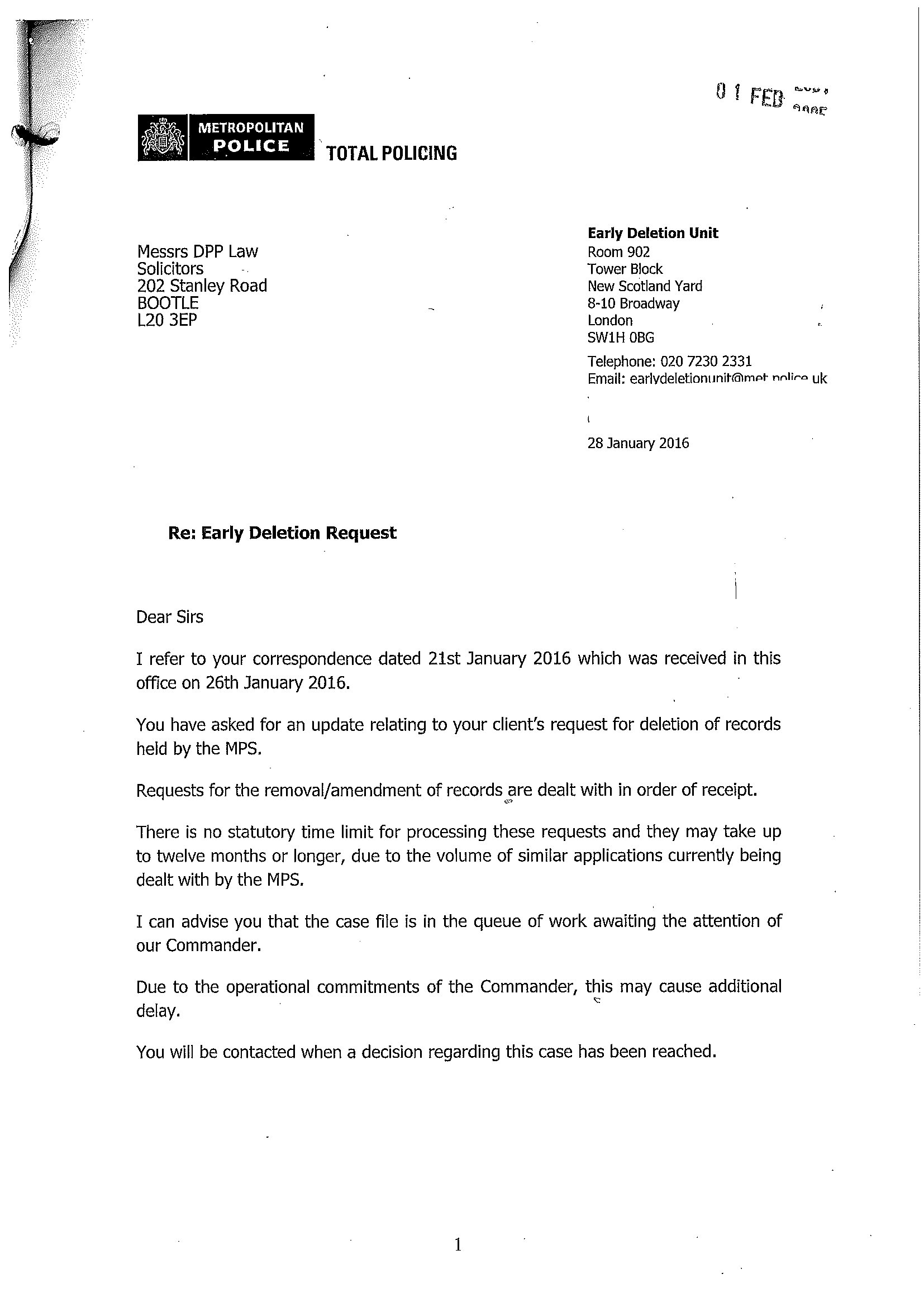
See redacted letter below:

The Metropolitan Police's Early Deletion Unit say that deletion of records requests can take up to 12 months or longer.
Redacted letter from the Metropolitan Police’s Early Deletion Unit confirming that requests may take up to 12 months or longer.

You may wonder how many requests are processed at the EDU. In response to a recent Freedom of Information Act request, the Metropolitan Police said that they were unable to provide this information because, remarkably, “This information is not recorded in a searchable electronic format”.

And yet, in another Freedom of Information Act request, the Met confirmed that:

“As of the 18th September there were 164 requests awaiting decision by the
Commander. These are regularly reviewed by the Commander and dealt with on
a priority basis. The outstanding requests awaiting decision are not
attributable to any staffing issues.”

In any event, I am pleased to confirm that the EDU did eventually process Mr Maslowski’s application. In mid-March 2016, the EDU ironically advised that the case was “eligible for early deletion”.

And you might think that now that a decision has been made, the offensive data would be deleted forthwith. But no, the EDU advise that “the deletion process may take several months to complete”.

See redacted letter below:

The Metropolitan Police wrote this letter to solicitor Iain Gould about deletion of records from their police systems.
Letter from the Early Deletion Unit confirming that Mr M’s case was “eligible for early deletion”.

Despite this, my client is extremely pleased. His arrest has been recognised by an independent body as unlawful, he has received financial compensation for his unlawful detention, but most importantly, ALL personal data obtained as a result of his arrest has been (or will be) destroyed.

His case proves that deletion of records from national police systems is possible, but it takes perseverance and knowledge of the system.

Contact me for help with your actions against the police using the online form below.

How Police Abuse Powers for Sexual Gain

Photo of Iain Gould, solicitor, who discusses police abuse.
Iain Gould, solicitor, discusses how police abuse their powers for sexual gain here.

By Iain Gould, Solicitor

I recently contributed to an investigation lead by the BBC Radio 5Live team about police abuse of powers for sexual gain.

You can hear the first part of the programme here:

Part 2 will be broadcast on 5Live on Sunday 3 April at 11a.m.

During my career as a solicitor who specialises in Actions Against the Police, I have acted on behalf of several victims of sexual exploitation by police officers.

Police officers have wide powers, status, and influence. Their role is to protect and serve the public. Each case of police abuse represents a serious betrayal of the trust and confidence that individuals, and the wider public, should have in them.

In 2012 the Independent Police Complaints Commission (“IPCC”) reported on this issue. (The Abuse of Police Powers to Perpetrate Sexual Violence). The report explained that “It is not possible to know precisely how many people have been victims of police officers or staff abusing their powers. There is no evidence to suggest it is commonplace, but nor can we be confident that all such cases are reported.”

It gave six examples of police abuse of power for sexual gain and concluded that forces were not doing enough to stop this type of corruption.

The authors urged “senior leaders in the police service to be alert and determined to root out this kind of abuse of power,” and said “Police forces should maximise every opportunity to prevent, or at least reduce, the likelihood of police officers and staff from engaging in the behaviours described within this report.”

But are they?

If the experience of my client “Clare” is anything to go by, I doubt it.

Police Misconduct

PC Jordan Powell joined West Midlands Police in 2004.

In September 2007, PC Powell was sent to investigate a report of a house burglary. The woman who made the report (not my client Clare) had been having domestic issues with her ex-partner. He was the suspected burglar.

Powell began texting flirtatious messages to the woman and a relationship developed culminating in PC Powell visiting her home whilst on duty and having consensual sexual intercourse.

The ex-partner found out and made a complaint. In 2008, PC Powell received a written warning for misconduct.

Despite this, it would appear that little was done to monitor and supervise his activities to prevent further abuses of power, in particular with Clare.

Continued Police Abuse

Clare was the victim of domestic abuse by her ex-husband. He was arrested on a number of occasions.

In 2010, Clare reported a burglary to the police and accused her ex-husband of stealing some of her jewellery. The case was handled by PC Powell and went to court, where Clare’s ex-husband was successfully prosecuted.

In May 2012, Clare reported further domestic abuse by her ex-husband and obtained a non-molestation order. The order could not be served on him so she attended her local police station for advice. She was again dealt with by PC Powell, alone.

Subsequently PC Powell texted Clare on his private mobile phone.

Some text messages were exchanged and in one Clare thanked PC Powell for his help. PC Powell responded by asking Clare to keep his number and to call or text if she needed help. He ended his text with a ‘X’ which Clare took to mean a kiss. She wasn’t comfortable with this.

Soon afterwards, Clare’s ex-husband breached the non-molestation order. Clare texted PC Powell to report the breach. There were further texts between them and one of the texts again contained an ‘X’ from the police officer.

The following day Clare sent PC Powell another text to report a further breach of the order by her ex-husband. PC Powell texted back saying that he would meet her at home. He ended the text with an ‘X’.

Again, Clare wasn’t comfortable with the ‘X’ in the text message but was not confident enough to challenge it because Powell was a police officer. PC Powell went to Clare’s home with another officer and took a statement.

Clare and Powell exchanged further texts. She admits that she was flattered by the attention.

Over the next few days, the exchanged text messages became more suggestive. It wasn’t long before PC Powell started visiting Clare in the middle of the night while he was on duty to have sex with her.

The relationship between PC Powell and Clare ended in July 2012. Clare felt PC Powell wanted to control the relationship and was visiting just for sex.

Honey Trap

PC Powell was caught when his own Force became suspicious and set up a “honey trap” operation using an undercover female officer.

The officer pretended to be a victim of domestic violence and rang police in June 2012. PC Powell was sent to her home, which was fitted with covert recording equipment, to investigate the complaint. Within a couple of hours of leaving, PC Powell had sent the “victim” flirtatious text messages from his personal mobile phone.

As part of the investigation, officers from West Mercia Police’s Professional Standards Department visited Clare who was brave enough to provide a full account as to what had happened.

Shortly afterwards, PC Powell was arrested and prosecuted for misconduct in public office. At trial the court heard how, on the day before his arrest, Powell sent text messages to three women asking for sex. He was jailed for 15 months after pleading guilty to three charges of misconduct in public office.

West Mercia Police dismissed Powell at a special case hearing chaired by the Chief Constable. In a statement issued after the dismissal hearing quoted by the BBC, the Deputy Chief Constable acknowledged that “Incidents of this nature have the potential to seriously damage the trust placed in us by those communities.”

Sickening Abuse

PC Powell clearly abused his position for sexual gain. He targeted vulnerable women. He then groomed them with compliments and flattery. Numerous sexual relationships developed.

What could his own force do to prevent such abuse?

West Mercia Police maintain that they did everything possible; that PC Powell was a “lone wolf”.

Maybe. But in light of the misconduct finding by the Force in 2008, West Mercia Police knew that PC Powell posed a risk, and yet they appear to have done little or nothing to monitor and prevent him from abusing his position.

As I said in the 5Live interview, it beggars belief that PC Powell was not dismissed in 2008 (when he was only given a written warning), and allowed to deal with vulnerable victims of domestic abuse alone.

What of Clare?  She says, “It sickens me to think about what PC Powell has done to me and other women. I have, thanks to him, had my self-confidence and esteem shattered, my trust in men and the police robbed. He has in my eyes, behaved more appallingly than my ex-husband, he abused his power as a Police officer; someone you trust and invite into your home and life, at a time when your whole world is falling apart”.

Civil Action Against West Mercia Police

With my help, Clare is now suing West Mercia Police for compensation.

In fairness to the force, the Assistant Chief Constable apologised at an early stage and the Force’s legal department admitted liability early on. Only quantum (the value of Clare’s claim) remains to settle her claim against the police and help her move on with her life.

As a result of PC Powell’s abuse, Clare has suffered psychological damage and has undergone lengthy counselling.

Although full details of her claim were presented in September 2015, West Mercia Police failed to offer suitable compensation and/or actively engage in settlement negotiations.

To progress matters, I had no alternative but to issue court proceedings on Clare’s behalf. This is a serious step, especially for Clare, who has never previously made a claim for compensation and is unfamiliar with the process.

I urge West Mercia Police put forward a reasonable and realistic offer to settle Clare’s claim. By delaying it they are inflicting a second injustice on her and delaying her recovery.

The Chief Constable also needs to conduct a root-and-branch review of Force procedure. As Lord Acton said, “Power tends to corrupt, and absolute power corrupts absolutely.” This appalling abuse of police powers demands strong leadership and control.

If you want help with your police abuse claim contact me using the online form below.


Why the Metropolitan Police Won’t Apologise to Lord Bramall

By Iain Gould, Solicitor

Recently the Metropolitan Police was in the headlines because it refused to formally apologise to Lord Bramall over its treatment of him during an investigation into historic child abuse allegations.

The Metropolitan Police raided Lord Bramall’s home in March 2015 and he was later interviewed under caution on 30 April 2015. He strenuously denied the allegations and said that “There wasn’t one grain of truth in the allegations” made against him.

In mid-January 2016, the Metropolitan Police finally declared that there “was insufficient evidence” to pursue charges against the 92-year-old Second World War veteran over the historic abuse inquiry.

Sir Max Hastings, military historian and friend of the peer said that Lord Bramall had “been through absolute hell” over the allegations. He said that in pursuing the investigation of historic abuse, the Metropolitan Police had lost sight of a “sense of justice and fairness” towards those accused and that “decency demanded” an apology.

This is why he won’t get one.

Metropolitan Police Statement

Patricia Gallan, Assistant Commissioner Specialist Crime and Operations, said in a statement: “The Metropolitan Police accepts absolutely that we should apologise when we get things wrong, and we have not shrunk from doing so.

“However, if we were to apologise whenever we investigated allegations that did not lead to a charge, we believe this would have a harmful impact on the judgments (sic) made by officers and on the confidence of the public.

“Investigators may be less likely to pursue allegations they knew would be hard to prove, whereas they should be focused on establishing the existence, or otherwise, of relevant evidence.”

Miss Gallan also said that she recognised “how unpleasant it may be to be investigated by the police over allegations of historic abuse. For a person to have their innocence publicly called into question must be appalling, and so I have every sympathy with Lord Bramall and his late wife and regret the distress they endured during this investigation.”

The force had a duty to fully investigate “many serious allegations referred to us every year” and should do so “irrespective of their status or social standing”, the statement went on.

“It stands to reason that we cannot only investigate the guilty and that we are not making a mistake when we investigate allegations where we subsequently find there is no case to answer,” the assistant commissioner said.

“I accept that we can always learn and improve,” she insisted.

Wrongful Arrest Apology Sought

But do the Metropolitan Police “learn and improve” and apologise when they “get things wrong”?

My client Raheel Khan (name withheld for confidentiality reasons) would disagree after he was wrongfully arrested in October 2013.

Mr Khan had previously served the Community as a part-time magistrate but that experience had not prepared him for a late night visit from police officers and a night in the cells.

Unbeknown to Raheel, on 12 February 2013, the County Court had imposed a non-molestation order against him in response to a series of spurious and vindictive allegations made by his ex-wife.

The non-molestation order was ordered to remain in force until 11 February 2014 at 11.59pm and provided that Mr Khan was, amongst other things, forbidden to use or threaten violence, intimidate, harass or pester, or communicate directly with his ex-wife. His only means of contact with her were to be through her nominated solicitors. Crucially, the order included a power of arrest so that if my client breached the order, he was liable to be arrested and brought before the Court.

Upon service of the order, my client contested it, saying that it had been supported by untrue and unfounded allegations and included a draconian power to arrest.

The Court agreed and, on 6 June 2013, discharged the non-molestation order, which was substituted with a “General Form of Undertaking”. In that both my client and his ex-wife effectively promised to not harass each other. As such, the threat of arrest for alleged breach of the non-molestation order was withdrawn.

On 9 October 2013, Mr Khan’s ex-wife reported a breach of the (now defunct) non-molestation order, claiming that my client had sent her emails. The Metropolitan Police decided to investigate and arrest my client.

On 11 October 2013, two officers attended my client’s home address at about 10.30pm. They told Mr Khan that he was to be arrested for breach of the terms of the non-molestation order.

Raheel told both officers that the non-molestation order had been discharged and replaced with a “General Form of Undertaking” which he had in his house. He offered to show it to the officers but they refused. They told Mr Khan that:

  • they had been instructed to arrest him;
  • they would not consider his documentation; and
  • he could give an account at the Police Station.

My client was dressed in his pyjamas, was not allowed to change, and was humiliatingly led outside in front of his neighbours to a waiting marked police van. He was taken to Ilford Police Station where he was processed and imprisoned in a cell overnight.

The next morning, Mr Khan was interviewed during which he produced the documentary evidence confirming that the non-molestation order had been replaced by an “Undertaking”. The interview lasted for less than 5 minutes and he was soon released without charge.

Complaint Against the Metropolitan Police

In November 2013, Mr Khan, upset at his treatment during the embarrassing and frightening episode, submitted a formal complaint to the Metropolitan Police’s Directorate of Professional Standards.

The Directorate’s long-winded investigation ended in mid July 2014. The Force thanked Mr Khan for raising the issue and confirmed that the officers’ behaviour had been unsatisfactory and breached professional standards. It accepted that Raheel’s arrest had been unlawful and upheld his complaint.  But no apology was forthcoming.

My client felt that the officers’ punishment (“management action”) was wholly inadequate and lodged an appeal.

Following review by the Independent Police Complaints Commission (“IPCC”) in October 2014, it was considered that management action was indeed appropriate but that, in addition, the Metropolitan Police should “give consideration” to Mr Khan’s request for a written apology.

(It was presumably considered that an apology would go some way to satisfy Mr Khan that he had been wronged, that the Metropolitan Police recognised what they had done wrong, and would learn from their mistake.)

Despite this clear recommendation from the IPCC the Metropolitan Police again failed to apologise.

Compensation Claim

Having exhausted the complaint process, Mr Khan felt that he had no alternative but to pursue a civil action against the police. He sought me out as a specialist in actions against the police following an internet search.

After carefully considering the facts I took Raheel’s case and demanded an apology on his behalf. I also intimated a compensation claim, alleging, false imprisonment among other things.

Following investigation, solicitors acting on behalf of the Metropolitan Police responded with a financial offer of settlement without admission of liability or an apology.

As is so often the case, whilst compensation may provide vindication and some comfort to my client, what he really wants is an apology. Despite Mr Khan’s repeated requests, a recommendation from the IPCC, and numerous requests from me, the Metropolitan Police have failed to do this simple, and free, thing.

The Force could easily address this, even while negotiations about compensation continue. At this point there is nothing to be gained by refusing to apologise, so why not do it?

Decency Demanded

My client’s experience is not unique. Mr Khan is one of many clients that I have represented (and continue to represent) who has to fight tooth and nail for justice. Unlike Lord Bramall, most are not in the public spotlight with friends and family in high places who can bring the police to account.

The Metropolitan Police’s response to Mr Khan (offer compensation with no admission of liability or apology) is in line with my experience of their general policy. A policy that fails to recognise what I consider to be its moral and economic duty as a public organisation to apologise when in the wrong, resolve issues quickly, and avoid lengthy and expensive legal battles.

I certainly do not recognise Patricia Gallan’s statement that the Metropolitan Police apologise “when we get things wrong”. Her statement reads more like a defence of their practices and indicates an unsympathetic attitude, despite the platitudes.

Sadly for Lord Bramall, Raheel, and countless others, the “decency demanded” by Sir Max Hastings for an apology does not seem to exist at Britain’s largest police force.

For help with your civil action against the police contact me via using the online form below or at my firm’s website http://www.dpp-law.com.


Is Legal Aid Affecting Domestic Violence Reporting?


By Iain Gould, solicitor

Her Majesty’s Inspectorate of Constabulary reported this week that police forces across England & Wales are on the verge of being “overwhelmed” by “staggering” increases in reports of domestic violence.

The HMIC, which has statutory responsibility for the inspection of Police Forces in England & Wales, confirmed in its recent report on the police’s response to domestic abuse that the number of domestic violence related crimes increased from 269,700 (in the year to August 2013) to 353,100 (in the year to March 2015), an increase of 31% (see page 10 of the report).

Zoe Billingham, HM Inspector of Constabulary, described this as “a staggering increase in domestic abuse related crime” and added that the workload in many specialist police investigation units is “becoming overwhelming”, affecting the quality and speed of some investigations.

Is this “staggering increase” attributable to a rise in domestic violence cases?

The HMIC suspects not.

The report confirms that calls for assistance to the police for domestic violence related incidents fell by 10% in the 12 months to March 2015.

Instead, the Government watchdog states that the increase could be partly because police forces are:

  1. “actively encouraging” victims to come forward; and
  2. logging crime more accurately.

This would reflect “a determined effort by police leaders to make domestic abuse a priority”, the report says.

Legal Aid and Domestic Violence

I have no doubt that domestic violence has become a priority for some forces but there remain many areas of concern. For example, improving frontline police officers’ attitudes and understanding of domestic violence.

(For more on this read my recent blog posts on the experience of Alex Faragher here, here, and here.)

Another factor to explain this “staggering increase” in reported domestic violence is an unintended but foreseeable consequence of changes in entitlement to Legal Aid.

In April 2013, Legal Aid was withdrawn for almost all private family cases including:

  1. contact and residence over children; and
  2. financial issues.

This greatly reduced eligibility for Legal Aid in family matters, but people can still apply for Legal Aid if they can show “evidence” that they have been the victim of domestic violence in the previous two years. This includes:

  • an arrest for a relevant offence;
  • a caution; or
  • a conviction.

Domestic Violence Evidence

Despite these changes being introduced over two years ago, most people still think that Legal Aid is generally available in family matters.

When seeking advice, people may be surprised to find out they will have to pay for legal help privately or represent themselves in Court, unless they can prove they are a victim of domestic violence.

In the circumstances, some may be tempted to raise false allegations of domestic violence in order to secure Legal Aid.

The changes to Legal Aid introduced in 2013 mean that there is now a financial incentive to fabricate domestic violence in a family law matter.

This can result in serious miscarriages of justice, as an ongoing case of mine shows.

Domestic Violence Wrongful Arrest

My client Kevin Phillips (name changed for confidentiality reasons) believes that his arrest by the police was a direct consequence of his ex-partner’s wish to secure Legal Aid funding for legal help with custody arrangements for their (then) four-year-old son.

Mr Phillips and his partner broke up. He wanted regular contact with his son.  Unfortunately, his ex-partner refused to attend mediation and routinely cancelled informal arrangements. So in June 2014 my client lodged an application to Court to formalise access.

At the first Court hearing in July 2014, my client’s ex-partner agreed to mediation and the hearing was adjourned.

But in mid-August 2014 the ex-partner went to her local police station to report an alleged assault by my client that she said occurred on 15th December 2012.

She alleged that during an argument Mr Phillips kicked her leg resulting in a broken fibula.

She told police that she had attended her local hospital for medical treatment and that to protect her then partner Kevin, she provided an entirely different account to hospital staff, stating that she was injured falling over her dog.

The Officer dealing with the complaint made an entry on the police system that police local to my client should arrest him.

On 15th August 2014 it was recorded that Mr Phillips’ local force had declined to arrest because of the delay between the alleged incident and the complaint.

Instead, on 18th August 2014, the officer assigned to the case arranged with Kevin for him to attend a police station at 6pm for an interview under caution. The relevant entry on the police system contains no reference that the officer in charge was contemplating arrest.

My client attended the police station on the date and time agreed.

Mr Phillips was shocked and confused when, instead of a voluntary interview, he was arrested in the station foyer on suspicion of Grievous Bodily Harm.

During interview under caution, Kevin denied any involvement and said that the assault complaint was a complete fabrication.

He was later released on bail pending further enquiries until 24th September 2014.

On 1st September 2014, the officer in charge recorded on the police computer system:

I am concerned that even with medical evidence it will not pass the full code test as there is very little prospect of conviction due to the time delays and the complainant told the hospital and her family that the injury was caused by falling over the dog”.

 Despite this my client was subsequently re-bailed on 29th September 2014, 21st October 2014, and 17th November 2014.

On 31st October 2014 the Crown Prosecution Service recommended no further action.

Abuse of Legal Aid System

My client should never have been arrested.

Following his experience, he lodged a complaint against the police. Somewhat unusually, but, no doubt, recognising the strength of his argument, Mr Phillips’ complaint of unlawful arrest was upheld.

This was on the basis that there was no necessity to arrest him as he attended voluntarily for the interview on 18th August 2014.

On the back of this decision, Kevin contacted me to bring a civil claim for compensation against the police.

Despite his complaint being upheld, as expected with this particular police force, liability was denied.

I am now in the process of instituting Court proceedings and have no doubt that his claim will succeed and he will be compensated.

But no matter how much compensation he receives (and the level of compensation available is regrettably modest), I suspect this will be of little comfort to my client. He has suffered:

  • the embarrassment and humiliation of arrest;
  • the stain on his good character; and
  • his life being put on hold for three months while on police bail.

Significantly, the arrest (based on false allegations) meant that the ex-partner got Legal Aid for expert help in the family proceedings to fight his application for regular contact with his son.

My client had to pay his family lawyers privately which added to the strain in a matter of great personal importance.

I hope that other people will not suffer like my client and that malicious accusations of domestic violence are not being used in a cynical attempt to “play” the Legal Aid system.

My concern however is that the recently reported HMIC figures suggest that this is exactly what is happening.

Contact me for help with your civil action against the police using the online form below.


Are Police Disciplinary Hearings “robust, independent, and transparent”?

Iain Gould, solicitor, asks if police disciplinary hearings are robust, independent, and transparent.

By Iain Gould, solicitor

I recently blogged on the case of Alex Farragher whose complaint about police misconduct led to a public police disciplinary hearing.

As of 1 May 2015, in accordance with Section 9 of The Police (Conduct) (Amendment) Regulations 2015, police disciplinary hearings “shall be in public” (subject to the discretion of the person chairing or conducting the hearing to exclude any person from all or part of the hearing).  That change, along with others, was aimed to create a “more robust, independent and transparent” police disciplinary system.

Has it worked?

The Law in Public Hearings

What does “in public” mean? The OED definition is “openly, for all to see or know”.

The concept of open justice has long been recognised.

In Scott v Scott (1913) AC 417, Lord Shaw of Dunfermline said “that publicity in the administration of justice ….(is) one of the surest guarantees of our liberties” and cited passages from Bentham and Hallam in support of the general thesis that in Bentham’s phrase “Publicity is the very soul of justice”.

The principle is just as important now as it was then; in Hodgson v Imperial Tobacco Limited (1998) 1 WLR 1056, Lord Woolf MR relied upon the following passage from Sir Jack Jacob’s Hamlyn lecture, The Fabric of English Civil Justice (1987) where he said:

“The need for public justice, which has now been statutorily recognised, is that it removes the possibility of arbitrariness in the administration of justice, so that in effect the public would have the opportunity of ‘judging the judges’: by sitting in public, the judges are themselves accountable and on trial”.

An application of the principles in Scott v Scott is to be found in McPherson v McPherson (1936) AC 177, a decision of the Privy Council’s in a Canadian case. There the undefended divorce of a well-known politician was conducted not in a court room (though there were empty courts available) but in the Judges’ Library. There was direct public access to the courts, but not to the Judges’ Library. It could be approached from the same corridor which encircled the building and provided direct access to the courts, but only through a double swing door, one side of which was always fixed shut, and on which there was a brass plate with the word “Private” in black letters on it. Through this swing door was another corridor, on the opposite wall of which was a further door to the Judges’ Library. Both this internal door and the free swinging half of the double doors were in fact open during this hearing. The question for the Court was:

“… whether those swing foots with ‘Private’ marked upon one of them were not as effective a bar to the access to the library by an ordinary member of the public finding himself in the public corridor as would be a door actually locked”. (p198)

Their answer, while accepting that no actual exclusion of the public was intended, was that:

“… even although it emerges in the last analysis that their actual exclusion resulted only from that word ‘Private’ on the outer door, the learned judge on this occasion, albeit unconsciously, was ……, denying his court to the public in breach of their right to be present, a right thus expressed by Lord Halsbury in Scott v Scott: ‘every court of justice is open to every subject of the King’.” (subject to any strictly defined exceptions).

In Storer v British Gas plc (2000) 2 All ER 440, the Court of Appeal decided that this fundamental principle was no less important in employment proceedings than in other proceedings. In that case, Mr Storer brought a claim against his employers. At a hearing at the Industrial Tribunal Centre, his claim was dismissed. On appeal, Mr Storer argued that this decision should be quashed on the basis that the hearing had not been held in public.

The relevant facts were as follows:

At the Centre, “12 Industrial Tribunals were sitting on that day.  The lists of cases to be heard in each were on public display.  There was also a list of floating cases, i.e. cases which had not been allocated to a court, but would be heard as and when a court became available.  Mr Storer’s case was one of these.  As the morning wore on, it seemed clear that his case would not be reached unless it was heard in a room not normally used as a court-room.  One was available – namely the office of the Regional Chairman, as that position was unfilled at the time.  As a Judge was available, and as the room was available, the court authorities took the decision to have the hearing there.  They did not consult Mr Storer on this.  The parties (including Mr Storer’s wife) were escorted there by a guide.  No member of the public accompanied them.  It is accepted that Mr Storer’s application for leave to appeal to the Court of Appeal accurately summarises the geographical situation of the room that was used:

(a)    The hearing was held behind a locked door which separated the area to which the public had access from that part which the learned Judge described as the ‘secure area’ on the second floor of the Tribunal office. This ‘secure area’ [is] protected by the door locked with a bush-button coded lock [which] provides the only means of access to the large open plan office off which the Regional Chairman’s room is located.

(b)   This locked door is clearly marked with a large sign stating ‘Private’ in black letters on a white background.

(c)    All access stairs from the public areas on the ground and first floors to the second floor where [the] locked door is located are marked clearly with a large sign stating”

PRIVATE

NO ADMITTANCE

TO PUBLIC BEYOND

THIS POINT

The Court concluded that the hearing had not been held in public, even if, in fact, no member of the public was physically  prevented from attending. The obligation to sit in public was fundamental, and the tribunal had no jurisdiction to conduct itself in this way.

How Public are Police Disciplinary Hearings?

Both my client Mr Edwin Taylor, and myself, have first-hand experience of the lengths to which the police will go to follow the letter of the law while ignoring the spirit of it in public police disciplinary hearings.

Following an incident that occurred on 14th February 2013, my client Mr Edwin Taylor lodged a complaint to the Metropolitan Police. The following description is based on his version of events.

Mr Taylor was driving home from work when he was stopped by a police carrier van. Edwin got out of his car. He was told that he had been driving erratically and asked to hand over his car keys. He refused.

Suddenly, one of the officers grabbed hold of Mr Taylor’s left arm and a struggle began. Many other police officers from the police van then stormed out and forcibly moved Edwin towards the pavement.

In doing so, Mr Taylor fell to the ground where he banged his head.

Edwin, with five or more police officers on top of him, was then handcuffed and leg restraints were strapped on him.

Mr Taylor was then told that he was under arrest for breaching s.5 of the Public Order Act. So as to further justify arrest, one police officer then said that he ‘could smell cannabis’ in Edwin’s car.

Mr Taylor was then transported to a police station. En route, Edwin said to both police officers that he was going to sue them for what they had done. An officer said in response “We’ll just say that you assaulted a police officer”.

Mr Taylor was then kept in custody until the next day and after he was interviewed for the alleged offences. Edwin was then bailed to return to the police station a few weeks later.

On his return, he was charged with assaulting a police officer and resisting arrest.

There was no further action against Mr Taylor in respect of his driving (the reason for his stop), the cannabis allegation or breaching s.5 of the Public Order Act.

At the first opportunity, Edwin pleaded not guilty and his case was eventually listed for trial nearly a year later. At Trial, the CPS without notice or reason decided to discontinue.

Police Disciplinary Hearing Access

After investigating Mr Taylor’s complaint the Professional Standards Bureau decided to bring gross misconduct proceedings against three of the officers.  The police misconduct hearing finally went ahead last week in the Empress State Building, South West London, nearly three years after the incident.

Edwin is intent on bringing a civil claim against the Metropolitan Police for unlawful arrest, assault and malicious prosecution. To find out how the officers performed, I sent my colleague to sit as watching brief.

My colleague met up with Mr Taylor outside the Empress State Building and they went into reception together. Having been frisked by security, Mr Taylor was ushered upstairs to the hearing room. My colleague was denied access as his name was “not on the list”. My colleague queried this given that the hearing was “in public”. He was told it didn’t matter, his name must be on “the list”.

My colleague asked to speak to the Investigating Officer and explained his role. Pursuant to Regulation 30 (3) of the Police (Conduct) Regulations 2012, Mr Taylor was (irrespective of any argument that this hearing was allegedly being held in public!), entitled to attend the hearing accompanied by one other person as an observer and my colleague was that person. The Presenting Officer promptly authorised entry.

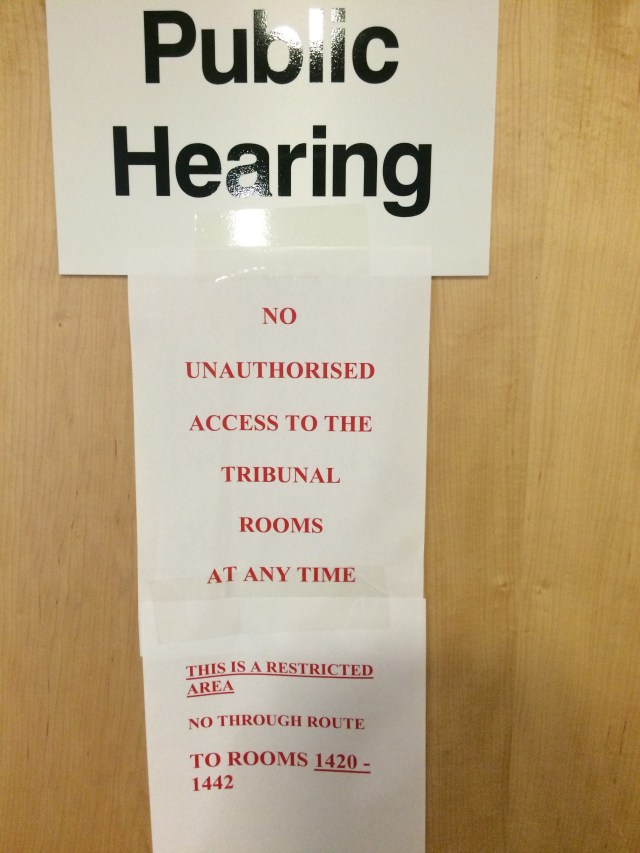
My colleague was then escorted to the hearing. Here’s what appeared on the hearing room door:

Public Police Disciplinary Notice.

I must say that I found my colleague’s experience intriguing.

Metropolitan Police hold their misconduct hearings at Empress Buildings. According to their website, “any member of the public or press wishing to attend a misconduct hearing may apply to do so but due to limitations on space and capacity, attendance at the hearing will be administered and booked by application”.

Should you be interested, you must then complete and submit an application providing your full name, address and date of birth.

The lucky few successful attendees are then sent a confirmation email but admission to the hearing is conditional. They must produce their personal registration letter (confirmation email) that was issued by the hearings unit and supporting photographic identification (passport, and/or driver’s licence), along with proof of address (ie a recent utility bill).

Needless to say, my colleague reports that no members of the public attended any one of the five days of the hearing.

Police Disciplinary Hearings Restrictions

Having checked out the websites for most of the other police forces in England and Wales, the Metropolitan Police’s conditions are fairly standard. There are however a few quirks here and there.

West Yorkshire Police state that notice of a public hearing will be made not less than five days prior to the hearing but that applications to attend “must be submitted within 48 hours of the notice being published”. This could effectively be a three-day window.

Most stress that space is limited. Thames Valley Police are bold enough to announce that “available space will limit numbers of the public attending to six people including members of the public”.

Should you be fortunate to apply in time, be selected, and have the necessary proof of ID with you, there’s still no guarantee that you will actually sit in on the hearing. Some like Gwent Police openly admit that “The Public/media will be given access to a room at Gwent Police HQ” which will broadcast “a live feed of the hearing”.

Consequences of Police Policy

To increase public trust in our police force, the police should freely and unconditionally open their doors to members of the public at disciplinary hearings.  Otherwise they are in danger of appearing to be (literally) a closed shop and to encourage an assumption that police officers judging  other police officers do not do so in a fair, unbiased and transparent way.

For example, Deputy Chief Constable of Essex Police Derek Benson claims that “Our intention will be to hold these hearings in public and make them as accessible as possible.”

But his force’s restrictive conditions (shown here) suggest to me that Essex Police (along with other forces) are paying only lip service to the concept of holding disciplinary hearings in public. In reality, they are putting many obstacles and discouragements in the way of the interested public.

This undermines the reputation of the police as being unbiased and effective in the investigation of crimes or misdemeanours committed by their own.

In the case of Storer v British Gas plc, the coded door lock was an actual physical barrier which prevented all access to the public. There was, the Court said “no chance of a member of the public dropping in to see how Industrial Tribunals (as they were then) were conducted, and the fact that none attempted to does nothing to show that this Tribunal was conducting the trial of the preliminary issue in public”.

What would the Court of Appeal make of the various barriers being put up by police forces around the country?

Contact me for help with your civil actions against the police using the online form below or here.

Update

I am pleased to confirm that at a Joint Settlement Meeting, the Metropolitan Police agreed an out-of-court settlement of £46,000 together with my client’s legal fees.

Does an Unjustified Taser Assault Point to a Wider Trend?

Iain Gould solicitor, asks if Taser assaults point to a wider trend.

By Iain Gould, solicitor

I have just settled a disturbing Taser assault case for Cornelius Thomas (details used with permission) against West Midlands Police.

I’m concerned about Mr Thomas’ personal experience, and also what this case says about police use of Tasers.

Taser Assault of Mentally Ill Man

Cornelius, who was aged 35 at the time of the incident, has a psychotic illness which has been diagnosed as bipolar affective disorder.

His condition first appeared in 1999 and he has received help from mental health services from 2001 onwards due to it repeatedly recurring.

On Friday 10 June 2011, he sadly suffered a deterioration in his mental state triggered by a combination of life stressors and a failure to take his medication.

After a mid-afternoon visit by his mental health doctor, Cornelius’ mental health team decided that he should be sectioned under the Mental Health Act. The team requested police assistance and an ambulance as this involved taking Cornelius to a psychiatric hospital unit and depriving him of his liberty.

Four Officers from West Midlands Police were assigned and, that evening, met the mental health team outside Cornelius’ home in Birmingham.

Cornelius, who was unaware of the decision to section him, had been out of the house with his 8-year-old daughter. At about 8pm he arrived home in his car with his daughter safely in the back seat. He saw two police cars and an ambulance near his house.

What happened next is a matter of dispute but Cornelius maintains that he was manhandled and then Tasered multiple times despite being non-aggressive and simply trying to escape from the officers into the safety of his own home.

In turn, West Midlands Police suggest that Cornelius was violent and uncooperative and in their Defence which was filed at court, admit that Cornelius was forcibly pulled from his car and Tasered four times:

  • in his chest, then
  • to his upper torso, then
  • to his torso again, before
  • finally in his back.

On each occasion he was Tasered, Cornelius said he felt a surge of electricity, intense pain and fear.

Cornelius told me that each Taser assault resulted in him falling to the ground suffering multiple minor soft tissue injuries, but he managed to get up and move a little closer to his front door.

On the final occasion that Mr Thomas was Tasered, he says that both his hands were in full view and that he was no threat. At this point Cornelius had his back to the police, his left hand on the door handle, and his right hand on the keys in the lock. Despite this, he was electrocuted again.

After the fourth Taser assault brought him to the ground Cornelius was handcuffed and transported to hospital where he was de-arrested and detained under Section 2 of the Mental Health Act 1983.

Following a medical examination, a Taser barb that had become embedded in the skin of his chest was removed.

Police Taser Assault Compensation Claim

Cornelius initially instructed non-specialist local solicitors who formally submitted a claim saying that West Midlands Police were negligent in their decision to deploy Tasers.

Following investigation, liability was denied, the Defendant maintaining that use of the Taser was “lawful, justified and proportionate in the circumstances”.

In response, his then solicitors advised Cornelius that the prospects of success were not good enough to “justify …proceeding further” and promptly closed their file.

Undeterred, Cornelius sought me out following research on the internet as a specialist in actions against the police and in particular the inappropriate use of Tasers.

In my opinion the claim had been poorly framed and investigated.

Cornelius gave a very credible account of what had happened. On his version of events it appeared to me that the officers had acted with unnecessary aggression and coercion rather than care and compassion.

I thought Cornelius had good prospects notwithstanding what his previous lawyers described as “the glaring inconsistencies between the account given by Mr Thomas and …. the Police Officers involved at the time of the incident when he was sectioned under the Mental Health Act”.

My confidence in Cornelius and his Taser assault claim has now been proven. He has agreed to an out-of-court settlement of substantial damages from West Midlands Police following the issue of court proceedings.

You can read more about Cornelius’ experience in The Mirror.

Taser Assaults on Mentally Ill Black People

But what of the wider picture?

I have recently commented on statistics that suggest that black people are three times more likely than white people to be involved in Taser incidents.

The research shows the electric stun gun was drawn, aimed or fired 38,135 times in England and Wales over five years.

In more than 12% of cases Tasers were used against black people, who make up about 4% of the population.

I have long maintained that there is a growing trend for the unnecessary and unreasonable use of Tasers (see here, for example).

This latest research proves a disproportionate use against a certain ethnic group.

Of that community, can it also be said that there is yet further disproportionate and excessive use of Tasers against those with mental health issues?

Matilda MacAttram of the campaign group Black Mental Health UK, maintains that there is emerging evidence that police are using Tasers against people with mental health problems, particularly those from African-Caribbean communities.

She is quoted as telling the BBC, “There’s an increasing amount of data, both anecdotal and also concrete, which show this supposedly “non-lethal” weapon is being used against people who are in a very vulnerable state”.

Cornelius Thomas would, no doubt, agree.

Contact me for expert advice if you have suffered a Taser assault through no fault of your own.


Why the Police Disciplinary Tribunal Failed Alex Faragher

Photo of Iain Gould, solicitor, who discusses why a police disciplinary tribunal failed Alex Faragher.
Iain Gould, solicitor, discusses why a police disciplinary tribunal failed Alex Faragher.

By Iain Gould, solicitor

This afternoon, a public police disciplinary tribunal decided on the seriousness of misconduct by two Officers who had admitted breaching the standards of expected behaviour.

The hearing was in respect of a complaint lodged by my client, Alex Faragher. I have previously blogged on this case here, where I explained why police misconduct investigations must be reformed and later asked if the police are guilty of gross misconduct.

Sadly, my comments in the conclusion of the earlier post about a perception of bias have been borne out by today’s proceedings.

The disciplinary panel at today’s tribunal was made up of two senior police officers, Assistant Chief Constable Marcus Beale (Panel Chairman), Detective Superintendent Blackburn, and an independent lay individual, David Bowden.

Police Disciplinary Tribunal Finding

After consideration of the facts and on the basis of the Officers’ record, the disciplinary panel decided that their behaviour was misconduct only rather than gross misconduct.

I am dismayed by this verdict.

Is it right and proper that these two men, who admitted their disgraceful misconduct, continue to be employed as police officers for West Midlands Police?

After much publicity, certain changes have been introduced to the way that police officers are disciplined so as to create a “more robust, independent and transparent” police disciplinary system.

One of the changes introduced is holding misconduct hearings in public. As I have previously said, that’s a start.

Sadly for Ms Faragher and so many others, the system hasn’t changed materially in that the police continue to prosecute, defend, and sit in judgement on themselves.

Disciplinary Tribunal Punishment

Assistant Chief Constable Marcus Beale said the voicemail comments fell “substantially below what is expected of a West Midlands Police officer”.

However, he added: “The panel assess that the breach does not require the full range of sanctions, and that it amounts to misconduct.”

The punishment? Both Officers have been issued with written warnings.

My client, who attended both days of the police disciplinary tribunal, is extremely disappointed with not only the process, but also the findings, and result.

As a woman who was an alleged victim of domestic violence, all she wanted was to be treated with respect and professionalism. After being treated so badly by the two Officers she feels that the disciplinary tribunal has added insult to injury by letting the Officers off the hook.

She is also concerned that this sends a message about how West Midlands Police treat victims of crimes (in particular domestic violence against women) and that others might be put off reporting crime.

The panel at the police disciplinary tribunal had an opportunity to right a wrong and deal with these concerns. They failed.

Ms Faragher is now en route to ITV studios to be interviewed. The panel at the police disciplinary tribunal and two Officers may think that this matter is now settled. But for her, this story is not over.

UPDATE 29 October 2015: Click here to watch the tv news report.

Contact me for help with your civil action against the police using the online form below or via my firm’s website.


Are the Police Guilty of Gross Misconduct?

Photo of Iain Gould, solicitor, who discusses gross misconduct in police matters.
Iain Gould, solicitor, discusses gross misconduct in police matters.

By Iain Gould, solicitor

I have previously blogged about the misconduct proceedings brought against two West Midlands Police Officers due to commence today, 26 October.

To recap, my client Alex Faragher called West Midlands Police to lodge a complaint of domestic violence. The Officers assigned to her case, subsequently called her mobile to discuss the allegation. When the call went to answer phone, they inadvertently left an expletive ridden voice mail.

In the voice mail, you can hear these two men calling this victim of domestic violence a “f….. bitch” & a “f….. slag” before suggesting that they “go back,  f.…… draft the statement out ourselves and then just get the bitch to sign it”.

Ms Faragher lodged a complaint about the voice mail and the Officers’ subsequent behaviour at the Police station as regards the preparation of her statement of evidence.

Police Misconduct Hearing

I am pleased to report that at a public hearing today, and despite the best efforts of the force’s Professional Standards Department during the course of the investigation to dilute the misconduct so that it related to the indisputable voice mail only, the Officers admitted all allegations of misconduct, i.e. in relation to the voice mail and conduct at the Police Station.

Apparently recognising the seriousness of the situation, one of the officers, PC Guest, repeatedly apologized, according to today’s newspaper reports.

Gross Misconduct in Police Matters

The issue for the tribunal (made up of two senior police officers and an independent lay person) to now decide is whether the Officers’ conduct amounts to just misconduct or whether their behaviour is so serious as to qualify for gross misconduct. So, what’s the difference?

Misconduct is defined as “a breach of the Standards of Professional Behaviour”.

Gross Misconduct is defined as “a breach of the Standards of Professional Behaviour that is so serious as to justify dismissal”.

(see Para 29 Schedule 3 Police Reform Act 2002).

This is not very helpful.

But, when you recognize that this an employment matter at its heart, things become clearer.

Gross misconduct in that context is either deliberate wrongdoing or gross negligence by the employee (police officer) which is so serious that it fundamentally undermines the relationship of trust and confidence between the employee and employer (Chief Constable).

Today, barristers employed by both officers made representations to the panel that the admitted misconduct was simply that, misconduct. The problem for the Officers is that:

  • the eyes of the world (given that the hearing is in public) are upon them, and
  • in my opinion, the behaviour (as captured on voice mail) is so extreme that it has brought the force into disrepute.

A finding of gross misconduct and dismissal without further notice must be the only possible sanction.

We should know tomorrow.

Read my blog for more insights into matters involving the police.


Why Police Misconduct Investigations Must Be Reformed

By Iain Gould, solicitor

At 11a.m. on Monday 26 October, two Police officers of West Midlands Police face a disciplinary hearing for gross police misconduct.

The hearing will take place in public. Police disciplinary hearings became public (subject to certain exceptions) on the 1 May 2015.  That change, along with others, was aimed to create a “more robust, independent and transparent” police disciplinary system.

But have the reforms into investigations of police misconduct worked? Read on to find out why I think not.

Police Misconduct Allegation

The two West Midlands Police officers due to be brought to account on Monday face an allegation lodged by my client, Alex Faragher in January 2014. (Alex gave me permission to use her details.)

Ms Faragher’s complaint centered on an incident that happened during an enquiry into an alleged domestic violence assault.

Two male officers attended upon her shortly after the incident but Alex was too upset and distressed to provide full details. The officers subsequently tried to contact Alex on her mobile phone but were unable to get through.  Accordingly, they left her a message but then failed to hang up properly.  Their subsequent conversation was then mistakenly recorded.

In the two-minute recording (an extract of which you can listen to here) one officer allegedly says to the other, “F…….  bitch, I specifically said, “you’re not going to give us the run around are you?” “No I want to press charges” she said. “F……. slag”.

A second officer then referred to writing their own version of her witness statement after her boyfriend had been arrested for assault.  He can allegedly be heard saying, “Either that or the only other thing we do is go back, f….ing draft the statement out ourselves and then just get the bitch to sign it”.

Later that evening, unaware of the voice recording on her phone, Ms Faragher went to Sutton Coldfield Police Station to give her statement to the same two officers.  Ms Faragher believes that her treatment at the Police Station was equally unprofessional because the officers did not take her dyslexia into account. They prepared a statement in her name and on her behalf and persuaded her to sign it without her first being permitted to read it and further because the officers then ignored her requests to amend particular parts of her statement.

It was only upon her return home later that evening that she both saw and heard the voicemail on her phone.  After hearing it, she felt “victimised and humiliated”. She said, “They turned up after 6:30pm and tried to call me and mistakenly didn’t hang up.  I picked up the conversation they then had in the police car that was recorded as a voicemail. I could not believe what I was hearing.” she said.

Photo of Iain Gould, solicitor, who discusses police misconduct investigation reform.
Iain Gould, solicitor, discusses police misconduct investigation reform.

Police Misconduct Complaint

In line with the policy set by the Independent Police Complaints Commission (“IPCC”), one would assume that the resulting investigation would take a relatively short period of time.  When Ms Faragher first complained she gave the police a copy of the recording along with a detailed account of what had happened.  She has since co-operated fully with the investigators.

Despite this, it took an investigator from the Force’s Professional Standards Department six months to finalise their investigation and produce their Complaint Investigation Report.

The Report was inadequate, even after all that time and my client’s help. Although both officers were interviewed under caution on the 3 April 2014, the Report failed to identify the officers’ response to the recording and answer a crucial question: do they accept that it’s them?

Both officers did however provide an account of subsequent events at the Police Station. Both maintained that they had acted properly at all times and any allegation of misconduct (in this respect) was denied.

After consideration, the investigating officer decided to not uphold this aspect of the complaint on the basis that there was no evidence available to corroborate either Ms Faragher’s account or the officers’ account.

But the Investigating Officer concluded that the officers had a case to answer in relation to the allegation that they had spoken about Ms Faragher in a discourteous and disparaging manner. This part of the complaint was upheld and will be addressed at the misconduct hearing.

Complaint to the IPCC

Whilst Ms Faragher was pleased that the officers were to be brought to account in relation to the taped conversation, this was only part of her complaint and the fact remained that the officers’ treatment of her at the station was unprofessional.

The decision of the investigator was, in my opinion, perverse, and designed to protect the officers from further scrutiny and a form of damage limitation.

On my advice, she appealed to the IPCC, the independent police watchdog.

On review by the IPCC in December 2014, it was found that whilst there was no evidence available to corroborate either the officers’ account or Ms Farragaher’s account of events at the police station, the taped recording added weight to my client’s complaint, particularly the comment that the officers would “go back, f….. draft the statement out ourselves and then just get the bitch to sign it”.

Accordingly, the IPCC case worker found that on balance, Ms Faragher’s complaint held “more credibility” and therefore upheld the appeal and decided that there was a case to answer for gross misconduct for both the recording and what happened at the police station.

The police disagreed.

In March 2015, West Midlands Police told the IPCC that they did not accept its recommendation that the officers face a Gross Misconduct hearing about events at the Police station.

In May, the IPCC stated that their original decision held and that West Midlands Police should include the additional complaints.

As a result, both will be addressed at Monday’s hearing.

Justice Delayed

On the face of it, West Midlands Police are harbouring two delinquent employees who should be dealt with as soon as possible.

But it has taken nearly two years from when Ms Faragher lodged her complaint to get them to appear before a Gross Misconduct hearing. All the time those officers have continued to work, although they are now reported to be on restricted duties in “non-public facing” roles.

Natural Justice demands that investigations into alleged police misconduct are full and fair, and that disciplinary proceedings are finalised in an expeditious manner.

Maintaining a system where police investigations are undertaken by officers in the same force leads to a perception of bias. And because there is no limit on the extent of investigation process or the time allowed, the most that the IPCC can demand is that the investigation process “should be proportionate to the nature of the complaint”.

The biggest stumbling block in assuring public trust and accountability in the police is the sense that internal discipline is not implemented effectively.

Cases like Alex Faragher’s show that, while reforms like public hearings may help, there is much more to do.

Contact me for help with you police misconduct matter using the online form below or via my firm’s website.


Is Confirmation Bias Responsible for Police Taser Assaults on Black People?

By Iain Gould, Solicitor

Photo of Iain Gould, solicitor, who discusses reasons for police Taser assaults. Iain Gould, solicitor, discusses reasons for police Taser assaults.

According to statistics just released by the Home Office to the BBC, black people are three times more likely than white people to be involved in Taser incidents.

The research shows the electric stun gun was drawn, aimed or fired 38,135 times in England and Wales over five years.

In more than 12% of cases Tasers were used against black people, who make up about 4% of the population.

I have long maintained that there is a growing trend for the unnecessary and unreasonable use of Tasers (see here, for example). Now, we have concrete evidence of their disproportionate use against a certain ethnic group.

But why?

One theory is that the police, like the rest of us, are subject to “confirmation bias” which is defined in Science Daily as the “tendency to search for or interpret information in a way that confirms one’s preconceptions”.

If police officers have the perception that black people are more likely to be involved in criminal behaviour, that they will attempt to evade capture, or forcibly resist arrest, they will consciously or unconsciously seek out proof. Using Tasers during an arrest is just one way of justifying their (unfounded) assumptions.

Taser Assault on Innocent Black Man

An example of police confirmation bias against black people is the case of my client Samuel Miller (name changed for privacy purposes).

Samuel is a young black man who had never been in trouble with the police. He was walking to his local gym on a sunny day in June 2010 when, unbeknown to him, local police were actively looking for a black suspect who had raped a student at knifepoint.

Mr Miller was stopped by an officer with a dog who told him that they were looking for someone with his profile.  Samuel gave his name and address and told him he was heading to the gym. The Officer called for backup. Samuel understandably felt uneasy.

10-15 minutes after he had first been stopped, several police vehicles arrived and positioned themselves so as to box Samuel and the dog handler in. Seven white officers alighted. Mr Miller was extremely alarmed by developments.

Four of the officers approached. At this stage, Mr Miller had his thumbs in his back pockets with his arms hanging down. One officer told Samuel to “Give me your hands”. Samuel did so and as he did, the officer took hold of his forearm and suddenly said, “He’s going to attack”.

The officer grabbed Mr Miller’s wrist and tried to force his arm behind his back and handcuff him. Samuel could not believe what was happening and having done nothing wrong and having been given no explanation, resisted.

In response, other officers applied a succession of knee strikes and blows to his body and then five or six punches to his face. Eventually, Mr Miller felt his leg about to give way and as he began to fall to the ground, he was Tasered to the back. His body shuddered and he fell heavily onto his right shoulder.

Following his arrest, Samuel could see the officers in discussion. They were holding a picture up on a piece of paper. He could see that the picture was of a black man’s face. The officers held it up and were looking at Samuel and looking back at the photograph. One officer said, “We’ve got the wrong man.”

Despite this Samuel was arrested and taken to a local police station. Upon arrival, he still had two of the Taser barbs embedded in his back. A police nurse and Doctor tried to remove the Taser barb from his body but concluded that the barb was embedded so deeply that Mr Miller would have to attend hospital.

After a short while, Samuel was taken to hospital where with some difficulty, the barb was extracted and stitches applied.

Mr Miller was taken back to the police station where he was eventually interviewed.

The police told him that he had been stopped because he bore a strong resemblance to an armed man wanted for a serious offence but that because of how he had reacted, he had been arrested for a public order offence.

Samuel was eventually released on police bail having spent over 14 hours in custody. Several weeks later, he was advised that no further action was to be taken against him.

With my help, Mr Miller brought a civil action against the police. Liability was robustly denied. Notwithstanding this denial, Samuel’s claim settled for substantial damages plus costs together with an apology following the issue of court proceedings.

Addressing Confirmation Bias

It appears that the police’s confirmation bias that black men like Samuel are dangerous individuals led to this brutal and unjustified Taser assault.

Mr Miller’s only “crimes” were being black and in the wrong place at the wrong time. His understandable and perfectly reasonable resistance to an unlawful arrest led to the disproportionate use of force, and especially the unnecessary discharge of a Taser when he had already been subdued and was falling to the ground.

The police then showed their true colours by arresting Samuel for a (bogus) public order offence because of how he had reacted, convincing themselves that his conduct was unlawful, and fitting the confirmation bias narrative. (s.5 of the Public Order Act 1986 says that a person is guilty of an offence if he “uses threatening (or abusive) words or behaviour, or disorderly behaviour”.)

In light of today’s BBC report and Mr Miller’s case it seems to me that the police still have a long way to go to address what Sir William McPherson described as an “institutional racist” organisation in his 1999 report about the Stephen Lawrence inquiry. They need to address confirmation bias as well.

Contact me for help with your claim against the police using the online form below or via my firm’s website.

Update

I am pleased to confirm that at a Joint Settlement Meeting, Greater Manchester Police agreed an out-of-court settlement of £50,000 together with my client’s legal fees.

Why Police Officers Should Think More

Screenshot

By Iain Gould, Solicitor

You’d expect that senior police officers would think about the law when authorising a person’s detention under the Police and Criminal Evidence Act after an arrest by a more junior officer. They are more experienced and have more training after all.

Unfortunately, as the two cases below show, the ability of custody officers and other senior officers to apply their minds varies greatly, which can lead to people being unlawfully arrested and detained. As I explain below, this lack of thought costs us all.

Getting the Police and Criminal Evidence Act Right- Dorset Police

The Police and Criminal Evidence Act 1984 (as amended) (“PACE”) introduced a number of safety checks to ensure that following an individual’s arrest, s/he is processed fairly and within the law.  An individual’s arrest and detention should be reviewed on a regular basis, particularly given that the police must justify any detention minute-by-minute.

It is therefore heartening to come across a case where a custody officer does his job and objectively assesses the lawfulness of an arrest and grounds of detention.  Step forward Sergeant Arnold of Dorset Police.

Sergeant Arnold was the custody officer on duty when my client John Warner arrived in handcuffs after his arrest for obstructing police.

Mr Warner had been out with a friend who, at the end of the evening, offered to give him a lift home.  Neither man had been drinking.  En route, the car was stopped by uniformed traffic police.

John’s friend, the driver, was requested by the traffic officers to switch off his engine and step out of the vehicle.  He refused.

The doors of the vehicle had been locked and the traffic officers’ attempts to persuade the driver to step out of his vehicle proved unsuccessful.  The officers therefore requested further assistance.

Two more police officers arrived at the scene.

One of them warned the driver that unless the door was opened voluntarily, he would use his baton to break into the vehicle.  In the absence of any co-operation by the driver, the officer then struck the offside window of the vehicle on a number of occasions before the window shattered.

The act of breaking the window succeeded in persuading the driver to unlock and exit the vehicle. Upon doing so, both he and my client were arrested for obstructing a police officer in the execution of his duty.

Both men were taken to Bournemouth Police Station.  There the arresting officer advised Sergeant Arnold, the custody officer, of the arrest circumstances.

The Law About Obstructing a Police Officer

Section 89(2) of the Police Act 1996 states it is an offence to wilfully obstruct a constable in the execution of his duty, or a person assisting a constable in the execution of his duty.

The legislation states that a person obstructs a constable if he prevents him from carrying out his duties or makes it more difficult for him to do so.

Crucially, the obstruction must be ‘wilful’, meaning the accused must act (or refuse to act) deliberately, knowing and intending his act will obstruct the constable.

There was no evidence that Mr Warner was ever asked to assist the officers in gaining the driver’s cooperation. He was never asked to:

  • disclose the driver’s name;
  • give an account; or
  • open his door.

John had simply sat passively in the vehicle at all times.

Applying the law correctly, the Sergeant refused to authorise Mr Warner’s detention on the basis that ‘no positive acts’ had been performed by my client to prevent the officers from doing their duty.

He was released from custody shortly thereafter.

Compensation for Unlawful Arrest

Imprisonment is from the moment someone’s liberty is interfered with (not, for example, when detention is authorised at the police station).

Even though my client was released by the custody sergeant within a few minutes of his arrival at the police station, he was entitled to be compensated from the time of his arrest to the time of his release, and for the force used against him (he was handcuffed as soon as he got out of the vehicle).

I recovered £2,000 plus costs for Mr Warner, which was more than reasonable in the circumstances.

Getting it Wrong- Kent Police

Compare the professionalism of Sergeant Arnold of Dorset Police with senior officers of Kent Police.

One evening in April 2014 my client Kyle Mathers had an argument with his wife.  His wife called the police for support and because she had no one else to call.  She was hoping the police would mediate.  Upon arrival, officers spoke with both Mr Mathers and his wife.

My client’s wife told the police that she and Kyle had argued but that no violence had occurred.  She did, however suggest that she had been assaulted by her husband over a year earlier after an argument about the children.  The police told Mr Mathers he had to leave the home.

He refused, and at about 8 p.m. the officers arrested my client for common assault.

The Law to Justify Arrest in a Common Assault

An offence of common assault is committed when a person either assaults another person or commits a battery.

An assault is committed when a person intentionally or recklessly causes another to apprehend the immediate infliction of unlawful force.

A battery is committed when a person intentionally and recklessly applies unlawful force to another.

On the basis of my client’s wife’s report, it could be argued that the officer had reason to suspect my client had (on his wife’s account) committed a common assault a year before.

But, by reason of s.127 of the Magistrates Court Act, any prosecution for common assault must be brought within 6 months from the time when the offence was committed.

So, the offence was not made out, meaning that Mr Mathers’ arrest and detention would be unlawful. Unfortunately, the arresting officer did not consider this before proceeding.

Senior Officer Errors

Shortly after arrest, Kyle was taken to North Kent Police Station and put before Sergeant Cole.

Section 34(2) of PACE states that if a custody officer becomes aware that the grounds for holding a person no longer exist then he must order his release.

Only the custody officer has the authority to release a person from police detention.

Sergeant Cole was given the circumstances of arrest which he recorded as “common assault in February 2013” and, at approximately 8.30 p.m. he authorised detention.  In doing so the custody officer also failed to identify the (obvious) time limit on prosecution.

Police and Criminal Evidence Act Protection

PACE doesn’t stop its guidance after the custody officer justifies initial detention.

Perhaps anticipating mistakes by senior officers, the lawmakers built in a number of safety nets to ensure that only people who should be in custody stay there.

Not later than 6 hours after detention is first authorised at the police station, an Inspector is obliged to carry out a review to determine that the grounds for detention remain.

Section 40 of PACE states that the review officer is responsible for periodically determining if a person’s detention, before or after charge, continues to be necessary.  This requirement continues throughout the detention period.

Enter Inspector Kent who at 11:13 p.m. carried out the first custody review.

You would think that a senior officer with the rank of inspector would identify the historic nature of the “offence” and realise that it was too late to prosecute.  Sadly, Inspector Kent raised no concerns and allowed Mr Mathers’ continued detention.

Later the custody officer, Sergeant Cole, was replaced by Sergeant Roach.  Surely he would notice a problem?  No, he too failed to spot that the alleged offence was time-barred because of the statutory time limit.

PACE ensured yet another custody review (not later than 9 hours after the first review).  The senior officers dutifully ensured it was done.

Step forward Inspector Stephens.  At 7.15 a.m. he too carried out a review and yes, he too failed to spot the time limit problem.

Mr Mathers asked for the services of a duty solicitor.  Enter the heroine of this story: Ms Lewis of TBW Solicitors.

Ms Lewis considered the custody record and immediately spotted the problem: the alleged offence which the arresting officers relied upon was time-barred.

She immediately made representations and within minutes, Mr Mathers was released.  In all, Mr Mathers spent approximately 19 hours in custody.

This is where I come in. As a solicitor who represents people in civil actions against the police I receive many referrals for help from other solicitors and their clients. I am now representing Mr Mathers in an action for false imprisonment against Kent Police.

I am confident that he will receive significant compensation, as he should considering the appalling errors made by no fewer than five Kent Police officers which led to him being unlawfully arrested and detained.

Lip Service to the Police and Criminal Evidence Act

Mr Mathers’ case shows that no matter how many safeguards lawmakers introduce, they can’t legislate to make police officers think.

The Police and Criminal Evidence Act (as amended) isn’t some obscure law. It’s a cornerstone of criminal law as much of it deals with arrest and detention. Every police officer receives extensive training on it, and senior officers such as custody sergeants work within its rules every day.

But it’s one thing to follow the time-limits in the PACE guidelines and pay lip service to the process, it’s quite another to think about why the person in custody is there in the first place.

As comedian Ron White says, “you can’t fix stupid”.

If you want help claiming compensation against the police contact me using the form below or via my firm’s website.

Note: All names changed for privacy purposes.

Should the police use tasers on children?

This is a guest post by my colleague John Hagan. Like me, John is a solicitor who specialises in civil actions against the police.

Reflecting on my participation in a debate on the use of police tasers against children on the Jonathan Vernon Smith show (BBC Radio Three Counties, listen here) earlier this week, I am reminded of the famous words of Franklin Roosevelt – is it not the case that so often “the only thing we have to fear, is fear itself”?

Paedophobia

Mr Vernon Smith was advocating the increased use of tasers by the police (items which he described as “wonderfully useful tools” but which I might describe as “guns for electrocuting people”) as necessary to stem what he appears to believe is a rising tide of violent crime, lawless behaviour and societal breakdown particularly in urban areas blighted by poverty and people who, in his words, “have not gone to school”. He seemed to me to be painting a picture of inner- city Luton as something akin to the apocalytpic gang land of New York in the movie “Escape from New York”, and seemed to have a particular concern that the current generation of children, particularly teenagers, was more violent and out of control than 20-30 years ago. He spoke of his belief that there were ever more cases of “extreme violence where youngsters are involved.” This is in fact a common human misconception known as “paedophobia”, or fear of children, which can be found throughout the annals of recorded history. Perhaps because we know ourselves to be growing older we become fearful of the young who will supplant us; perhaps because we know nothing fundamentally bad happened to us in the past, but of course we do not know what the future holds, the present naturally seems more dangerous; perhaps because the news media thrives on the “excitement” of bad news rather than the general mundane civilities of life, it is very common for people to think they are living in a ‘worse’ time than their parents or grandparents did. Such sentiments are found being loudly expressed in every human generation.

Crime Statistics

But that does not mean they are true. The latest UK official crime statistics show, as they have shown in a continuous trend for several years now, that crime generally is falling and that violent crime in particular in at its lowest level since 1981. The April 2014 Crime Survey of England and Wales, prepared by the Office for National Statistics, shows that in 2013 on a proportional level, 2 in every 100 adults were victims of violent crime, compared with 5 in every 100 in 1995. This directly contradicts the basis on which Vernon Smith and others want to roll out ‘armament’ of the police. Violent crime is not rising; they are afraid of phantoms. And such a fear is not, in my opinion, any kind of sound basis for fundamentally changing the nature of policing in this country by replacing an unarmed constabulary with one which is armed with firearms as a matter of course.

I consider this to be the thin end of the wedge of militarisation of the police, leading inexorably towards the American model where every cop has a gun, and the population as a whole has 300 million guns, which is statistically almost one per person. Is that where we want to go ? Escalation – an ‘arms race’ between the cops and the robbers will ensue, and it is simply not necessary. We live in a more peaceful and gentle society than we did 20 years ago. And perhaps, I might have said to Mr Vernon Smith, there are other ways we should deal with the problems of the poverty and lack of education than shooting the children of the poor with taser guns.

Police Taser Abuse

My firm has represented numerous adult individuals who have suffered at the hands of police missuse of tasers. Such situations of “trigger happy” cops, overreacting with use of a taser in situations where it is not justified (such as this case about shooting a man  with a taser who has turned his back on them in his own home, or shooting a drunken man in the back, causing him to fall and knock his front teeth out) will increase as deployment of tasers proliferate and police officers carrying such weapons becomes the norm.

So I certainly do not think we should be using tasers on children, save in the most extreme examples involving older teenagers and real threats to life and limb. The fact that the host of a BBC show can quote with apparent approval statistics showing the increased use of tasers against children as young as 11-14 is I think a warning sign that we must guard our civil liberties against this type of ‘mission creep’ lest we suddenly find ourselves living in a world where such firearms proliferate , and rather than a stern word, misbehaving children are regularly dealt with by electrocution.

Red Tape

Indeed, Mr Vernon Smith who repeatedly accused me of “not living in the real world ” and being “irresponsible” and “very disrespectful” to the police, showed that his sympathy appeared to be with the person who pulled the trigger on the taser gun, rather than the person on the receiving end of it, on the basis that, to paraphrase slightly, there’s a lot of paperwork to fill in if you shoot people. Red tape, eh? An interesting perspective with which I can do nothing but disagree in the strongest possible terms.

Mr Vernon Smith put it to me that if the police wanted tasers was that not a reason to give them tasers? Absolutely not. For all the fantastic and often very brave work that police officers do, let us not forget that giving the police unquestioningly what they ask for is living in a police state. Our society preserves its liberty and happiness by checks and balances. If the police ask for something, I think it is ok to say “No”.

And to expect not to get shot down for it.


Compensation Claims Against the Police – What’s the Point?

By Iain Gould, Solicitor

On Thursday, I was contacted by a journalist from BBC Hereford & Worcester and asked whether I would comment on the news that the local police force, West Mercia, had paid out £700,000.00 in the past 7 years for compensation claims against the police.

These related primarily to unlawful arrest, assault, and forced searches claims.

The journalist felt that:

  • this was a significant sum of money to pay out;
  • payment of such a sum indicated that there was a real problem with West Mercia Police; and
  • they needed to get their house in order.

As I have represented a number of people who have brought compensation claims against the police in the West Mercia area, I agreed.

You can listen to the interview here:

As you will hear, initially, I was able to remind the listeners that the police enjoy wide powers over the general public. It is incredibly important that we, the public, hold them to account when they exceed those powers either accidentally (by ignorance) or by design (abuse).

When they do transgress it is important that the police:

  • apologise;
  • admit liability;
  • learn from their mistakes; and
  • pay the modest level of compensation that the law provides.

Origins of Compensation Claims Against the Police

Then the interview took a somewhat different course to the discussion I had with the BBC journalist before the interview.

Andrew Easton, the interviewer, asked me why compensation should be paid in unlawful arrest cases; how does a lump sum of compensation help that person?

I was not expecting such a philosophical debate. In essence, he was asking not about compensation claims against the police, or about the amount of compensation paid out by West Mercia Police; instead he was questioning our system of tort law.

This aspect of law dates back to Roman times (another one to add to the Monty Python “What have the Romans ever done for us?” sketch) even though the word “tort” was only referred to in the 1580s in the legal sense. Compensation is paid by one party (the tortfeasor) to the other. The intention is to put the person who has suffered a loss in the position they would have been in if the civil wrong (a tort) had not occurred.

In 2,000 years this is the best solution numerous societies have come up with, despite the drawbacks. We cannot turn the clock back but, when someone has been wrongfully arrested and suffered such an experience, should they instead receive financial compensation?

Why Pay Compensation After an Unlawful Arrest?

For anyone involved in the criminal justice system, it is easy to forget the immediate shock and upset that an unlawful arrest can cause, especially to someone who has no experience of the system and who considers themselves to be a good, law abiding, and upstanding member of the community.

Irrespective of the circumstances of the arrest (in your home, in the street, etc), you are immediately deprived of your liberty and possibly handcuffed, a painful and humiliating experience. You are then escorted to a Police station. Upon arrival, you:

  • are initially detained in a holding room before then being taken into a custody suite, possibly one of the most intimidating places you could wish to enter;
  • are then presented to a Custody Sergeant and the circumstances and reason for your arrest explained;
  • are searched and stripped of your possessions;
  • are quizzed about your general health and welfare;
  • may or may not be entitled to contact someone to advise that you have been arrested;
  • may or may not be told what is going to happen and how long you will be held;
  • are taken to a cell and the door locked. The cell will probably be no more than a 6 foot by 8 foot room with a wooden bench and small toilet. There may or may not be any natural light.

While locked up you are constantly under observation and completely dependent on the police for anything and everything, even toilet paper and the option to flush the toilet should you need.

Depending on how busy the custody suite is and available resources, the detention staff may or may not respond to any requests that you have.

Often, you may find that if you call for assistance over the intercom system (for an update, to consult the codes of practice, for a blanket or for toilet paper), you find that the police cannot respond in a reasonable period of time, or at all.

That is just the beginning.

You may or may not be held for a lengthy period of time (up to 4 whole days), interviewed, be obliged to provide your finger prints, photograph and a DNA sample, and then be bailed to return to the Police station at a later date or charged to appear in Court.

Doesn’t an experience like that deserve compensation?

My interviewer was not convinced; how is receiving an award after making compensation claims against the police going to help, he asked?

Claiming More than Compensation

During the interview, I concentrated on the principle of compensating the victim, a deeply held principle that I believe strongly and which I have maintained throughout my legal career.

My interviewer was right to challenge and on reflection; I consider that the point of paying compensation goes deeper: not only vindicating and compensating victims but (hopefully) deterring similar incidents from happening in the first place, and putting the responsibility for compensation upon the police.

Indeed, primary motives of many of my clients are for the police to learn lessons, to implement better training, and to ensure that such an event does not happen again. Frequently they also tell me that they want an apology, and that if they had received a full and frank apology at the beginning, that they would have let matters lie.

For example, a client I represented several years ago, Audrey White, was assaulted by officers of Greater Manchester Police during an anti-war public demonstration. (You can read the case report here.)

During the course of her case, I established that junior officers had been given inaccurate advice at an earlier debrief as regards the nature and extent of Police powers with regard to removal of “disguises”.

The officers then acted upon that advice in forcibly removing a Gordon Brown face mask that Audrey was wearing for political and theatrical effect causing her injury and upset.

It wasn’t about the money for Mrs. White. She donated her compensation to charity. More importantly for her, as part of the settlement, she received an apology and an assurance that lessons would be learnt.

Compensation Claims Provide Accountability

And what of the just allocation of responsibility?

There is a police complaint system in place but as I have previously blogged here and here, it leaves much to be desired.

As a result, victims are often left with no alternative but to seek redress by pursuing a claim in the civil courts. One such victim was Mr X who I reported on here.

Mr X was assaulted by a Police officer and then prosecuted by the Police for having the temerity to lodge a complaint about the officer shopping on duty.

Despite being found guilty at trial at the Magistrates Court, he was acquitted on appeal when CCTV footage became available that exonerated him. His subsequent complaint to the police was summarily dismissed.

Upon instruction, I sued the police on his behalf and shortly before trial, the Force agreed financial compensation.

During the course of the civil court proceedings, I established that by reason of an entry in his pocket note book, the officer had lied in a subsequent entry in the same note book, in his witness statement and on oath at the Magistrates court.

Following the settlement Mr X submitted a fresh complaint and the officer was interviewed under caution. A police file has now been passed to the CPS to consider criminal charges.

Such accountability for this rogue police officer would not have been possible unless Mr X had brought his compensation claims against the police.

Purpose of Compensation Claims Against the Police

So, what is the point of compensation? Many of my clients tell me that no amount of compensation makes up for the ordeal that they have gone through. They would prefer for the incident to have never happened.

In cases like this we need to remember the benefits that arise not just from the settlement but also the process.

By pursuing compensation claims against the police, my clients get much more than money: they get heard.

For help with your own compensation claims against the police contact me via my firm’s website, using the form below, or on 0151 933 5525.


Why the New Police Code of Ethics is a Waste of Paper

Picture of Iain Gould, Solicitor (lawyer) and specialist in actions against the police claims.
Iain Gould, Solicitor (lawyer)

By Iain Gould, Solicitor

I was interviewed for BBC Breakfast today about the new Police Code of Ethics.

The Code, which you can read on the College of Policing website, serves as a reminder to police officers to fulfil duties that seem basic and obvious.

Described by Chief Constable Alex Marshall as ‘a first for everyone who works in policing in England and Wales’, it applies to all those who work in policing, including volunteers and contractors.

The Police Code of Ethics applies the ‘Nolan’ Principles, which originate from the 1995 report prepared by the Committee on Standards in Public Life, and holds at its core the following principles:

  • Accountability
  • Fairness
  • Honesty
  • Integrity
  • Leadership
  • Objectivity
  • Openness
  • Respect
  • Selflessness

In addition, the Police Code of Ethics incorporates the existing Standards of Professional behaviour which covers the following:

  • Honesty and Integrity
  •  Authority, Respect and Courtesy
  • Equality and Diversity
  • Use of Force
  • Orders and Instructions
  • Duties and Responsibilities
  • Confidentiality
  • Fitness for Duty
  • Discreditable Conduct
  • Challenging and Reporting Improper Conduct

Despite referring to the Nolan Principles, I am struck by how little attention they are afforded. In the whole 32 page document only one page sets out the Principles and how they apply to policing in the UK.

As police officers are already obliged to respect and behave in accordance with Standards of Professional behaviour, which take up the vast majority of the new Code, this is merely a re-branding exercise.

What’s required is real reform.

Police Misconduct to Continue

Last year I wrote about why the existing system for dealing with police misconduct, which has been carried over into the new Police Code of Ethics, fails the public.

Then I found myself in the unusual position of agreeing with Sir Hugh Orde, Chairman of the Association of Chief Police Officers, when he said that it is ‘critical’ that there now be a fully independent police investigation system.

At the heart of any reform must be the introduction of a robust and objective disciplinary system.

The greatest encouragement to police corruption is a disciplinary system which makes no adequate effort to detect and punish corruption or misconduct.

The Independent Police Complaints Commission has proved useful but is woefully under-resourced and by reason of the Police Reform and Social Responsibility Act (2011), the majority of complaints against the police are dealt with in-house by the same Police Force.

As a result, investigations are often simply a whitewash.

Consider, for example, the experience of my client Pamela Boxford-White. She complained to Wiltshire Police following her (unlawful) arrest for Breach of the Peace using the internal police complaints procedure. Unsurprisingly, her complaint was rejected. She was told by a Chief Inspector in Wiltshire Police that the officers who arrested her had no case to answer and that no further action would be taken.

I had to issue civil court proceedings on her behalf to get the apology and compensation she deserved.

Only when government and the police make genuine and robust efforts to tackle corruption and misconduct in their ranks will it stop.

The introduction of a new Police Code of Ethics, while good for media coverage, changes nothing.

If you have suffered as a result of police misconduct and want help to sue the police, contact me using the online form below, on 0151 933 5525, or via my firm’s website.


Will the Metropolitan Police Abuse their Body Cameras?

By Iain Gould, Solicitor

I was interviewed on BBC Radio 5Live today about the Metropolitan Police’s decision to pilot a scheme in which 500 front line officers will wear body cameras.

You can hear the interview here:

Body camera debate

There is considerable debate about the use of body cameras, which is not surprising given that the trial, if extended, will ultimately result in 10,000 to 20,000 Metropolitan Police officers using the cameras, with many more around the UK following suit.

In my opinion, such cameras have the potential to be crucial in re-establishing public confidence in the police. They can help members of the public in their fight against police misconduct and at the same time help the police reduce the number of complaints and police abuse claims made against them.

But the Metropolitan Police Commissioner, Sir Bernard Hogan-Howe, has said that such cameras will not be permanently switched on and that officers will be able to turn them on and off as they choose.

If this is allowed the body cameras’ role in providing a much-needed check and balance against abuse of police powers will be lost.

Picture of a police officer wearing a body camera.
Police officer wearing a body camera.

Many reasons why continuous recording will never happen have been put forward (Human Rights, employment regulations, and so on) but unless the deployment of such cameras is not subject to stringent guidelines, their effectiveness will be limited.

I would suggest a mandatory rule that such cameras must be turned on during any interaction with the public. If an officer fails to do so, not only should disciplinary action be taken when it is established that the camera was not deployed, but any footage obtained should be excluded from being used as evidence. This would have the desired effect of putting pressure on the police officers on the beat (and their superiors) to ensure that the cameras are routinely used.

As with any new habit, a ‘carrot and stick’ approach would help. The ‘carrot’ is ensuring that the difficult job of being a front line police officer is supported by impartial and contemporary evidence from a video camera. The ‘stick’ reminder of the threat of disciplinary action or a failed prosecution will help to ensure compliance.

Political motive for body cameras?

Unless and until such guidance is issued, the deployment of these cameras is little more than a political quick fix to try to restore public confidence.

What is really required is a change of culture where all police forces adopt a robust complaints system that is open and transparent and where police officers are held to account. The use of body cameras would go some way to providing the transparency required, but without a system of continuous use when interacting with the public, the Metropolitan Police’s motives could be seen as suspiciously self-serving.

If you have a police abuse claim and want legal help, contact me, Iain Gould, using the online form below, on 0151 933 5525, or via my firm’s website.


Image credit: West Midlands Police on flickr.

How the police and government are misleading the public about Taser assaults

Picture of Iain Gould, Solicitor (lawyer) and specialist in actions against the police claims.
Iain Gould, Solicitor (lawyer)

By Iain Gould, Solicitor

 I was interested to read in a recent article in The Sunday Times (behind paywall) about Taser assault by the police cases. It seems that the authorities are now going on a public relations offensive. By doing so, they may be deflecting attention from the real harm caused by these deadly weapons. And they are getting help from the government to do so.

Taser assault by the police media reports

Simon Chesterman, the deputy chief constable of the Civil Nuclear Constabulary and lead on armed policing for the Association of Chief Police Officers was quoted as saying:

  • the UK police’s training in the use of Tasers is “probably the best in the world”;
  • that “we’re regularly accused of being trigger-happy, but do the maths- we’re not”; and
  • that the voltage sent into the subject’s body is “very low- less than the electricity of Christmas- tree lights.”

The charm offensive may be explained by the fact that public concern about these weapons is increasing and Taser assault by the police cases are more regularly reported in the news.

This week the BBC reported how I won £24,000 compensation for my client Richard Hagan following a Taser assault by the police, and I have previously blogged about the risks of Taser use.

(You can read my thoughts about why Taser use more than doubled in two years, if the police are using Tasers correctly, and if Merseyside Police are using Tasers with excessive force by clicking on the links.)

I am not surprised that the police are keen to defend their use of these weapons, and in certain circumstances, I agree that their use is appropriate. (You can hear my interview on BBC Radio where I explain this by clicking on the link.)

But despite voicing my concerns and the increased news coverage, overall Taser use has increased dramatically from 3,128 in 2009 to 10,380 in 2013. Of this number, there were 1,733 actual Taser shootings. Chillingly, in 2011 a Taser was deployed more than 320 times against under-18s.

Picture of a Taser being discharged.

The problem with reports and statistics of Taser assault by the police cases

Reports often concentrate on the initial impact of the Taser. In The Sunday Times article one victim, Sean Lawless, simply said “It hurt. A lot”. This is understandable, as the shocking (pun intended) visual image of someone being shot with a Taser quickly captures the imagination.

But as the effect of a Taser assault by the police is to incapacitate, the injuries sustained after the initial Taser impact on falling are frequently more severe than if the subject had simply fallen over without being Tasered.

This is because when a person falls, the natural instinct is to raise their hands so as to break the fall. But once Tasered, the victim ‘freezes’ and their muscles are temporarily paralysed, giving them no chance to protect themselves.

In my experience as a solicitor who deals with claims against the police (read about me here) it is this secondary injury, caused when the victim falls, which causes more harm.

(A ‘secondary injury’ is a personal injury sustained by the victim after they are incapacitated by the Taser.)

Naturally, the police would prefer not to discuss these potentially devastating injuries and it seems to me that the government are helping the police to deflect attention from secondary injuries by the way they report on Taser assaults.

The official Home Office report: ‘Police use of Taser statistics, England and Wales, 2009 to 2011’ categorises only seven different types of use: from the lowest state of the Taser simply being drawn; to the highest state of the weapon being fired with the electrical probes making contact and causing the incapacitating effect.

Crucially, the official statistics fail to record the subsequent (secondary) injuries caused after the Taser is fired.

As a result secondary injuries are rarely commented on or reported in the news to the same extent.

This is a mistake. As Richard Hagan’s case (details provided with permission) shows, secondary injuries often affect the victim far more than the initial Taser impact.

Secondary injuries following Taser assault by police

On 7 March 2011, my client Richard Hagan, a bricklayer who was 26 at the time, had been at the Printhouse Pub in Prescot, watching a Liverpool game and having a few drinks.

Shortly after midnight he headed home with his partner and her father. They came upon a group of people arguing in the street. A police car, driven and solely occupied by PC Warren of Merseyside Police, pulled up. The officer told the group, including Mr.Hagan who happened to be nearby, to get on the pavement.

As the police car drove away someone shouted abuse at it. The car stopped and reversed. PC Warren got out and told Mr. Hagan to ‘come here’.

Instead, Mr. Hagan panicked and ran away.

The police officer chased him through a residential area. As Mr. Hagan ran towards a main road, PC Warren fired a Taser ‘stun gun’ into his shoulder and buttock. Mr. Hagan was paralysed by the electric shock and fell forwards onto the road surface. He sustained serious injuries, smashing his front four teeth, lower right incisor, and other facial injuries.

After the assault, which was seen by his distraught partner, Mr. Hagan was arrested, handcuffed and taken to Kirkby Police Station where he was kept in a police cell overnight.

As a result of the assault Mr. Hagan lost the four front teeth and had to have a bridge and crown fitted. He will need more dental work in the future.

You can hear Mr. Hagan describe how he needed about 10 months of painful dental treatment as a result of his Taser injuries in this BBC radio interview:

Merseyside Police denied liability and claimed that the force used was reasonable and proportionate. I disagreed. Following court proceedings, I settled Mr. Hagan’s Taser assault by the police claim for £24,000 plus legal costs.

 Unreported Secondary Taser Injuries

Public and media concern with the use of Tasers tends to focus on the 50,000 (or 1,200 if the police are to be believed) volts shot through the victim’s body and the potential cardiac issues that arise, but in my opinion the bigger risk is from secondary injuries.

As Richard Hagan’s case demonstrates, there is a significant danger of head and facial injuries when they hit the ground. These secondary injuries can be far worse than the initial electric shock from the Taser.

But the police officers who defend the use of Tasers seem to be trying to deflect the public’s attention from this.

They talk about training, how careful they are in the use of Tasers, and try to minimise the impact of Taser assaults. They refer to government statistics, which do not deal with secondary injuries, to back up their case.

But by doing so those officers, and the government officials who create the statistics on Taser use, are missing the point.

Even if the training in the UK is “the best in the world”, and the total number of Taser impacts is significantly less than the overall use figure, the weapons are still being used against civilians, including children, with potentially life-changing consequences.

And even if the amount of volts shot through a victim’s body is less than the amount used in Christmas tree lights, it is still enough to cause temporary paralysis and serious secondary injuries.

It is time that the police and government are asked about the effects of secondary injuries as well. Maybe then they will accept that the impact of a Taser assault by the police is more serious than they suggest and moderate the use of these weapons accordingly.

If you have been injured after a taser assault by the police contact me using the form below, on 0151 933 525, or via my firm’s website.


Image credit: Marcelo Freixo on flickr.

‘Can We Trust the Police?’- ITV ‘Tonight’ Programme

Picture of Iain Gould, Solicitor (lawyer) and specialist in actions against the police claims.
Iain Gould, Solicitor (lawyer)

By Iain Gould, Solicitor

Recently I was interviewed for an ITV ‘Tonight’ programme about trust in the police.

The programme, which deals with police misconduct, will be broadcast on ITV at 7.30p.m. tonight, Thursday 13 February 2014.

As a solicitor who specialises in police misconduct claims the producers sought my input on a number of issues relating to the question of public confidence in the police. They also interviewed one of my clients who had suffered as a result of police misconduct.

The reporters commissioned a survey of 2,000 people. 1 in 5 of those surveyed felt that the police were not on their side. Almost 2 in 5 considered that corruption was a problem within the police.

Police Misconduct Compensation Claims

My clients Peter Garrigan and Karim Allison would agree with the people surveyed who were concerned about perceived police corruption.

Both of them had to fight all the way to civil jury trials to clear their names after they were prosecuted in criminal courts using false evidence submitted by the police.

In my experience, the police fabricate evidence. But they would have the public believe that the police misconduct cases I deal with are rare, and that things are improving. Indeed, David Crompton, the Chief Constable of South Yorkshire Police, sought to assure the public that his force was now a ‘very different place in 2012’ compared to the Hillsborough era.

And yet I am contacted on a regular basis by people like Peter Garrigan and Karim Allison. Ordinary men and women who have suffered as a result of police misconduct.

Despite promises that things have changed since:

  • Hillsborough;
  • Stephen Lawrence;
  • Jean Charles de Menezes;
  • Andrew Mitchell‘s ‘plebgate’ affair; and
  • countless other scandals,

I am not convinced by the police’s platitudes.

In the past I have supported calls for a Royal Commission (see here). I repeat that call again. It is time that the police account for their actions. It is the only way to restore public confidence.

If you have suffered as a result of police misconduct contact me using the online form below, on 0151 933 5525, or via my firm’s website.

Update

The programme can be seen via the ITV player for a short time by clicking here.


How False Imprisonment Claims Can Be Made Against Private Security Companies.

Picture of Iain Gould, Solicitor (lawyer) and specialist in actions against the police claims.
Iain Gould, Solicitor (lawyer)

By Iain Gould, Solicitor

I recently settled an assault and false imprisonment claim for my client, Mark Holt. (He has agreed to me giving his details.)

Mark, 53, is a prominent local businessman and peace campaigner who has never been in trouble with the police before.

You can read his case report here.

False Imprisonment at a Train Station

On Tuesday 10 January 2012, Mark Holt (pictured below) was returning home from a day out in Liverpool with his wife. He attempted to pass through the ticket barriers at Liverpool Central Train Station but was prevented from doing so by a ticket inspector, and was then assaulted by a private security guard.

The guard was employed by Carlisle Security, a sub-contractor of Merseyrail, the station operators.

Photo of Mark Holt, who made a false imprisonment claim against a private security company.
Mark Holt, who made a false imprisonment claim against a private security company.

Mark, who was not misbehaving, was put in a headlock and forced to the ground by the guard, smashing his right front tooth and cutting his lip. He also injured his neck, shoulders, and back in the assault. He suffered psychologically and needed medical treatment.

Another Carlisle Security guard came to assist in pinning Mark to the ground while British Transport Police Officers were called.

To (literally) add insult to injury, the first security guard gave a false statement to the police who attended saying that Mark:

  • had thrown a punch, which missed;
  • that he was abusive and disorderly; and
  • that the guard restrained him out of fear for his own safety.

The police accepted this (false) version of events and arrested Mark for a breach of section 4 of the Public Order Act.

Mark was kept overnight in a police cell before being released twelve hours later on police bail.

The police later dropped the case.

Claim for Assault and False Imprisonment Against a Private Security Company

Private security companies will understandably be liable if their employees assault or imprison members of the public unlawfully but what about when a third-party, in this case the Police, imprison the individual? Who, if anyone, is liable?

Upon arrival, the Police Officers were given a version of events by the security guard. Although never challenged, I expect that the officers would say that they quickly formed a reasonable suspicion that a Public Order offence had been committed by Mark, so they were justified in arresting and detaining him.

The 12 hour detention would also be justified by the Police. They would say that as Mark had had a drink it was reasonable for his rights to be delayed at the Police station while he was ‘bedded down’ for the night. The next morning, he was interviewed and then released on Police bail.

So, on the face of it, the Police had acted lawfully.

But could the security company be liable instead for Mark’s arrest and imprisonment by the Police? Could they be liable for the officers’ actions even though the Police themselves had acted lawfully?

According to Lord Bingham in the case of Davidson v North Wales Police (1994), if a person merely gives information upon which a Police Officer decides to make an arrest, that person would not be liable. If on the other hand, that person’s conduct amounted ‘to some direction, or procuring, or direct request, or direct encouragement, that they (the police) should ….arrest’ that individual would be liable to an action for false imprisonment.

Here, I was of the opinion that the security guard had procured the Police Officers to act as they did and therefore the security company would be liable for both assault and false imprisonment.

CCTV Footage Helps Prove the False Imprisonment Claim

I obtained CCTV footage which proved that the security guard had assaulted Mark. It also showed the police attending and Mark being handed over to them by Carlisle Security’s guards.

In the circumstances, I claimed damages for Mark against Carlisle Security Ltd.

After I submitted the claim, Carlisle Security’s Head of Legal also reviewed the CCTV footage and responded by explaining that the company provide ‘byelaw enforcement officers’ who have the power to arrest and detain or issue penalties to passengers breaking Merseyrail’s byelaws.

He felt that his company’s security guards were acting correctly as they were assisting Merseyrail staff in enforcing byelaws, as they felt that Mark was not in a fit condition to travel. So he denied liability for Carlisle Security.

Following review by the company’s insurers, this denial of liability was retracted and liability admitted.

However, the insurers refused to settle at a reasonable amount so I issued proceedings for Mark Holt’s claim for assault and false imprisonment and eventually settled it for four times more than their original offer. This meant that Mark received a five-figure sum plus legal costs.

Private security guards, or ‘byelaw enforcement officers’, may seem like a cost-effective way for public transport operators to enforce their laws.

But, without the proper training, and recognition that their guards are acting with police-like powers, private security companies are at risk of more false imprisonment claims.

If you have a false imprisonment claim and want compensation contact me using the online form below, on 0151 933 5525, or via my firm’s website.