One of my key roles is to win appropriate compensation for people who have been unlawfully arrested – but I know that every one of my clients would quite happily trade the money that they recover if they were able to get back the time/liberty that was taken from them in such harrowing and disturbing circumstances as an unlawful arrest and incarceration in Police custody.
It is imperative that the Police take seriously their duty, ongoing during every minute of a person’s detention, to consider whether continued detention following arrest is justified and necessary. I am therefore pleased to see criminal charges being brought against an Officer for a failure to immediately release from Custody a man whom he knew to have been unlawfully arrested.
My comments stand whether or not the Officer is guilty of the offence of misconduct in public office – the fact that the charges are being brought shows a proper spotlight of seriousness and scrutiny being shone upon this crucial issue. Compensation is one thing, but the first thing that those who have been unlawfully arrested want is to be released and to be allowed to return to their lives as soon as possible.
PC James Martin of Hampshire and the Isle of Wight Constabulary has denied the offence awaits trial in 2025.
She was initially arrested for alleged breach of a bail condition, which had in fact been lifted weeks earlier by the court, and she was then further arrested on what I considered to be a false allegation of assaulting a police officer – the assault supposedly occurring whilst the officers, having trussed up my client not only in handcuffs but also leg restraints, were in the process of throwing her into the back of a police van.
The hostility which permeates the policing profession when it comes to activists like Gemma, also seems apparent in the harshness of some of the treatment they receive from the Courts as well. Gemma’s case actually concluded in April 2024, but I was not able to immediately write about it because Gemma was at that time under a different set of bail conditions which included a prohibition forbidding her (on pain of arrest) from “posting anything online regarding any police officers or encouraging or instructing anyone else to do so.”
This type of Orwellian gagging order, clamping down not only on Gemma’s freedom of speech but also (indirectly) that of others, for which she would otherwise pay the penalty, seems more a product of 1984 than 2024…
Be that as it may, the bail condition now having been lifted, I can continue with this story without jeopardising Gemma’s liberty.
Two Defendants, Two Denials
As I explained in last week’s blog, because there was a dispute over who was responsible for the mistake which apparently led to Gemma’s bail status not having been updated on police databases, it was necessary to bring legal proceedings against both the Ministry of Justice (the MOJ) – who were responsible for the Magistrates’ Court Service who had imposed and then varied the bail condition – and the Chief Constable of Norfolk Constabulary, whose officers carried out the arrest.
The MOJ filed a Defence in which they acknowledged that Norwich Magistrates’ Court had withdrawn the bail condition preventing Gemma from attending Neat Market Road in Norwich (the place of her arrest on 19 February 2022) on 8 February 2022 and that a notification as to the correct bail conditions (i.e. that there were none) was sent to the police on 17 February 2022 (two days prior to Gemma’s arrest) and that therefore the police should have been aware that Gemma was now on unconditional bail.
Hence all liability for Gemma’s arrest, whether under the Data Protection Act, in Negligence or under the Human Rights Act was denied.
For their part, Norfolk Constabulary filed a Defence to Gemma’s claim which was equally vociferous in its denial of liability. They claimed to have no knowledge of the alleged notification of the correct bail conditions which the MOJ claimed was sent on 17 February, and instead relied upon the notification which they said the court had sent to the Police National Computer (PNC) on the day of the hearing itself (8 February) which had (incorrectly) maintained that Gemma was still under an exclusion not to enter Neat Market.
Hence, it was maintained by Norfolk Constabulary that their officer’s arrest of Gemma was lawful as it was honestly based on apparently correct information appearing on police computer systems. They staunchly asserted that they did not receive notification of the withdrawal of the bail conditions at any time prior to Gemma’s arrest and that when my client was first arrested and protested that the bail conditions had been removed, Police Sergeant Rimmer had carried out checks on both the PNC and the Athena Case Management System used by the police, and the results were that the bail conditions remained in place/live.
It was further asserted that all of their uses of force upon Gemma were lawful and that it was legitimately perceived by the Officers present that Gemma had assaulted one of their member whilst they were in the process of lifting her into the back of the van – whilst she was handcuffed and leg strapped.
Be that as it may, these two contradictory Defences obviously raised a number of questions and, indeed, eyebrows.
The principle question that occurred to me was this – if Norfolk Constabulary’s version of events, as advanced in its Defence, was correct and none of the Police computer systems contained the correct information about the lifting of Gemma’s bail condition – then how was it that the Officers, within seconds of Gemma’s second arrest (for the alleged assault upon one of the Police Officers), suddenly became so confidently aware that the bail condition had been lifted. I strongly suspected that all relevant documentary evidence had not been disclosed to us yet by the Police and therefore, in the aftermath of the filing of the Defences, I probed their position with a series of requests for further information (under Part 18 of the Civil Procedure Rules) and specific disclosure (under Part 31 of the Civil Procedure Rules), the best tools which a lawyer has to test the other party’s case prior to trial.
In particular, I required Norfolk Constabulary to explain exactly how and precisely when Acting Inspector Binns became aware of the true state of affairs in regards to Gemma’s bail status, in light of the assertions made in the Defence to the effect that neither the PNC nor the Athena System had been amended to show the correct bail status, and furthermore the Police’s claim not to have received any ‘manual update’ from the Court as to my client’s correct bail status.
It turned out that I had asked exactly the right questions, as in response, Norfolk Constabulary now handed over previously unseen documents which completely changed the picture as to liability and led to the Police having to file an amended Defence in which the following admissions were made–
On 9 February 2022, Police Constable Ward emailed the Court to enquire about the outcome of Gemma’s Magistrates Court case. Rachel Lewis, Team Leader at the Court, emailed the Officer to confirm that Gemma had attended and entered a not guilty plea. The trial date was provided.
PC Ward forwarded the email to Police Sergeant Larkin that day, PS Larkin emailed Rachel Lewis to ask if the bail conditions had remained. She responded: “No, she is now on unconditional bail”.
PS Larkin then emailed Rachel Lewis on 15 February 2022 and wrote: “We have just looked at Barnes in relation to this as we are building the file – the System states she is still on bail? Is there somewhere we can double check? Rachel Lewis responded: “She is on unconditional bail”.
PS Larkin and Rachel Lewis exchanged further emails during which it was acknowledged that the PNC had not been updated at that time (15 February 2022) because of a Court error. Rachel Lewis said that she would raise it with the Courts ‘resulting’ team; in the meantime, she provided PS Larkin with the actual result copied from the Court system (i.e the confirmation of ‘no bail conditions’).
PS Larkin then emailed Police Sergeant Taylor who was anticipated to be the attending Sergeant at the Neat Market protest that weekend. The subject header was ‘DO NOT ARREST GEMMA BARNES FOR BREACH OF BAIL’. He wrote that there had been an issue at the Court and the correct result was that Gemma was now on unconditional bail. However, the Sergeant attending the Livestock Market was then changed i.e. it was no longer PS Taylor but, crucially, PS Larkin’s email was not passed on, and neither of these senior officers (Taylor or Larkin) had updated the wider Police computer systems.
PS Larkin had then received a phone call from A/Inspector Binns on 19 February (whilst PS Larkin was on a rest day) to ask about the bail conditions, following Gemma’s arrest, and had verbally disclosed to the Inspector what he knew. Apparently, no notes were made of this conversation.
Well: if you don’t ask, you don’t get.
None of that crucial chain of email correspondence between Norfolk Constabulary and the Magistrates Court, and between PS Larkin and PS Taylor, had been referenced at all in either the Complaint Investigation Report or Norfolk Constabulary’s pre-action response to the letter of claim which we had sent on behalf of Gemma. Had they been, then it is quite clear that this claim could have been settled at a much earlier stage and without the need to issue Court proceedings also involving the Ministry of Justice.
It was now quite clear that Norfolk Constabulary was aware of the lifting of Gemma’s bail conditions but had, for whatever reason, failed to properly record and enshrine that information within its ‘datasphere’, an omission that various Officers ‘on the ground’ at the time of Gemma’s arrest had then been able to rely on as their ‘excuse’.
Whether these failings were as a result of deliberate malice towards Gemma, or incompetence – or some institutional hybrid of the two, in a Force where some Officers seem to have regarded Gemma as a ‘problem’ and relished the opportunity to teach her a lesson, cannot be known for certain – but in the end it was my client who ended up teaching the Police lessons about respect for civil rights, their use of arrest powers, the double duties of thorough and candid disclosure and the cost of failing to do so.
Shortly after the filing of the amended Defence I was able to bring Gemma’s claim to a successful conclusion with Norfolk Constabulary agreeing to pay her £8,750 damages for her wrongful arrest, plus the legal costs which we she had incurred in having to bring proceedings not only against them but also the Ministry of Justice.
I am proud to have been on the front line of this fight alongside Gemma. When the Police fail to respect individuals, and fail to respect their own professional duties and the boundaries of the law that govern them, this is what results.
I have written before about my admiration for Rob Warner of the ‘Crimebodge’ website and You Tube channel, who has for over a decade been shining a spotlight on crucial issues of Police misconduct and civil rights violations.
I am doubly pleased therefore to be able to tell you that Rob’s new book explaining the laws that govern – or should govern – the Police, and what you can do about it if they are broken, is now out and can be purchased via this link: https://starchamber.co.uk/.
One for all of my readers’ Christmas lists, I would say, and to further whet your appetites, I here present, with Rob’s permission, my foreword to the book-
As a solicitor who specialises in actions against the Police, I have long admired Rob Warner’s YouTube channel “Crimebodge” in which he highlights Police misconduct, in order to educate members of the public as to their essential rights and thereby ensure that those with power over others never break free from the gravitational pull of proper accountability – and at the same time he also, unashamedly, entertains.
Rob is a champion of a healthy and fair-mindedly sceptical, but not cynical, approach towards Police powers and practices, helping to shed the light of the modern day on the remnants of the bad old world of paternalistic Police corruption. The excellently-curated Crimebodge videos help to tame Police power and restrain future abuses and to encourage those who have been wronged to take action in the form of a complaint and/or civil claim. By exposing what really goes on, on the front lines of the ‘Thin Blue Line’, they also play a crucial role in ensuring that the clients who I represent will be given a fair hearing by judges and juries, in an ever-more transparent society.
The book that you now hold in your hand is an essential companion piece to Rob’s video blogs, a ready- reference ‘bible’ of Police powers (and those of other ‘agents of the State’) – their uses and abuses, their limitations and the laws that govern them, all written in a highly engaging and accessible style. As a solicitor, I am very proud to be a member of the legal profession but when it comes to textbooks on their areas of practice, most lawyers either can’t or won’t communicate in a clear and concise style, or sufficiently ‘lift the lid’ on the mechanisms of how the law works in practical terms. Rob, on the other hand, has done just that in this passionate and eloquent work.
Investing your time in reading this book will, as I have indicated above, entertain you; it will also allow you to better understand the laws of our country in this complex domain, and how the Police do (or do not) implement their powers; when you should – and shouldn’t – question such powers, and what to do if you believe your civil rights have been infringed. Everyone who reads this book is adding to the ‘knowledge base’ amongst the general population which provides that gravitational pull of ‘accountability’ that is crucial in a democratic society and which, indirectly but indeed, helps the Police, through the very act of pushing back against misconduct and holding rogue officers to account, to fulfil their founding purpose of ‘Policing by Consent’ – the consent of wider society, the consent of the governed.
Consent requires knowledge; and this book gives you that knowledge.
How you can help me
I hope that you have enjoyed reading this week’s blog post and the many others available on this website. If you have, then I would like to ask you a favour – in a world in which large and non-specialist law firms (generally from a personal injury background) are increasingly throwing huge marketing budgets into online advertising in order to ‘capture’ Actions Against the Police clients – I need your help to ensure that those in need of real expert advice come to the best place for representation. If you value the insights and expertise which I share on this blog, and the results which I have achieved for the people whose stories are recounted here, please post a positive review on Trustpilot to get the word out. Every 5 star review I receive makes a big difference in helping those who need the right advice to come to the right place. Thank you!
The conveyor belt of Police Officers who have to be ejected from the Force after going ‘on the pull’ whilst on duty (trying to use the ‘gravitational pull’ of their uniforms for a sexual purpose, we might say) shows no sign of slowing down. This month has seen gross misconduct findings against ex-PC Benjamin Pearson of Derbyshire Police, whose attempted seduction of a woman who he met during the course of his duties as a public Officer very much mapped onto the ‘modus operandi’ of this (shockingly common) type of Police Officer whose motivation is apparently to combine the ‘Knight in shining armour’ with the ‘Stag night’.
The misconduct panel made the following findings about PC Pearson, who was formally based at Buxton Police Station, prior to placing him on the Police Barred List-
PC Pearson encountered a woman whilst responding to an incident involving an abandoned motor vehicle, and at the conclusion of the incident gave this woman his personal mobile phone number.
He then followed up an hour later with a text message to the woman telling her “Would love to take u out maybe, my marriage ended a month ago, she cheated x”.
When the woman responded by sending PC Pearson messages disclosing issues in her own relationship, the fact that she was taking anti-depressant medication and that she was under investigation for an offence herself, PC Pearson did not back away but only emboldened his own interest in her and, between September and December 2022, sent her hundreds of personal messages, some of which were explicitly sexual, as well as using Police computer systems to access information about the woman, including looking up her home address.
This was extremely serious, and indeed sinister behaviour – bordering, in my opinion, on that not merely of the ‘seducer’ but of the stalker.
As the Independent Office for Police Conduct (IOPC) Operations Director Steve Noonan said about this case –
“PC Pearson abused his authority and position of trust by pursuing an improper emotional relationship with a member of the public he met on duty…It was not a one-off incident and he carried on sending sexualised messages over several months after the woman indicated she was emotionally vulnerable”.
Unfortunately, this type of Officer is specifically looking for that type of vulnerable person to exploit.
Thankfully, Benjamin Pearson has now been held to account, and placed upon the Police Barred List – although some might say he should be behind actual bars. Hopefully the woman whom he targeted will also receive the help and compensation she deserves from Derbyshire Police.
As Matthew explains in the article, Police data reveals at least 255 cases over the last three years in which the homes of innocent people were wrongly raided by the Police, resulting in total damages payouts of over £300,000 – although in reality that figure will be much higher, as major Forces such as the Met, West Midlands Police and West Yorkshire Police claimed to be unable to provide information on this issue.
‘Smarter Policing’ is absolutely the answer to this problem: but I am satisfied that without the spotlight shone upon it by successful compensation claims such as those of my clients highlighted, stupid errors are going to continue to occur, and terrified families will pay the emotional price.
The criminal courts will determine culpability in this case, arising from an incident which occurred in April 2022, and I have long been calling for much more of this type of scrutiny of Police violence i.e through the lens of the very criminal law which it is the Police’s crucial duty to enforce. The enforcers cannot be allowed to be exempt from enforcement themselves, although all too often in practice this is what occurs.
Taser weapons are an arsenal which as a society we should watch over with great concern and caution so that their use does not become routine, and they are deployed only in the most appropriate of circumstances. Let them not become the instruments of a ‘mission creep’ which sees the UK’s inherently ‘unarmed’ Police Forces evolve into ‘every cop has a gun’ miniature armies, in the style of American law enforcement. In my opinion, there is a great danger inherent in the fact that these weapons have the potential to be lethal or cause catastrophic injuries, and yet at the same time are viewed by many Officers as ‘low level’ stun guns – increasing the likelihood of ‘accidental’ discharges, or trigger fingers twitching in anger or even in laziness, rather than only in circumstances where the use of a 50,000 volt electrocution device is essential and justified.
Read here some of the previous blogs written by myself and my colleagues about compensation awards which we have won for the victims of Police taser misuse-
A deeply disturbing case in the news last week was that of ex- Greater Manchester Police Officer Dean Dempster, who was convicted of sexually assaulting a 6-year-old girl in December 2023 whilst he was on duty. Dempster was subsequently discovered to have downloaded hundreds of indecent images of children, and his sentence of only 9 years imprisonment seems frankly insufficient.
I was particularly struck by the comment of GMP’s Deputy Chief Constable Terry Woods, who stated of Dempster “He is not a police officer; he is a child sex offender, a criminal and he has no right to be near police uniform or serve the public.” This is concerning in its own way, because the fact of the matter is that Dempster was a Police Officer, and to deny that fact is to close one’s eyes to the obvious but chilling reality that predators are specifically attracted to ‘police uniform’ because of the power over others which it grants them, and specifically the opportunity to exploit the vulnerable: domestic violence victims, the mentally unwell and, of course, children and young people.
It is not enough for the Police to say that predators are anathema to the Police, to imply that they are the opposite of ‘true officers’, when so many abusers have chosen the profession because its access to power, violence, the privileged protection it offers and the vices of toxic masculinity common in its culture are attractive to and to some degree enabling of them.
It should not come as a surprise to the Police that they have predators within their ranks, as if they were a choir of angels who have suddenly unmasked a devil in their midst; they should be alive to the danger and constantly on the lookout for such men trying to infiltrate their ranks, their first duty in protecting the public being to protect them from Police Officers who abuse.
I have blogged on numerous occasions about wrongful arrests which have occurred as a result of mistakes made by the Electronic Monitoring Service (EMS) – otherwise known as the ‘Electronic Mistake Service’. I have represented many people who have been unfairly deprived of their liberty whilst under the electronic ‘surveillance’ of an ankle tag, despite fully complying with the terms of their licence or bail conditions. However, I have not previously represented a client whose arrest occurred in quite such farcical circumstances as those which feature in this week’s blog – and with the farce being supplied not by EMS themselves, but by the Police.
My client Anthony was on Court bail, subject to a condition not to return to the apartment block where he lived (as the incident involved a dispute with one of his neighbours). This condition was monitored by an Electronic GPS ankle tag, operated by EMS.
Some electronic tags are designed to enforce a timed curfew – and an alert will be triggered by EMS if they detect that the subject has been outside of his home address after a certain time in the evening. In Anthony’s case he had no such daily curfew, but what is known as ‘GPS Zone Conditions’ i.e forbidding him from entering a defined geographical area known as the ‘exclusion zone’. In Anthony’s case, the exclusion zone was around his apartment block. As a result, Anthony took up residence at his parent’s address. However, his bail conditions did permit him to return to his flat, if he was, by prior arrangement, in the company of Police Officers.
In due course, Anthony did indeed attend his flat in the company of Police Officers in order to collect some of his possessions. Everything passed off normally/ peacefully.
A few weeks later, Anthony was minding his own business at his parent’s house, making a cup of tea for a builder, when Police Officers stormed into the house, took hold of his arms and forced him onto the ground, striking him in the back in the process, and then tightly handcuffing him to the rear.
The Officers then informed Anthony that he was under arrest for breaching his bail conditions. Anthony was stunned and did not know what they were talking about – a situation not helped by the fact that the Officers initially told him the wrong date for the alleged breach of bail. Furthermore, during the course of the arrest, one of the Officers had pressed his ‘panic’ button, causing further Officers in marked Police vehicles to come racing to Anthony’s parents’ address, adding further to his distress and embarrassment.
Anthony was conveyed to a local Police Station, and on being produced before the Custody desk was informed that the correct date of his alleged breach of bail was – you’ve guessed it – the very day he had attended his flat with a Police escort as described above. Anthony made strenuous representations to this effect and the Custody record was subsequently updated with the following entry –
DP [Detained Person] was brought into custody following a reported EMS bail breach as documented by EMS.
DP explains that the time and dates given he was escorted to the property by police for purposes of facilitating a Prevent Breach of the Peace [PBOTP]. A check of Storm [Police computer logs] confirms that this is the case; the DP has requested PBOTP to collect belongings and disclosed his conditions to officers a the time, officers have booked and facilitated a PBOTP at the address on those occasions. Storm incidents…confirm. This is allowed by his conditions. Detention is therefore not authorised.
I have contacted EMS to advise them of this.
Shortly thereafter, Anthony was released and conveyed back to his parent’s house by Officers.
That may have been the end of the incident as far as the Police were concerned, but it wasn’t from Anthony’s point of view: he later had to attend A&E in regards to the injuries sustained to his back, arms and wrists during his arrest, and the psychological impact of the incident persisted even longer – for during the following months, whilst Anthony remained under the same bail conditions, he was frequently on edge, anxious and fearful that the same ‘bolts from out of the blue’ might fall on him again, no matter how compliant he was with his conditions.
My subsequent enquiries on Anthony’s behalf established that the fault here did indeed lie with the Police and not the Electronic Monitoring Service. Anthony had done everything right in securing the agreement of the Police to attend his previous home address, and only going there at the arranged time with a Police escort – but the Police had nevertheless made him a victim of what can only be described as their ‘doubly whammy’ negligence. Firstly, they had failed to notify EMS that they would be escorting Anthony to the premises on the day in question and then secondly, when EMS had issued the subsequent ‘breach’ alert, the Police had failed to correlate the date and check whether it was actually a breach before sending a squad of Officers to seize my client – a check which evidently took the Custody Sergeant only a matter of minutes to perform when prompted.
Despite the fact that Anthony’s detention lasted for only 50 minutes, I am pleased to confirm that I have recently been able to settle his claim for the sum of £5,000 damages plus legal costs, to properly reflect the distress, aggravation and embarrassment inflicted upon him by this regrettable incident.
The circumstances were indeed farcical, but it was no laughing matter. Technology should be used to aid human brain cells – not to lazily bypass them.
Each time I read another Police Complaint Outcome Report displaying naked bias in favour of the Police, and adopting a tone of either passive aggression – or indeed in some cases aggressive aggression- towards the complainant, I am left feeling angry and I reflect on what change could be implemented to Professional Standards Departments (PSD) in order to make the Police complaint system fair, effective and fit for purpose.
Increasingly, I think the problem could be identified in the third word of the title of those Police units that investigate public complaints i.e. ‘Department’.
The problem is inherent in the fact that the complaint is handled by a department or unit of the very Police Force whose Officers are the subject of the complaint. The tone which is so often adopted by PSD investigators in their communications with Officers under investigation – in the manner in which they question/interview them (even when conducting interviews under a formal caution) – and that is also displayed in the outcome report itself, so often reveals the collegiate/comradely impulses which PSD Officers have towards their fellow ‘Bobbies’. Members of the public under suspicion of an offence are ‘others’ – but Police Officers, are part of ‘us’. We are all human beings at the end of the day and none of us who are part of a tight- knit organisation ever find it easy to set aside our ‘team’ loyalties in favour of total objectivity, in the face of criticism. My experience suggests that most PSD investigators struggle to do this most of the time.
One solution would be to have Police complaints randomly allocated to another Force in England and Wales, thereby introducing a physical and emotional distance between the investigating Officers and the Officers under investigation in each complaint e.g. have West Yorkshire Police PSD investigate a complaint made against the Metropolitan Police Service, rather than by those who drink their coffee in the same canteen…
An even more radical solution, but one which certainly would shake things up in terms of Policing culture and mentality, would be to abolish the in-house Professional Standards Departments of each Force and replace them with one, national Super- Police Force whose sole role would be to handle all complaints made against Officers of the regional Forces. A kind of ‘Professional Standards Bureau of Investigation’ whose motto would be We Watch the Watchmen.
Until that day comes, I feel it remains especially incumbent upon those lawyers such as myself who specialise in representing the victims of Police misconduct, to continue to shine a spotlight on the current, inadequate system of ‘policing the police.’
A case in point is that of my client Patrick, a student who was on a night out with friends in a busy city- centre environment when he was approached by several Police Officers, including one whom I shall identify as PC Trumpton.
Patrick was advised that he was to be searched for drugs; he fully complied with the search and nothing was found. He had not been taking and nor was he in the possession of any illegal drugs. All Patrick was guilty of was being a little ‘merry’ after consuming several pints of alcohol.
Patrick questioned why he was still being detained and explained that he hoped to secure a job in national security and that PC Trumpton’s actions could “fuck up” his career.
PC Trumpton now announced that Patrick was under arrest for “drunk and disorderly behaviour” whereupon Patrick, in a state of shock, was handcuffed, marched away to a Police van and then transported to the Wirral Custody Centre where he was detained overnight.
The following morning, Patrick was obliged to provide his fingerprints and a DNA sample, and be photographed, and was then issued with a Community Resolution Order. This is essentially an offer of a low-level quasi-caution, and no further legal action, in return for an ‘admission’ of the alleged offence.
I was subsequently instructed by Patrick and on hearing his story I agreed that this sounded like a gross abuse of Police power and an unlawful arrest – almost certainly not born out of a legitimate suspicion by the Officer that Patrick had committed any offence, but rather out of the Officer’s offence at being given a minor bit of ‘lip’ by Patrick.
Definition of Drunk & Disorderly Behaviour
The offence of drunk and disorderly behaviour, as defined by s.91 of the Criminal Justice Act 1967, requires that three essential elements be satisfied –
the person is drunk AND
is behaving in a disorderly way AND
their conduct occurs in a public place.
To be very clear, ‘disorderly conduct’ is defined as relatively high level anti-social behaviour such as –
engaging in fighting or ‘tumultuous’ conduct.
making unreasonable noise and continuing to do so after being asked to stop.
disrupting a lawful assembly of people.
What it absolutely does not encompass is low-level use of swear words, arguing with or questioning a Police Officer’s decisions or behaviour or merely being intoxicated.
Patrick had already made the decision not to accept the Community Resolution Order, and I now assisted him with the filing of a complaint against the Police.
How To Overturn a Complaint ‘Whitewash’
The ‘Finalisation Report’ produced by the Professional Standards Department was a typical piece of pro-police propaganda which displayed an almost cheerleader- like enthusiasm for the Officer who was the central subject of the complaint. All of PC Trumpton’s actions that night were deemed to be ‘acceptable’.
“No learning has been identified” concluded the report – well, I certainly agreed with that! I had no hesitation in advising Patrick to appeal the outcome to the appropriate review body (the Office of the regional Police and Crime Commissioner – the OPCC – not to be confused with the Independent Office for Police conduct – the IOPC – which has review oversight over higher level complaints).
Amidst the points of appeal which I raised on Patrick’s behalf were the following –
Although Police body camera footage was not released to my client – the Police always keep their cards close to their chest when dealing with complaints – we did have access to a mobile phone recording of Patrick’s interactions with PC Trumpton (I have written before about the benefits of Big Brother being watched by all his Little Brothers and Sisters) and this footage demonstrated how unreasonable it was for the PSD investigator to purport to conclude that Patrick was “acting in a disorderly manner” or “repeatedly swearing at PC [Trumpton]”. In fact, the only time that Patrick could be heard swearing was when, immediately prior to PC Trumpton arresting him, my client asserted that the Officer’s behaviour towards him was “fucking up” his hopes for a career in national security. The use of a swear word in this context could, on no reasonable analysis, be deemed to constitute ‘disorderly’ behaviour, especially given that my client’s protest about his continued detention (following the negative search) and his questioning of the Officer’s continued, intrusive demands for his personal details were entirely legitimate – as PC Trumpton had no power to continue my client’s detention once the search was complete and no power to require my client to provide his personal details.
Indeed, on the mobile phone footage available to us, the only aggressive/targeting swearing which could be heard was from one of the other Police Officers who could be heard shouting at a bystander “Stop being a fucking dickhead, now fuck off!”.
In asserting that PC Trumpton “Patiently gave [Patrick] several opportunities to provide hisdetails and reassured [Patrick] giving him clarification as to why he was in this situation” the PSD investigator was demonstrating either that he failed to understand the true legal framework of Police powers applicable in this situation, or else was deliberately misrepresenting the same – as he had completely failed to comment on the fact that Patrick was simply not obliged to ‘provide his details’ and hence that it was unlawful for PC Trumpton to continue to detain my client following the completion of his search.
The PSD report also failed to engage with the fact that PC Trumpton apparently had no intention of arresting Patrick until he swore, mildly, in the manner described above, whilst expressing frustration about the effect this Police interaction could have on his future career prospects in this modern world where ‘data prints’ matter more than finger prints.
My submission was that a reasonable, proportionate and unbiased outcome for the complaint investigation would have been for PSD to conclude that PC Trumpton had exercised his powers unlawfully by choosing to punish Patrick for what the Officer apparently perceived as a lack of respect for Police power/status and/or to rub salt into the wound about which my client was at that moment complaining (i.e. the creation of Police records which might effect his future employment) – rather than out of any reasonable belief that Patrick’s behaviour was ‘disorderly.’
I am pleased to confirm that the Police Complaints Adjudicator at the OPCC upheld significant parts of our appeal and directed the PSD to reconsider its original conclusions.
This time – and apparently solely because of my push back on behalf of my client, because the underlying evidence had not changed – another PSD investigator now concluded as follows –
“Whilst [Patrick] accepts that he is intoxicated and he is in a public place, I do not believe, from what is shown on body worn footage that his conduct amounted or met the definition of behaving in a disorderly manner and discretion could have been afforded to avoid an arrest. It is further noted that the behaviour of an individual that can be seen in the background of the footage is far more problematic and displaying further signs of disorderly behaviour than [Patrick], and yet [the other individual] is not stopped or questioned further regarding his behaviour… in summary, the grounds to conduct a search were sufficient, however any subsequent actions including the detention and arrest were unreasonable”.
In a complete reversal of the position expressed in the original PSD report, it was now conceded that PC Trumpton’s actions were ‘not acceptable’ and the Police offered an apology to my client “for the disruption and upset” caused by this incident and announced that it was now necessary for PC Trumpton to “receive learning” in relation to his powers of arrest, and specifically in regards to the grounds for an arrest for the offence of drunk and disorderly behaviour, in order to “improve any potential knowledge gaps”.
The PSD report went on to conclude with several paragraphs of ‘mantra’ regarding how ‘all complaints are taken seriously’ and how one of the ‘most important functions’ of the Police Complaint system is to support individuals and to learn from complaints and incidents where Policing standards have fallen below the expected level, which was described as “a vital source of information to help drive improvements in Policing”.
Yet further, the new complaint outcome report went on to acknowledge that “a strong learning culture… reflecting on experience and actively seeking feedback from stakeholders, including the communities we serve” was ‘extremely important’ to maintaining public confidence in the Police service.
I strongly agree with those words – but I also think that my strength of belief and investment in them is far greater than that of most PSD staff who ‘copy and paste’ such pious paragraphs into their reports (like the rote- prayers of which might ‘top and tail’ a sermon) whilst actually conducting the investigation in the opposite spirit – as demonstrated by the outcome of this particular Complaint investigation the first time around, before a lawyer got involved on behalf of this particular ‘stakeholder’.
An organisation’s ‘learning culture’ is not that strong if it depends so often on third party advocates to point out the necessary learning, is it?
A Police Complaint culture bristling with pro-police bias and an often visible antagonism towards complainants, will render the opposite results from all those polite and pious ‘mission statement’ phrases which I have quoted above and will continue to down-grade public confidence in the Police service.
Indeed, this ‘toxic’ and ultimately self-defeating element of pro-police prejudice in complaints handling was still evident in PSD’s second ‘Finalisation Report’, notwithstanding the positive conclusions which I have highlighted above.
The investigator went on to plead a bizarre form of ‘mitigation’ on behalf of PC Trumpton arguing that – despite the finding that there were no grounds to justify an arrest of my client –
“[Patrick’s] presence and/or behaviour may have resulted in an occurrence of anti-social behaviour or a public safety concern…[Patrick’s] behaviour may well have escalated again…without seeing [Patrick’s] prior behaviours, I am unable to say whether an incident may have occurred later in the evening requiring Police contact”.
I find these comments deeply disappointing, and indicative of an almost breathtaking degree of arrogance and pride on behalf of PSD – despite being led to the water trough and made to drink they are still ‘bridling’ against the admissions they have now had to make.
In doing so, the PSD investigator here appears to be day-dreaming himself into the kind of dystopian Police state in which people can be arrested for ‘pre-crimes’, not because they have committed any offence but because the whim of an Officer determines that they ‘may’. On this sort of an analysis, any partygoer who had consumed more than a few pints of alcohol and was encountered by a Police Officer in the centre of any of our vibrant student- and stag- night- centric cityscapes would be fair game for being rounded up to cool their heels in the cells overnight because of what ‘might’ happen later…
It is that form of sermonising by PSD which is indicative of “learning” that goes in one ear and out the other.
“Abuse of position for a sexual or improper emotional relationship or purpose” is a term of jargon used in modern day Policing to describe an age old problem – the exploitation of ‘damsels in distress’ by so called ‘knights in shining armour’.
Decades ago this problem wasn’t properly recognised within the Policing profession – or, perhaps was recognised by an Officer’s superiors, with a wink and a nod. Twenty years ago an Officer could get a ‘slap on the wrist’ for impregnating a woman whom he had arrested only weeks earlier and whilst she was still under criminal investigation. Nowadays, however, the ethical boundaries surrounding this sort of behaviour have been rigorously defined and are properly implemented, and many Officers who commit Abuse of Position for a Sexual Purpose will be the ones who are facing imprisonment.
APSP Policies apply not only to Police Officers but also Special Constables, Police staff and Police volunteers.
As is stated in the Surrey and Sussex Policy linked to above, the importance of these guidelines cannot be underestimated –
“The professional relationship between a member of the Police service and public depends on trust and confidence. Police Officers and staff members who display sexualised behaviour towards a member of the public who they have come into contact with through their work, undermines the profession, breaches trust, exploits a power imbalance, is unprofessional, and may constitute a criminal act” (1.3).
The Policy goes on to define Abuse of Position for a Sexual Purpose (APSP) as –
“Any behaviour by a Police Officer or a Police staff member, whether on or off duty, that takes advantage of their position as a member of the Police service to misuse their position authority or powers to pursue a sexual or improper emotional relationship with any member of the public”.
Note the phrase – ‘any member of the public’. This form of Police corruption is not defined as being confined to those who are specifically victims of crime or who have pre-existing mental or emotional vulnerabilities. Abuse of Power for a Sexual Purpose is quite rightly regarded as serious corruption and those Officers who have committed it, even if they do not face criminal charges – which would generally be in the form of a prosecution for Misconduct in Public Office, or are perhaps prosecuted but found not guilty in the criminal Courts – are likely to nevertheless face Gross Misconduct proceedings and scarcely a week has gone by in recent years without multiple cases of this nature making the news headlines.
I have represented dozens of women who have been subjected to this particularly invidious form of abuse of power and have recovered tens of thousands of pounds of compensation on their behalf by suing the Police for Assault and Battery, Harassment, or under the law of Misfeasance in Public Office, which is the civil ‘counterpart’ to the criminal offence of Misconduct in Public Office. You can read about the stories of some of the women whom I have helped in previous ‘chapters’ of this Blog –
Nicola, who won £17,000 from West Yorkshire Police after a Crime Scene Investigator called Daniel Cordwell, attending her home after a burglary, kissed her without her consent;
Kate, who won £25,000 from Merseyside Police, after she had reported a man who was sexually exploiting young women and girls, and was then hersef subject to a campaign of sexual harassment by text message from the investigating Officer, DS Stubbs;
Misfeasance in Public Office is a civil tort (i.e. wrongful act by one person toward another) for which compensatory damages can be recovered if the following criteria are satisfied (as defined in the case of Three Rivers District Council v Bank of England (No 3) [2001] UKHL 16 –
The perpetrator must be a public officer;
The perpetrator must have acted in the purported performance of their public duty or must have exercised a power or opportunity made available to them as a public officer;
The perpetrator must have acted unlawfully and with either deliberate or reckless malice;
The perpetrator’s conduct must have caused the victim loss or damage.
Most cases of Police Officers/ staff members exploiting their role or knowledge of a person’s case to groom or seduce them into a sexual relationship (or attempting to do so), will fit the definition of this tort, if, as is so often the case, the Officer’s actions ultimately result in psychological harm to their target.
As the Surrey and Sussex Police policy makes clear, abuse of position for a sexual or improper emotional relationship, covers more than outright sexual intercourse or sexual touching, and includes lewd communications, unnecessary contact, suggestive messages on social media and asking members of the public whom officers have met in the course of their duties on a ‘date.’ It also covers the ‘preparatory’ work of a would-be exploiter or predator, such as ‘researching’ potential targets using social media or Police computer systems and databases.
I will also echo here the ‘warning signs’ of inappropriate, exploitative Police behaviour, which are cited in the APSP policy, but which I have sadly seen in the real world on so many occasions, during my handling of such cases –
The perception of a police officer or staff member as a ‘knight in shining armour’, often manifesting as ‘gushing praise’ of the officer;
Unexpected visits or ‘welfare checks’ from a certain officer or staff member;
A domestic abuse investigation ‘steered towards’ a low- level of quick resolution (for often the knights in shining armour are not only focused on getting the victim into bed, they will also callously neglect the criminal case they were supposed to be investigating in the first place, thereby causing a double dose of harm to the woman);
Flirtatious behaviour, including use of ‘nicknames’ or ‘pet’ names and the classic “kisses on the end of messages – xx” a ‘casual’ affectation with an ultimately corrupt and sinister purpose;
On a similar basis, the use of “emojis” and other informal, unprofessional means of communication;
Contact or visits from the officer or staff member when they are off duty;
Presents, gifts or letters from the officer or staff member.
Continued or renewed contact after an incident or case is closed.
The provision of an officer’s personal mobile phone number to a victim or witness of crime.
As you will have seen from reading this blog, and my many other case reports on this subject, I have a great deal of expertise in representing those who have suffered from Police Abuse of Power for a Sexual Purpose, in circumstances ranging from ‘remote’ contact and text-message harassment all the way up to full-blown sexual seduction and exploitation. It is, in my opinion, one of the worst forms of Police corruption, but thankfully in the modern era, its victims do not need to suffer in silence. If you or someone you know requires help or advice in this area of law, please make contact with me via this website.
The ‘clang factor’ is the phrase which is often used when legal professionals are trying to describe the disturbing impact of the beginning of a period of false imprisonment upon a person – an onomatopoeic invocation of the sound of a cell door slamming shut upon your liberty. In the leading case of Thompson & Hsu v the Commissioner of Police of the Metropolis [1997] the Court of Appeal enshrined the principle that compensation for a period of false imprisonment should be assessed with each passing hour on a reducing scale; in other words the compensation awarded for the first hour of your loss of liberty will be greater than the amount awarded for your second hour of detention, and that in turn will be greater than the amount awarded for the third hour (and so forth). Applying this reducing scale, the Judges in Thompson found that for a straightforward case of false imprisonment the appropriate sum of compensation for 1 hour of detention would be approximately £1,300 (updated for inflation and subsequent Court rulings), but that rather than this being a flat rate leading to compensation for 24 hours false imprisonment of over £30,000 the reducing scale matrix would mean that the average compensation for an entire day of false imprisonment will only be around £8,000 (updated).
The reasoning behind this approach is that it is the initial shock of the wrongful deprivation of your liberty which most upsets and disturbs you (the quotation from the guidance in Thompson is as follows “The Plaintiff is entitled to have a higher rate of compensation for the initial shock of being arrested”) and that as each hour goes by thereafter the shock (or clang) factor is diminishing and you are coming more to terms with what has happened to you i.e. this infringement of your civil liberty has become less ‘painful’, blunted by the mundanity and monotony of incarceration.
There is a certain logic to this form of approach in the assessment of damages for false imprisonment, but I know from long experience talking to people from all walks of life who have suffered unlawful arrests that the ‘clang’ of the cell door is often only the beginning and not the high point of their anguish; often the reverberations of that noise echo for a long time after a person’s release, in the corridors of their mind, leading to long term mental health issues.
Or, to put it another way, handcuffs can be quickly removed, but mental chains last longer.
The question this poses, given the way that the Court of Appeal guidance on the assessment of damages is structured, is whether it is possible to get a fair compensation award for the long term effects of false imprisonment – and the answer, as I will explain below, is that it is – with the help of expert psychological/psychiatric evidence.
“Being unexpectedly wrenched from ones normal, expectable existence and plunged into the sheer terror of imprisonment without apparent reason is a highly traumatic experience. This extreme, abrupt discontinuity in a person’s life experience is capable of producing psychiatric disorders…”
(Simon)
Although I am not a psychiatrist, the thousands of cases of wrongful arrest which I have handled over the course of my career have left me very familiar with the mental scars which can be caused by such events and which frequently include the following –
Flashbacks and nightmares; the rewind and replay button that you can’t control.
The previously innocuous sound of a knock on the door becoming something which now causes a person a chilling stab of fear, if not a full blown panic attack, for the ‘go to’ assumption in the mind of a person injured in this way, is no longer that the visitor is probably a courier come to drop off an Amazon parcel, but rather the Police come to take them away.
A lingering sense of guilt and shame, of having become socially ‘dirty’ and diminished in people’s eyes by this experience of being made a suspected criminal, irrespective of the fact that you know yourself to be entirely innocent.
A loss of the sense of security that most of us take for granted in our lives caused by the loss of control resulting from arrest, incarceration and accusation. This can lead to long term anxiety conditions. And all of this is exacerbated if the wrongful arrest has occurred in a person’s home – turning what should be safest of safe spaces for them into the arena of their trauma, the ordinary surroundings of their home a daily reminder of what occurred.
Unwanted personality change – in the form of feelings of paranoia, becoming ‘hypervigilant’ and anger management issues, including shortness of temper/irritability.
Being made to feel ‘guilty until proven innocent’, in a reverse on normal expectations of societal fair play.
Feelings of isolation/social withdrawal.
Strain on relationships.
Loss of faith in the law and in particular loss of trust in the Police, who have turned from being a protective to a persecuting force in the person’s life.
Anger towards authority and a feeling of being betrayed by ‘the system’.
Long term depression often also sets in, flowing from the helplessness and sense of injustice which people experience during those tormenting, powerless hours of fear and frustration in a cell.
In addition, physical symptoms can flow from this psychological harm – including raised blood pressure, sweating, headaches, dizziness and nausea.
Going beyond a hampering of day to day activities and an impairment of enjoyment in life, very serious consequences flowing directly from these symptoms can include self harm, suicidal thoughts and long term absence from work, potentially causing significant financial loss and career disruption.
As Dr Robert Simon cogently observes (in the article which I have already quoted), comparing the impact of imprisonment upon hostages on the one hand and wrongfully arrested persons on the other –
“Hostages are not stigmatised because they are viewed as being unjustly imprisoned by antisocial individuals operating outside of the criminal justice system. The false arrest of a person by duly empowered authorities entrusted with protecting the public reduces and uncomfortable psychological dissonance. Thus, the person who is falsely arrested may continue to be viewed with suspicion despite his or her proven innocence”.
Any wrongful arrest is also, in effect, a wrongful accusation of criminal behaviour – even if the arrest process does not actually culminate in a criminal charge, let alone a conviction. This in itself is a deeply destabilising experience for people whether or not they have previously experienced arrest for any reason.
As another academic paper puts it –
“It is not unreasonable to assume there is an extra layer of resentment, frustration, confusion, anger and dissonance involved when the individual knows they were wrongfully accused”
My casework has also demonstrated to me that there is a very significant difference between the experience of being arrested in a scenario in which you can come to terms with the fact that the Police were legitimately investigating a third party’s accusation against you (i.e. any malice originated from that third party) as opposed to being arrested because of malice or incompetence on behalf of the Police or the Court system i.e. where the agents of justice are themselves the bad actors and originators of the crisis.
By way of an illustration of this, I turn to a case which I have recently settled, on behalf of a client whom I will identify as Sajid.
Sajid was originally arrested in January 2023 following an accusation that he had been involved in a ‘road rage’ incident, and was thereafter detained for some four and a half hours before being released on bail.
In December 2023, the same Police Force arrested Sajid again – but this time entirely unlawfully. Sajid was informed that he was under arrest for failing to attend a Court hearing, about which he knew nothing.
He was kept in Police Custody overnight before being transferred to the Court in handcuffs, where he was further detained in the Court cells. When his case was eventually heard later that afternoon, it was established that the Court Summons had been sent to an incorrect address as a result of a Police error. My client had indeed known nothing about the missed Court hearing for which he had been arrested.
In support of Sajid’s claim, I arranged for him to be examined by a Consultant Clinical Psychologist who assessed the impact which this wrongful arrest had had upon him and determined that he had developed a condition of Specific Phobia and depression as a result of the incident.
Sajid’s mental health difficulties following the incident included the following–
Struggling to fall asleep because he was thinking a great deal about what had happened.
Loss of weight due to a loss of appetite presumed to be relating from stress.
Anxiety about the Police – articulated in the phrase “They will come to get me”.
Feelings of paranoia about the Police – that they were now “Out to get me”. These feelings of fear and paranoia were manifesting themselves in Sajid’s day to day life in such ways as him not walking his dog as often as he used to, for fear that his dog – who is not of a dangerous breed – would nonetheless be labelled as dangerous by the Police, who might then use this as another excuse to arrest him.
Irritability and withdrawal from others and a lack of self-care, which lead to him developing an oral infection.
When I presented Sajid’s case to the lawyers acting for the Police Force they sought to argue that my client would have experienced a similar range of symptoms in any event, owing to his earlier arrest in January 2023.
I was able to cogently argue that this suggestion was incorrect. There is a world of difference between experiencing a lawful arrest (i.e. one in which the Police are acting upon an ostensibly reasonable third party allegation) and then experiencing an unlawful arrest as a result of an apparently inexplicable Police error. My client’s psychological symptoms thereafter were intrinsically tied into the shock, confusion and sense of vulnerability, persecution and paranoia which would be generated in most of us by an arrest on demonstrably false premises. Such an arrest causes a sense of instability and distortion, opening a Kafkaesque trap door beneath a person’s confidence in the fairness of the system, which a lawful arrest does not do.
Thankfully, the type of expert medical evidence which I was able to obtain in Sajid’s case not only helps to define the full extent of the psychological impact of a wrongful arrest – allowing appropriate levels of compensation to be sought over and above that laid down for loss of liberty counted only by the hours of the Custody clock (as per the Thompson guidelines), it also provides a treatment plan, in that the expert will assess how much and what form of therapy is likely to benefit the victim of a wrongful arrest best, such as Cognitive Behavioural Therapy (CBT), Eye Movement Desensitisation and Reprocessing (EMDR) or, in certain cases, the provision of appropriate antidepressant medication. The cost of such treatment on a private basis can then also be built into a negotiated settlement package. In this way, the expert solicitor and the medical expert, can help the victim of false imprisonment, no matter how long its duration, to access the treatment they need to overcome the psychological harm inflicted.
Because it is often only with the closure of a successful claim, that a person can fully escape the closing of that cell door upon them.
Imagine being on your own at night in a side street, cornered by a gang who force you to the ground, break your arm, take and rifle through your wallet, mock and threaten you – and then order you to leave their ‘turf’ on pain of further violence. A harrowing scenario; but this is exactly what happened to my client Isaac at the hands of Officers from West Midlands Police.
In the early hours of 21 September 2019, Isaac, a black British man, was in Birmingham City Centre. Isaac had been out socialising and he intended to travel to his mother’s address in order to sleep there.
At or around 02:00, Isaac was on Cumberland Street, close to Brindley Place, when he was approached by a police officer, now known to Isaac as PC Hurrell.
PC Hurrell asked Isaac to stop. Isaac complied with PC Hurrell’s instruction and stopped. Isaac asked PC Hurrell what the problem was.
Without any warning, PC Hurrell took hold of Isaac’s forearms and gripped them tightly.
Isaac was shocked and surprised at PC Hurrell’s unnecessary use of force and he defensively pulled away and out of PC Hurrell’s grip.
At this stage, Isaac noticed that PC Hurrell was wearing a camera on his body. Isaac was therefore under the impression that PC Hurrell was filming their interaction from the outset. This gave him some reassurance, although he was taken aback at the officer’s aggressive attitude.
Other officers now joined PC Hurrell – PCs Mervyn, Ingram and Davies. They were also all wearing cameras.
One of the officers, believed to be PC Mervyn, took hold of Isaac’s left arm, while another officer, believed to be PC Ingram, took hold of his right arm. Isaac was compliant both verbally and physically, and did not resist being held by the officers.
Only at this point did PC Hurrell state that the officers wanted to search Isaac. However, PC Hurrell provided no further information to Isaac about what the search was about and nor did any of the other officers.
Isaac asked the officers why he was being detained and what was going on. Still no justification for any search or detention, nor indeed any further information at all, was provided to Isaac by any of the officers.
Instead, the officer who was holding Isaac’s left arm, believed to be PC Mervyn, kicked Isaac’s legs, causing him to trip to the ground, in a face-down/prone position.
When Isaac was on the ground, the officers held him there, and forced his arms together behind his back.
Whilst this was happening, Isaac felt the officer on his left arm, believed to be PC Mervyn, bend it in an unnatural way, by pressing down on the upper part of the arm and simultaneously pulling up on the lower part of the same arm. Isaac was caused to experience real fear for his life at this point, in view of the level of force being used against him by multiple officers.
Isaac heard a crunching sound from his left elbow, accompanied by immediate, severe pain, which caused him to cry out. The officers nevertheless continued handcuffing Isaac, disregarding his distress.
Contrary to Isaac’s initial impression, and as he later discovered, it was only at this point that any of the four Officers activated their body-worn video cameras.
Once the officers had applied handcuffs to Isaac’s wrists, they lifted him back up and onto his feet.
Isaac continued to exclaim and complain about the pain to his arm. One of the officers, believed to be PC Ingram, said, “We’ll sort your arm out in a second.”
The officers then commenced a search of Isaac’s person, which included placing their hands in Isaac’s pockets removing his property from them, patting Isaac down and holding him tightly by his injured left arm.
During the search, and in response to Isaac’s cries of pain, one of the officers, believed to be PC Mervyn, said, mockingly, “You’ll win a BAFTA for this.”
PC Mervyn also told Isaac to “Shut up” in relation to his complaints about his arm.
Isaac asked the officers to allow him to straighten his arm in order to alleviate the pain he was in, but this perfectly reasonable request was refused and they kept him in cuffs until the search was done.
Throughout the course of the search, Isaac continued to complain about the pain to his arm and what had been done to him, which he said had not been needed. Isaac stated that he had been engaging with the officers, that what had been done to him was “Harsh”. He knew he was innocent and would have had no reason to resist the officers.
Their search was, of course, entirely negative.
Following the search, however, even as they released Isaac from his temporary imprisonment in the handcuffs, PC Ingram informed him that he was going to be dispersed from the area. The officer stated that she had authority from their inspector to ‘disperse’ anyone from the area that she believed “could cause anti-social behaviour”. The officer informed Isaac that he had 15 minutes to leave the city centre.
Another officer, believed to again be PC Mervyn, threatened Isaac that he was now in danger of being “locked up” for “breach of a dispersal order”. Isaac said that he did not know what the officer’s problem was and informed the officers that he perceived the treatment he had received from them was motivated by his race i.e. because he was black.
In Isaac’s own words –
“It hurts, mate it hurts like a fucker and I don’t know why you would do that. It’s inhumane, man. If I was being a cunt, I could understand, but I am trying not to be ‘cos I know these things happen, but you – imagine if I was a cunt, he could have killed me. If he worked in America, jeez, I’d be shot to death.”
PC Ingram then handed Isaac the “dispersal notice” and the officers left the scene, leaving Isaac with a short time to get out of the city center or face arrest simply for the ‘crime’ of being there.
(1)If the conditions in subsections (2) and (3) are met and an authorisation is in force under section 34, a constable in uniform may direct a person who is in a public place in the locality specified in the authorisation—
(a)to leave the locality (or part of the locality), and
(b)not to return to the locality (or part of the locality) for the period specified in the direction (“the exclusion period”).
(2)The first condition is that the constable has reasonable grounds to suspect that the behaviour of the person in the locality has contributed or is likely to contribute to—
(a)members of the public in the locality being harassed, alarmed or distressed, or
(b)the occurrence in the locality of crime or disorder.
(3)The second condition is that the constable considers that giving a direction to the person is necessary for the purpose of removing or reducing the likelihood of the events mentioned in subsection (2)(a) or (b).
It is worth pausing here to note that although Isaac was considerably less bothered about this ‘insult’ added to his injury, as he had been on his way out of the city centre when the Police had stopped him anyway – I think that this ‘dispersal notice’ was as an unlawful a use of Police powers as was the rest of the incident. The Officer who was issuing it could not define or describe any anti-social behaviour from Isaac, and instead relied upon her imagination, telling him – “You’ve got no reasonable excuse to be up here, so I believe you are either going to commit an offence or give us a bit of grief later on, so therefore…” In other words, the officer had turned the power to disperse someone suspected of harmful behaviour into the dispersal of someone for failing to have a ‘reason’ for being in the city centre – a public space, of course. Thankfully, we do not live in a country in which Police Officers are the arbiters of who gets to come into public spaces and who does not, provided they are law-abiding – but this night PC Ingham and her colleagues behaved as if they did, and already having had his arm broken by them, Isaac was in no position to argue with them.
Furthermore, despite what had been said about the officers “sorting [Isaac’s] arm out in a second”, at no time during the interaction with the officers did any of them provide Isaac with any first aid, nor did they offer to obtain or offer to assist him to obtain medical attention.
Isaac travelled to his mother’s home and attempted to go to sleep there. However, due to the pain Isaac was still experiencing to his left arm, early the following morning he attended Birmingham City Hospital A&E. Following an X-ray, Isaac was found to have a fracture to his left elbow and was discharged with a sling/collar and cuff and analgesia.
On 25 September 2019, Isaac made a police complaint by telephone, which was subsequently recorded.
Thereafter, Isaac attended hospital follow-up and physiotherapy for his fractured elbow which rendered him unfit for work as a joiner/carpenter for several months. The psychological impact which he received from this incident, was even more long- lasting.
Playing the Blue Card?
On 7 April 2020, West Midland Police’s Professional Standards Department (“PSD”) completed an investigation report in relation to Isaac’s complaint, although he was not notified of the outcome until 8 June.
As a result of the complaint report, Isaac discovered that none of the officers had made contemporaneous notes of the force used on him on 21 September 2019, nor had any of the officers completed a Use of Force form, and this despite the fact that they had pinned him chest down on the ground, putting him at risk of potentially fatal positional asphyxia, handcuffed him and he had undoubtedly brought his broken arm to their attention.
These are hardly matters to be taken lightly amongst an Officer’s record- keeping responsibilities, but the only written, contemporaneous documentation completed by the officers were PC Hurrell’s brief notes relating to having stopped and searched Isaac and the stop and search record, neither of which referred to him having been injured by the officers. The complaint had instead placed great reliance on ‘long after the event’ accounts provided by the four Officers between March and April 2020 (i.e some 6 months later).
Isaac also discovered that the part of the incident during which he had sustained the injury to his left elbow had not been recorded on any officers body-worn video camera.
The investigation report determined that Isaac’s complaint was “not upheld” and that there had been no criminal offences identified and no breaches that would warrant misconduct proceedings. Merely a number of “learning points” were identified for the officers relating to activating body-worn video cameras and contemporaneous record-keeping.
On 11 June 2020, Isaac appealed to the Independent Office for Police Conduct (“IOPC”).
Sadly, the IOPC decided not to uphold Isaac’s appeal, again in reliance on the accounts of the officers provided in March and April 2020.
This is a perfect example of all that is imperfect with the Police Complaint system –
An investigation which took over 8 months to conclude (and only after Isaac had to complain about the length of the complaint process itself).
Police Officers given the ‘benefit of the doubt’ in the absence of objective video recording or contemporaneous written records, despite the fact that they were responsible for the non-existence of these recordings.
The IOPC taking the ‘path of least resistance’ and rubber-stamping the complaint outcome report, despite its flaws.
During the incident, when Isaac was protesting about what the officers had done to his arm, there was some debate about whether he was ‘playing the black card’, with the officers insisting that he would have been treated in exactly the same way had he been white. I think the truth of the matter is that those officers, subsequently and undoubtedly, benefited from being able to ‘play the Blue card’ – that unofficial but very real ‘get out of jail free’ card for officers which renders the majority of the Police-investigating-Police complaints process a pointless charade.
Calling their Bluff
Thankfully, I am not dismayed by the ‘blue card’ and I am more than happy to call the bluff of Police forces on behalf of my clients who deserve so much better than the white-washing of their legitimate complaints and the denial of their meritorious claims.
I brought Court proceedings on behalf of Isaac, and after a hard- fought battle of almost 2 years duration – during which the Chief Constable continued to dispute liability and assert that his officers had done no wrong – I secured for Isaac, shortly before trial, a settlement from West Midlands Police of £27,500 damages plus his legal costs.
So, in the end, it turned out that PC Mervyn was very wrong: Isaac did not win a BAFTA.
Often in today’s data- rich world, human errors can lead to ‘mistaken identity’ arrests – arrests which demonstrate that the vast volume of modern information can prove to be a hinderance to law enforcement – unless it is applied with some good old-fashioned common sense…
In autumn 2019 my client Xavier, a professional musician, had been working on a video shoot in Spain. He flew back from Malaga to Stanstead Airport in the UK, accompanied by his girlfriend, his manager, and several other people who had been on the video shoot.
Unfortunately, on the plane’s touchdown at Stanstead Airport, my client’s life was turned upside down. Several Officers of Essex Police boarded the plane and shouted Xavier’s name. When Xavier stood up and identified himself, the Officers told him he was under arrest, handcuffed and escorted him from the plane. Xavier was devastated and deeply humiliated – feeling the eyes upon him of not only all the strangers on that plane but his girlfriend, manager and work colleagues. Xavier could only imagine that they were thinking the worst.
No reason had been given to Xavier by the Officers for his arrest (which I will pause to observe was, in itself, a breach of Section 28 of the Police and Criminal Evidence Actsufficient to have rendered the arrest unlawful) and this continued throughout his journey from the airport into Police Custody.
It was only when Xavier arrived at the Police Station that he was informed that he was under arrest in respect of warrants issued for a failure to attend the Magistrates Court and in respect of breaching previous Court Orders and a Community Order. The person identified in these warrants, however, was not Xavier but another individual with a completely different first name and surname, whom I will refer to for the purposes of this blog as Gabriel. Xavier was not familiar with this person and had no idea as to why he had apparently been mistaken for him.
This was despite the fact that Xavier was, of course, in possession of the best form of identity verification possible i.e. his passport, as he had been engaged in international travel.
Having been arrested on a Saturday night, Xavier was then kept in Custody until Monday morning when he was transported in handcuffs to Bromley Magistrates Court where he spent a miserable 8 hours or so, before being released after the Duty Solicitor who had attended upon him persuaded the Court that Xavier was not the ‘wanted man’ Gabriel – the Solicitor had seen a photographic image of Gabriel (who was clearly not Xavier) and furthermore was able to point out the difference in their dates of birth.
When I presented a claim for wrongful arrest on behalf of Xavier to Essex Police, their lawyers initially disputed liability stating that the warrants for the arrest of Gabriel had been legitimately issued by the Magistrates Court and then circulated on the Police National Computer system (PNC) by the Metropolitan Police, and furthermore that Xavier’s name was linked to Gabriel’s profile on the PNC as an ‘alias’ of the wanted man. It was said that this ‘alias’ information had been added to the PNC by Cambridgeshire Police in 2016 following a previous arrest of Gabriel.
In the circumstances, it was necessary for me to present letters of claim on behalf of Xavier to Cambridgeshire Police and the Metropolitan Police, both of whom maintained that they had no responsibility for linking Xavier’s PNC record to Gabriel’s PNC record. They pointed the finger of blame back at Essex Police.
In the meantime, I had obtained expert evidence from a psychologist to assess the anxiety, depression and trauma which Xavier had suffered as a result of his very public and humiliating arrest and I commenced Court proceedings on behalf of Xavier in order to protect his position to bring a claim for breach of the Human Rights Act.
After thoroughly investigating the involvement of the multiple Police Forces referred to above, the Magistrates Court and the UK Border Force (a non- Police, Law Enforcement Command within the Home Office) I was able to establish that there was no legitimate basis for Essex Police to have believed that my client was the wanted man Gabriel, that they therefore had no power to arrest him under the warrant, and hence they were liable for his wrongful arrest.
In October 2021 settlement terms were reached with Essex Police whereby they agreed to pay Xavier £17,500 damages for deprivation of liberty and the psychological trauma of the arrest, plus his legal costs.
That, however, was not the end of this story.
PNC Profiling Problems
One of the virtues that I pride myself in is leaving no stone unturned when it comes to investigating/fighting my client’s cases.
I considered the evidence which had been uncovered during my successful pursuit of Essex Police for damages relating to Xavier’s unlawful arrest at Stanstead Airport in 2019, as related above.
Although Essex Police were ultimately unable to avoid carrying the can for that arrest, I was intrigued by the suggestion that Cambridgeshire Police had potentially sown the seeds of future trouble for Xavier by recording his name as an ‘alias’ of the career criminal Gabriel.
In discussing past events with Xavier, I had discovered that my client had been arrested by the Metropolitan Police in the Spring of 2016. At the time, he had not done anything about this, but I now encouraged him to pursue the matter further, suspecting that this arrest was a result of incorrect links on the Police National Computer system between him and Gabriel.
The documentation which I had seen indicated that Cambridgeshire Police Officers had entered Xavier’s name onto Gabriel’s PNC record as an ‘alias’, in around mid-February 2016, and had then gone on to place a ‘wanted/missing’ marker on Xavier’s PNC profile in mid-March 2016, indicating that Xavier (not Gabriel) was wanted for arrest for intent to supply Class A drugs in Cambridgeshire. Basically, whoever had done this was treating Xavier and Gabriel as if they were the same person – with two different PNC records – when clearly they were not. ‘Aliases’ are one of the oldest tricks in the criminal’s book, and it is baffling, and concerning, that Police Officers could so easily fall into the trap of ‘contaminating’ an innocent person’s profile with the crimes of a separate individual like this.
As a result of this mistake, on 15 March 2016, whilst parked in his motor car in the area of Croydon, Xavier was arrested by two Metropolitan Police Officers who, having run an ID check on him (after asking to see his licence), were informed over their radios that Xavier was “Wanted for conspiracy to sell Class A drugs”. Accordingly, he was arrested, handcuffed and taken into Custody at Croydon Police Station.
Xavier was subsequently released on Police bail and told to report to Cambridge Police Station in April 2016. When he did so, Xavier was informed that no further action was to be taken against him – notwithstanding this, however, we now know that Cambridgeshire Police then doubled down on the mistaken misidentification of Xavier and Gabriel by adding Xavier’s date of birth to Gabriel’s PNC profile.
Then, in June 2016, an event which was significant in all of our lives took place; the Brexit Referendum and the UK’s vote to leave the European Union – but which was all the more significant for Xavier as he was a Dutch National living in the UK. He therefore subsequently had to apply for Leave to Remain under the EU Settlement Scheme.
In December 2019 the Home Office wrote to Xavier, informing him that his application for Leave to Remain could not be progressed due to “ongoing criminal investigations”. We now know that this related not to anything that Xavier was suspected to have done, but to the erroneous ‘ghost in the machine’ connection between Xavier and Gabriel’s PNC profiles, which appeared to have originated with Cambridgeshire Police’s mistaken data entry of March 2016 (posting Gabriel’s wanted marker on Xavier’s profile) – kickstarting the series of arrests that I describe above, and which apparently suggested to the Home Office that Xavier should be considered a Persona Non Grata.
I am pleased to confirm that in October 2020 the Metropolitan Police directed Cambridgeshire Police to expunge Xavier’s name and date of birth from Gabriel’s PNC record.
But very real damage had already been done as a result of this ‘virtual’ mistake.
Although this error originating with Cambridgeshire Police – treating Xavier’s real identity as if it were just a mask or alias of the career criminal Gabriel – did not result in any more actual arrests after those of March 2016 and November 2019, it continued to indirectly affect Xavier’s life in numerous ways. He became wary of the Police and felt like he was constantly ‘looking over his shoulder’. He got into the habit of carrying his passport and official Court documentation around with him in order to be able to explain this misidentification if another incident occurred and in particular felt scared of international travel knowing that the airport/border was the place where this type of electronic mistaken identity was most likely to affect him.
On behalf of Xavier, I pursued Court proceedings against Cambridgeshire Police for breaches of the Data Protection Act and have recently recovered £35,000 damages for him, plus legal costs.
This makes a grand total of £52,500 damages which I have won for my client against the two Police Forces who through their errors of their own making – which could have been easily avoided with a bit of human brain power, rather than a rote-response to PNC data – had so badly affected his life over a period of 8 years.
Let this be a lesson to them:With Great Data Resources Comes Great Data Responsibility!
Names have been changed for the purposes of this blog (…but not confused).
Police resources are rightly acknowledged to be strained on that stressful ‘thin blue line’ between society’s law and order. But what also needs to be highlighted is the contribution which the ‘thin red line’ in many Officers’ heads play in turning peaceful situations into wholly avoidable confrontations, which not only, immediately, eat up Police time and resources, but cause lasting harm to members of the public.
My client Liam is a self-employed curtain wall fixer, whose job takes him up and down the country. In February 2020 he was working on a construction site in Birmingham.
One evening, at ‘half time’ in a football match which Liam was watching in the pub, he popped into a local Sainsburys store in order to get some cash by way of ‘cash back’, buying some chewing gum to facilitate this process, a total transaction which cost him £50.64.
The next morning, Liam established that two £50.64 transactions had been charged by Sainsburys to his bank account rather than just one. Puzzled, he called his bank to check the situation and they confirmed that this was correct. The bank representative who Liam spoke to encouraged him to return to the store to obtain a refund on the second (clearly inaccurate) transaction and issued him with two authorisation codes to identify the two separate transactions and help facilitate his refund request.
Accordingly, during a break from work, Liam called into the Sainsburys store to obtain his refund. He explained the issue to the store manager whose response was obstructive/ suspicious rather than being helpful. All the manager said he would do was check the CCTV in relation to Liam’s original visit to the store.
My client encouraged him to do just that, to which the manager complained about Liam’s ‘attitude’. Liam – who was conscious of the fact that he was due back in work – complained that the manager was wasting his time, to which the manager said that Liam was wasting his time. Increasingly annoyed, Liam protested that he had effectively been “robbed” of £50 by the Sainsburys’ staff, at which the manager, in a response not likely to win any customer service performance awards, responded “Fuck off, just get out” and ordered Liam to leave the store.
Liam was flabbergasted at the manager’s attitude and refused to leave until he had received a full refund. In response, the Sainsburys’ manager called the Police to report “an offensive customer in the store”.
Liam was not perturbed by this, and waited for the Police to attend, expecting that once they had heard the full story, they would assist him in resolving the dispute. It was all a storm in a teacup as far as he was concerned.
Shortly afterwards, four uniformed Officers of West Midlands Police (WMP) arrived at the store.
Liam was approached by PC Mulvale and explained to him exactly what had happened, and what the bank had said.
PC Mulvale was immediately dismissive and asserted “No bank can authorise a shop to give you your money back” and was uninterested in Liam’s explanation that he had authorisation codes from his bank.
As the Officer continued to lecture Liam that “A bank does not have the authority to tell a shop…” Liam said “Listen mate, he should just give me it!”
Liam’s frustrated, but actually perfectly reasonable comment, did not go down well with the Officer. It is sad to say that many Police Officers consider it to be tantamount to a criminal offence for a member of the public to interrupt their ego whilst talking, and PC Mulvale now raised his voice menacingly, telling Liam “Interrupt me again and you won’t have an excuse to talk to me again, do you understand?”
Liam was surprised by the Officer’s aggressive reaction and responded “Listen mate, I know my rights”.
Once again, experience shows that even a relative passive and perfectly reasonable comment like that, is a potentially dangerous thing to say around an Officer with an inflamed ego: PC Mulvale now lunged forward, grabbed Liam’s right arm and began to push him out of the store saying “Right, your right is to leave the shop under Breach of the Peace”.
Several of the other Officers now also laid hands on Liam and variously attempted to push/pull him out of the store. When Liam attempted to pull free of the Officer’s grasp, PC Mulvale said “Now you’re under arrest for breach of the peace” and told Liam to put his hands out so that he could handcuff him. When Liam refused, PC Mulvale took out his PAVA incapacitant and sprayed Liam directly in the face with it. My client simply couldn’t believe what was happening to him.
Liam, whose eyes were now beginning to burn from the spray, told the Officer that he was “a muppet”, as the assault upon him continued. PC Mulvale now handcuffed Liam’s right wrist, and attempted to take him to the ground with a leg sweep, whilst another of the Officer’s colleagues, PC Hollies, punched Liam twice in the left side of his head.
PC Mulvale then delivered a ‘knee strike’ to Liam’s groin, whereupon he and his colleagues overpowered a totally perplexed Liam and took him to the floor.
Liam was restrained and handcuffed on the floor and now accused of “Resisting arrest”.
Evidently having got Liam where he wanted him, PC Mulvale then resumed his lecture, saying to my client “If only you shut your mouth we could have talked about it. I’m not here to be called a fucking muppet by you, do you understand?”
Liam was then brought to his feet and marched outside. He was bundled into the cage section in the rear of a Police van, and whilst he was waiting for the van to move off, overheard one of the female Officers saying to her colleagues “That was a bit over the top wasn’t it?”
Liam couldn’t quite believe what had happened to him. He was of course already late in terms of his return to work and was being taken away into Custody in significant pain and discomfort – all apparently because he had had the temerity to request a £50 refund from Sainsburys.
Liam was taken to a Police Station where he was searched, had his belongings taken away from him and was locked in a cell. He was subsequently seen by a Force Medical Examiner. Liam’s eyes were red and watery from the PAVA, he had angry red marks on his wrists from the handcuffs and a ‘ringing’ and muffled hearing, in his left ear (the side of his head where PC Hollies had struck him).
Shortly after Liam’s arrest, PC Mulvale and his colleague PC Hollies made statements regarding the incident in which they falsely asserted, that Liam’s behaviour was aggressive and that he had said “I am not fucking going anywhere”, “I am not going to be fucking arrested” and “Your PAVA is shit”.
You may also be interested to note in passing that PC Hollies described the punches that he threw as “distraction strikes”, a Police term of art often employed by Officers seeking to ‘distract’ Courts and complaint investigators from the truth… a subject which I addressed at length in this recent blog post.
Liam was brought out of his cell to be interviewed and was told that he was currently under arrest for assaulting an Officer, resisting arrest and breach of the peace. He gave a full and truthful account of what had occurred, and denied acting unlawfully. He was then accused of hitting and spitting at PC Mulvale and possibly fracturing the Officer’s wrist. My client was indignant and protested that PC Mulvale should be ‘done for perjury’.
Liam had fully expected camera footage of the incident, from Sainsbury’s or from Officers’ body worn cameras, to be available at the time of his interview – but despite the fact that his interview did not take place until 12 hours after his arrest, no such footage was shown to him. Liam was disturbed by this, as he knew that such footage would have proven that he had done nothing wrong and that the Officers’ accusations against him were false. He therefore insisted that the Police take steps to secure the footage.
Eventually, after 13 hours in Custody, Liam was released “Under investigation”. He then had to take a taxi back to his hotel, losing further good money after bad.
The next morning, Liam awoke to find spots of blood and a yellow discharge from his left ear on his pillow. On his return home to Liverpool several days later (after he had completed the work he was contracted for in Birmingham) Liam attended a walk-in centre where he was advised that he might have suffered a perforated left ear drum. Fortunately, this painful condition resolved relatively quickly.
A few days later, he did at least hear some good news: the Officer who had interviewed him, called Liam and told him that no further action was going to be taken against him. The question which Liam could now legitimately pose was; but was any action going to be taken against the Officers who had assaulted and wrongfully arrested him?
How I helped Liam Prove his Case
Investigating this case on behalf of Liam, I established that whilst he was in Custody, a West Midlands Police Sergeant had attended the Sainsbury’s store and used her body camera to record the CCTV footage of the incident, from the shop’s monitor screen. However, this CCTV footage did not contain any audio.
What did have full audio and video of the incident (and its build up) was the Sainsbury’s staff’s own body worn camera footage, which was separately obtained by West Midlands Police, and reviewed by the main officer investigating the criminal charges against Liam, and his supervising Sergeant.
But, following their decision to ‘drop’ these charges, that body camera footage was immediately destroyed in contravention of a Force policy which required such material of “evidential value” to be retained for at least 6 months.
However, well aware of the difficulties which the Police experience when it comes to preserving video footage which contradicts or incriminates their Officers, I had taken steps when first instructed by Liam to independently contact Sainsbury’s Data Protection Office and to obtain/ preserve their staff’s body camera footage before it was lost forever.
In August 2020, Liam lodged a complaint to West Midlands Police about the incident, but the subsequent investigation dragged on for such a length of time that he was actually obliged to make a second complaint about the time-delay of the first.
The Cartoonish Bias of the Police Complaint System
Finally, in November 2021 (i.e. almost 18 months after the incident) West Midland Police’s Professional Standards Department (PSD) completed their outcome report – although to add further insult to injury, Liam was not notified of its findings until late January 2022.
What seems to matter most in these PSD investigations is not the distinct details which make up the subject matter of each complaint, but rather the uniform fact that the subject of each of these complaints are by definition other Officers and colleagues of the investigators.
Like a smiling assassin, the courteous covering letter which introduced the report reassured Liam that “[We] are grateful for you taking your time to share your concerns, which are important to West Midlands Police. Complaints against the Police enable the Force to identify when we have got it wrong and allow us to try and make it right…”. The letter went on to promise a “fair, open and thorough investigation.”
Sadly, what such politeness means in translation is this – “Let us pay-lip service to helping you, whilst we find excuses to help the Officers.”
The Complaint Report went on to deem Liam “Aggressive, abusive and threatening”, and to assert/ conclude that all of the Police Officers had acted “in good faith”, that their decision to arrest Liam was “justified” and all their uses of force were “necessary and reasonable” against a ‘violent’ individual.
As is ever the case with such investigations, wherever there was doubt, the complaint handler gave the benefit of it to his colleagues rather than the civilian. It was established that neither PC Mulvale nor PC Hollies had activated their own Body Worn Cameras at any point, despite this being a mandatory requirement of WMP policy whenever there is a use of force by Officers, but this was censured only as a “learning and development” requirement i.e not even a ‘slap on the wrist’ just a bullet- point for their next appraisal form.
Of the four Officers present only one had activated his Body Camera, and this only towards the end of the incident, capturing a mere 1 ½ minutes of largely inconclusive footage which was, nevertheless, twisted and interpreted by the Complaint investigator in favour of the Officers wherever possible.
What the “thorough” Complaint Investigation had not bothered to request, however, was a further copy of the Sainsbury’s staff body camera footage – which, whilst the Police had deleted their own copy, still existed because of my early efforts on Liam’s behalf to get Sainsbury’s to share/ preserve it.
As with many people who have never experienced the negativity of the Police Complaint process before, Liam was left feeling frustrated and demoralised and could only conclude that the ‘investigation’ was nothing more than a cover up.
Accordingly, with my advice and assistance, in February 2022, Liam lodged an appeal against the complaint outcome to the Police Watchdog, the Independent Office for Police Conduct (IOPC).
The process then dragged on for over another year, until on 31 March 2023 the IOPC finally rode in on their white charger, declaring that the original West Midlands Police Complaint Investigation was “not reasonable and proportionate” and that a reinvestigation of Liam’s complaint was required.
Getting A Real Refund
Whilst this was the right outcome, it was deeply disappointing that it took the IOPC as long as it did to reach this conclusion, and of course the underlying problem is that a fair and proper Complaint Investigation in the first place by WMP themselves would never have reached the conclusion it did. The footage which I had helped my client to preserve, from the Sainsburys’ staff’s body cameras, proved the truth of his account and the falsehoods which had been told by the Officers in an apparent attempt to frame him and excuse themselves.
Despite the passage of time – we are now fast approaching 18 months since the IOPC decision – Liam still awaits the outcome of WMP’s “reinvestigation”, one which they are no doubt conducting with gritted teeth. Liam is not holding his breath, and understandably has been left with no faith in the Police Complaint system as a whole. He does not think that West Midlands Police have any real intention of holding PC Mulvale and his colleagues to account. I cannot say that I disagree with him.
However, the truth of Liam’s account of what occurred has been verified in very real terms, by West Midland Police’s response to the civil Court proceedings which I instituted on behalf of Liam, and which I have been able to push through on his behalf proactively and independently of the sclerotic complaints system.
Having secured an admission from the Chief Constable that Liam was wrongfully arrested and assaulted by his Officers, I am very pleased to confirm that WMP have now agreed to pay my client damages of £22,500, plus his legal costs; a settlement figure almost four times greater than their initial offer of £6,000- a final “refund” which reflects my client’s claim for aggravated damages, further inflated by the Police’s infuriating and ultimately self-defeating handling of his legitimate complaint.
Once again, the conclusion we are left with at the end of this case, is that the Police are ultimately far happier to put public money where their own mouth should be. As satisfying as it is for Liam to receive the compensation to which he is entitled, he continues to be denied the apology and the condemnation of the bullying Officers PC Mulvale and PC Hollies, which I believe the Chief Constable of West Midlands Police owes to him.
Update
Rob Warner at Crimebodge has produced a video about Liam’s case. Watch it here:
In the early hours of the morning, one day in the summer of 2023, my client Neil was at home, awaiting the arrival of a female friend.
On hearing the sound of a car crashing, he went outside to discover that his friend had hit a parked car; fortunately without injury to anybody.
Shortly thereafter, several Officers of Derbyshire Constabulary arrived at the scene in response to the road traffic collision, including PC Scales and PC Hougham-Slade.
PC Hougham-Slade seemed to assume that Neil had been in the car with his friend. Neil clarified that he wasn’t and then innocuously asked the Officer if he had a ‘light’ for Neil’s cigarette stating “I am dying for a fag mate. Got a fag behind me ear and can’t even get a light”.
PC Hougham-Slade asked what Neil had just said and his friend (correctly) clarified that Neil had said that he had a fag behind his ear but couldn’t get a light.
PC Hougham-Slade then – completely unnecessarily, and almost as if he was looking for a reason to pick an argument with my client – started to lecture Neil, telling him “Fag is also a derogatory term to homosexuals, so if you are going to start making comments like that…”.
Neil was taken aback at this bizarre intervention and as the Officer again warned him against “using that language”, notwithstanding that it was clear to all involved that Neil had been referring to a cigarette not a person, tempers rose.
Neil asked the Officer not to “Fucking start” on him and then when the Officer persisted in telling him to stop swearing, Neil did, perhaps a little ill-advisedly say the word ‘faggot’.
In response, PC Hougham-Slade immediately grabbed hold of Neil, and the other Officers, including PC Scales, ‘piled in’ as well. Neil was pushed and pulled, menaced with CS gas spray, and struck repeatedly in the face by PC Hougham- Slade. The Officers then forced Neil down across the bonnet of his friend’s car, and handcuffed him to the rear.
PC Hougham-Slade now told Neil that he was under arrest on suspicion of a Section 4A Public Order offence.
A person is guilty of an offence if, with intent to cause a person harassment, alarm or distress he –
Uses threatening, abusive or insulting words or behaviour, or disorderly behaviour or
Displays any writing, sign or other visible representation which is threatening, abusive or insulting.
Thereby causing that or another person harassment, alarm or distress.
It has long been held by the Courts that Police Officers on the front line of the thin blue line need to display reasonably thick skin when it comes to unpleasant but ‘everyday’ swear words used in their presence – especially when, in this case, they have provoked the offensive language by lecturing someone for using a ‘slur’ when in fact everyone involved knew that the word had been used with a totally different and harmless intent.
Unfortunately, once, as is often the case, the Officers had started to escalate the situation – “weaponizing” Section 4 so as to arrest Neil for disrespecting them, or at worse, committing mere and definitely non-criminal “rudeness” – they doubled down on their aggressive behaviour rather than diffusing tensions.
Continuing to protest about his treatment – but not physically resisting in any way – Neil was taken to a nearby Police van, where PC Scales shoved him in the back, double- handed and without any warning, propelling Neil into the ‘cage section’ of the vehicle. With his own hands handcuffed behind his back, and therefore unable to break his fall, Neil suffered injury to his legs and what is worse his head, which hit the inside door of the prisoner’s cage.
Still handcuffed to the rear, Neil was unable to get to his feet and sit down, and remained on the floor of the van in pain and discomfort during the ensuing journey to a local Police Station.
The Custody Record recorded the circumstances of the arrest as follows –
“Report of RTC [Road Traffic Collision] attended. DP [Detained Person] near the RTC (not involved) made a homophobic slur and warned by Police. Started swearing at Police and called Officer ‘a faggot’. Arrested for S4A (homophobic aggravated).”
Neil was processed and incarcerated in a cell, later that day brought out of his cell and interviewed and not released until almost 14 hours after his arrival at the Station.
Neil was released on Police bail but a few weeks later was advised that no further action would be taken against him.
Meanwhile, in attempting to disguise his own crime, PC Scales had told Neil that he himself had tripped and fallen, whilst telling his Police colleagues that Neil had simply fallen over. In the bad old days of Policing, when the only witnesses to abuse of power were tight- lipped colleagues, PC Scales might have gotten away with this; but the body camera that he had been wearing captured incontrovertible proof of the Officer’s violence.
Following his release, Neil was contacted by Derbyshire Constabulary’s Professional Standards Department who informed him that PC Scales was under investigation for assault.
Indeed, PC Scales was subsequently charged and in March 2024, after initially denying the offence, pleaded guilty to assaulting my client, receiving a conditional discharge and a fine.
He was also subsequently found guilty of gross misconduct, and would have been dismissed from the Police Force had he not already resigned by that point.
PC Scales has, quite rightly and like other Officers before him, paid the professional price for his abuse of power. Those whose job it is to uphold the law must, by definition, never be above it.
I presented a detailed civil claim for compensation on behalf of Neil to Derbyshire Constabulary and the Force admitted that not only was PC Scales’s gross act of violence unlawful, but so too was PC Hougham- Slade’s initial arrest of Neil, and the force used in handcuffing him in the first place.
The role of Police Officers is to police our streets – not our language, as if they are the teachers and everyone else children in their classroom.
Neil will now receive £15,000 damages, plus his legal costs. On this occasion, I am pleased to credit Derbyshire Constabulary for taking decisive action against PC Scales and likewise for not unnecessarily drawing out my client’s claim for fair compensation. More Police Forces should take a leaf out of their book, in this regard.
This week’s blog post sees me once again turn the spotlight on one of the biggest and most perennial problems with the Police – how their raison d’etre of investigating and uncovering wrongdoing is so very often inverted into a coverup mission when the person accused of the wrongdoing is a fellow Officer. In other words – whilst you can set a thief to catch a thief, when it comes to professional misconduct, don’t trust a copper to catch a copper.
I currently act on behalf of Scott Barratt who suffered a fractured nose after being kicked in the head by PC Alan Kirkwood of Lincolnshire Police in January 2023. This awful injury did not occur after a fight, or even an attempted flight, but after PC Kirkwood, wielding a taser gun, had ‘red- dotted’ my client with the weapon (i.e marked him with its targeting laser), ordered him to get down on his hands and knees – and then quite deliberately, once Scott was in this most submissive and vulnerable position, kicked him in the face with the words “Fucking bastard.”
My client had raised his hands on being confronted by the officer, backed away and then got down on the ground, exactly as instructed. He tried to explain that he was an innocent passerby (he had been out walking his dog with his partner), who had actually tried to stop the real suspect whom the Officer had been pursuing, but his explanation and his total compliance with the Officer’s instructions fell on deaf ears and only served to put him at the mercy of the Officer’s anger, as described above.
It subsequently transpired that PC Kirkwood had mistaken Scott for a suspected bicycle thief with whom the Officer had had a minor scuffle moments before; this could not have been further from the truth, given that my client, a man of impeccable character had actually tried to intervene to help the officer (by grabbing the suspect), but even had my client been the ‘real’ suspect that could not have justified the ‘vigilante justice’ which PC Kirkwood decided to dole out to him. The Officers actions were, in my opinion, pre-meditated, brutal and totally unbecoming of a man sworn to uphold the law.
All of the facts which I have narrated above were indisputably caught on PC Kirkwood’s own body camera (let us give thanks again for these electronic angels on Police Officer’s shoulders…), but a recent Complaint Investigation by Lincolnshire Police PSD (Professional Standards) has purported to conclude that the Officer, in effect, did nothing wrong. The PSD investigator praised the Officer’s use of force as “reasonable, proportionate and necessary” whilst the Deputy Chief Constable herself concluded that Kirkwood had “no case to answer” for any misconduct, let alone gross misconduct.
In this case, Lincolnshire PSD appear to have deliberately overlooked the very strong evidence of misconduct on the part of their Officer, and instead allowed him to hide behind a host of excuses – principle of which were the Officer’s suggestion that he was afraid of violence from my client, that his right arm (holding the taser) was already badly injured and that his ‘not full force’ kick to Scott’s face was a legitimate ‘distraction strike.’
Lies, Damned Lies and Distraction Strikes
What is a ‘distraction strike’?
Let me provide you with two alternative definitions-
A Police tactic involving delivering a blow to a non- compliant suspect’s body (not usually their face) in order to weaken physical resistance by surprising them, throwing them off balance and/ or causing temporary pain.
A euphemism employed by misbehaving Officers to disguise unlawful violence, by hiding excessive force behind the label given to the legitimate Police tactic described above; in other words, embedding a lie in a useful piece of Police ‘jargon.’ (See for example the case of my client ‘Robert’, reported here.)
Rather than ‘calling a spade a spade’, the second type of use of this phrase is, in effect, ‘calling a Sword a Spade’ and in my opinion is clearly what happened in this present case.
When interviewed in response to my client’s complaint, PC Kirkwood explained that he had slipped and fallen (whilst pursuing the original suspect), banging his right arm in the process and suffering injury thereby. The Officer claimed that when he was confronting my client, he could not be confident that he was going to be able to use his taser if threatened, nor be able to restrain my client because his arm was going numb and he was starting to lose function in his fingers. Notably, however, this alleged degree of incapacity/ vulnerability on the part of PC Kirkwood was not borne out by the video footage which showed that –
After the kick, PC Kirkwood pulled Scott to his feet and marched him to the police car, with his taser still raised and firmly held in his right hand;
Immediately afterwards, PC Kirkwood raced after a group of youths, grabbed one of them and used his right hand to apply the handcuffs to this person;
PC Kirkwood then ran over to assist other officers struggling with another male;
The footage also showed PC Kirkwood using his radio with his right hand.
At no point did the Officer activate his ‘emergency’ button to request assistance.
Sadly, the PSD investigator let these significant inconsistencies in the Officer’s evidence pass without adverse comment – in a way one would certainly not expect the Police to do, if the interviewee had been a member of the public accused of an offence – and instead limply accepted the Officer’s account of his arm pain and numbness as a ‘crucial’ factor in his decision making.
The PSD investigator also went on to opine, on the basis of no specific evidence whatsoever, that “suspects are often initially compliant but then quickly change to non-compliant”. This type of pleading on the part of the ‘accused’ Officer is sadly not uncommon, as an investigator in his enthusiasm for Police fraternity, forgets that he is supposed to be objective/ impartial and instead becomes an advocate for the accused, employing some ‘creative thinking’ to help bolster his brother Officer’s case.
PC Kirkwood was reported to have later commented that my client might “have an axe to grind” against him; if he does, it is only the axe which the Officer planted in Scott’s back in the first place.
Turning back to the Officer’s employment of the ‘distraction strike’ doctrine as a justification for his kicking my client in the head – this was happily seized upon by the Complaint Investigator whose description of the strike as “reasonable, proportionate and necessary” I have already quoted above. This failing was compounded by the ultimate decision maker, DCC Debenham who declared that an Officer is “entitled to deliver a pre-emptive strike if he considered it necessary to do so.” This is simply wrong in law, as it reduces test of reasonable force to a subjective one (based on the officer’s own claimed motivations) and omits the requirement for all uses of force to be considered objectively as well.
Once again, I consider this reasoning to be a biased, shallow, defective and in the interests of Police self-service. Let us look at a detailed explanation of the ‘theory’ behind a ‘distraction strike’ as defined by a Police Personal Safety Trainer, and see if PC Kirkwood’s justification stands up next to it/ bears proper analysis.
A distraction strike is delivered in order to –
“Weaken the subject’s resistance by changing their thought process, assist in balance displacement or induce temporary pain and motor disfunction. The intention is that after the distraction strike…the officer has a small window of opportunity to disengage from the subject and apply some kind of control technique or even withdraw to a safer distance to deploy any other piece of protective equipment such as a baton or PAVA or taser.”
In this case-
There was no ‘resistance’ from my client – quite the opposite.
There was no need for ‘balance displacement’ – my client was already on the ground.
There was no need for the officer to create an ‘opportunity to disengage’ – my client had already been backing away from PC Kirkwood, before obeying the officer’s instruction to put himself on the ground.
There was absolutely no need for PC Kirkwood to ‘withdraw’ in order to ‘deploy his taser’ – he was already doing so.
In summary, there is no justification for a ‘distraction strike’ if the subject, here my client, was not in fact doing anything that he needed to be distracted from (unless the Officer wanted to distract Scott from his obedience to the Officer’s commands, perhaps?). Indeed, had the Officer waited but seconds more – shielded from any surprise attack by his distance, his elevation and the taser gun in his hands – then Scott would have been fully on the floor with both of his hands behind his back. It is hard to imagine a subject more compliant to an officer’s commands than my client, nor a greater power imbalance between a submissive individual on his hands and knees and a standing officer armed with a taser weapon.
In terms of adding insult to injury this complaint decision – which I am now actively appealing to the Independent Office for Police Conduct (IOPC) on behalf of my client – was another, metaphorical but still very painful ‘kick in the face’ – not only for Scott but frankly for all of us. Abuse of power needs to be curbed by the Police taking robust action against rogue Officers – not bending over backwards to find ways to exonerate and excuse them. When the Policing profession fails to police itself, it is failing in its primary duty to society.
I will probably never fail to be amazed by the amount of times that Professional Standards investigators will actively harm the public good and besmirch the reputation of the Police by absolving Officers of misconduct and major breaches of the Code of Ethics on the basis of such bureaucratic double-speak as that second type of ‘distraction strike’ and by reaching decisions which are wilfully perverse in the face of the evidence, hoping, it seems to demoralise and drive away complainants.
Thankfully, neither Scott nor I are demoralised in this case – indeed, we are all the more determined to hold the Officer to proper account, and trust that the IOPC will do its duty in this regard; an act which in the long term can help restore the reputation and legitimacy of the Policing profession, as well as delivering justice to my client.
This is a continuation of the story of my client Zac, a black man battered and subjected to an unlawful strip search by the Metropolitan Police, which I began last week.
Trials and tribulations
Zac was originally represented by another firm of solicitors who advised him, in 2014, to issue Court proceedings (so as to protect his position – as his injury claims would be subject to the three-year limitation period) but thereafter to stay the proceedings pending the outcome of the complaint process. Unbeknownst to all involved at the time, that complaint process still had almost another four years to run.
Dissatisfied with the representation he had received to that point, Zac instructed me to act on his behalf from February 2017. I submitted a detailed letter of claim on Zac’s behalf to the Metropolitan Police but they initially ‘ducked’ out of responding to it by hiding behind the ongoing complaint process.
The Met finally responded to my letter of claim in March 2018, denying liability for Zac’s claims in their entirety.
In response I drafted the appropriate statements of case and Court proceedings were served upon the Commissioner of Police of the Metropolis in May 2018.
Initially, the Met strenuously defended these legal proceedings, submitting a Defence in June 2018 and statements from the three key Officers in support of that Defence.
Having experienced Police brutality on the day of the incident Zac, now had to undergo a ‘character assassination’ in the pleadings of the Defence, in which his honesty was attacked and he was portrayed as aggressive and hostile.
Each time the Police denied and disputed his complaint or claim, Zac understandably felt that he was being re-traumatised. It played on his mind not only that PC Waddington and PC Munich had simply stood back and watched as he was placed in a chokehold and taken to the ground – but that they had also, ever since then, stood by their colleague and, to Zac’s mind, tried to conceal the truth. He was haunted by thoughts that had he died that day as a result of the pressure applied to his neck and chest, there would have been no independent evidence, and his family would have been “fed lies” about what had really happened.
Zac felt that his mental wounds from the incident had never been allowed to heal because of the Police ‘System’ fighting him tooth and nail through every step of the complaint and claim process.
As a result, what Zac was most focused on was the Police accepting fault and properly admitting liability – proving to the world their Officer’s wrongdoing in violently attacking, detaining and then strip searching him. This was so much more important to him than anything else, that he declined a significant offer of monetary compensation that was made by the Met on a ‘without prejudice’ basis (i.e a financial settlement without an admission of liability) in October 2018.
The determination of myself and my client was seemingly rewarded when, in late September 2019, the Met Police finally admitted liability for Zac’s claim in the following terms, leaving the case to proceed to Trial on the issue of assessment of damages –
“The Commissioner admits that the Claimant’s searches, both at the scene and at the Police Station and detention for those purposes, were unlawful. As a consequence, it is admitted that Police actions at the time would be found to be unlawful.”
In due course, however, the Met’s admission would prove to have more of the character of a tactical manoeuvre about it, than of contrition born of an honest acceptance of the justice of Zac’s case.
It became increasingly clear that the Police had accepted liability only because of what they would argue was a ‘technicality’ – PC Bullock’s failure to comply with the procedures prescribed by Code A of PACE when conducting the stop and search – rather than any admission as to the fundamental truth of Zac’s case on the issues of PC Bullock’s motivation for conducting the search and the totally disproportionate nature of the force that he used.
In due course, with Judgment entered for my client, but these fundamental issues still in dispute between the parties, the case went to Trial at Central London County Court in January 2020. Even now the manoeuvring and ‘game playing’ of the Metropolitan Police had not ended; on the second day of the Trial, during his cross examination of Zac, the Police barrister made an ‘apology’ to Zac on behalf of the Metropolitan Police Commissioner, which was limited to PC Bullock’s failure to properly introduce himself and identify his Police Station before commencing the search, and which ‘apology’ was then used in further questions put to Zac by the barrister to seek to persuade him, in open Court in front of the Jury, to drop his claim for exemplary (i.e. punitive) damages against the Police on the basis that his claim would deprive the Met of money essential for carrying out their Policing functions.
In my opinion, this was a shameless and underhanded trick. The apology, sprung upon my client unannounced like an act from a ‘showpiece theatre’ performance, was entirely disingenuous. It was not intended to reflect genuine remorse on the part of the Police, nor to make my client feel better – it was used as a weapon by which Zac could then be attacked in front of the Jury and made to look like a ‘money grabber’ if he then didn’t agree the Defendant’s suggestion that he drop part of his claim – and all of this was done whilst he was in the witness box, giving evidence under oath and unable to directly communicate with or take advice from me, as his solicitor.
In my opinion, it was a discreditable stunt by the Met’s legal team – but they didn’t stop there.
At the end of the second day of the Trial, following almost two hours of cross examination of Zac, the Police Barrister made an application to introduce into evidence a Custody Record relating to a separate arrest which they had not previously disclosed.
This was, plainly and simply, a pre-meditated ambush of my client, in an attempt to discredit him in front of the Jury. It was in direct contravention of one of the most basic tenets of our Civil Court system, which is that each party must share with the other all of the documentary evidence upon which they intend to rely well in advance of the Trial, in the interest of allowing the other time to fairly consider and respond to the same, and furthermore in the interest of avoiding the time delay and costs incurred in going to Trial, by adopting what is called the ‘cards on the table’ approach.
The hypocrisy of the Police approach to Zac’s case at Trial almost beggared belief. They used an ‘apology’ as a back door way to attack Zac for (in effect) being a drain on public funds – when, in reality, the Police could have saved vast amounts of public money, Officers’ time, Zac’s time and the Court’s time by addressing his original 2012 complaint in a fair and contrite manner, over seven years previously.
Further adding salt to Zac’s wounds, it had been put to him by the Police barrister during cross examination that he was ‘irrational’ for believing that PC Bullock’s behaviour towards him was in any way motivated by racism – notwithstanding the absence of any good reason for the Officer to have stopped and searched him that day.
Indeed, the conduct of the Police legal team, and especially the barrister up to this point, was such that one member of the Jury was provoked to pass a note to the Judge querying whether the conduct of the Police barrister in his cross examination of Zac was, in itself, ‘potentially discriminatory’.
The contents of that note led the Police barrister to apply for the Jury to be discharged on the basis (he argued) that at least one of them was now prejudiced against him, and thereby the Jury could not be relied upon to provide an impartial decision on the facts. The Trial Judge, His Honour Judge Freeland QC approved this Application by the Defence and, effectively, declared a ‘mistrial’.
My client was therefore, once again, called upon to muster all his reserves of stoicism in the face of injustice and delay. After waiting over five years for the complaint process to resolve, and then going through a further two years of litigation to Trial, that Trial had now collapsed as a result of game playing by the Police lawyers, which further aggravated his suffering. What is more, shortly afterwards the first wave of the Covid pandemic hit our shores, sweeping away ‘social gatherings’ including Jury trials, and yet further prolonging Zac’s wait for justice.
The Defence mounted by the Met continued to deny the full extent of his injuries and belittle the seriousness of the force used upon him by PC Bullock – especially in terms of the chokehold.
A further statement was served on behalf of PC Bullock. Apology and admission or not, the Met continued to muster its battle lines in the face of Zac’s claim.
The Met’s conduct of its Defence, combined with the continued threat of Covid conjured up a ‘perfect storm’ of ongoing delay. Re-Trials listed to commence in March 2021 and then December 2021 were each in turn adjourned, and by November 2021 it was being projected that it would not be possible for the Trial to finally be heard until the Autumn of 2022, such was the systemic backlog of Jury trials across the country at that point.
It was in this context that, when the Met finally tabled an offer of £30,000 damages, plus legal costs – almost twice as much as their previous highest offer of settlement – Zac decided to take it. Matters were brought to a successful conclusion on the basis of a settlement order which I negotiated on Zac’s behalf in July 2022.
Thus did Zac’s long and winding battle for justice against the Met, after almost ten years, end in a notable victory.
In order to achieve this, Zac demonstrated great determination and perseverance – and a willingness to endure conduct by the Police and their lawyers which was not merely delaying and demoralising but which in itself added further scars to the wounds already inflicted; but in the end, all the more worth it for the sense of satisfaction and empowerment that he achieved.
Most paths to justice do not last anywhere near as long as Zac’s did, but this case is a salutary reminder of some of the demons which still haunt the Police and by extension, the victims of their misconduct; arrogance, hostility, pride, and prejudice.
Postscript
Although the Met may have ridiculed Zac’s suggestion that he was the victim of racial profiling in this incident – i.e an aggressive targeting for a search based not on reasonable grounds, but on the colour of his skin – I consider that the facts can be allowed to speak for themselves in terms of what has been described as the ‘institutional racism’ of the Policing profession. And I can call as a further witness to this, Zac himself who was the subject of a second baseless ‘drugs search’ and assault by yet more Metropolitan Officers, in very different circumstances in 2020 – whilst this first case was still ongoing – and as a result of which he won further damages of £7,500. You can read my blog post about that later case here.https://iaingould.co.uk/2023/11/13/you-smell-cannabis-i-smell-a-rat/
In this week’s blog, I am presenting another case ‘from the archives’ because it highlights issues of Police misconduct which remain as relevant today as they were 10 years ago – specifically issues of ‘racial profiling’ in the exercise of Police Stop and Search powers and the resistance of the Police to Policing themselves when it comes to misconduct allegations.
A pasty and a patsy?
“PC Bullock had excellent detection rates as he would do a lot of stop and searches. He would frequent areas where people were known to smoke marijuana and would obtain a number of positive searches in that way. However, I would not describe his worth ethic as being good. He would go out at lunchtime to get a sandwich, get his sanctions and detections for the day and then he would think he wouldn’t have to do anything else for the rest of the day.
I remember that that day, PC Bullock had gone out for his sandwich, so I knew he would bring back a Stop and Search record form, as he always conducted a stop and search when he went to get his lunch…”
PS Balchin, Chiswick Police Station.
These were the words of PC Bullock’s Sergeant as quoted in the Complaint Investigation Report subsequently completed by the IPCC (Independent Police Complaint Commission – the forerunner of the current Independent Office for Police Conduct) in relation to the Stop and Search of my client Zac on 27 December 2012 (“that day…” to which the Sergeant refers in her statement).
Zac is a black man who was born in Somalia and came to the UK when he was 6 years old. On the day in question, he was not doing anything out of the ordinary – simply taking his dog for an afternoon walk on Chiswick Common. As it was a mild day, he was wearing only a shirt and a pair of jeans and he was carrying with him nothing more illicit than a ‘Greg’s Bakery’ plastic bag, containing a sandwich and a bottle of soft drink.
Zac let his dog off the lead, so it could stretch its legs whilst he ate his sandwich.
It was whilst doing this that Zac became the target of one of PC Bullock’s ‘2 for 1’ lunchtime deals, as described in the above quotation from his Sergeant – i.e. collecting a sandwich and a Stop/Search form for himself (or, we might say a ‘pasty and a patsy’).
PC Bullock approached Zac and demanded to know what he was doing in the area. When Zac replied that he was having his sandwich whilst his dog exercised, the Officer announced “Okay, for that smart answer, I am going to search you”. It was at this point that Zac noticed that although PC Bullock was in ‘plain clothes’, and had not identified himself to Zac as a Police Officer, he appeared to be holding a Police warrant card in one of his hands.
As matters continued to unfold, and in contravention of the GOWISELY procedure laid down by Code A of the Police and Criminal Evidence Act (PACE) – which governs Police stop/searches upon members of the public – PC Bullock did not formally identify himself, provide his name or Police Station or explain the grounds for his search and the legal powers under which it was purportedly being carried out.
When Zac questioned what he had done to justify being searched, PC Bullock replied “In my eyes you look suspicious – I believe that you’re concealing something”.
PC Bullock’s response made no sense to my client, who could see no reason for the Officer’s proposed search of him – other than that he was a young black man in an affluent area.
Zac then heard PC Bullock requesting “Further assistance” via his personal radio and questioned the Officer as to why he was doing this – pointing out that at no point had he refused a search.
Although Zac was unhappy as to why the Officer had targeted him, he kept these thoughts to himself and peaceably surrendered to the Officer’s search. PC Bullock proceeded to pat him down and search his pockets – as he did so, removing Zac’s bank card and pocketing it himself.
Despite the search having proved negative, PC Bullock kept hold of Zac’s arm and now informed him that he could not leave and would have to await the arrival of other officers.
Soon afterwards, two more plain-clothed Metropolitan Police Officers arrived – a male (PC Munich) and a female (PC Waddington).
Armed with these ‘reinforcements’, PC Bullock now informed Zac that he was going to be taken away for a strip search. Zac was utterly shocked and questioned how this could possibly be necessary – his concern all the greater because his dog was off the lead, wandering around the park.
When Zac protested to PC Munich about what was happening, with words to the effect of “Why do I have to be strip searched? I have done nothing wrong. I was just walking my dog”, he was suddenly grabbed from behind by PC Bullock in a ‘chokehold’ manoeuvre, which left him gasping for breath and struggling for balance. Zac was taken to the ground, landing heavily on his chest under the body weight of PC Bullock.
Despite the distress that Zac was in, PC Bullock maintained the chokehold and made goading remarks including “Look at you now” and “You’re nothing”.
In an effort to relieve the potentially deadly pressure which PC Bullock was applying to his neck, Zac frantically tapped on the ground – the wrestler’s gesture of ‘submission’. Only then did PC Bullock loosen his grip, although he continued to taunt Zac with the words “You’re not such a tough guy after all”.
This outburst of violence from PC Bullock towards Zac had simply been watched without comment by PC Munich and PC Waddington, neither of whom made any attempt to stop or restrain their colleague (which is sadly, the default mode of Police Officers when one of their colleagues is ‘going over the top’).
Indeed, the only action that either of this pair of Officers took at this stage was to ‘warn off’ another member of the public, who came over to ask if Zac was okay and questioned what the Officer was doing to him. This man was threatened with arrest if he did not move away, which seemed to scare him off.
Zac was in discomfort to his face, throat, neck, back, ribs and left shoulder and then suffered further pain to his shoulder as PC Bullock handcuffed his hands behind his back, before pulling him to his feet.
Zac now believes that he was on the floor in the chokehold for only approximately 90 seconds – but this terrifying experience felt like it lasted a lot longer whilst it was happening.
Unfortunately, his ordeal was far from over. Once Zac was on his feet, PC Bullock attempted to escort him towards some nearby bushes saying words to the effect of “I am going to teach you a lesson”. Zac was extremely concerned for his personal safety, but PC Munich at last intervened and told PC Bullock “He’s had enough. You’ve gone too far”.
Zac remained the Officers’ prisoner however, and was taken to an unmarked Police car nearby – the Officers did at least allow Zac to call his dog over, who was then taken with them in the boot of the car.
A Naked Abuse of Power
Zac was driven to Chiswick Police Station and taken into a side room by the two male Officers, PC Bullock and PC Munich. His handcuffs were removed – but he was then ordered by PC Bullock to remove his clothing, an instruction with which Zac unwillingly complied, fearing that he would be once again attacked if he refused.
Zac was then required to, humiliatingly, squat, turn around and bend over whilst the Officers ‘inspected’ him, before he was allowed to put his clothing back on – and PC Bullock finally returned Zac’s bank card to him. Nothing, of course, had been found on him.
My client was now issued with a Stop/Search form and told that he could leave, with PC Bullock firing what he probably thought was a last parting shot at him – “You can always try your luck and report me.”
Outraged by what had occurred, Zac, having been ushered out of the back door of the Police Station (collecting his dog along the way) immediately re-entered the Station through the front door in order to file a complaint.
Shortly after he had left the Station, Zac then received a phone call from a female Officer, now known to be PC Bullock’s Supervising Sergeant, PS Balchin – the Officer with whose quotation I opened this account. Zac gave her a full account of what had occurred, and she told him that she would investigate and report back to him. This was notwithstanding her total lack of impartiality in this matter for unbeknownst to Zac, PS Balchin was the officer who had, apparently quite casually, authorised PC Bullock’s strip search of him.
The next day, it was necessary for Zac to attend A&E in order to have his injuries checked out. He had multiple cuts and bruises across his body, including pain and discomfort in his chest, left shoulder, neck and upper back. X-rays were taken. It was found that Zac had suffered a dislocation to his left shoulder, although fortunately all of his physical injuries resolved within about 8 weeks.
The incident also had an unsurprising and significant impact on Zac’s mental health. He became depressed and withdrawn, afraid to leave his house in case he experienced a similar event, and when he did go out, he was anxious whenever he heard or saw a Police Officer or car, the sound of a Police siren being enough to trigger a panic attack. His sleep was disturbed by regular nightmares about being strangled. Psychologically, Zac felt that these events left him feeling a ‘shadow’ of his former self, for a long time afterwards.
Zac had ‘done the right thing’ by promptly bringing a complaint to the attention of PC Bullock’s superiors – but little did he know at the time, his attempt to secure justice for what had been done to him through the Police Complaint process would drag on for over five years before coming to a bitterly disappointing conclusion.
The Whitewash Watchdog?
Historically, one of the most common forms of institutional corruption in this country has been Police ‘laundering’ of Officers reputations; the lengths to which Professional Standards investigators are apparently prepared to go in order to dismiss legitimate complaints and exonerate their colleagues, even in the face of strong evidence of misconduct.
This is a system with an inbuilt resentment of complaints and strong inclination to always give the ‘benefit of the doubt’ to the accused officer, which can wear down the will of even the most determined complainant.
Three times during the five years following this December 2012 incident, the Metropolitan Police produced Complaint Reports – the first by the female Sergeant who was PC Bullock’s direct supervisor, PS Balchin – all of which either completely exonerated PC Bullock, or, at best, found him guilty of minor procedural misconduct in the exercise of his powers (essentially, failing to properly provide his details to Zac). No criticism was made in these reports of any of the substantive issues of misconduct from Zac’s point of view i.e. the Officer’s either random or racially prejudiced targeting of him and grossly excessive uses of force (which if perpetrated by a member of the public, would no doubt have been treated as criminal violence) or the degrading misuse of strip- search powers.
Zac quite rightly felt that each of these reports was nothing more than a ‘whitewash’. I agree with him; I have seen enough of such reports in my time and they are, to be frank, the main product of the Police Complaint system, at least it has existed up to the present day – after all ‘laundries’ tend to produce crisp, white sheets.
Each time Zac appealed these internal investigations, the IPCC upheld his appeal, but each time the repetition of the process was essentially fruitless – other than that, at the third time of asking it was accepted by the Met that PS Bullock had lacked the necessary authorisation for the strip search. Once again, however, any criticism of PC Bullock was confined to procedural errors rather than the real issues with which Zac was concerned.
Zac was conscious that the IPCC was frequently referred to by the media as the ‘Police Watchdog’ (just as its successor body the IOPC is today). Again, he was to learn through bitter experience something which I and other Police Misconduct lawyers have been saying for a long time – that in both of its incarnations, this Watchdog often behaves more like a ‘lapdog’, timid and unwilling to show any real bite in response to pro-police bias in the Complaints system. It has to be said that one appeals to them “more in IOPC than expectation”…
Finally, however, even the IPCC’s patience with the Police seemed to be exhausted and after Zac appealed the third iteration of the Complaint Investigation Report, they (the IPCC) finally took over conduct of the investigation themselves and went on to produce a report in May 2017 which concluded that PC Bullock did have a case to answer for misconduct.
However, in January 2018, PC Bullock appeared at a Misconduct Meeting chaired by Inspector Edwards of the Metropolitan Police, at which all of the allegations against the Officer were dismissed.
Zac – who had been allowed to attend the Misconduct Meeting, but only as a silent observer and not to give any evidence or speak for himself – was devastated. He was left feeling that the Complaint system was designed only to offer an illusion of accountability to the public, disguising its true purpose of protecting Police Officers and that the IPCC, despite all its pious words, was toothless and useless.
Nevertheless, despite all these emotional ‘knockdowns’, Zac still retained faith that there was justice to be found somewhere in the system, and ultimately turned to me for assistance in bringing a civil claim against the Metropolitan Police for false imprisonment and assault and battery.
Find out what happened when Zac’s case went to Court, when I continue his story in next week’s blog post.
I have written on numerous previous occasions about the many unfortunate incidents of wrongful arrest which occur at Airports; but in this high season of holiday travel I thought it was also appropriate to shine the spotlight on a recent case of mine which involved a wrongful arrest at the second busiest nexus for international travel – our Sea Ports.
My client Gerry travelled from Belfast to the UK via the Port of Birkenhead on Merseyside. On disembarking from the boat at Birkenhead at approximately 7am, Gerry was handcuffed and arrested by the Port of Liverpool Police for an alleged offence of theft.
The Port of Liverpool Police are a small, non- Home Office Police Force, not dissimilar to Mersey Tunnels Police, with a geographically limited jurisdiction. They have responsibility for dock estates and port areas on Merseyside and are governed by the Mersey Docks & Harbour (Police) Order 1975.
Gerry was then conveyed to Wirral Custody Suite where the circumstances of his arrest were entered in the Custody Record as follows –
THEFT – AO [Arresting Officer] IS PRTS [Port of Liverpool] POLICE OFFICER AND RECIEVES INFO DP [Detained Person] IS WANTED AND ON A STENNA LINE FERRY FROM BELFAST TO TWELVE QUAYS, BIRKENHEAD. AO DETAINS DP AT THE PORT, PNC CHECK RECEALS DP WANTED BY ESSEX POLICE SUS THEFT X 5 FROM 16/6/23 WHERE HE ALLEGEDLY HAS STOLEN NUMEROUS ITEMS TO THE VALUE OF £4,000 FROM NUMEROUS COMMERCIAL PREMISES.
Gerry was searched, had his photograph, DNA and fingerprints taken and was incarcerated in a cell all day, until, at approximately 6.40pm that evening Officers from Essex Police arrived and Gerry was transferred into their Custody and conveyed to Grays Police Station in Essex.
There, after a long journey across the country, Gerry spent an uncomfortable night in the cell before being taken for interview, where it finally became clear to the Police that they had the right name – but the wrong man.
The person whom the Police were actually after was a serial shoplifter who had also recently committed a ‘dine and dash’ offence at a restaurant. As soon as the details of these offences were explained to Gerry in interview, he asserted his total innocence telling the interviewing Officer “I’m guessing you’ve loads of CCTV and we can fast forward this if you just get it up, shot of the CCTV and you look at me, I was not at any of those places. I really wasn’t”.
Once a selection of the CCTV clips of the suspect in various locations had been played, Gerry was able to turn the tables on his interviewer by posing the simple question – “Does that dude look like me?” – to which the answer was a resounding ‘no’.
Gerry further commented “If you look at my face and then you look at him – you tell me why I was here for the last 27 hours. …if I don’t laugh I’ll be more angry”.
Following Gerry’s interview, the Police evidential review confirmed that the suspect in the CCTV footage and Gerry were of distinctly different builds, with different colour hair and that even if Gerry’s name matched that of the suspect, his date of birth did not.
Shortly thereafter, Gerry was ‘refused charge’ and released from Custody. He had, in total, been deprived of his liberty for a period of approximately 30 hours.
Gerry had passed through the Custody of no less than three different Police Forces – firstly arrested by the Port of Liverpool Police Officer, who had then transported him to a Merseyside Police Station (the Port Police lacking any such facilities themselves) and thereafter being handed over to Essex Police for the continuation of his un-magical mystery tour…
As has happened all too often before, it ultimately transpired that Gerry’s details on the Police National Computer System had become confused with the details of another person by the same name – a mistake for which Essex Police accepted liability in this case. As ever, the most common location where such ‘human errors’ cause the wrongful arrest of innocent individuals are the termini of international travel – our air and sea ports.
I am pleased to confirm that Gerry’s case has now been settled, not only for a payment of a five- figure sum of damages, plus legal costs, but also a formal apology for the distress and inconvenience caused to him.
In September 2023, my client Edward was staying at a friend’s house in Grimsby. One evening he went out socialising in Grimsby Town, met a woman and the two of them returned to Edward’s friend’s house in the early hours of the morning, only to discover officers of Humberside Police in attendance.
The officers told Edward that they were looking for his brother, Liam. Indeed, they had just conducted a search of the house looking for Liam – but he was not there. My client, who had not seen Liam recently, but who knew the Police were after him commented playfully (perhaps a little ‘cheekily’) “Enjoy lads…you know what, it’s a game of hide and seek innit”.
Thinking nothing further of this, Edward then went into his friend’s house. The Police officers present now had a discussion between themselves, however, and decided on the basis of my client’s comment that he might in fact know the location of Liam – and that because he wasn’t volunteering this information to the officers, despite knowing that his brother was wanted, then he was thereby himself committing the criminal offence of ‘assisting an offender’.
This is an offence contrary to Section 4(1) of the Criminal Law Act 1967 which, under the heading ‘Penalties for assisting offenders’ provides as follows –
Where a person has committed a relevant offence, any other person who, knowing or believing him to be guilty of the offence or of some other relevant offence, does without lawful authority or reasonable excuse any act with intent to impede his apprehensional prosecution shall be guilty of an offence.
PC Healey now knocked on the door of the house, asked Edward to step outside “for a chat” and once he did so, the officer arrested my client “On suspicion of assisting an offender”.
Shocked and confused, Edward truthfully asserted that all he knew was that Liam had told him that he was staying with his current girlfriend – but he (Edward) did not know this girl’s address.
All Edward knew – in his own words to the officers – was that his brother was at “Some bird’s” but the officers, unphased, proceeded with his arrest.
Edward was handcuffed, searched and locked in a caged section of a nearby Police van, despite his continued protests that he was being arrested for no reason other than being Liam’s brother.
He was particularly distressed because he had been arrested in front of the girl he had met that night and his other friends in the house, and he now also feared he was not going to be able to attend work in the morning, risking his employment at a job he had only recently started. He protested that his brother’s misdemeanours were nothing to do with him.
As is very common in such situations, Edward was not only experiencing the emotional distress and disorientation of a wrongful arrest, he was also suffering significant pain and discomfort from the tight and uncomfortable handcuffs with which he had been ‘manacled’.
Edward was then driven to a nearby custody centre where he was processed and incarcerated in a cell.
According to the Custody Record, the circumstances of Edward’s arrest were as follows –
“Officer had been conducting arrest attempts for a wanted male, suspect has disclosed to officers he has recently seen the wanted male but would not assist officers.”
After around five long and unpleasant hours in the cell Edward was brought out – and then released with no further action.
By now however, it was too late for him to go into work and he lost a day’s wages as a result, although fortunately he kept his job – albeit, by the skin of his teeth (as he later told me).
After receiving Edward’s instructions I considered this to be a shocking abuse of Police power and pursued a claim for damages for Edward’s wrongful arrest from the Chief Constable of Humberside Police.
Following investigation, the Police admitted full liability but made an offer of settlement of only £1,700.
I obtained disclosure of all the Police evidence relating to this case – including, crucially, the body camera footage of the arresting officer and his colleagues, which now revealed that, unbeknownst to Edward, the officers had also carried out a search of his bedroom. I advised Edward that this revelation gave rise to an additional claim for Breach of Privacy under Article 8 of the European Convention on Human Rights (ECHR).
When Humberside Police continued to fail to make any satisfactory offer of compensation, I commenced court proceedings on behalf of Edward.
A Defence was filed in which the Police stated that the officers at the scene had initially believed that Edward had said that he did know the whereabouts of his brother, and was choosing not to give the address to the officers – but that on review of the body camera footage they now accepted that was not what Edward had said and accordingly the officers had ‘misheard’ my client.
However, the fact of the matter here is that even if Edward had known the precise address where his brother was staying at the time, he was under no obligation to volunteer that information to the Police and nor would his refusing to tell them in response to direct questioning have constituted a criminal offence. The wording of Section 4 of the Criminal Law Act, quoted above, is quite clear – the ‘assistance’ of an offender must be a positive act intended to impede the suspect’s apprehension; this law was never intended to criminalise a failure to disclose information to the Police in such circumstances. It is an offence that is designed to sanction those who assist offenders not those who don’t assist the Police, yet, even on their own interpretation of what Edward had done that night, it was that latter (non- existent) offence for which PC Healey and his colleagues were actually arresting Edward, not the actual offence.
This was actually reflected in the Police Incident Log the day after Edward’s arrest, in the following entry made by the arresting officer’s supervisor.
The S [suspect] was detained for assisting an offender…I asked the officer what evidence was there that the S did some positive act to assist the S. The arresting officer could not give me any evidence. I have watched the BWV [body worn video] the S actually states to officers “I don’t know where my brother is” officers can be heard discussing there is no evidence for arrest because they were told to. In the officer’s statement, the S states that his brother is playing hide and seek. At no point does he state he is helping his brother and I have been provided no evidence to understand why he is IC [in Custody].
As the Police supervisor correctly and succinctly concludes – “There may be a moral duty to tell Police, but this is not a criminal offence”.
That is of course quite correct – if the law were otherwise it would effectively criminalise all family members and friends of a criminal suspect who did not, in the parlance of the street, turn themselves into ‘grasses’.
Personally, I am very grateful that we live in a country in which brothers, mothers, friends, and neighbours are not required by law to inform on one another – questions of morality/ethics being quite another matter, but quite rightly one which rests in the individual’s free conscience. You can read my previous blogs on this subject, covering unlawful arrests for “obstruction through silence” here and here.
I am pleased to confirm that the claim has now been recently settled for a payment of £5,000 damages, plus Edward’s legal costs.
The name of my client and his brother has been changed.




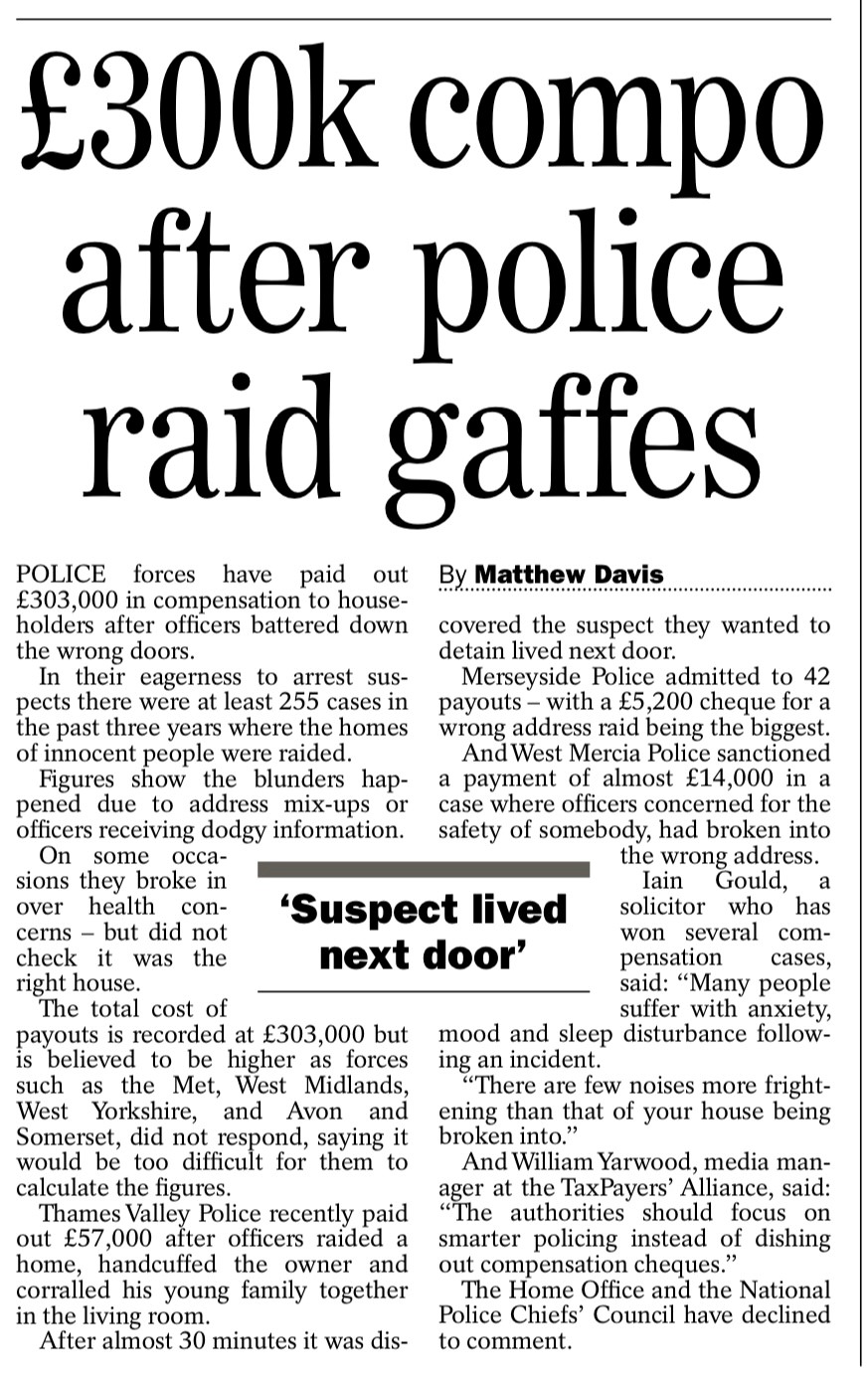










You must be logged in to post a comment.