What should I do if my Complaint to the Police is Rejected?

Photo of Aidan Walley, solicitor and specialist in civil actions against the police.
Aidan Walley, solicitor and specialist in civil actions against the police.

This week’s blog post is by my colleague and fellow actions against the police solicitor, Aidan Walley.

What should you do if your Police complaint is rejected? The answer is don’t be surprised, and don’t give up – consult an expert solicitor for advice on the next steps. Iain Gould has on many, many occasions on this blog highlighted what are not merely the gross inadequacies of the Police complaints system but its active antipathy and obstructiveness towards members of the public raising legitimate concerns. In this week’s blog post I will be adding to that roster of complaint stories – and demonstrating the silver lining: justice can certainly be done, through the civil claims system, when the complaints system lets you down. 

At the time of these events, in September 2020, my client Ann was in her 60s, vulnerable by means of various health conditions, including a heart problem, and was residing in a block of supported accommodation in Birmingham. 

One day in the early hours of the morning, Ann was at home asleep when she was suddenly awoken by the noise of a commotion in the communal corridor outside her flat. Alarmed, dressed only in her night clothes and barefoot, Ann went to investigate what was happening. 
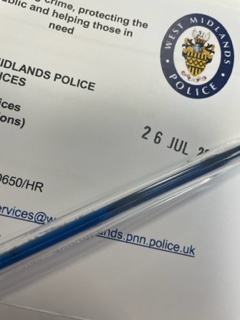
Letter from West Midlands Police

On opening the door of her flat, Ann saw three West Midlands Police officers, along with members of an ambulance crew and building security, restraining her neighbour “Peter”. One officer present was Police Sergeant Shafiq, who was standing on the opposite side of the corridor. On seeing Ann, PS Shafiq ordered that she return inside her flat.

Ann was acutely aware that Peter was a highly vulnerable individual who suffers from a number of physical and mental health issues. At this stage, Peter had been handcuffed and was being restrained on the floor, and appeared to be highly distressed. Ann knelt down next to him and placed her hand on his shoulder to comfort/ reassure him. She then stood up, but remained in the doorway to her flat, observing.

Ann then witnessed PS Shafiq pull Peter’s arms further up his back, causing him to cry out in pain. Ann verbally remonstrated with PS Shafiq for what she saw as an unnecessary use of force. PS Shafiq approached my client and again ordered her to go into her flat, to which Ann refused.

PS Shafiq then repeatedly pushed Ann on her left shoulder. The final push forced Ann backwards into her flat, and she fell to the floor. As she fell, one of her legs involuntarily made contact with PS Shafiq.

On hitting the floor, Ann was immediately aware of pain in her back and neck. PS Shafiq entered my client’s flat and stood over her, leaving Ann extremely fearful as to what he might do to her next. Thankfully he did not assault her further. She requested his name and collar number, but he ignored this request and left the flat.

Feeling at once shaken and outraged at what had been done to her, Ann picked herself up and followed the officers as they escorted Paul out of the building to an awaiting ambulance. In the presence of the building’s security guard, Ann again requested PS Shafiq’s name and collar number. In response, PS Shafiq muttered something inaudible to my client and then in a much louder voice said “Remember that”. 

Ann returned to her flat and called 101 to report the actions of PS Shafiq. The following day she received a return call from an officer at the local Station. This officer informed Ann that he had viewed the Body Worn Video footage of the incident and asked her as to whether she recalled “kicking” PS Shafiq. Somewhat nonplussed, Ann confirmed that her foot had made contact with PS Shafiq while she had fallen (after he had pushed her). Shockingly, the officer then replied that Ann would now be arrested for assaulting a police officer. 

A splendid example of customer focused and sensitive complaint handling, I’m sure we can all agree…

 Ann was naturally extremely concerned at the suggestion that she was to be arrested, and later the same day attended the Police Station. There she spoke to a different Sergeant who said that he had also viewed the footage and that Ann would not be arrested. My client informed this Sergeant that she wished to make a formal complaint and thereafter the matter was referred to West Midlands Police’s Professional Standards Department.

 The same day Ann attended her GP in relation to the injuries she had suffered as a result of PS Shafiq’s assault upon her.

Photo of a West Midlands Police Professional Standards Department Investigators Report.

 The following month, October 2020, Ann received a response from the Professional Standards Department. Although her complaint was not upheld, and it was deemed that the Officer’s behaviour was “acceptable” it was proposed that –

 “PS Shafiq engages in a debrief with his supervisor, who will be of at least the rank of Inspector, to reflect on the incident. This process facilitates the officer to be able to consider the actions he took, reflect upon them and take the opportunity to consider if more tactical verbal communication could have resulted in a less physical outcome”.

 What a delicate way of saying that perhaps angry, testosterone- fuelled men on a power- trip shouldn’t push elderly women around?

 Thankfully, Ann did not let matters rest there but instructed my firm to pursue a civil claim for compensation for the assault upon her and its psychological aftermath – including, of course, the menacing manner in which her first telephone complaint was met with an apparent attempt to ‘scare her off’ from pursuing the complaint, and the dissatisfaction she was left with when the final outcome was reached. All too often in these types of matter, the Police add emotional insult to the injuries inflicted, arising from their knee- jerk reaction which is to regard complainants not in the way they would victims of crime, but as hostile, anti- police actors who need to be ‘defeated’ or deflected.

 The first response Ann received on the telephone – the threat of arrest – was just a more ‘naked’ version of this brand of anti-complainant Police mentality; the final written report was, in my opinion, simply a more politely dressed-up version of the same problem.

 With my assistance, Ann pursued full blown litigation against West Midlands Police.  

We rejected the Police’s first offer of settlement  in the sum of £3,250 – a derisory amount for the physical and mental suffering they had caused to Ann – and, after I had obtained expert evidence to support her claim for both physical and psychological injury and issued Court proceedings, I was ultimately able to bring the claim to settlement for £20,000 damages, plus Ann’s legal costs

Having your legitimate complaint rejected by the Police can be a frustrating and upsetting experience – but if you instruct the right solicitor, such as Iain Gould, John Hagan, or myself, justice can be done and the Police made to pay the price for all those acts of misconduct they’re not prepared to own up to. 

Note from Iain Gould: Week after week, I share my knowledge and experience so that people can better understand their rights and options. If this blog has helped you, or if you believe in the importance of holding the police to account, please take a moment to leave a 5 star review. Your review is more than just feedback – it is a way to guide others towards expert representation when they need it most. Thank you!

What to do if you’ve been wrongfully identified by Police Facial Recognition technology (Part 2)

Picture of a UK police facial recognition van.
A UK police facial recognition van.

In this article I discuss the increasing prevalence of Police Facial Recognition Cameras, whether their use infringes civil liberties/ rights and what you can do if you have been wrongfully arrested or detained as a result of Facial Recognition technology. 

This is a continuance of last week’s blog post on the increasing number of arrests based on Police use of Facial Recognition Technology and the wrongful arrests which may arise as a result of its use.

Is there Ethnic Imbalance in the way Live Facial Recognition Works?

 A Live Facial Recognition (LFR) camera takes digital images of a crowd moving through the “zone of recognition” in real time. 

The LFR software then automatically detects individual human faces amongst the crowd, and extracts facial features from the image to create a “biometric template”.  

The LFR software (the Genie in this particular bottle) then compares the biometric template with those of the faces on the pre-determined Police watch list. 

The facial images from the crowd are compared against the facial images from the watch list, and the LFR system generates a “similarity score”, a numerical value indicating the extent of similarity between the faces. The operators of the system will have set a “threshold value” to determine when the LFR software will generate an alert indicating a possible match. 

The decision-making process then reverts from the robot to the human: Police Officers must review the alerts and make a decision as to what, if any, further action to take. 

The Police guidance set out in the Authorised Professional Practice for live facial recognition seeks to reassure us – “In this way, the LFR system works to assist Police personnel to make identifications, rather than the identification process being conducted solely by an algorithm.” 

Early, legitimate, concerns that LFR algorithms were mis-identifying black people’s faces more often than white people’s, and women’s more than men’s, (see the Bridges judgment of the Court of Appeal, 2020 ) have to some degree been assuaged, and the pace of technological change is such that these algorithms are surely only going to become better and more accurate with each passing year. The Met Police point to a report commissioned from the National Physical Laboratory, which seems to confirm that LFR systems, when used at the highest settings, now produce no statistically significant difference in outcomes between demographic groups (i.e people of different genders/ ethnicities).  

But the devil, as always, is in the detail. LFR algorithms have configurable settings for face detection – good quality frontal face images of sufficient size giving the most accurate identification results. The settings can be ‘lowered’ to increase the number of faces processed – but such a relaxation of the criteria, allowing poorer/less accurate images to be used by the system increases the “false match rate”.  

As I highlighted above, at the highest ‘face match’ settings there were no false positives but at lower settings – casting the net wider – not only did “false positives” occur but they were disproportionality higher for black subjects than for Asian or white subjects – “The demographic variation in the nominated score distribution does not affect equitability if settings are such that the chance of a false alert is very low.  However, if settings allow for a higher number of false alerts, these are likely to occur disproportionality within black or Asian ethnicities.” (NPL report, 9.3). 

The NPL report goes on to state that the “False Positive Identification Rate” (FPIR) is equitable between gender and ethnicity and age at face-match threshold 0.6 and above.  At face-match thresholds lower than 0.6 FPIR ‘equality of outcomes’ varies between demographic groups dependant on the settings of operational deployment, including the size and composition of the watch list and the number of crowd subjects passing through the zone of recognition during deployment, which led the NPL to caution  – “Given our observations on the demographic variation in FPIR, we would recommend, where operationally possible, the use of a face match of 0.6 or above to minimise the likelihood of any false positive and adverse impact on equitability” (NPL report, 1.4.6). 

All of this must be considered through the lens of the Equality Act 2010  – Chief Officers must demonstrate compliance with their non-delegable Public Sector Equality Duty (PSED) under Section 149 Equality Act 2010, particularly in terms of taking steps to “rigorously” understand and monitor their LFR system’s algorithmic performance in relation to statistical accuracy and demographic variants (which as, highlighted above, depends on the settings that its operators have implemented).  

As the APP guidance enjoins its Officers, Forces must “Satisfy themselves that everything reasonable that could be done has been done to ensure that the software does not have an unacceptable bias on any basis, including on the grounds of race, sex, religion or belief.  No system is every 100% non bias. There is always something within the system (and operator).  Forces need to identify and understand the degree to which this occurs and then mitigate against this. 

Clearly, therefore, this is still an area of some concern, and needs to remain on our own – shall we say – ‘watch list’.

Practice not Theory: Legal Remedies for a ‘False Positive’ Arrest

 As the views I have expressed in these posts make clear, I think a good argument has been made for the usefulness of this technology in modern day policing, and so I am prepared to concede the theory of the case.  But that doesn’t alter the fact that I will always strive to bring to each and every individual case in which a person consults me because they have been unlawfully arrested/detained by the Police, an analytical attention to detail, a questioning of the facts to find out what went wrong –and a refusal to stop until the full truth has been uncovered. This is because whenever theory is put into practice, mistakes and abuses can occur, and when they do I offer my 30 years of success in litigation against the Police as proof of the fact that if there is a path for a wrongfully arrested person to achieve restitution/compensation, I will find it.  

The checks and balances on this most recent of Policing tools already exist, and so, if you have been wrongly arrested on the basis of a supposed facial recognition match don’t hesitate to contact me for advice. 

My daily job is holding Police power to account, and in regard to this new technological power, the following considerations are particularly pertinent – 

  • have the LFR cameras been used in an overt way, or have they been deployed in a manner constituting covert surveillance, thereby potentially breaching the Regulation of Investigatory Powers Act 2000 (RIPA)?   
  • have the algorithmic settings unfairly increased the risk of non-white faces being misidentified (clearly a problem which still exists despite significant improvements); or indeed have they been set so low, or provided with such inadequate material in the form of the ‘watch list’ (blurry/ low- resolution or older images), that the risk of “false positives” for all demographic groups is too high? 
  • all the hazards and risks dependent in the human part of the process: i.e decision- making and deployment of Officers to respond to the potential face matches:
  • notwithstanding what the algorithm has indicated – is it reasonable to believe that a person identified by the LFR system actually is the person on the watch list? 
  • is it reasonable, in all the circumstances of the case, to use force or threats of force to detain the suspected ‘match’ ? 
  • have the Officers on the ground actually got the right person? – errors in this regard are bound to occur, just as much as they do in the deployment of ‘stingers’ against innocent people’s vehicles. 
  • the Police and Criminal Evidence Act 1984 – in particular Code G (governing the rules of a lawful arrest)  and Code D (identification procedures)   
  • the Human Rights Act 1988  – use of LFR may engage Article 8 (the right to private and family life) and/or Article 9 (freedom of thoughts, conscience and religion), Article 10 (freedom of expression) and Article 11 (freedom of assembly and association) 
  • the Data Protection Act 2018  
  • has the authorisation for deployment of LFR been given by an Officer of senior rank (generally, not below the rank of Superintendent), defining the boundaries of time/ geography for the deployment and sufficiently justifying the same in writing?

The Authorised Professional Practice also sets out the ‘paper trail’ of documentation which must be created in support of each LFR operation, and which a lawyer such as myself would seek to obtain and interrogate in the event of a wrongful arrest occurring. These include – 

  • LFR Standard Operating Procedure including the criteria for watch lists; sources of imagery; guidance for when an alert is generated and arrangements to ensure that the deployment is overt (e.g. signage) : Setting the Forces’ false alert rate in policy and assessing the success of deployment against these metrics to ensure ongoing proportionality of use and reassurance to the public
  • the written authority document for each LFR operation, outlining the aim of the deployment and, in compliance with the Human Rights Act, explaining how and why the deployment is necessary (not just desirable) and proportionate 
  • Data Protection Impact Assessment (DPIA) : explaining what the “pressing social needs” are for each particular LFR deployment; why sensitive processing is needed to achieve the legitimate aim and why the purpose cannot be achieved through less intrusive means
  • Equality Impact Assessment (EIA)
  • Community Impact Assessment (CIA) 
  • LFR training materials so that those Officers and staff using the technology fully understand its technical capabilities (and limitations) and how to properly respond to an alert. 

In Conclusion

 We can’t alter the pace of technological change, but we can ensure the integrity of fundamental rights and upon them we should accept no encroachment.

 From here on the front lines, I am confident that Police misconduct experts such as myself, who:

  • know what they are doing
  • know how to obtain the necessary disclosure from the Police; and
  • can read between the lines to build our clients’ cases

will be able secure justice and win compensation for those wrongfully arrested as a result of Facial Recognition technology, using the existing laws and policy safeguards which ringfence its deployment, as set out above. 

But as ever, those laws and rights must be exercised in practical terms to ensure that they are not lost, and that they fill both their primary purpose of compensating the wrong individual and secondary purpose of protecting others from similar harm, by policing the Police. 

Let the Police have the best modern tools they want; lawyers like me will use the best traditions of the law to Police them when they misuse those tools – if you’ve been wrongly identified by facial recognition, seek expert legal advice as soon as possible – hold power to account, don’t unplug it.

How you can help me

I hope that you have enjoyed reading this week’s blog post and the many others available on this website. If you have, then I would like to ask you a favour – in a world in which large and non-specialist law firms (generally from a personal injury background) are increasingly throwing huge marketing budgets into online advertising in order to ‘capture’ Actions Against the Police clients – I need your help to ensure that those in need of real expert advice come to the best place for representation. If you value the insights and expertise which I share on this blog, and the results which I have achieved for the people whose stories are recounted here, please post a positive review on Trustpilot to get the word out. Every 5 star review I receive makes a big difference in helping those who need the right advice to come to the right place. Thank you!

Should You Fear Police ‘Revenge’ If You Make A Complaint?

Image of a Merseyside Police car

When they first consult me, some of my clients are concerned that by pursuing a complaint or claim against the police, they will suffer reprisals.

In response, I advise that as a solicitor who has specialised in this area for more than 30 years, I have come across only one case in which clients suffered direct victimisation from an officer bent on revenge in response to a complaint – and even then it was my clients who had the last, and longest, laugh.  

My clients, husband and wife Richard and Michelle Hall lived in St Helens, Merseyside with their children.

On 4 December 2015, Mr Hall was arrested and detained by Merseyside Police officers.

During the course of Mr Hall’s detention, PC Allen and other officers carried out a search of Mr Hall’s home address.

Upon Mr Hall’s release later that day, he viewed his home CCTV and was shocked by what he saw, believing that the search was conducted in a disrespectful and unprofessional way, and that PC Allen had helped himself to a packet of crisps from the Hall’s home, which he was munching as he discharged his criminal justice functions. (Watch the CCTV footage on the Liverpool Echo’s website.)

A few days later, Mr Hall understandably filed a complaint against PC Allen (“the first complaint”).

The complaint was investigated by Merseyside Police’s Professional Standards Department (“PSD”).

During the investigation, PC Allen was placed on restricted duties and was also interviewed.

On 11 February 2016, PSD informed PC Allen that he was no longer being investigated, and that the restriction on his duties had been removed. One of the investigation findings was that whilst PC Allen had been eating crisps during the search, he had not stolen them from the Halls.

The following morning, at around 7:30am, Mr Hall left the house as usual, to take his children on the ‘school run.’

Then, shortly after 8:00am, Mrs Hall, who was now alone in the house, noticed a police vehicle parked outside.

The driver of the police vehicle parked outside of the premises was none other than potato- based snack food fan, PC Allen. He was with a female officer, PC John.

Mrs Hall got dressed and went outside, surprised, alarmed and upset to see PC Allen in the van (whom she recognised from the CCTV footage of the search on the 4 December).

Mrs Hall tried to attract the attention of the officers to establish the reason for their presence. Chillingly, neither officer acknowledged Mrs Hall.

Mrs Hall returned inside and called her husband to inform him of PC Allen’s presence. She felt intimidated and was extremely upset.

PC Allen and PC John remained outside of the premises for approximately 13 minutes, before driving away before Mr Hall got home. The officers seemed to have had no legitimate business in the road.

As a consequence, on 13 February 2016, Mr Hall made a further police complaint, alleging that PC Allen’s conduct on 12 February 2016 amounted to harassment (the “second complaint”).

This was again investigated by Merseyside Police PSD.

On or around 22 February 2016, the investigation report into Mr Hall’s first complaint was sent to him, informing my client that his first complaint had not been upheld and/or that there was no case to answer, except for Mr Hall’s allegation that PC Allen had failed to leave a copy of the search record at the premises, prior to leaving, which was upheld. PC Allen was deemed to “need no more than words of advice regarding the importance of documenting all items any damage caused and the correct process regarding the completion of the PCE 10 search record”.

On 10 March 2016, PC John provided an account to Merseyside Police PSD, in which she stated that PC Allen had made the decision to park up outside the Halls’ home on 12 February 2016. PC John further stated that she did not personally have any enquiries to conduct in the area that day.

PC Allen himself provided an account to PSD in which he claimed to have gone to the area on 12 February to engage in a “high visibility patrol”. PC Allen further stated that he had parked the police vehicle outside the premises as he had “finished late the night before and thought that an opportune moment to complete [his] notebook”. PC Allen confirmed in that account that he was aware that it was Mr Hall’s home address.

On 21 June 2016, Mr Hall received the investigation report into his second complaint. He was informed that his complaint against PC Allen of oppressive conduct/harassment had been upheld and that PC Allen was deemed to require management action. In particular, it was found that PC Allen and PC John had been tasked to respond to another job whilst they were parked outside the Hall’s home but had failed to do so immediately. The following was also stated in the investigation report:

“…It is…reasonable to believe that the only logical explanation that Constable Allen has parked outside the Hall’s home address is to either cause annoyance, in response to the complaint made against him previously by Mr Hall, or because he himself was annoyed because of the serious allegations which had been made against him and, the more serious ones had not been proven…”

In the circumstances, I advised Mr and Mrs Hall to bring a claim against Merseyside Police for breach of Article 8 of the European Convention on Human Rights (ECHR) – the right to respect for private and family life, or, in other words the sanctity of the home as a ‘safe space.’

This may not have been an ‘invasion’ of an English man’s castle (as that old common law adage puts it), but it amounted in my opinion to a ‘siege’ which deserved to be firmly censured.  

Merseyside Police denied liability and the case proceeded to trial in June 2018. You can read more about the legal basis for the Article 8 claim in my original blog post on this case.

When giving evidence at trial, PC Allen maintained that he had a legitimate reason for parking up outside the Hall’s home address; that he was in the vicinity carrying out high visibility patrol. He claimed that he was aware of, and had experience of, people living in the area defrosting/ demisting their cars on driveways by leaving their cars unattended with their engine running, and that such vehicles were “easy pickings” for opportunistic car thieves.  As he drove around he ‘remembered’ that he had not completed his pocket notebook from the previous day.  In the circumstances, he decided to pull up, “electing a safe place …… to stop”.  By sheer coincidence, it was immediately outside of the Hall’s home address! 

Having so parked up, and having completed his pocket notebook entry, PC Allen went on, he observed a man delivering papers. As he did so, the man left his engine running and so PC Allen advised him he was committing an offence. PC Allen obtained the man’s personal details and carried out a radio check to ensure he was insured. He was, and so PC Allen gave him some ‘words of advice’ and allowed him to continue. Thereafter, the officers were passed a job over the radio; PC John attempted to access the database via her laptop but couldn’t get a connection, and so the officers returned to the Police Station.

On review of the evidence available, it was established that, at that morning’s briefing, there had been no tasking for a ‘high visibility patrol’. Yet further, enquiries with the Police Intelligence System revealed only one theft of a motor vehicle in the area. There was simply no evidence that such thefts were an issue or ‘high priority’.

In the circumstances, it was clear to me that PC Allen had deliberately parked up outside the Hall’s home address a day after being told that Mr Hall’s first complaint had been resolved to send them a message: “I’m not going to forgive and forget.” It was an act of revenge, and one that caused an innocent family considerable upset.

Her Honour Judge Sykes agreed and in Court ruled as follows:

“In my judgment, if powers of police are used arbitrarily, without legitimate cause, that engages Article 8.  The Claimants’ submit that this case is analogous to covert surveillance. I agree that this is an appropriate analogy.  A duty of respect is imposed under Article 8, it calls upon the Police not to carry out acts to intimidate or cause anxiety.  I am satisfied that Article 8 is engaged.  I am also satisfied that the Defendant has failed to show that the interference was in accordance with law and in pursuance of legitimate and proportionate aim”.

Both of my clients received compensation awards, an order for their legal costs to be paid and a declaration by the Court that their Article 8 rights had been violated.

Here’s what Richard Hall kindly said on case conclusion…..

Had a complaint against Merseyside Police and went to see Iain. Iain was very direct and to the point but this guy knows his stuff and we won on the 26th June 2018 with a Breach of Article 8 of my human rights, so no matter how trivial your complaint or issue is with Merseyside police or any other force, always put a call in to Iain first to get the correct advice.

I can offer no absolute guarantee that the individual officer or the Force generally will not seek ‘reprisal’ for a claim or complaint, but I can say that such action is extremely rare, and even more so when the person claiming or complaining is doing so with the benefit of legal representation (remember that Mr Hall had brought his first complaint before instructing me). Most officers who are the subject of a claim or complaint just want to forget about it – not to go out and cause further trouble for themselves. In this respect, PC Allen is a salutary lesson – his petty act of revenge meant that Merseyside Police, not the Halls, were the ultimate losers in this case.

How you can help me

I hope that you have enjoyed reading this week’s blog post and the many others available on this website. If you have, then I would like to ask you a favour – in a world in which large and non-specialist law firms (generally from a personal injury background) are increasingly throwing huge marketing budgets into online advertising in order to ‘capture’ Actions Against the Police clients – I need your help to ensure that those in need of real expert advice come to the best place for representation. If you value the insights and expertise which I share on this blog, and the results which I have achieved for the people whose stories are recounted here, please post a positive review on Trustpilot to get the word out. Every 5 star review I receive makes a big difference in helping those who need the right advice to come to the right place. Thank you!

Lies, Damned Lies, and Police Apologies

Photo of Aidan Walley, solicitor and specialist in civil actions against the police.
Aidan Walley, solicitor and specialist in civil actions against the police.

This week’s blog post is by my colleague, and fellow actions against the police solicitor, Aidan Walley.

Recently I wrote about the case of my client Natalia, a victim of rape who was unnecessarily arrested by Greater Manchester Police (GMP) for a minor offence, deeply exacerbating her existing trauma and re-enforcing her distrust of the police. 

Throughout her claim, GMP denied that Natalia had been arrested unlawfully and, despite my repeated attempts to encourage GMP to apologise to Natalia, they refused to do so before ultimately settling Natalia’s claim on a “without prejudice basis” (I.e without formally admitting wrongdoing – though the damages paid speak loudly in that silence). 

Natalia’s claim has now been reported on by the BBC as well as featuring on North-West Tonight. Most notably, the Force now apologised to Natalia, but only after being contacted by the BBC: 

A spokesperson for the force … said GMP was sorry for the impact that this interaction had on Natalia … “We have improved officer training on our revised voluntary attendance policy and are ensuring all officers are trained to recognise and respond to the trauma felt by survivors of domestic and sexual abuse.” 

Natalia also received a letter from GMP’s Professional Standards Department stating as follows: 

I have detailed the above to demonstrate that arrest was an option open to the officers once a crime was recorded and in the investigatory phase given that they thought that there was a crime to be investigated. 

I want to make it clear that I think this was the wrong decision, but I believe it was one made in good faith by the officers.

 Having detained you on the date in question the officers established that your detention was not appropriate due to a medical commitment so sought to make alternative arrangements and after advice at this stage elected to move to interview by Voluntary Attendance.

After that point, the crime was reviewed by a more experienced Detective Inspector. He took a different view to those having recorded the crime and the investigating officers who were planning to interview you as part of the investigation and concluded that there was no evidence of a crime and directed that no further action be taken.

 I consider that this decision by the Detective Inspector was the correct one when having the full facts at his disposal, and I reiterate that I regard the operational decision to detain you by the officers to be the wrong one and apologise sincerely for this on behalf of GMP.

Photo of letters from Greater Manchester Police.

 The subject of getting an apology from the police – and when you do how genuine it is – is something Iain Gould has written about on a number of occasions. When first speaking to a client, they often tell me that they want an acknowledgement from the police that something went wrong. However, I am required to tell them not to get their hopes up, as the police rarely apologise. In civil claims there is no obligation for the police to apologise or even admit liability, even in the most egregious cases, and a Court cannot order them to do so. Furthermore, apologies that are given are often written to appear sincere on a first glance, but on further reading are little more than creative word play primarily designed to obfuscate Police wrongdoing, often and displaying contempt for Claimants. 

The same is true for the ‘apology’ that Natalia has now received. The spokesperson’s statement that “GMP was sorry for the impact that this interaction had is not an apology for arresting Natalia. Moreover, the apology offered by the Professional Standards Department was first qualified by the assertion “I think this was the wrong decision, but I believe it was one made in good faith by the officers”. Rather than just simply apologising for this “wrong decision”, GMP still felt the need to justify the officers’ actions, so that the apology also becomes a commendation! 

In my view, such apologies are nothing more than a PR exercise to save face once a case becomes more widely reported. GMP had ample opportunity to admit that the arrest was wrong and offer a genuine and heartfelt apology to a rape victim throughout Natalia’s claim, but refused to do so. These later “apologies” do nothing to alleviate the distress caused to Natalia, or other wrongfully arrested individuals.

I can only hope that GMP has truly learnt from this incident, as they claim to have done, and therefore avoid the need to “apologise”, through clenched teeth, to victims of unnecessary arrest – by not arresting them in the first place.

My client’s name has been changed.

How you can help me

I hope that you have enjoyed reading this week’s blog post and the many others available on this website. If you have, then I would like to ask you a favour – in a world in which large and non-specialist law firms (generally from a personal injury background) are increasingly throwing huge marketing budgets into online advertising in order to ‘capture’ Actions Against the Police clients – I need your help to ensure that those in need of real expert advice come to the best place for representation. If you value the insights and expertise which I share on this blog, and the results which I have achieved for the people whose stories are recounted here, please post a positive review on Trustpilot to get the word out. Every 5 star review I receive makes a big difference in helping those who need the right advice to come to the right place. Thank you!

Another Foot In The Door: Section 93 of the Crime & Policing Bill 2025

This week’s blog post comes from my colleague and fellow actions against the police solicitor, John Hagan.

There is a reason why the phrase An Englishman’s home is his castle is such a resonant one; it sums up a principle which underpins the liberal and democratic traditions of British society and we infringe upon it at our peril. 

I therefore feel compelled to add my voice to the chorus of those who have expressed concern about section 93 of the Crime and Policing Bill, which is currently at committee stage at the House of Commons, and which provides as follows – 

93 Electronically tracked stolen goods: search without warrant 

(1) In the Theft Act 1968, in the heading of section 26 after “goods” insert “with warrant”.

(2) In the Theft Act 1968, after section 26 insert—

“26A Electronically tracked stolen goods: search without warrant

(1) A constable whose rank is at least that of inspector (a “senior officer”) may authorise a constable to—

(a) enter specified premises, and

(b) search the specified premises for specified items.

(2)  A senior officer may give an authorisation under subsection (1) only if satisfied that—

(a) there are reasonable grounds to believe that—

(i) the specified items are stolen goods,

(ii) the specified items are on the specified premises, and

(iii) it is not reasonably practicable to obtain a warrant for the entry and search (under section 26 or another enactment) without frustrating or seriously prejudicing its purpose, and

(b) there is electronic tracking data indicating that the specified items (or any of them) are, or have at some time since they are believed to have been stolen been, on the specified premises.

(3) An authorisation may be given orally or in writing.

 This clause, if enacted as currently drafted into law, would grant the Police yet further powers to intrude into the ‘inner sanctum’ of our private lives, without the prior oversight of the Court i.e. a new power of entry into a person’s home, without the need for Court approval in the form of a warrant.  Also note the vague definition of “electronic tracking data” – any “information as to the location, determined by electronic means, of an item.” 

Rob Warner has produced an excellent recent video surveying this problem which I would recommend everyone to watch, on his Crimebodge YouTube channel below:

And for those of you who haven’t read his equally excellent “Copper Stopper” handbook, read about it here

Not every change is for the best, and sometimes politically expedient amendments to the law risk fixing a system that isn’t broken – or that already has the necessary tools to deal with the problem, provided they are used properly – and risk fuelling authoritarian ‘mission creep’ amongst the agents of the state, infringing fundamental personal liberties and enabling new forms of abuse and exploitation of Policing power. 

The best laws are not those which are apparently designed for ‘headline grabbing’ – especially when the problem they purport to address could be fixed without changing the law, and instead by better management and application of existing resources. Section 93 of the new Bill appears to have been drafted to address news reports about Police being unwilling to act upon tracking data showing the location of people’s stolen mobile phones or other easily moveable computing devices; but we should be careful about throwing away our personal freedoms just for the sake of our personal phones – and, in reality, the power which already exists for the Police to apply for a Court warrant to search premises is what should, more efficiently and pro-actively, be utilised in appropriate cases of reported theft. That way, the Court oversight – the guardrails around State intrusion into our family homes which our forebears erected, would be maintained – rather than being further dismantled. Bear in mind that the Police already have wide powers under the Police & Criminal Evidence Act 1984 (PACE) to force entry into premises without Court permission – 

  • Under Section 17 of PACE  – to arrest wanted persons for serious offences, or if there is an immediate threat to the life or threat of serious injury of an occupant of the premises (“saving life or limb”).
  • Under Section 18 of PACE  – to search premises at which an already arrested person resides. 

I personally do not think that we should allow those powers – those gaps in the guardrails – to get any wider. 

When I look at the proposed legislation I think of all the ways it could be abused by reckless, authoritarian or negligent Police Officers and the deep harm such abuse of power could cause, not only to the personal lives of those individuals whose homes are violated by a Police intrusion under this law, but also its wider implications in further diluting the principal of the sanctity of our ‘castles’ and injuring society as a whole; wearing down people’s expectations of privacy beneath the tramping feet of Police trespassers as the Police gain evermore ‘rights of way’ over the threshold of our homes. The more wedged the Police Officer’s boot becomes in the door, the more society may, in the long term, come to forget that we ever had a right to close it in their face.  

John Hagan, solicitor and specialist in civil actions against the police.

Contemplating these themes, reflect on the following – 

  • The rapidity with which the ill- thought-out emergency legislation brought in to address the Coronavirus pandemic was exploited by Police Officers, some of whom seemed gleeful to have their inner authoritarian enabled, as if they were living in the ‘papers please’ curfew- state of their dreams 
  • The existing exploitation of Police powers of entry into the home – particularly under Section 17 of PACE – the supposed power of entry to “save life or limb” which is, very often, invoked by Officers when in fact nobody’s life or limb is in danger, but the Officer just has a twitchy nose
  • The many innocent families who have already suffered from mistaken address raids and  misinterpretation of electronic data, including IP addresses and vehicle numberplates 
  • Big Brother does not have all the answers, and I caution that we should be very wary about giving his foot-soldiers another excuse to come into our homes, especially one which is going to be based on notoriously imprecise location data, in a country whose cities have a very high population density, often sharing terraced streets or apartment blocks.   

Not all change is for the best and the strongest wisdom often has age-old roots. Let us hope that modern day legislators take a proper look before they leap, and come to the same realisation which led to the abolition of the “Smoke Money” Act during the reign of King William and Queen Mary (1688 – 94), which had previously imposed a tax payable to the Monarch on the basis of how many hearths, or fire-places, a house possessed. The preamble to the Act repealing this imposition decried it as contrary to the institutions of English justice, in the following strident terms, which I am tempted to adopt for our present purpose – 

“Not only a great oppression to the poorer sort, but a badge of slavery upon the whole people, exposing every man’s house to be entered into and searched at pleasure by persons unknown to him.”

How you can help me

I hope that you have enjoyed reading this week’s blog post and the many others available on this website. If you have, then I would like to ask you a favour – in a world in which large and non-specialist law firms (generally from a personal injury background) are increasingly throwing huge marketing budgets into online advertising in order to ‘capture’ Actions Against the Police clients – I need your help to ensure that those in need of real expert advice come to the best place for representation. If you value the insights and expertise which I share on this blog, and the results which I have achieved for the people whose stories are recounted here, please post a positive review on Trustpilot to get the word out. Every 5 star review I receive makes a big difference in helping those who need the right advice to come to the right place. Thank you!

GMP Pay Compensation to Rape Victim Subject to Unlawful Arrest

This week’s blog post is by my colleague, and fellow actions against the police solicitor, Aidan Walley.

Photo of Aidan Walley, solicitor and specialist in civil actions against the police.
Aidan Walley, solicitor and specialist in civil actions against the police, explains how he helped a client win her claim against Greater Manchester Police.

Last week, the European Court of Human Rights gave its judgment in the case of X v Cyprus, a deeply disturbing case in which Ms X, a British holidaymaker, made a report of rape to the Cypriot police. The police did not believe Ms X and arrested and charged her with public mischief. She was convicted but, thankfully, acquitted on appeal.

Unfortunately, such cases occur not only abroad but also in the UK. The European Court’s judgment above closely mirrors my own concerns regarding the unnecessary arrests of victims of sexual assault, and my hope that such violations of their rights end.

My client Natalia*, whose case was also previously reported by BBC News last year, was one such victim who was subject to a wholly unnecessary arrest, causing her yet more trauma.

In 2019, Natalia was a victim of rape, which was reported to Greater Manchester Police (GMP). However, despite the seriousness of the allegation, Natalia’s attacker was not arrested. Instead, officers invited him to attend a voluntary interview. The subsequent investigation by GMP was significantly botched and resulted in no further action being taken against Natalia’s attacker. After Natalia complained to GMP’s Professional Standards Branch, the Force and Andrew Burnham (in his role as the Greater Manchester Police and Crime Commissioner) eventually apologised to her.

As a result of her attack, Natalia was diagnosed with Post-Traumatic Stress Disorder, which was greatly exacerbated by the handling of the investigation and the subsequent complaint process. What happened next only caused Natalia further anguish.

On the morning of 15 September 2023, two male GMP officers, including PC Dalzell, attended Natalia’s home.

Understandably, Natalia was reluctant to speak to two unknown male officers given her previous trauma and on-going complaint against GMP. She partly opened the door to talk to them. The officers stated repeatedly that they needed to speak with Natalia inside the house about an ongoing case involving Twitter posts. They refused to discuss further details while standing on the street, and insisted that Natalia let them in, but without making their real intentions clear. When her partner joined her at the front door, Natalia fully opened the door, and the officers entered the premises.

Once inside Natalia’s home, the officers revealed their true intentions and PC Dalzell arrested Natalia for sending “malicious communications”, relating to an accusation that a malicious post had been made on Twitter.

Natalia was distressed and objected to her arrest, stating that she believed it was in retaliation for her complaints. Natalia and her partner then explained to the officers that she had a hospital appointment later the same day and produced a hospital letter. Eventually, the officers backed down and agreed for Natalia to attend a voluntary interview a few days later. The officers then left.

The following morning, Natalia emailed PC Dalzell to ask if the voluntary interview could be postponed. PC Dalzell responded, “for the time being we’re going to cancel the voluntary attendance interview so don’t worry about attending”.

Natalia heard nothing for several days, she began to fear that officers would come and suddenly arrest her again. On 18 September 2023 she emailed again for an update before another officer called and told her that the case was closed because the case did not meet the public interest criteria.

At no point was Natalia made aware of who her accuser was, or what the alleged tweets were. In November 2023 Natalia received a partial response to a Subject Access Request to GMP which included a redacted copy of the relevant crime report. Through this, Natalia found that the accusations against her were linked to her report of rape and complaints to GMP and that the alleged offence had taken place on 4 January 2023 but had not been reported until 27 April 2023. However, no attempt had been made to contact Natalia nor arrange a voluntary interview prior to her arrest on 15 September 2023, despite GMP long being in possession of Natalia’s contact details.

Natalia suffered distress and upset because of the incident, which served only to further undermine her confidence and trust in the police.

Following initial instruction, I was satisfied that Natalia’s arrest was wholly unnecessary. Further, the entry into Natalia’s home, her safe space after her attack, was a disproportionate violation of her rights under Article 8 of the European Convention on Human Rights (right to private and family life).

As my colleague Iain Gould has blogged about many times before, under section 24 of the Police and Criminal Evidence Act 1984 (PACE) a lawful arrest requires two elements: an officer must reasonably believe that the suspect was involved in the commission of a criminal offence, and it must be necessary to arrest for one of the reasons set out in section 24(5). In Natalia’s case, it appeared that the arresting officer would struggle to satisfy either criterion, but particularly that of necessity.

Paragraph 2F of Code G of PACE provides that the arresting officer must consider whether the suspect’s voluntary attendance is a practicable alternative to arrest, and it was clear that PC Dalzell failed to give any considerations to an alternative to arrest as:

  • by reason of her previous reports and complaints, GMP already had Natalia’s contact details;
  • prior to arrest there was no attempt to contact Natalia and interview her voluntarily;
  • Natalia was suspected of a minor, non-violent, offence that took place over the internet several months prior to her arrest;
  • Natalia was of good character with no previous convictions or arrests.

However, in clear defiance of the Pre-Action Protocols for civil claims, GMP’s solicitor actively failed to respond to a letter of claim. This left Natalia with no alternative but to authorise me to issue Court proceedings.

In response, GMP’s solicitor filed a robust Defence in which it was asserted that PC Dalzell had a genuine and reasonable belief that Natalia was guilty of an offence and that it was necessary to arrest her.

Surprisingly, it was claimed that the arresting officers were not aware that Natalia was a vulnerable victim of rape, notwithstanding the assertion that the officers had fully reviewed the victim’s statement and the crime log prior to arresting Natalia.

Despite my repeated challenges to their position, GMP refused to openly accept that Natalia had been unnecessarily arrested and refused to apologise to her, all the while making “without prejudice” offers to settle her claim. (“Without prejudice” offers are confidential offers made between the parties, which a Defendant can make whilst still maintaining an official denial of liability and which the Court cannot be informed about until the case has concluded.)

Despite the stress of proceedings, Natalia persevered, and ultimately accepted, an appropriate offer of compensation from GMP.

Following the conclusion of her claim, Natalia said:

“As a survivor of rape, I cannot begin to explain the excruciating journey I have faced since reporting it to the police. Not only did I endure a soul-crushing, inefficient police investigation and contemptuous treatment throughout the process, but I also became the target of an unlawful arrest, further highlighting the serious gaps in competence and attention to detail within the Greater Manchester Police. From reporting the rape to suing the police, my actions have all had a singular purpose: to ensure that real lessons are learned and that no further vulnerable victims of such heinous crimes are revictimised by police forces.”

Whilst Natalia’s case is not an isolated incident, I hope that the lessons learnt from this and other cases, will prevent other victims of rape being criminalised in the future.

*As Natalia is a victim of sexual assault, under Section 1(1) of the Sexual Offences (Amendment) Act 1992 she has been granted life-long anonymity and her name has been changed.

How you can help me

I hope that you have enjoyed reading this week’s blog post and the many others available on this website. If you have, then I would like to ask you a favour – in a world in which large and non-specialist law firms (generally from a personal injury background) are increasingly throwing huge marketing budgets into online advertising in order to ‘capture’ Actions Against the Police clients – I need your help to ensure that those in need of real expert advice come to the best place for representation. If you value the insights and expertise which I share on this blog, and the results which I have achieved for the people whose stories are recounted here, please post a positive review on Trustpilot to get the word out. Every 5 star review I receive makes a big difference in helping those who need the right advice to come to the right place. Thank you!

On The Front Line of Civil Rights (Part 1): Public Protest and Police Prejudice

This is a guest post by my colleague and fellow actions against the police solicitor, John Hagan.

My client Gemma Barnes is an animal rights activist and campaigner who often exercises those rights of peaceful protest which should be acknowledged as a fundamental hallmark of a democratic society, no matter where you stand on the political spectrum  – “I may disagree with what you say, but I support your right to say it.” 

A necessary corollary of this, is that the Police must, whilst maintaining law and order, not fall into a mindset of ‘us versus them’ – as if the Blue team are a rival army lining up against the Red team. Sadly, this is all too often what happens, and Police prejudice and personal hostility towards protestors like Gemma open up a trapdoor of civil rights abuses.  

On the morning of 19 February 2022, Gemma attended an animal rights protest at Neat Market  in Norwich, the site of a cattle market.  

Prior to the events in question, she had been subject to a bail condition not to attend Neat Market Road (which had been the scene of previous protests). However, this condition had been withdrawn by Norwich Magistrates Court on 8 February 2022.

 PC Chittock of Norfolk Constabulary recognised Gemma and alleged that she was in breach of her bail condition. Gemma, and some of her companions, explained that the bail condition had been withdrawn, but their protests fell on deaf ears.

 At approximately 9:29am, PC Bhogal arrested Gemma for a purported breach of the bail conditions. In response, she clearly and repeatedly explained to PC Bhogal and other officers that the bail condition had been withdrawn. The Officers nevertheless handcuffed her and marched her to a nearby car park, where Police vehicles were located.

 In protest at her unlawful arrest, upon reaching the car park, Gemma sat/ lay on the ground thereby offering ‘passive resistance’ to the officers. She did not actively lift a finger against them, but equally she was not going to facilitate what she saw as an unlawful ‘kidnapping’ into custody.

Gemma continued to verbally protest her arrest, and with the help of other protesters, at approximately 9.38am, showed Police Sergeant Rimmer, PC Bhogal, and other officers present, an email dated 8 February 2022 from her criminal defence solicitors which clearly stated that the bail condition had been lifted. Gemma begged the officers to call her Solicitors and/or the Court to confirm the information that she had provided to them, but they refused to do so.

 The officers then began forcibly pulling Gemma up by her arms and legs, causing her pain, and attempted to place her into the rear of a police van.

 PS Rimmer then ordered that Gemma be searched before being placed into the van. She was accordingly placed back down onto the ground and searched by PC Clark.

 The officers then applied ‘leg restraints’ to Gemma (bear in mind, she was already handcuffed, completely outnumbered by the officers and not fighting them) before they lifted and threw her into the rear cage section of the police van. As they did so, PC Green, who was positioned inside the van, grabbed and pulled Gemma’s legs further into the cage. As Gemma was being violently manhandled in the manner described, with none of her limbs under her own control, her handcuffed hands made an accidental, glancing contact with PC Clark’s head (as that officer was bending down over Gemma, at the same time Gemma was being ‘posted’ into the van).

At approximately 9.56am PC Bhogal then further arrested Gemma for allegedly assaulting an emergency worker I.e on the basis of her hands coming into momentary contact with PC Clark. As this was occurring, other protesters tried to film Gemma’s arrest but were repeatedly pushed back by the officers, with far more force than the accidental contact Gemma’s helpless hands had made with PC Clark…

Gemma was then locked in the rear cage section of the Police van.

Click on the “play” arrow below to watch mobile phone footage of the incident, showing Gemma being manhandled into the back of the van.

At approximately 9.57am, unbeknownst to Gemma at the time, but subsequently revealed by body camera footage, PC Chittock, who was sitting in the driver’s seat of the Police van, called to PS Rimmer and informed him – “Serg, Serg, she needs to be de-arrested, it’s Binnsy….”

 PC Chittock had just been informed by Acting Inspector Binns, by way of a radio call, that Gemma had been telling the truth about the withdrawn bail condition all along.

 When PC Bhogal then climbed into the van PC Chittock informed him – “Mate, the bail’s been lifted apparently, I’ve just had – but we’ll go with it mate, you know.”

In response, and totally uncontrite, PC Bhogal replied – “We’ll go with it, I just acted on the information I had. Right, let’s go mate.

And so, the two Officers drove Gemma away into custody.

 Also unbeknownst to Gemma at the time, at 9.59am whilst still at Neat Market, PS Rimmer received a telephone call from Acting Inspector Binns who informed him that the bail conditions had indeed been dropped, and that “their presence was an admin error.” From the available body camera recording, PS Rimmer’s side of the said conversation was as follows-

 “Yeah, when I saw the email I saw something like no conditions but obviously it was still showing on the PNC so I was under the impression it was just no additional ones. Right, fair enough, well she’s just assaulted one of the officers so we’ll run with that instead. Yes, yes, obviously we’ve been under the belief that those bail conditions are still in place. Yes, absolutely, I’ll get the Breckland officer who was assaulted to write a statement when we get back to Breckland and we’ll all put it together, it’s captured on body worn so it’s all good. No, not your fault boss…it’s all good.”

Notwithstanding the clear confirmation which Inspector Binns had provided as to the withdrawn bail condition, to multiple officers, no officer de-arrested my client in respect of either offence, or even ‘let on’ to her that they now knew the truth – surely the minimum courtesy that she deserved.

Instead, the officers all seemed rather pleased with the fact that they now had an additional ‘reason’ to keep Gemma in captivity i.e the minor contact that had occurred between Gemma’s handcuffed hands and PC Clark’s head whilst the officers were lifting and shoving her into the van, in the process of what they now knew to be a wrongful arrest and in circumstances where Gemma obviously did not have full control of either her legs or arms.

On arrival at Wymondham Police Investigation Centre (PIC), shortly after 10:14am, Gemma again and repeatedly protested that the bail condition had been lifted and referenced the email from her solicitor in that regard. In response, despite now knowing that she was telling the truth, PC Bhogal replied – “You will have your day in Court, that email could be from anyone.

PC Bhogal and PC Chittock were then present throughout my client’s ‘booking in’ process, but at no point did either officer inform the Custody Sergeant that they knew that Gemma’s bail condition had in fact been withdrawn.

PC Bhogal informed the Custody Sergeant that Gemma had first been arrested for breach of bail. In describing this offence, the officer continued to withhold from the Custody Sergeant the crucial information as to the withdrawal of the bail condition and maintained his silence on this issue, even when the Sergeant directly asked Gemma if he could see a copy of the email from her solicitor regarding the bail condition, so as to investigate her ‘alibi.’

PC Bhogal then informed the Custody Sergeant that Gemma had been further arrested for “assault upon an emergency worker”. Whilst describing this offence he stated that Gemma had “elbowed” PC Clark, which was untrue.

Photo of John Hagan, actions against the police solicitor.
John Hagan, actions against the police solicitor.

At approximately 10.25am, the Custody Sergeant, still in the dark as to the true state of affairs known to not only PCs Bhogal and Chittock but also PS Rimmer, authorised my client’s detention in relation to the alleged breach of bail and in relation to the alleged assault upon an emergency worker, the circumstances of which were recorded as “the DP (Detained Person) elbowed PC  in the head.”

At 10.28am, Gemma, maintaining that the bail condition had been lifted, cogently questioned the Sergeant why it was necessary for her to be detained for these low-level assault allegations to be investigated (the circumstances of which had all been caught on body worn camera in any event). My colleague Iain Gould has blogged before on many occasions about the importance of the necessity criteria and why an arrest is not lawful simply because of suspicion of an offence – the person’s detention must be necessary in itself for a specific purpose, usually to facilitate the “effective investigation” of the offence.

In response, the Sergeant stated – “We need to establish whether or not there is a breach of Court bail…our responsibility is to put you in front of the Court…”

Once again, PC Bhogal and PC Chittock, who were listening to this interaction, said nothing about their knowledge of the withdrawal of the bail condition.

Gemma was accordingly searched, processed, and placed into a cell in the PIC.

Finally, at 11:22am, the Custody Sergeant recorded in the custody record that he had received – “confirmation from the DP’s solicitor that the bail conditions were lifted but it appears that the court have not updated PNC [Police National Computer]. I have spoken to the DP and informed her that she is now only here for the matter of assaulting an Emergency worker to be investigated.” 

Remarkably, this confirmation had not come from any of the Sergeant’s colleagues at varying levels of seniority, who had all known the truth for hours.

At around 11:30am, Gemma was assessed by a Health Care Professional in the PIC.  On examination, it was found that she had “bruises and red marks around RT wrist, redness around Left wrist, Says has injury to shoulder. No marks/bruise seen. Requesting Valium, as the Police have caused her to have a mental health episode.” She was prescribed painkillers.

 Only at 7:30pm that evening was Gemma interviewed by PC Butcher, in relation to the ‘assault’, and she was not finally released from custody until around 9:10pm, almost 12 hours after her unlawful detention had begun.

Unsurprisingly, a few weeks later, Gemma was informed by the Police that they would not be taking any action in relation to the alleged assault of the emergency worker.

 I personally think it was a travesty that she was arrested and detained for that assault charge in the first place, and I consider that arrest to be one that was born plain and simple out of an institutionally biased ‘Police v Protestors’ mentality on the part of the officers, who clearly saw Gemma as a ‘problem’ who needed to be taught a lesson, and were quite happy to seize upon a second excuse to detain her, after the first had vanished into thin air.

Gemma subsequently lodged a complaint which was investigated by Norfolk Constabulary’s Professional Standards Department (PSD). By means of a report dated 1 September 2022, PSD rejected Gemma’s complaint on the grounds that in all respects the “level of service” provided to her was acceptable.

 This ‘par for the course’ complaint response/ rejection left Gemma only with the option of suing the responsible parties to obtain redress for her wrongful arrest.

In considering whom to sue, I had to take account of the suggestion that the Magistrates Court might have failed to properly notify the Police of the change in Gemma’s bail conditions, leading to erroneous information appearing on Police computer systems (see the comment that was made in the Custody Record at 11.22am, as highlighted above – effectively, the Police were washing their hands of moral or legal responsibility for that ‘glitch in the matrix’).

 It was therefore necessary to pursue claims against both the Chief Constable of Norfolk AND the Ministry of Justice (the Government department who are responsible for the Court Service).

One of the lessons which long experience in suing both the Police and the (many armed!) Ministry of Justice, is that both organisations will be as cryptic as possible about the operation of their databases and how communications are sent between Police, Courts, Border control etc. Often there is no doubt that errors of commission or omission have corrupted a person’s PNC profile, but the problem is finding out whose fingerprints are on the error, in situations in which the private communication channels between law-enforcement agencies are guarded by a deliberate or negligent lack of disclosure and obfuscation.

Here, the MOJ were claiming they had discharged their duty by notifying the Police of Gemma’s change in bail status, albeit a few days later than would have been ideal – whilst the Police were seeking refuge behind this delay and their claim that Gemma had in any event been validly arrested for assaulting PC Clark during the course of the arrest, which the officers honestly believed they were entitled to make. On the face of it, therefore, both Defendants were advancing vigorous defences, despite the fact that everyone agreed that Gemma was entirely innocent of any breach of bail that day.

 I am pleased to say, however, that I pride myself on leaving no stone unturned in any aspect of my client’s cases – and especially when it comes to Police disclosure of documents and information, my watchwords are : What else have you got, that you are withholding from us?

 In Part 2 of this blog, next week, I will provide the intriguing answer to that question…

£20,000 Damages for Postal Summons Address Error Arrest

In early 2023, an Officer of Nottinghamshire Police contacted my client Roisin in relation to a minor road traffic accident in which she had been involved.  Arrangements were made for Roisin to attend a local Police Station, to be interviewed under caution, which she duly did. 

At the conclusion of the interview, Roisin was told that she might be summonsed in due course to attend Court. 

My client heard nothing further about this matter, and was thus utterly shocked when, almost seven months later the ‘Boys in Blue’ turned up at her home to arrest her for failing to attend Nottingham Magistrates Court.

Roisin honestly explained that she was unaware of any Court summons or requirement for her to attend Court. The Officers were unfazed by this and replied that they had no option but to arrest her.

Roisin was then taken into Police Custody where she was searched and processed and detained in the cell block overnight. The whole experience had been made more terrible for Roisin by the fact that the arrest took place in front of her youngest child, and she was reduced to crying for most of the hours that she spent in the grim and unpleasant Police cell.

The following day she was transported to Court in handcuffs feeling as bewildered, humiliated, and degraded as any law-abiding citizen thrown into such a situation would be. 

Thankfully, at least, it did not take long after the Court Hearing commenced for my client’s innocence in this matter to be vindicated; it was quickly established that the Court summons had been sent to my client’s old home address, where she had not lived for some five years.

It is frankly appalling how many people like Roisin suffer wrongful arrest by reason of ‘incorrect address’ errors every year – and indeed how much legitimate Police and Court time is wasted in the process as well. I have blogged about precisely this form of wrongful arrest numerous times over the last 18 months, showing the prevalence of the problem. It is the ‘collateral damage’ caused to people’s lives by bureaucratic laziness/ sloppiness within the criminal justice system, and absolutely inexcusable.

On the basis that it was Nottinghamshire Police Officers and/or staff who were responsible for issuing the original Court summons to the incorrect address (when my client had done all that she reasonably could to ensure they had her correct address, including cooperating with the initial contact earlier that year and attending a Police interview), I advanced a claim on her behalf against the Chief Constable of Nottinghamshire for:

I am pleased to confirm that in December 2023, following receipt of a detailed letter of claim which I had sent on behalf of Roisin, East Midlands Police Legal Services, acting on behalf of the Chief Constable of Nottinghamshire, accepted that the Postal Requisition had been sent to my client’s previous address as a result of a Police “administrative error” and that liability for all of the causes of action outlined in my letter of claim was admitted. 

Roisin was detained in total for over 26 hours.  Her compensation would, however, be measured not only by reference to the precise amount of time for which she was deprived of her liberty but also the sadly much longer lasting psychological impact of a wrongful arrest, and I therefore arranged for Roisin to be examined by a Clinical Psychologist.

When you leave a Police cell behind, it does not necessarily leave you behind. After her arrest, Roisin’s sleep was frequently disturbed, by thoughts that noises outside her house were someone coming to ‘get’ her and by disturbing feelings of being trapped in the cell and separated from her young children (aged only two and four at the time). This got so bad that she was eventually prescribed sleeping tablets. She suffered symptoms of low mood and of anxiety – even something as simple as an unexpected knock on the door could trigger a panic attack and cause her heart to race. She also became very nervous and on edge at any sight of Police officers in the local area. She was signed off work for some time as a result of these symptoms.

The medical expert whom I instructed diagnosed Roisin as suffering from a Specific Phobia, as well as anxiety and depression as a result of this incident.

I am pleased to confirm that in April of this year I was able to conclude Roisin’s claim for damages in the sum of £20,000, plus her legal costs, on the back of that report and with a threat of Court proceedings against the Police. The kind of threat which my Police opponents know I do not bluff about!  

If the Police arrest you after using the wrong address, you may be entitled to compensation and I can help you to maximise your award – getting you every penny you are entitled to for such a shocking invasion of your privacy and violation of your liberty; and thereby hopefully helping the Police to learn from their mistakes.

My client’s name has been changed.

“Giving Us Evils”: Know Your Rights When It Comes To Police Stop & Search

Detained and searched for looking at a Police Officer the wrong way? Sadly, that was what happened to my client Allen Norman.

Police Officers live in a world of ranks, uniforms and chains of command and unfortunately often bring that mentality to the everyday world, behaving as if they ‘out-rank’ ordinary citizens.

One afternoon in June 2022, Allen was shopping in the heart of London and passed a Police carrier that was parked up, close to a Boots store.

Having completed his shopping in the store, Allen returned outside and went to retrieve his bicycle, which was locked to a nearby lamppost. 

At this time, two male Police Offices – now known to be PC Laurie and PC Minnerthey of the City of London Police, approached Allen and asked if he was “Alright” and what he was up to.

Allen was immediately apprehensive, as many of us would be if stopped by the Police in such circumstances.  He asserted that he was fine, but that he would not be answering any questions.

PC Minnerthey then began to accuse Allen of “Giving us evils” as he had walked past their Police carrier and then of allegedly “Fiddling around with a lot of stuff” in the Boots store (whatever that was supposed to mean).

PC Minnerthey announced that he was going to search Allen under Section 1 of the Police and Criminal Evidence Act (PACE), produced his handcuffs and reached out to grab Allen’s arms.  Allen felt threatened and sought to clarify upon what grounds the Officer wanted to search him, asserting that the Officers’ actions were unlawful. He knew his rights under the Police Codes of Practice – the ‘GOWISELY’ procedure, which Officers are supposed to adhere to, but in fact routinely abuse.

Ignoring this, the Officers now grabbed Allen’s arms and forcefully handcuffed him.

Again, Allen demanded to know on what grounds the Officers were asserting a legal power to search him.  PC Minnerthey repeated his bizarre accusation: that Allen had been giving him and his colleagues “Evils”, before then going into a shop and “Fiddling around”.

PC Laurie then stated that as Allen walked down the road, he was seen “eyeballing” the Police carrier, “paying a lot of attention” to the Officers within, and had then gone into a shop where he was seen to be “fumbling around” and “potentially up to no good.”

Numerous other officers now attended, it obviously being a slow day in the city of London…

The Officers continued to hold Allen – although he was not resisting them, or attempting to leave – and searched him, including removing his wallet and mobile phone from his possession.

Apparently having polished his script a little more, PC Minnerthey now advised Allen that – “You’ve appeared to be concealing yourself in the shop while you appeared to be fiddling about with things, okay, we’ve come over to have a chat with you and straightaway you’ve been very very “anti”, not letting us get a word in edgeways.  You’re extremely nervous, your breathing rate is up there, we think you’ve got something to hide. We suspect you might have been involved in something in the shop and therefore we’ve searched you under section 1 PACE for any stolen items.”

Section 1 of PACE (with irrelevant sub-clauses omitted) provides as follows-

1 Power of constable to stop and search persons, vehicles etc.

(1)A constable may exercise any power conferred by this section—

(a)in any place to which at the time when he proposes to exercise the power the public or any section of the public has access, on payment or otherwise, as of right or by virtue of express or implied permission; or

(b)in any other place to which people have ready access at the time when he proposes to exercise the power but which is not a dwelling.

(2)Subject to subsection (3) to (5) below, a constable—

(a)may search—

(i)any person or vehicle;

(ii)anything which is in or on a vehicle,

for stolen or prohibited articles; and

(b)may detain a person or vehicle for the purpose of such a search.

(3)This section does not give a constable power to search a person or vehicle or anything in or on a vehicle unless he has reasonable grounds for suspecting that he will find stolen or prohibited articles.

Allen correctly denied that the Officers’ had any grounds to detain and search him under this legislation; of course, this did not stop them.

It was in fact quite apparent that, no matter how they attempted to dress it up, the reason that the Officers were searching Allen was because they didn’t like the way he had looked at them as he passed their vehicle.  Somewhat unsurprisingly, PACE does not in fact grant Officers the power to search someone because he is suspected of giving them the evil eye’ and the Officers had no legal grounds for interfering in Allen’s business that day.

To be entirely clear, no member of the public or member of staff from the Boots store had made any accusation of shoplifting against Allen whatsoever, and at its highest all the Officers could apparently say was that they had seen Allen ‘fiddling about’ with things in the store – but just as with looking at Police Officers, ‘fiddling around with things in a store’ is not a crime; in fact it is shopping. 

The search having proved negative, Allen’s handcuffs were removed after a period of about 7 minutes.

Allen was outraged by the incident and felt as if he had been mugged, although at all times he kept his temper under control and spoke respectfully to the squad of Police Officers now assembled around him.

Aware of his rights, Allen asked PC Minnerthey for a Stop Form.  He was at first (wrongly) told that a Stop Form could not be provided because he had not given his personal details (which he was under no legal obligation to do).  Allen asserted that he was entitled to a Stop Form whereupon the Officers told him that he would have to subsequently attend Bishopsgate Police Station, in order to collect it. 

His phone was now returned to him, and he was told that he was free to go.

Throughout their conversation with Allen, as evidenced on their own body camera recordings, PCs Minnerthey and Laurie had, in effect, confessed their improper motivations to him. It is quite clear that they had detained, manhandled and searched him simply because they thought he was looking at them ‘the wrong way’ as he went past, compounded by his ‘failure’ to smile and engage with them when they approached him. Allen was in fact doing nothing wrong, and was in no way behaving in a criminally suspicious manner – but sadly the Officers’ mindset was obviously such that they immediately considered the slightest display of a ‘anti-police’ attitude tantamount to being a crime in itself.

Such, indeed, is the mindset of the very many Police Officers who fall into the trap of believing that they outrank ordinary civilians and that, accordingly, acts of insubordination from those ‘lower down’ the rungs need to be punished by some muscular exercise of Police powers. In this way, the boundaries of Police Officers’ egos very frequently exceed the boundaries of the law.

This attitude is at the heart of a huge proportion of all acts of Police misconduct and oppression.

A few days later, Allen duly attended Bishopsgate Police Station, required them to give him a copy of the Search Form and lodged a formal complaint. That complaint was summarily dismissed by Inspector Mackenzie (which is the knee-jerk Police reaction to most complaints). 

Allen therefore turned to me for assistance, and when the City of London Police continued to maintain their denial of any wrongdoing, I instituted County Court proceedings on behalf of my client, suing the Police for false imprisonment and assault and battery on the basis that the Officers had grossly misused their Stop and Search powers under Section 1 PACE because they did not honestly or reasonably suspect that Allen was in possession of “Stolen or prohibited articles”

I am pleased to confirm that through those Court proceedings I was able to win for Allen compensatory damages of £8,500, plus his legal costs and a letter of apology from the City of London Police in the following terms –

“The Commissioner admits liability for false imprisonment and assault and battery as set out in your Particulars of Claim.

On behalf of the Commissioner I accept that on 22 June 2022 you should not have been detained or searched by the Commissioner’s officers.  The officers’ grounds for stopping and searching you were not objectively reasonable in the circumstances.  I unreservedly apologise to you on behalf of the Commissioner and confirm that the officers involved will be notified of this decision. I trust that this apology will go some way to restoring your trust and confidence in the City of London Police.” 

A healthy scepticism of Police authoritarianism is essential in any democratic society; indeed it is the first bulwark in the defence of our civil liberties. Police Officers who baselessly pull rank on ordinary citizens – in this case with only the shameless excuse of having been ‘looked at the wrong way’ – need to be taught a lesson in good manners, in respect for individuals’ privacy, dignity and integrity of person, and in the limits and purpose of their powers.

That the Police still won’t properly police themselves, is amply demonstrated by their mass rejection of legitimate complaints. Perhaps when the letter of apology I have quoted above comes as a prompt and heartfelt response to a person’s initial complaint, then we will know that things have really changed for the better.

Until they do, it is up to brave citizens such as Allen Norman to take on the system, and teach the Police how to be better.

Since the conclusion of his case, Allen has sadly passed away.  His son has given me permission to publish this blog post, telling me that his father would have wanted this story told. I am proud to give Allen Norman the last word against overbearing and unconstitutional Police bullying.

Update

Rob Warner at Crimebodge has produced a video about Allen’s case. Watch it here:

Hard Fought Win Against GMP results in £30K Damages Payout

Earlier this month, I wrote about the sense of satisfaction that can be achieved by a Claimant in a Police action through a well-deserved but hard- fought win in collaboration with your lawyer, and a case in point is the one which I will describe in today’s blog post, in which my client eventually prevailed – but only after Greater Manchester Police (GMP) had fought him tooth and nail through the Magistrates and County court systems – and literally so in the living room of his girlfriend’s house.

My client faced Police brutality and a robust defence from GMP , but his determination to achieve justice saw him through to victory; and this is how he did it.   

In the summer of 2019, Ben was in a relationship with a woman who lived in Greater Manchester. 

 One afternoon, whilst Ben was at his partner’s house, the couple had an argument, as couples do, concerning the behaviour of Ben’s partner’s teenage daughter. Although voices were raised inside the house, there was no violence involved and nobody called the Police.  

Unfortunately, Police Officers including PC Day and PC Hassan were in the vicinity investigating an unrelated matter, and overhearing the argument, took it upon themselves to intervene. The officers entered the garden of the house and PC Day opened the back door, where he was met by Ben and his partner.  

PC Day said that the officers “Wanted to come and speak to you and see what the shouting.” 

Ben considered that the presence of the officers was unnecessary and replied “Well, I don’t want to speak to you.”  His partner said that there had been an argument and that she wanted Ben to leave.  Ben wholeheartedly agreed, telling the Officers “Which I am doing when I’ve got my stuff.” 

Nevertheless , PC Day stepped into the house, uninvited, and referred to the “shouting and screaming” (although this was certainly no longer ongoing).  

Whilst Ben’s partner went upstairs, PC Hassan pushed my client into the front room (placing his right hand upon Ben’s chest) and was followed by PC Day.

 Ben walked into the kitchen, where he again said that he would collect his stuff and go, to which PC Hassan replied “That’s sound”.   

Ben made it clear that he just wanted to “Get out of this situation” and “Get my stuff and go.”  PC Day said “Right, well get your stuff and go and we’ll supervise it.” 

But then – without warning –  PC Hassan then grabbed Ben’s left arm, announcing that he was unhappy with his behaviour. 

Maintaining a firm grip on Ben’s arm, PC Hassan then pushed Ben out of the kitchen and back into the living room.  

PC Hassan now announced that Ben was under arrest for “Breach of the Peace” and simultaneously applied a handcuff to his left wrist, whilst PC Day took hold of Ben’s right wrist. PC Hassan told Ben to put his hands behind his back.

Ben was bewildered at the Officers’ unnecessary force, and sought to remonstrate verbally, but without any physical resistance.  

However, his complaints fell on deaf ears, as without warning, and whilst Ben was talking to PC Hassan, PC Day sought to pull Ben to the ground – but lost his footing/grip as he did so, causing both he and my client to fall towards the floor. Ben was shocked, but managed to steady himself and stood back up.   

Unfortunately, his shock was only just beginning, as Ben then felt a blow to his face from PC Hassan and was then grappled by multiple officers. Ben attempted to defend himself from this assault by pulling his arms free, and shaking the officers off, but was unsuccessful. The officers delivered multiple blows to Ben’s face and body and forced him back against the wall, and then onto the floor in the corner of the room. 

In effect, Ben had been ‘mobbed’ by the officers, the two male officers having been joined by one of their female colleagues. He was completely overwhelmed.  

Whilst Ben was lying on his front on the floor, with other officers holding down his body, PC Day then gripped Ben’s neck, pushed his face into the carpet and sprayed him in the face with CS gas from ‘point blank’ range.  Ben was in agony and struggled to breathe. 

This type of ‘spay-painting’ of an already subdued victim is a sadly common feature of this type of Police brutality case, in my experience – irrespective of sex or age.   

Ben’s ordeal had not finished there; PC Day now punched him in the face and PC Hassan delivered further blows with his hands to Ben’s back, all whilst Ben was being held face- down on the floor. 

Ben’s arms were then taken hold of and he was handcuffed to the rear whilst still on the floor, with multiple officers applying pressure to various parts of his body, including his torso and legs. 

Ben was immediately aware of significant pain and discomfort in his face and body from the blows, and of burning sensations to his face and in his mouth and blood coming from his mouth. He was also struggling to breathe and genuinely feared that he might die.  Extremely frightened, Ben called out for an ambulance , begging the officers with the words “I’ll do whatever you want.”  

Ben was then marched out of the house, the prisoner of the Officers, and placed in a van.  Before being taken to Custody, however, Ben had to first be transported to hospital for the injuries which the Officers had inflicted upon him to be ‘patched up’, and there he underwent a facial x-ray and it was noted that he had a loose tooth, which subsequently fell out. 

To quite literally add insult to injury, whilst at the hospital, Ben was further arrested for the alleged offence of assaulting the three Police Officers who had in fact assaulted him. Again, this is another sadly typical feature of such cases – that the innocent victim of Police violence faces charges that could result in his criminalisation and imprisonment, all for the ‘crime’ of having been beaten up by the Officers in the first place, as if they feel such charges now need to be laid to justify the level of force they have used.  

Thereafter, Ben was taken to a local Police Station, where he was processed and incarcerated.  

Early the following morning, Ben was interviewed under caution and then yet further arrested for assault with the intention of resisting arrest. Once again, I view this as the Police trying to bury their own wrongdoing in a shallow grave of false charges, showering their victim with the ‘dirt’ of criminal offences.  This is a sadly common tactic by the Police, and I can think of many occasions when it has been utilised by GMP in particular

 Ben was eventually released ‘under investigation’ after a period of 14 hours in custody. 

 Even this was not the end of his ordeal; some six months later, in February 2020, a Postal Requisition was sent to Ben charging him with the following offences – 

a.      Assaulting PC Day thereby occasioning him actual bodily harm contrary to Section 47 of the Offences Against the Person Act 1986

b.      Assaulting by beating PC Prudence, an Emergency Worker, namely a Police Officer, acting in the exercise of the functions of such a worker, contrary to Section 39 of the Criminal Justice Act and Section 1 of the Assault on Emergency Workers (offences) Act 2018.  

c.      Assaulting PC Hassan with intent to resist or prevent the lawful apprehension or detainer of himself, contrary to Section 38 of the Offences Against the Person Act 1861

 Ben of course pleaded not guilty to these trumped-up charges, but had them and hence the real prospect of being wrongly convicted and being sent to prison hanging over him for well over a year, all against the stressful backdrop of the Covid pandemic and our national lockdowns, until the case was eventually listed for trial in June 2021 at Manchester Crown Court (a trial actually conducted at the Lowry theatre, owing to the continued restrictions of the pandemic).  The stress which Ben felt at the thought of imprisonment was made all the worse by the fact that in the interim, he and his partner had had a baby girl and Ben was tormented at the thought of being separated from his daughter by incarceration. All of this played havoc with Ben’s mental health, causing him to become extremely anxious and withdrawn, and devastating his faith in the inherent justice of ‘the system’ and the Police in particular. 

Then, at Court, the Crown Prosecution Service chose to offer no evidence and Ben was found not guilty on all three counts. 

That decision indicates the objective weakness of the evidence against my client – the incident was caught in detail on multiple officers’ body cameras and clearly the CPS lawyers had realised that they were on a hiding to nothing pursuing it.  

Why had Ben been charged in the first place and had to wait all this time for his innocence to be secured? As I have said above, I strongly feel that the decision to charge was, perversely but precisely,  because of the level of force the Police had used against him.  

It might now have been hoped that when I presented a civil claim for compensation to GMP on behalf of Ben,  that they would see sense and do the right thing; but instead, they denied liability, giving us no choice but to issue County Court proceedings against the Chief Constable of Greater Manchester Police, which were met with an apparently robust defence.  

GMP failed to take this further opportunity to admit their culpability,  and instead threw buckets of time and money at this case, apparently determined to bring all resources to bear to deny Ben’s entitlement to civil redress for the wrongs he had suffered, including serving statements from all the officers involved and fighting the case almost all the way to trial. 

Ultimately, my determination and Ben’s courage in pursuing the case, saw him through to victory and GMP cracked in the ‘home straight’  a few months before trial, agreeing to pay Ben £30,000 damages plus his legal costs (which will be substantial).  

I would like to think that GMP and its officers will learn a valuable lesson from this case, and curb future practices of attempting to hide Police brutality and wrongful arrests behind the smokescreen of meritless prosecutions… but like someone who’s just been sprayed with CS gas at point-blank range, I won’t be holding my breath. 

My client’s name has been changed.


Is Police ‘Conflict Management’ Training Working?

This is a guest post by my colleague and fellow solicitor, John Hagan.

Photo of John Hagan, solicitor.
John Hagan, solicitor.

Those of us who want to live in a civil society, where violence is always the last resort, and not some version of a Judge Dredd comic, in which a ‘hardcore’ police force shoots people for littering, may have been dismayed by the reaction of some sections of public opinion to a video released this week showing a Metropolitan police officer shouting at a motorist and viciously smashing the motor car’s windscreen with his truncheon, before trying to cut his way in through it with a knife.

In the video the police officer can be seen confronting the motorist (identified in press reports of this story as Leon Fontana), who, perhaps not coincidentally, is a young Black man. My colleague Iain Gould has previously blogged about the dangers of “Driving whilst Black” i.e the perception that black men are disproportionately targeted by the police for traffic stops.

The police have powers under S.163 and 164 of the Road Traffic Act 1988 to require drivers to stop their vehicles and produce their licence and insurance and confirm their identity. It does not however empower the police to require that a motorist who has been stopped must exit his vehicle, nor to require that he hand over his car keys.

Whilst it is true that Leon states he is not going to get out of the car, he is otherwise co-operating with the officer, and is not refusing to let the officer check his details. When the officer states that he is concerned that Leon might just drive off, Leon removes his keys from the ignition and places them on the dashboard…then within 30 seconds of the conversation beginning the officer is screaming “Get out of the car! You’re not allowed to drive it!” and starts smashing the windscreen viciously.

It appears that the officer has just received some information suggesting that Leon may only have a provisional licence (this subsequently proves to be incorrect, as it is a case of mistaken identity, cleared up within moments, as soon as other officers become involved…). However the officer immediately reacts to this information by shouting “Get out the car – you’re not allowed to drive it!” and within 15 seconds has started to pummel the side of the car with his truncheon before the man inside has even had a chance to respond. The officer is now screaming his command “Get out of the car!” as if he was involved in a life and death situation rather than a routine traffic stop. If a member of the public had been behaving like this – basically attacking the car and shouting at the top of his voice – he would surely have been arrested. The officer appears to have no impulse control in this situation, and there is no sign that he made any attempt at a reasonable and civil discourse with the driver. Surely this is not how we want our police officers to behave, nor why we empower them with special authority to inflict violence or commit damage to property. The officer was, in my opinion, behaving in a totally unprofessional and irresponsible manner.

As the footage continues, the motorist can be heard telling the attacking officer (in an entirely calm tone of voice) that he has a licence and insurance. The officer informs the motorist “You are not qualified, you’re not allowed to drive” apparently having jumped to an unshakeable belief that the motorist is an unqualified individual without going to the trouble of listening to what he is being told, or making any effort to check documents and establish the driver’s actual identity.

Manifestly, the police are here to reduce violence and aggression in society, not actively introduce it into otherwise calm situations (the motorist had clearly responded to police instructions to stop his car and was talking to them through an open window).

If somebody tells an officer that they have been mistaken for somebody else, surely the officer should spend at least a minute or two investigating that possibility in an amicable manner rather than shouting the person down and smashing his windscreen to pieces? And what purpose was being served by the officer smashing the windscreen – surely he didn’t intend to pull Leon out through it? The destruction of someone’s property by a police officer to make them comply with instructions during a low- level traffic stop is in my opinion a crazy and unjustifiable turn of events.

In my opinion, the police officer’s actions can only be characterised as anti- social, thuggish behaviour which clearly flies in the face of the norms of civilised behaviour as well as the specific training which police officers are given as to how to resolve a conflict situation.

Police officers are extensively taught the techniques of ‘conflict management’ which emphasise that violence must be a last resort after non- violent approaches to resolving the situation in the form of ‘officer presence’ and ‘tactical communications’ are first considered. Does anyone really doubt that the officer pictured in this video could have had a productive conversation with the motorist had he so chosen?

Sadly, as I discovered during my appearance on the Jonathan Vernon Smith (JVS) Show on BBC 3 Counties radio last week, some people do condone the officer’s behaviour.

You can listen to my interview here:

One caller to the show stated “the guy in the car should be prosecuted” whilst another called the motorist a “toe rag” and accused him of “winding up” the officer by the act of filming the confrontation.

JVS himself, perhaps adding fuel to the fire of his listener’s fury, speculated aloud that the police may have believed Leon to be a dangerous criminal with a history of using weapons, and that he might even have had “a gun in the glove box”. However, there was no basis for this assertion. All the evidence available to us is to the effect that the worse the police suspected of Leon was that he was driving without a full licence or insurance, which is a non- imprisonable offence.

The police are entrusted with special powers to use force against other citizens, but it is only right that the officers respect the safeguards that the law has put in place to prevent the abuse of those powers and to ensure that we have a functioning civil society in which people can have trust in the police – without which, they obviously cannot do their jobs and the risk of harm to both officers and citizens generally increases.

Police powers of arrest without a warrant are enshrined in the Serious Organised Crime and Police Act 2005 S.110. In order to exercise his power of arrest, the officer must have a reasonable belief in its necessity on the basis of one or more of the following criteria –

  1. that:
  • the name of the relevant person is unknown to, and cannot be readily ascertained by, the constable,
  • the constable has reasonable grounds for doubting whether a name furnished by the relevant person as his name is his real name,
  1. that:
  • the relevant person has failed to furnish a satisfactory address for service, or
  • the constable has reasonable grounds for doubting whether an address furnished by the relevant person is a satisfactory address for service,

3. that the constable has reasonable grounds for believing that arrest is necessary to prevent the relevant person:

  • causing physical injury to himself or any other person,
  • suffering physical injury,
  • causing loss of or damage to property,
  • committing an offence against public decency, or
  • causing an unlawful obstruction of the highway,
  1. that the constable has reasonable grounds for believing that arrest is necessary to protect a child or other vulnerable person from the relevant person.
  2. that the constable has reasonable grounds for believing that arrest is necessary to allow the prompt and effective investigation of the offence or of the conduct of the person in question, or
  3. that the constable has reasonable grounds for believing that arrest is necessary to prevent any prosecution for the offence from being hindered by the disappearance of the person in question.

It is highly questionable whether the officer in this case could have possibly had a reasonable belief that any of the above conditions applied to Leon Fontana. In which case, he had no power to arrest Leon, and no power to use force against his motor car to effect an ‘arrest’ – which renders his smashing of the windscreen not only a civil but possibly a criminal offence.

Contrary to what some of the listeners of the JVS show apparently believe, there is no seventh criteria of “having reasonable grounds for believing the person to be a toerag” nor any power for the police to arrest someone who is filming their encounter, or refusing to exit a vehicle, if there are no other circumstances such as a refusal to identify themselves or an attempt to abscond or obstruct the investigation of a suspected offence on the part of that person.

Here, as we can all hear, Leon was offering to identify himself – or at least was trying to go through that process in a respectful manner with the officer, but was being obstructed by the officer’s unreasonable anger towards him.

This case reminds me of another I have recently been involved with, also a video taped encounter,  in which police officers stopped a car on suspicion of ‘no insurance’ and in which the driver – a middle- aged white man as it happens – resolutely refused to identify himself to the officers involved and repeatedly made it clear that not only would he not exit the car, he would simply not identify himself or produce any documentation. The officers attempted to reason with him for  approximately 8 minutes, before deciding to discharge a CS gas spray into the car.

Whilst I do not agree that the CS gas should have been used, it is perhaps telling that in a confrontation with an older, white motorist the police gave considerably longer to conversation with an individual who was a lot more obstructive, than did the officer in this video towards a young black man.

I am sure that in the present case, all the unpleasantness could have been avoided, if the officer had just engaged in the civil conversation which Leon was offering him.

But you may think I am biased in that assertion, being a lawyer primarily working on behalf of people who believe they have been the victims of police misconduct.

In which case I will call as my next witness, the other contributor to the JVS show that morning, Peter Kirkham, who was formerly a Detective Chief Inspector with the Met.

Mr Kirkham acknowledged that the officer’s behaviour was “not a good example of conflict management skills” and made the point “when you’re dealing with a conflict situation the idea is you’re not making it more aggressive”.

Acknowledging that it was plain from the video that the officer has lost his temper, Mr Kirkham concluded by saying that if he was the supervising officer he would certainly be investigating the conduct of the officer concerned, whose actions could amount to criminal damage if there was no justification for his use of force.

The officer appears to have suffered a moment of madness; sadly for him he must now face the consequences of this. The uniform he wears is a symbol of the special authority vested in him but it does not, and should not, give him immunity from accountability for actions which if perpetrated by a member of the public may well have resulted in a night in the cells.


Should the Police “Arrest First” and Investigate Later?

Iain Gould solicitorBy Iain Gould, solicitor

The head of the National Crime Agency, Lynne Owens has been in the news. According to The Sunday Times and quoted in The Telegraph, whilst Chief Constable of Surrey Police she told police officers investigating rape cases to “arrest first” and investigate later.

Owens, who is now head of the National Crime Agency, is said to have made the changes when she was Chief Constable for Surrey Police between 2011-2015.

According to the report, minutes from a September 2015 meeting called by the then Police and Crime Commissioner for Surrey, Kevin Hurley reveal that Owens was asked how the force was going to improve their detection rates for rape.

The minutes record: “The chief constable was keen to ensure officers were robustly pursuing offenders. Officers tended to receive an allegation then wait to make an arrest after gathering evidence. They needed to change this and make an arrest first and then gather the evidence.”

Nick Ephgrave, then Deputy chief constable and who now leads the force, told the meeting that the tactics had raised the rape detection rate from 6 per cent to 15.8 per cent, a significant turnaround in a year.

It is obviously satisfying to see a Chief Constable adopting a robust approach to the investigation of crime but it is imperative that Police forces operate within the legal powers conferred upon them. In my dealings with various Police forces, I am afraid however that tactics of arresting prior to sufficient evidence to form the basis of reasonable suspicion being gathered first are not necessarily limited to Surrey Constabulary. An arrest on suspicion of a sexual crime, such as rape can have serious long-lasting consequences for the person arrested if they were in fact entirely innocent, and have been arrested by the Police simply as part of a ‘fishing expedition’ which effectively amounts to an abuse of Police power of arrest, as I shall explain.

Robert’s Case

I have recently concluded a case on behalf of Robert (name changed for obvious reasons), a student who when just 16 years old, was arrested by North Wales Police on suspicion of rape.

In the summer of 2013, a music Festival took place in North Wales. Robert attended along with several friends.

Towards the end of the festival, a female complainant, Ms A made a complaint to a crisis worker that she may have been raped the previous evening.  Ms A ‘s initial account was as follows;

“I went to the toilet block, talking to two lads.  I went to a tent…..  I don’t remember anything else but I think I have been raped because it hurts down below.  I think I remember one of the boys wearing a red puffa jacket”.

Ms A subsequently gave a statement to the police.  Her recollection of the evening was vague due to her consumption of a large amount of alcohol.  She recalled that the previous evening, she had visited the site toilets with a friend, GH.  While she was waiting outside the toilets for GH, she started a conversation with an unknown white male.  Ms A started kissing this male.  She was then introduced to the unknown male’s friend, “Robert” who was “mixed race” and who was wearing a distinctive red puffa jacket.

Ms A’s next recollection was of consensual oral sex with the white male in a tent.  Ms A also recalled something hard being pushed into her vagina.  Ms A remembered saying “stop, it hurts and I can’t do this”, getting dressed and then leaving the tent.

Ms A was examined by a paediatrician who concluded that she had received trauma to her genital area and that the marks were consistent with an attempt at intercourse.

GH was interviewed and he recalled he had seen Ms A and the unknown male kissing and then walking off together followed by “Robert”.

Several days later, friends and family of Ms A contacted North Wales Police to report that they had identified the mixed race male in the red puffa jacket introduced as “Robert” as my client.

On the basis of this information, several Police officers travelled to my client’s home address and arrested him on suspicion of rape.  Robert was 16 years old, is of mixed race and had never been in trouble with the Police before. He was taken to a Police Station. This was despite the fact that Ms A had never alleged that the mixed race male had any sexual contact with her, but rather his white friend.

At the Police Station and without the least evidential or reasonable foundation, the circumstances of arrest were said to be;

“The Detained Person has been identified as being responsible for rape.  Circumstances are that the I/P recalls being in a tent at the festival and being subjected to rape. D/P has been identified via clothing worn and full description of a male seen with the I/P prior to the incident”.

The necessity for the Claimant’s arrest was said to be to “allow the prompt and effective investigation”.

My client was obliged to provide his personal details.  He was then searched, his personal belongings including his mobile phone seized, and he was then placed in a holding cell where he was subsequently joined by his mother who had been obliged to travel to the Police Station separately.

Robert was subsequently taken for interview. He answered all questions truthfully and directly. The interview was rather meandering and in fact was a fishing expedition rather than fact based enquiry. On review, it was apparent that the officers had no information whatsoever to implicate Robert.  After 58 minutes of questioning, the Duty Solicitor intervened and put it to the interviewing officers that their questions resembled questions which would ordinarily be put to a witness rather than a suspect.   The relevant passage of the interview is as follows:

Solicitor: Sorry, the two times she’s described having sex, oral sex with a white man and then sex, you haven’t given any description as to the person she’s having sex with then.

IO:  No there is no description actually in the notes here I’ve got.

Solicitor:   So that has led you to arrest him as opposed to a voluntary interview or anything.

IO:  The clothing description and …

Solicitor:  She doesn’t say she’s …………….  red puffa jacket

IO:  The jacket also with the description as well, Robert is seen in the vicinity heading in the same direction.

Solicitor:   Is that just because you have a name? Because you’ve been able to pick a name up.

IO:  Hm hm

Solicitor: You arrested him and used him to get your information, that is disgraceful, Robert is 16 and has never been in trouble before.

IO:  I understand the point you’re making.  I’ll make a note of that.

Solicitor:  I’d like you really to get on and finish this interview because it’s disgraceful

Thereafter, the Police advised Robert that he was to be released on Police bail. The Duty Solicitor again made robust representations as to why Police bail was wholly inappropriate and that Robert should be released NFA (no further action). On the basis of those representations, the issue was reconsidered and a decision made to release Robert without charge.

Finally, in the early hours of the morning, Robert was released. Notwithstanding his release, the Police retained 2 T-shirts belonging to Robert and his mobile phone which were eventually returned several weeks later.

Robert was understandably shocked by what happened to him but equally satisfied that he had done no wrong.

Robert is in my opinion a young man going places and despite his arrest was not going to be deterred from getting on in life. He continued his studies and successfully passed several ‘A’ Levels 2 years later.

Robert was however left with a fear of intimacy with girls; he was concerned that if he developed a relationship with a girl, a similar allegation could be made. He was particularly fearful if he drank leaving gaps in his memories. A Psychologist concluded that this fear represented a chronic adjustment disorder but that with time, he would overcome these issues.

The Law

For any arrest to be lawful, it must be founded on reasonable grounds. This necessitates consideration of whether, objectively, it was reasonable to suspect the Claimant of the offence for which he was arrested. It is also necessary to consider whether the arresting officer honestly suspected the Claimant of the offence for which he was arrested. Further, it is necessary to consider whether the decision to arrest was a lawful exercise of discretion, applying the Wednesbury principle of reasonableness: see Castorina v Chief Constable of Surrey (1996)

Castorina was followed in the more recent case of Buckley and others v The Chief Constable of Thames Valley Police [2009]. The following was stated by the Court of Appeal in Buckley:

“Suspicion is a state of mind well short of belief. The threshold for establishing reasonable grounds for suspicion is a low one. It is an inherent possibility in the need for diligent investigations of serious offences than an innocent person may be arrested on reasonable grounds. Importantly, the correct approach to judgment upon the lawfulness of arrest is not to separate out each of the elements of the constable’s state of mind and ask individually of them whether that creates reasonable grounds for suspicion; it is to look at them cumulatively, as of course the arresting officer has to at the time.”

It is clear that the test for reasonable suspicion represents a low threshold for the arresting officer to meet. What is required to reasonably suspect a person of an offence falls far short of what would be required to charge them and thereafter to ultimately convict them of the same offence. The relevant information is that which was available to the arresting officer prior to the arrest, not any information that might have been gained afterwards, for example, during interview.

Every arrest must also meet the requirement of necessity. Section 24(5) of PACE 1984 sets out a number of criteria for the consideration of whether an arrest is necessary.

The application of the necessity criteria was considered in Richardson v Chief Constable of West Midlands Police [2011], in which a schoolteacher successfully challenged the lawfulness of his arrest for assaulting a pupil, after he had attended the police station voluntarily. The decision in Richardson was then considered in Hayes v Chief Constable of Merseyside Police [2012]

In Hayes, Hughes LJ, having acknowledged that it might be quite unnecessary to arrest a schoolteacher who had attended the police station voluntarily, said that the correct test for the assessment of whether an arrest met the requirements of necessity was:

“…(1) the policeman must honestly believe that arrest is necessary, for one or more identified section 24(5) reasons; and (2) his decision must be one which, objectively reviewed afterwards according to the information known to him at the time, is held to have been made on reasonable grounds…”

The Claim

On Robert’s behalf, I intimated a claim against the Chief Constable of North Wales Police. Following investigation, liability was denied. In relation to the commission of the offence, the Police asserted that there were clearly reasonable grounds on which the arresting Officer was entitled to suspect that an offence of attempted rape had been committed by Robert:

  1. A complaint of rape had been made by Ms A;
  2. The paediatrician had concluded that Ms A had received acute trauma to her genital area;
  3. The marks were consistent with an attempt at intercourse;
  4. Ms A identified a mixed race male as being present when she began kissing the unknown white make and went back to his tent;
  5. Ms A could recall walking back to the tent with the unknown white male and the mixed race male;
  6. This mixed race male was described as wearing a red puffa jacked and being in his late teens/early twenties;
  7. Robert was 16 years of age and of mixed race.
  8. Enquiries by Mrs A’s friends and family identified that this mixed race make was Robert;
  9. The descriptive match with Robert was sufficiently proximate to implicate him (see inter alia, Armstrong -v- West Yorkshire Police [2008] EWCA);
  10. Ms A had been under the influence of alcohol and accordingly had an impaired personal recollection of events.

 In terms of the necessity of Robert’s arrest, his arrest was plainly necessary to allow the prompt and effective investigation of the offence and the arresting Officers was entitled to form the view, as he plainly did, that the relevant necessity ground for arrest was made out.  

As settlement terms could not be agreed, it was necessary to issue Court proceedings.

Court Proceedings

On Robert’s behalf, I argued that:

(a) There were no reasonable grounds to suspect Robert of the commission of the offence for which he was arrested.  I relied in particular on the following facts which individually or in aggregate negated reasonable suspicion;

i) Ms A performed oral sex on a white male.  Robert was of mixed race

ii) Ms A gave no description of the male who allegedly attempted to rape her.

iii) Despite being able to identify Robert by name and description, Ms A did not allege at any stage that Robert had himself committed the or any offence.

iv) Robert was identified as being an associate of the possible suspect.  It was apparent that the Police had arrested him so as to gather information as to the identity of the suspect,   not because of any reasonable or otherwise, suspicion to arrest.

(b) The arresting officer did not reasonably believe that lawful grounds for arrest existed;

(c) The arresting Officer did not at the material time honestly and reasonably believe that it was necessary to arrest Robert on suspicion of any offence or for any other lawful reason; alternatively

(d) There were no reasonable grounds for believing that for any of the reasons specified in s24(5) of PACE it was necessary to arrest Robert.  There was no evidence that this young man of good character would not have answered questions voluntarily; further or alternatively

(e) The arresting officer failed to have any or any proper regard to the requirements of PACE Code of Practice G and in particular paragraph 1.3. of the said Code which requires that ‘officers exercising the power (of arrest) should consider if the necessary objectives can be met by other less intrusive means’; further or alternatively

(f) The arresting officer in deciding whether to arrest Robert failed to exercise his discretion lawfully or at all; further or alternatively

(g) At no material time were there reasonable grounds for believing that Robert’s detention at the police station was necessary for any of the reasons specified in section 37 of PACE or at all.

The arrest and detention having been unlawful, it followed that all touching of Robert amounted to assault (ie to search and take his fingerprints/DNA sample) and that the seizure of Robert’s property amounted to trespass to goods.

As is so often the case, the Police denial of liability was nothing other than strategic manoeuvring and after 6 months of further prevarication, I am pleased to report that the Police agreed to destroy Robert’s personal data (fingerprints, DNA and photograph) and expunge the record of arrest from all local and national Police records and pay compensatory damages of £15,000 plus full legal costs.

The case highlights a more worrying trend in Police tactics employed in the investigation of sexual crimes; ‘arrest first, investigate later’, which may give the victim and Police and Crime Commissioners anxious for positive ‘detection’ rates some comfort but fails to take into account the catastrophic impact it can have on any innocent individual who is caught up in such an investigation.


Read more of my blog posts about actions against the police here.

R-E-S-P-E-C-T

By Iain Gould, solicitor

I have a tremendous amount of respect for people who to take actions against the police.

Their fight for justice can be a hard, long, and stressful process. Why? Because they have to:

  1. know enough about the law and police procedure to determine if they have a valid complaint and/or potential claim
  2. be mentally strong enough to take action against the police
  3. be determined to find a suitably qualified solicitor they can trust, given the considerable financial risk of litigation.

People often get help with the first part. Duty solicitors at police stations, family and friends, research on the internet, can all help identify wrongs. But the rest is down to the individual.

How matters progress often depends on their past experiences. Many of my clients have never been in trouble with the police and often still trust them, despite what happened.

As a result, they (perhaps naively) think that the police complaint process is fair and impartial. This view is not unusual. Research commissioned by the Independent Police Complaints Commission (“IPCC”) found that:

“those that had the least amount of contact had much higher expectations of police behaviour and were therefore more willing to complain about a range of potential misconduct.”

Sadly, trust in the police complaints process is often misguided. Often, only when it fails do we find out if the person involved is truly determined to seek justice. One such person was my client, John Rutherford (name changed at his request), from London. His story shows why I have such respect for people who brings actions against the police.

Racial Abuse Arrest

On 26th February 2014 my client, a professional, middle-aged white man got into an argument with a black woman after parking his car on the narrow street in front of his home. The woman verbally abused him for blocking the path of an oncoming car while he adjusted his road-side wing mirror to stop it from being damaged. He responded by telling her to park her own car behind his to let the traffic pass. Their exchange involved the use of coarse language and ended when the woman took photographs of his car and said that she was going to report Mr Rutherford to the police for racial abuse. She told John that, even though she knew he had not racially abused her, she was confident the police would take her seriously, and not “some fat, angry, white guy”.

More than 3 weeks later, on 20th March 2014 at 9:30am, Mr Rutherford was shocked when 11 Metropolitan Police officers turned up at his home.

An officer told my client that he was under arrest for using “racially aggravated threatening words and behaviour” following the incident on 26th February.

John vehemently denied that he had been racially abusive. The police refused to listen and told Mr Rutherford that they were taking him to his local police station. He was not allowed to shower but was allowed to dress under close supervision of an officer. During this process, one of the officers flippantly said to my client “Your taxi is waiting, the meter is running”.

John was “booked in” before the Custody Sergeant. The circumstances of his arrest were recorded as “Officers investigating an allegation of road rage have cause to believe this male is involved.  Allegation of racially aggrieved (sic) Sect 4 POA.  Arrested to interview, prevent harm.”

The reason for arrest was recorded as “to allow the prompt and effective investigation of the offence or of the conduct of the detained person”. My client was searched and his personal possessions removed.

He requested pre-interview disclosure information. The Custody Sergeant refused, saying, “We don’t, not to people like you”.

Mr Rutherford asked for the Duty Solicitor. He was then photographed, his fingerprints and DNA sample taken, and locked in a police cell.

The Duty Solicitor and officer in charge saw John at approximately 11am.  The Duty Solicitor told my client that he had also not been given any pre-interview disclosure information and that he had been advised that the alleged victim, the foul-mouthed woman, had not even been interviewed. Given that the police appeared not to have crucial evidence Mr R immediately asked how they could justify his arrest.  The officer in charge realised they were on shaky ground on this point and tried to dismiss it, saying that he was about to interview the alleged victim at 12pm.

After several hours of detention, an Inspector visited Mr Rutherford in his cell for his custody review.  He told John that “I have authorised your further detention”.  My client immediately challenged the officer, saying that he had pre-judged the further detention without hearing from Mr Rutherford or his solicitor.

The Inspector agreed to investigate and authorised my client’s release. At 4pm John was released on police bail and told to return to the Police Station on 9th April.

Police Complaint Farce

Readers will be in no doubt that Mr Rutherford is an intelligent man. He felt aggrieved that:

  • the police could not justify his arrest having failed to obtain the victim’s evidence first, even though the incident occurred over three weeks earlier.
  • they failed to invite him to attend for a voluntary interview, instead sending 11 officers to his home causing John and his family great embarrassment, shock, and distress.
  • he had been mistreated during arrest and at the police station.
  • the police denied his reasonable request for information.
  • they pre-judged his further detention and delayed his release.

In his opinion, he had the legal grounds for a complaint. Mr Rutherford is also confident, determined, and articulate. Consequently, he had the first and second traits of people willing to take on the police.

My client lodged a formal complaint within a few days of his arrest which was handled by an Inspector in the same division as the arresting officers. Incensed by his treatment so far, John’s priority was to ensure that he would not be re-arrested when he returned to the police station on 9th April.

The investigating Inspector agreed that Mr Rutherford could attend the Police Station on 9th April as a volunteer.  During interview, John established that the so-called “victim” had just been interviewed earlier that day (9th April), despite being told previously that she was going to be interviewed on the same day he was arrested (20th March). The allegation of racial abuse was put to Mr Rutherford which he vehemently denied. The case was referred to the CPS for advice and John was informed that his complaint could not be investigated while the police waited for the CPS’s input.

Eventually, on 21st May, Mr Rutherford was advised that no further action was to be taken against him.  John understandably felt aggrieved by the actions of the Metropolitan Police and pursued his complaint.

To say he was given the run-around would be an understatement:

  1. His complaint was (wrongly) dealt with internally by the Metropolitan Police, rather than being referred to the IPCC. Mr Rutherford described this as “akin to getting Bernard Madoff to investigate customer complaints about his own investment scheme”.
  2. The Inspector who initially investigated the complaint failed to apologise, even though he confirmed that “You were circulated as a suspect on the 05/03/14 to facilitate a prompt and effective investigation and protect a vulnerable person.  On reflection, once the vulnerability passed the decision to arrest could have been reassessed and could possibly have been investigated utilising less intrusive methods”.
  3. Dissatisfied with the response, he appealed. The same Inspector dealt with the appeal. In January 2015 he said: “the investigation process could have been progressed without the requirement for arrest however the arrest itself was not unlawful”. Despite this, Mr Rutherford made some progress when the Inspector finally said “I wish to apologise for the distress this incident has caused you and accept our failings in how we progressed this investigation.  To be clear, this investigation did not require your detention in custody to secure your account, nor was it necessary to affect a prompt investigation”.
  4. John was dissatisfied with the apology for “distress” only, and, among other things, with the Metropolitan Police’s failure to admit his unlawful arrest and false imprisonment, or to confirm that they had breached professional standards. He appealed to the IPCC.
  5. In March 2015, a year after the arrest, the IPCC confirmed Mr Rutherford’s view that his complaint was not suitable for Local Resolution and should never have been dealt with internally. It also confirmed that the Inspector’s response to the appeal was effectively a re-hash of the initial investigation, and that the matter should be sent back to the Metropolitan Police for a re-investigation.

Instructing an Actions Against the Police Solicitor

By this time, John Rutherford was despondent. He, like many, was initially reluctant to engage a solicitor. I suspect this was because he felt comfortable dealing with the complaint himself and wanted to avoid issues about legal fees, trust, and confidence in his legal representation.

He found me on Google and got in touch. At this point, the third trait (finding a suitable solicitor) kicked in and we vetted each other.

I was frank with Mr Rutherford. I offered no guarantees but, on the strength of his instructions and the documents he provided, I felt he had a viable compensation claim for wrongful arrest and false imprisonment.  I was confident enough to act under a Conditional Fee (“no win no fee”) Agreement, in which I only got paid if he won.

After the IPCC’s criticism the Metropolitan Police Inspector who originally investigated John’s complaint completely changed his tune. He now confirmed in a third report that, in his opinion, “The arrest was unnecessary and therefore unlawful. Your complaint has been upheld”.

Despite this, Mr Rutherford remained unhappy with the complaint investigation. On my advice we focussed on his civil claim for compensation. I intimated a claim.

I explained to my client that the Inspector’s opinion was not binding on the police in the civil claim. Unsurprisingly, the Metropolitan Police’s legal department failed to either admit or deny liability suggesting that “the matter could have been investigated utilising less intrusive methods”.  (my emphasis) They put forward an offer of £2,500.

I advised John that this offer was too low in my opinion. I suggested we put forward a counter-offer and, if the police did not accept it or make a reasonable offer, to issue court proceedings. This was not an easy decision for him to make.

It is a common misconception that “no win no fee” agreements also mean “no risk”. In fact, when the Claimant issues court proceedings they are at risk of paying the Defendant’s legal costs if they do not win or beat an offer. Litigation is not cheap and the police instruct expensive lawyers. It is not uncommon to see legal bills in actions against the police for over £50,000.

The decision to issue court proceedings required Mr Rutherford to trust my judgement. He knew that I have the necessary skills, expertise, and confidence which come from practising in this area of law for over 20 years. I was also invested in his success because I was risking my firm’s money and time by acting under a “no win no fee” agreement. But irrespective of the level of confidence and trust, there are no guarantees.

After weighing the options John took my advice and authorised me to issue court proceedings.

In response, despite their previous offer and failure to increase before proceedings, the Metropolitan Police put forward a revised offer of £6500.

Better, but not enough.

Mr Rutherford authorised me to negotiate further. I eventually settled his claim for £7400, nearly three times more than the first offer, plus legal costs.

Here’s what John said about my service:

“I was happy with every aspect of advice that you gave me, along with the guidance that you offered, I negotiate contracts for a living, and am quite legally aware. However, the threat of issuing proceedings against the Metropolitan Police caused me concern.  Your constant encouragement that everything was ok along with your experience and attention to detail impressed and bolstered my confidence, I was also happy with the result”.

Specialist Legal Help

People often complain direct to the police to get answers, accountability, and sometimes compensation. They do this without legal representation because they trust the police to investigate their complaint in a fair and just manner, without bias.

Instead, what they get is delay, avoidance, and a strong institutional bias against the person bringing the complaint and in favour of the officer(s) involved. They often only seek a solicitor’s help when they have lost all faith in the police complaint system.

In April 2016 there were 134,785 practising solicitors in England and Wales. Search Google for “actions against the police solicitors” and you’ll get 127,000 results. How hard can it be to find a good one to take on the police?

Answer: not so easy. This is because actions against the police solicitors work in a complicated, niche area of law. There are many lawyers out there who specialise in either criminal defence or civil litigation. There are few who cover both and also have the necessary background, skills, and attitude to risk to take on the State.

People have to spend time to find a solicitor they can work with, potentially for years. They have to look beyond the promises made on slick websites and make sure the solicitor is the right one for them.

Mr Rutherford knew enough about the law in actions against the police, had the courage to take them on, and the determination to find a specialist solicitor with whom he could work. He has my respect.

For help with your civil actions against the police contact me via the online form below.


Why Police Misconduct Investigations Must Be Reformed

By Iain Gould, solicitor

At 11a.m. on Monday 26 October, two Police officers of West Midlands Police face a disciplinary hearing for gross police misconduct.

The hearing will take place in public. Police disciplinary hearings became public (subject to certain exceptions) on the 1 May 2015.  That change, along with others, was aimed to create a “more robust, independent and transparent” police disciplinary system.

But have the reforms into investigations of police misconduct worked? Read on to find out why I think not.

Police Misconduct Allegation

The two West Midlands Police officers due to be brought to account on Monday face an allegation lodged by my client, Alex Faragher in January 2014. (Alex gave me permission to use her details.)

Ms Faragher’s complaint centered on an incident that happened during an enquiry into an alleged domestic violence assault.

Two male officers attended upon her shortly after the incident but Alex was too upset and distressed to provide full details. The officers subsequently tried to contact Alex on her mobile phone but were unable to get through.  Accordingly, they left her a message but then failed to hang up properly.  Their subsequent conversation was then mistakenly recorded.

In the two-minute recording (an extract of which you can listen to here) one officer allegedly says to the other, “F…….  bitch, I specifically said, “you’re not going to give us the run around are you?” “No I want to press charges” she said. “F……. slag”.

A second officer then referred to writing their own version of her witness statement after her boyfriend had been arrested for assault.  He can allegedly be heard saying, “Either that or the only other thing we do is go back, f….ing draft the statement out ourselves and then just get the bitch to sign it”.

Later that evening, unaware of the voice recording on her phone, Ms Faragher went to Sutton Coldfield Police Station to give her statement to the same two officers.  Ms Faragher believes that her treatment at the Police Station was equally unprofessional because the officers did not take her dyslexia into account. They prepared a statement in her name and on her behalf and persuaded her to sign it without her first being permitted to read it and further because the officers then ignored her requests to amend particular parts of her statement.

It was only upon her return home later that evening that she both saw and heard the voicemail on her phone.  After hearing it, she felt “victimised and humiliated”. She said, “They turned up after 6:30pm and tried to call me and mistakenly didn’t hang up.  I picked up the conversation they then had in the police car that was recorded as a voicemail. I could not believe what I was hearing.” she said.

Photo of Iain Gould, solicitor, who discusses police misconduct investigation reform.
Iain Gould, solicitor, discusses police misconduct investigation reform.

Police Misconduct Complaint

In line with the policy set by the Independent Police Complaints Commission (“IPCC”), one would assume that the resulting investigation would take a relatively short period of time.  When Ms Faragher first complained she gave the police a copy of the recording along with a detailed account of what had happened.  She has since co-operated fully with the investigators.

Despite this, it took an investigator from the Force’s Professional Standards Department six months to finalise their investigation and produce their Complaint Investigation Report.

The Report was inadequate, even after all that time and my client’s help. Although both officers were interviewed under caution on the 3 April 2014, the Report failed to identify the officers’ response to the recording and answer a crucial question: do they accept that it’s them?

Both officers did however provide an account of subsequent events at the Police Station. Both maintained that they had acted properly at all times and any allegation of misconduct (in this respect) was denied.

After consideration, the investigating officer decided to not uphold this aspect of the complaint on the basis that there was no evidence available to corroborate either Ms Faragher’s account or the officers’ account.

But the Investigating Officer concluded that the officers had a case to answer in relation to the allegation that they had spoken about Ms Faragher in a discourteous and disparaging manner. This part of the complaint was upheld and will be addressed at the misconduct hearing.

Complaint to the IPCC

Whilst Ms Faragher was pleased that the officers were to be brought to account in relation to the taped conversation, this was only part of her complaint and the fact remained that the officers’ treatment of her at the station was unprofessional.

The decision of the investigator was, in my opinion, perverse, and designed to protect the officers from further scrutiny and a form of damage limitation.

On my advice, she appealed to the IPCC, the independent police watchdog.

On review by the IPCC in December 2014, it was found that whilst there was no evidence available to corroborate either the officers’ account or Ms Farragaher’s account of events at the police station, the taped recording added weight to my client’s complaint, particularly the comment that the officers would “go back, f….. draft the statement out ourselves and then just get the bitch to sign it”.

Accordingly, the IPCC case worker found that on balance, Ms Faragher’s complaint held “more credibility” and therefore upheld the appeal and decided that there was a case to answer for gross misconduct for both the recording and what happened at the police station.

The police disagreed.

In March 2015, West Midlands Police told the IPCC that they did not accept its recommendation that the officers face a Gross Misconduct hearing about events at the Police station.

In May, the IPCC stated that their original decision held and that West Midlands Police should include the additional complaints.

As a result, both will be addressed at Monday’s hearing.

Justice Delayed

On the face of it, West Midlands Police are harbouring two delinquent employees who should be dealt with as soon as possible.

But it has taken nearly two years from when Ms Faragher lodged her complaint to get them to appear before a Gross Misconduct hearing. All the time those officers have continued to work, although they are now reported to be on restricted duties in “non-public facing” roles.

Natural Justice demands that investigations into alleged police misconduct are full and fair, and that disciplinary proceedings are finalised in an expeditious manner.

Maintaining a system where police investigations are undertaken by officers in the same force leads to a perception of bias. And because there is no limit on the extent of investigation process or the time allowed, the most that the IPCC can demand is that the investigation process “should be proportionate to the nature of the complaint”.

The biggest stumbling block in assuring public trust and accountability in the police is the sense that internal discipline is not implemented effectively.

Cases like Alex Faragher’s show that, while reforms like public hearings may help, there is much more to do.

Contact me for help with you police misconduct matter using the online form below or via my firm’s website.


Should the police use tasers on children?

This is a guest post by my colleague John Hagan. Like me, John is a solicitor who specialises in civil actions against the police.

Reflecting on my participation in a debate on the use of police tasers against children on the Jonathan Vernon Smith show (BBC Radio Three Counties, listen here) earlier this week, I am reminded of the famous words of Franklin Roosevelt – is it not the case that so often “the only thing we have to fear, is fear itself”?

Paedophobia

Mr Vernon Smith was advocating the increased use of tasers by the police (items which he described as “wonderfully useful tools” but which I might describe as “guns for electrocuting people”) as necessary to stem what he appears to believe is a rising tide of violent crime, lawless behaviour and societal breakdown particularly in urban areas blighted by poverty and people who, in his words, “have not gone to school”. He seemed to me to be painting a picture of inner- city Luton as something akin to the apocalytpic gang land of New York in the movie “Escape from New York”, and seemed to have a particular concern that the current generation of children, particularly teenagers, was more violent and out of control than 20-30 years ago. He spoke of his belief that there were ever more cases of “extreme violence where youngsters are involved.” This is in fact a common human misconception known as “paedophobia”, or fear of children, which can be found throughout the annals of recorded history. Perhaps because we know ourselves to be growing older we become fearful of the young who will supplant us; perhaps because we know nothing fundamentally bad happened to us in the past, but of course we do not know what the future holds, the present naturally seems more dangerous; perhaps because the news media thrives on the “excitement” of bad news rather than the general mundane civilities of life, it is very common for people to think they are living in a ‘worse’ time than their parents or grandparents did. Such sentiments are found being loudly expressed in every human generation.

Crime Statistics

But that does not mean they are true. The latest UK official crime statistics show, as they have shown in a continuous trend for several years now, that crime generally is falling and that violent crime in particular in at its lowest level since 1981. The April 2014 Crime Survey of England and Wales, prepared by the Office for National Statistics, shows that in 2013 on a proportional level, 2 in every 100 adults were victims of violent crime, compared with 5 in every 100 in 1995. This directly contradicts the basis on which Vernon Smith and others want to roll out ‘armament’ of the police. Violent crime is not rising; they are afraid of phantoms. And such a fear is not, in my opinion, any kind of sound basis for fundamentally changing the nature of policing in this country by replacing an unarmed constabulary with one which is armed with firearms as a matter of course.

I consider this to be the thin end of the wedge of militarisation of the police, leading inexorably towards the American model where every cop has a gun, and the population as a whole has 300 million guns, which is statistically almost one per person. Is that where we want to go ? Escalation – an ‘arms race’ between the cops and the robbers will ensue, and it is simply not necessary. We live in a more peaceful and gentle society than we did 20 years ago. And perhaps, I might have said to Mr Vernon Smith, there are other ways we should deal with the problems of the poverty and lack of education than shooting the children of the poor with taser guns.

Police Taser Abuse

My firm has represented numerous adult individuals who have suffered at the hands of police missuse of tasers. Such situations of “trigger happy” cops, overreacting with use of a taser in situations where it is not justified (such as this case about shooting a man  with a taser who has turned his back on them in his own home, or shooting a drunken man in the back, causing him to fall and knock his front teeth out) will increase as deployment of tasers proliferate and police officers carrying such weapons becomes the norm.

So I certainly do not think we should be using tasers on children, save in the most extreme examples involving older teenagers and real threats to life and limb. The fact that the host of a BBC show can quote with apparent approval statistics showing the increased use of tasers against children as young as 11-14 is I think a warning sign that we must guard our civil liberties against this type of ‘mission creep’ lest we suddenly find ourselves living in a world where such firearms proliferate , and rather than a stern word, misbehaving children are regularly dealt with by electrocution.

Red Tape

Indeed, Mr Vernon Smith who repeatedly accused me of “not living in the real world ” and being “irresponsible” and “very disrespectful” to the police, showed that his sympathy appeared to be with the person who pulled the trigger on the taser gun, rather than the person on the receiving end of it, on the basis that, to paraphrase slightly, there’s a lot of paperwork to fill in if you shoot people. Red tape, eh? An interesting perspective with which I can do nothing but disagree in the strongest possible terms.

Mr Vernon Smith put it to me that if the police wanted tasers was that not a reason to give them tasers? Absolutely not. For all the fantastic and often very brave work that police officers do, let us not forget that giving the police unquestioningly what they ask for is living in a police state. Our society preserves its liberty and happiness by checks and balances. If the police ask for something, I think it is ok to say “No”.

And to expect not to get shot down for it.


Compensation Claims Against the Police – What’s the Point?

By Iain Gould, Solicitor

On Thursday, I was contacted by a journalist from BBC Hereford & Worcester and asked whether I would comment on the news that the local police force, West Mercia, had paid out £700,000.00 in the past 7 years for compensation claims against the police.

These related primarily to unlawful arrest, assault, and forced searches claims.

The journalist felt that:

  • this was a significant sum of money to pay out;
  • payment of such a sum indicated that there was a real problem with West Mercia Police; and
  • they needed to get their house in order.

As I have represented a number of people who have brought compensation claims against the police in the West Mercia area, I agreed.

You can listen to the interview here:

As you will hear, initially, I was able to remind the listeners that the police enjoy wide powers over the general public. It is incredibly important that we, the public, hold them to account when they exceed those powers either accidentally (by ignorance) or by design (abuse).

When they do transgress it is important that the police:

  • apologise;
  • admit liability;
  • learn from their mistakes; and
  • pay the modest level of compensation that the law provides.

Origins of Compensation Claims Against the Police

Then the interview took a somewhat different course to the discussion I had with the BBC journalist before the interview.

Andrew Easton, the interviewer, asked me why compensation should be paid in unlawful arrest cases; how does a lump sum of compensation help that person?

I was not expecting such a philosophical debate. In essence, he was asking not about compensation claims against the police, or about the amount of compensation paid out by West Mercia Police; instead he was questioning our system of tort law.

This aspect of law dates back to Roman times (another one to add to the Monty Python “What have the Romans ever done for us?” sketch) even though the word “tort” was only referred to in the 1580s in the legal sense. Compensation is paid by one party (the tortfeasor) to the other. The intention is to put the person who has suffered a loss in the position they would have been in if the civil wrong (a tort) had not occurred.

In 2,000 years this is the best solution numerous societies have come up with, despite the drawbacks. We cannot turn the clock back but, when someone has been wrongfully arrested and suffered such an experience, should they instead receive financial compensation?

Why Pay Compensation After an Unlawful Arrest?

For anyone involved in the criminal justice system, it is easy to forget the immediate shock and upset that an unlawful arrest can cause, especially to someone who has no experience of the system and who considers themselves to be a good, law abiding, and upstanding member of the community.

Irrespective of the circumstances of the arrest (in your home, in the street, etc), you are immediately deprived of your liberty and possibly handcuffed, a painful and humiliating experience. You are then escorted to a Police station. Upon arrival, you:

  • are initially detained in a holding room before then being taken into a custody suite, possibly one of the most intimidating places you could wish to enter;
  • are then presented to a Custody Sergeant and the circumstances and reason for your arrest explained;
  • are searched and stripped of your possessions;
  • are quizzed about your general health and welfare;
  • may or may not be entitled to contact someone to advise that you have been arrested;
  • may or may not be told what is going to happen and how long you will be held;
  • are taken to a cell and the door locked. The cell will probably be no more than a 6 foot by 8 foot room with a wooden bench and small toilet. There may or may not be any natural light.

While locked up you are constantly under observation and completely dependent on the police for anything and everything, even toilet paper and the option to flush the toilet should you need.

Depending on how busy the custody suite is and available resources, the detention staff may or may not respond to any requests that you have.

Often, you may find that if you call for assistance over the intercom system (for an update, to consult the codes of practice, for a blanket or for toilet paper), you find that the police cannot respond in a reasonable period of time, or at all.

That is just the beginning.

You may or may not be held for a lengthy period of time (up to 4 whole days), interviewed, be obliged to provide your finger prints, photograph and a DNA sample, and then be bailed to return to the Police station at a later date or charged to appear in Court.

Doesn’t an experience like that deserve compensation?

My interviewer was not convinced; how is receiving an award after making compensation claims against the police going to help, he asked?

Claiming More than Compensation

During the interview, I concentrated on the principle of compensating the victim, a deeply held principle that I believe strongly and which I have maintained throughout my legal career.

My interviewer was right to challenge and on reflection; I consider that the point of paying compensation goes deeper: not only vindicating and compensating victims but (hopefully) deterring similar incidents from happening in the first place, and putting the responsibility for compensation upon the police.

Indeed, primary motives of many of my clients are for the police to learn lessons, to implement better training, and to ensure that such an event does not happen again. Frequently they also tell me that they want an apology, and that if they had received a full and frank apology at the beginning, that they would have let matters lie.

For example, a client I represented several years ago, Audrey White, was assaulted by officers of Greater Manchester Police during an anti-war public demonstration. (You can read the case report here.)

During the course of her case, I established that junior officers had been given inaccurate advice at an earlier debrief as regards the nature and extent of Police powers with regard to removal of “disguises”.

The officers then acted upon that advice in forcibly removing a Gordon Brown face mask that Audrey was wearing for political and theatrical effect causing her injury and upset.

It wasn’t about the money for Mrs. White. She donated her compensation to charity. More importantly for her, as part of the settlement, she received an apology and an assurance that lessons would be learnt.

Compensation Claims Provide Accountability

And what of the just allocation of responsibility?

There is a police complaint system in place but as I have previously blogged here and here, it leaves much to be desired.

As a result, victims are often left with no alternative but to seek redress by pursuing a claim in the civil courts. One such victim was Mr X who I reported on here.

Mr X was assaulted by a Police officer and then prosecuted by the Police for having the temerity to lodge a complaint about the officer shopping on duty.

Despite being found guilty at trial at the Magistrates Court, he was acquitted on appeal when CCTV footage became available that exonerated him. His subsequent complaint to the police was summarily dismissed.

Upon instruction, I sued the police on his behalf and shortly before trial, the Force agreed financial compensation.

During the course of the civil court proceedings, I established that by reason of an entry in his pocket note book, the officer had lied in a subsequent entry in the same note book, in his witness statement and on oath at the Magistrates court.

Following the settlement Mr X submitted a fresh complaint and the officer was interviewed under caution. A police file has now been passed to the CPS to consider criminal charges.

Such accountability for this rogue police officer would not have been possible unless Mr X had brought his compensation claims against the police.

Purpose of Compensation Claims Against the Police

So, what is the point of compensation? Many of my clients tell me that no amount of compensation makes up for the ordeal that they have gone through. They would prefer for the incident to have never happened.

In cases like this we need to remember the benefits that arise not just from the settlement but also the process.

By pursuing compensation claims against the police, my clients get much more than money: they get heard.

For help with your own compensation claims against the police contact me via my firm’s website, using the form below, or on 0151 933 5525.


Why the New Police Code of Ethics is a Waste of Paper

Picture of Iain Gould, Solicitor (lawyer) and specialist in actions against the police claims.
Iain Gould, Solicitor (lawyer)

By Iain Gould, Solicitor

I was interviewed for BBC Breakfast today about the new Police Code of Ethics.

The Code, which you can read on the College of Policing website, serves as a reminder to police officers to fulfil duties that seem basic and obvious.

Described by Chief Constable Alex Marshall as ‘a first for everyone who works in policing in England and Wales’, it applies to all those who work in policing, including volunteers and contractors.

The Police Code of Ethics applies the ‘Nolan’ Principles, which originate from the 1995 report prepared by the Committee on Standards in Public Life, and holds at its core the following principles:

  • Accountability
  • Fairness
  • Honesty
  • Integrity
  • Leadership
  • Objectivity
  • Openness
  • Respect
  • Selflessness

In addition, the Police Code of Ethics incorporates the existing Standards of Professional behaviour which covers the following:

  • Honesty and Integrity
  •  Authority, Respect and Courtesy
  • Equality and Diversity
  • Use of Force
  • Orders and Instructions
  • Duties and Responsibilities
  • Confidentiality
  • Fitness for Duty
  • Discreditable Conduct
  • Challenging and Reporting Improper Conduct

Despite referring to the Nolan Principles, I am struck by how little attention they are afforded. In the whole 32 page document only one page sets out the Principles and how they apply to policing in the UK.

As police officers are already obliged to respect and behave in accordance with Standards of Professional behaviour, which take up the vast majority of the new Code, this is merely a re-branding exercise.

What’s required is real reform.

Police Misconduct to Continue

Last year I wrote about why the existing system for dealing with police misconduct, which has been carried over into the new Police Code of Ethics, fails the public.

Then I found myself in the unusual position of agreeing with Sir Hugh Orde, Chairman of the Association of Chief Police Officers, when he said that it is ‘critical’ that there now be a fully independent police investigation system.

At the heart of any reform must be the introduction of a robust and objective disciplinary system.

The greatest encouragement to police corruption is a disciplinary system which makes no adequate effort to detect and punish corruption or misconduct.

The Independent Police Complaints Commission has proved useful but is woefully under-resourced and by reason of the Police Reform and Social Responsibility Act (2011), the majority of complaints against the police are dealt with in-house by the same Police Force.

As a result, investigations are often simply a whitewash.

Consider, for example, the experience of my client Pamela Boxford-White. She complained to Wiltshire Police following her (unlawful) arrest for Breach of the Peace using the internal police complaints procedure. Unsurprisingly, her complaint was rejected. She was told by a Chief Inspector in Wiltshire Police that the officers who arrested her had no case to answer and that no further action would be taken.

I had to issue civil court proceedings on her behalf to get the apology and compensation she deserved.

Only when government and the police make genuine and robust efforts to tackle corruption and misconduct in their ranks will it stop.

The introduction of a new Police Code of Ethics, while good for media coverage, changes nothing.

If you have suffered as a result of police misconduct and want help to sue the police, contact me using the online form below, on 0151 933 5525, or via my firm’s website.


How the police and government are misleading the public about Taser assaults

Picture of Iain Gould, Solicitor (lawyer) and specialist in actions against the police claims.
Iain Gould, Solicitor (lawyer)

By Iain Gould, Solicitor

 I was interested to read in a recent article in The Sunday Times (behind paywall) about Taser assault by the police cases. It seems that the authorities are now going on a public relations offensive. By doing so, they may be deflecting attention from the real harm caused by these deadly weapons. And they are getting help from the government to do so.

Taser assault by the police media reports

Simon Chesterman, the deputy chief constable of the Civil Nuclear Constabulary and lead on armed policing for the Association of Chief Police Officers was quoted as saying:

  • the UK police’s training in the use of Tasers is “probably the best in the world”;
  • that “we’re regularly accused of being trigger-happy, but do the maths- we’re not”; and
  • that the voltage sent into the subject’s body is “very low- less than the electricity of Christmas- tree lights.”

The charm offensive may be explained by the fact that public concern about these weapons is increasing and Taser assault by the police cases are more regularly reported in the news.

This week the BBC reported how I won £24,000 compensation for my client Richard Hagan following a Taser assault by the police, and I have previously blogged about the risks of Taser use.

(You can read my thoughts about why Taser use more than doubled in two years, if the police are using Tasers correctly, and if Merseyside Police are using Tasers with excessive force by clicking on the links.)

I am not surprised that the police are keen to defend their use of these weapons, and in certain circumstances, I agree that their use is appropriate. (You can hear my interview on BBC Radio where I explain this by clicking on the link.)

But despite voicing my concerns and the increased news coverage, overall Taser use has increased dramatically from 3,128 in 2009 to 10,380 in 2013. Of this number, there were 1,733 actual Taser shootings. Chillingly, in 2011 a Taser was deployed more than 320 times against under-18s.

Picture of a Taser being discharged.

The problem with reports and statistics of Taser assault by the police cases

Reports often concentrate on the initial impact of the Taser. In The Sunday Times article one victim, Sean Lawless, simply said “It hurt. A lot”. This is understandable, as the shocking (pun intended) visual image of someone being shot with a Taser quickly captures the imagination.

But as the effect of a Taser assault by the police is to incapacitate, the injuries sustained after the initial Taser impact on falling are frequently more severe than if the subject had simply fallen over without being Tasered.

This is because when a person falls, the natural instinct is to raise their hands so as to break the fall. But once Tasered, the victim ‘freezes’ and their muscles are temporarily paralysed, giving them no chance to protect themselves.

In my experience as a solicitor who deals with claims against the police (read about me here) it is this secondary injury, caused when the victim falls, which causes more harm.

(A ‘secondary injury’ is a personal injury sustained by the victim after they are incapacitated by the Taser.)

Naturally, the police would prefer not to discuss these potentially devastating injuries and it seems to me that the government are helping the police to deflect attention from secondary injuries by the way they report on Taser assaults.

The official Home Office report: ‘Police use of Taser statistics, England and Wales, 2009 to 2011’ categorises only seven different types of use: from the lowest state of the Taser simply being drawn; to the highest state of the weapon being fired with the electrical probes making contact and causing the incapacitating effect.

Crucially, the official statistics fail to record the subsequent (secondary) injuries caused after the Taser is fired.

As a result secondary injuries are rarely commented on or reported in the news to the same extent.

This is a mistake. As Richard Hagan’s case (details provided with permission) shows, secondary injuries often affect the victim far more than the initial Taser impact.

Secondary injuries following Taser assault by police

On 7 March 2011, my client Richard Hagan, a bricklayer who was 26 at the time, had been at the Printhouse Pub in Prescot, watching a Liverpool game and having a few drinks.

Shortly after midnight he headed home with his partner and her father. They came upon a group of people arguing in the street. A police car, driven and solely occupied by PC Warren of Merseyside Police, pulled up. The officer told the group, including Mr.Hagan who happened to be nearby, to get on the pavement.

As the police car drove away someone shouted abuse at it. The car stopped and reversed. PC Warren got out and told Mr. Hagan to ‘come here’.

Instead, Mr. Hagan panicked and ran away.

The police officer chased him through a residential area. As Mr. Hagan ran towards a main road, PC Warren fired a Taser ‘stun gun’ into his shoulder and buttock. Mr. Hagan was paralysed by the electric shock and fell forwards onto the road surface. He sustained serious injuries, smashing his front four teeth, lower right incisor, and other facial injuries.

After the assault, which was seen by his distraught partner, Mr. Hagan was arrested, handcuffed and taken to Kirkby Police Station where he was kept in a police cell overnight.

As a result of the assault Mr. Hagan lost the four front teeth and had to have a bridge and crown fitted. He will need more dental work in the future.

You can hear Mr. Hagan describe how he needed about 10 months of painful dental treatment as a result of his Taser injuries in this BBC radio interview:

Merseyside Police denied liability and claimed that the force used was reasonable and proportionate. I disagreed. Following court proceedings, I settled Mr. Hagan’s Taser assault by the police claim for £24,000 plus legal costs.

 Unreported Secondary Taser Injuries

Public and media concern with the use of Tasers tends to focus on the 50,000 (or 1,200 if the police are to be believed) volts shot through the victim’s body and the potential cardiac issues that arise, but in my opinion the bigger risk is from secondary injuries.

As Richard Hagan’s case demonstrates, there is a significant danger of head and facial injuries when they hit the ground. These secondary injuries can be far worse than the initial electric shock from the Taser.

But the police officers who defend the use of Tasers seem to be trying to deflect the public’s attention from this.

They talk about training, how careful they are in the use of Tasers, and try to minimise the impact of Taser assaults. They refer to government statistics, which do not deal with secondary injuries, to back up their case.

But by doing so those officers, and the government officials who create the statistics on Taser use, are missing the point.

Even if the training in the UK is “the best in the world”, and the total number of Taser impacts is significantly less than the overall use figure, the weapons are still being used against civilians, including children, with potentially life-changing consequences.

And even if the amount of volts shot through a victim’s body is less than the amount used in Christmas tree lights, it is still enough to cause temporary paralysis and serious secondary injuries.

It is time that the police and government are asked about the effects of secondary injuries as well. Maybe then they will accept that the impact of a Taser assault by the police is more serious than they suggest and moderate the use of these weapons accordingly.

If you have been injured after a taser assault by the police contact me using the form below, on 0151 933 525, or via my firm’s website.


Image credit: Marcelo Freixo on flickr.

Why must Court Proceedings be issued in a Compensation Claim Against the Police?

Actions against the police solicitor Iain Gould

By Iain Gould, Solicitor

Sometimes I get frustrated when helping my clients bring a compensation claim against the police.

What appears to be a perfectly straightforward case against the police where compensation should be paid can often result in a hard-fought battle.

When this happens I have no alternative but to issue court proceedings and fight for my clients all the way to a Court hearing.

This is expensive, time-consuming, and stressful for all involved, including the police officers themselves who, like my clients, must endure cross-examination at Court.

I had to take another compensation claim against the police to trial last week because the Metropolitan Police refused to settle.

My client, Luke Appleyard, 21, a student at the University of London, will shortly receive £13,250 from the Metropolitan Police after being attacked by a police dog.

(You can read the full case report here.)

So, taking his compensation claim against the police all the way to a jury trial was worthwhile. But was it really necessary?

Compensation Claim Against the Police for Defenceless Student

Photo of my client Luke Appleyard, who I represented in his compensation claim against the police
Luke Appleyard

Shortly after midnight on Friday 9 October 2009, Luke (pictured and details used with permission), of Carshalton, Surrey, was walking with a friend through Carshalton Park.

The park was dark and quiet.

Suddenly, an Alsatian dog appeared running quickly towards them. Without warning, the dog jumped up and bit Luke on his right forearm, which he had instinctively raised to protect his face.

The dog hung on for what Luke estimates was three minutes before Metropolitan Police officers arrived and released it.

Luke’s arm (shown below after the wounds had been cleaned) was bleeding heavily but the police insisted on searching him before getting medical help.

Photo of Luke Appleyard's arm after he had been attacked by a police dog.
Luke Appleyard’s arm after the police dog attack.

He was later told that the dog had been set on him as a result of mistaken identity, and that the police were searching for two robbery suspects.

Mr. Appleyard was taken by ambulance to hospital where his bite wounds were treated. He has since been left with about 20 scars on his right arm which makes him uncomfortable wearing short sleeves in public.

Luke Appleyard had never been in trouble with the police before. After the unprovoked attack, he:

  • was injured;
  • was upset;
  • suffered nightmares;
  • developed a fear of large dogs; and
  • lost confidence in the police.

As he received no apology or offer of compensation from the police, he decided to take matters further.

He found my details online and asked me to represent him in his compensation claim against the police.

After discussing it with him, I decided to take his claim. I initially represented Luke as a legal aid lawyer but later, when funding was withdrawn, acted on a ‘no win no fee’ basis.

I submitted details of Luke’s claim but the Metropolitan Police denied liability, saying that the police dog handler acted within the police’s guidelines when deploying the dog, ‘Storm’.

They claimed that Luke was running away, that the officer shouted a warning before releasing Storm, and that the force used was reasonable and necessary.

As this was a very different version of events to the one Luke had told me, I had no alternative but to take Luke’s compensation claim against the police to a full jury trial.

Compensation Claim Against the Police Wins at Jury Trial

On Wednesday 11 December, at the conclusion of the three-day trial at the Central London Civil Justice Centre, the jury returned a verdict indicating that they did not believe the Metropolitan Police officers’ account.

They heard evidence that the police officer in control of Storm was 110 metres away from Luke and his friend when the dog was released. The police dog handler claimed that he:

  • was able to make a positive identification from this distance;
  • shouted an audible command to Luke to stop running; then
  • released Storm.

I had seen the police officer’s statement long before the trial and was sure that this was impossible.

Manchester United’s football pitch is 105 metres from goal to goal.

Photo of Manchester United's football pitch.
View of Manchester United’s football pitch.

The officer claimed that he could see further than that distance in the dark and positively identify Luke and his friend as the people they were searching for.

The jury disagreed with the police’s version of events. They were not satisfied that Luke and his friend were running, or that the decision to release Storm was necessary or reasonable.

Paying for a Compensation Claim Against the Police

Instead of apologising and offering fair compensation, the Metropolitan Police fought Luke’s genuine claim so that he had no alternative but to go to an expensive, and unnecessary, jury trial.

The legal costs on both sides in Luke’s case will be many times more than the compensation he is paid. Because he won, all costs will be paid by the Metropolitan Police, who in turn are funded by taxpayers.

At a time when the Metropolitan Police’s funding is being closely examined, I hope those responsible will think long and hard about their conduct.

If you want to make a compensation claim against the police contact me, Iain Gould, using the online form below, on 0151 933 5525, or via my firm’s website.

Image credit: cc licensed ( BY ) flickr photo by Paul: http://flickr.com/photos/vegaseddie/6160401568/


Why Andrew Mitchell got lucky

Iain Gould, Actions Against the Police SolicitorBy Iain Gould, Solicitor

Andrew Mitchell, the ‘Plebgate’ MP and former Chief Whip, appeared at a press conference yesterday in his ongoing case against the police.

Mr Mitchell, who I have previously written about here, is angry that the Crown Prosecution Service (‘CPS’) declined to prosecute PC Toby Rowland, the police officer at the centre of the story who reported the incident on 19 September 2012.

While his case continues, in my opinion, Mr Mitchell got lucky.

Andrew Mitchell’s disputed case against the police

On 19 September 2012, there was an incident at the gates of Downing Street between Mr Mitchell and PC Rowland.

The police officer declined to allow Mr Mitchell to exit on his bicycle via the main security gates, which were closed.

The officer instead directed Mr Mitchell to a nearby pedestrian gate which he opened for the politician.

In response, PC Rowland claims that Mr Mitchell said,

‘You should know your f***ing place, you don’t run this f***ing government, you’re f***ing plebs.’

Mr Mitchell, however claims that he simply said,

‘I thought you guys were supposed to f***ing help us.’

Although the exact wording of what was said is disputed, both say that the officer warned Mr Mitchell for swearing.

In the following weeks, newspapers published a story quoting the ‘plebs’ comment, Mr Mitchell resigned as Chief Whip, and a Channel 4 investigation cast doubt on the police’s version of events.

Following an expensive year-long investigation, the CPS have decided to prosecute only one police officer, PC Wallis, who claimed to have witnessed the incident in an email to his MP. All other police officers involved, including PC Rowland, will not face criminal charges.

Five police officers face gross misconduct charges, and three face lesser charges. PC Rowland is not among them.

Andrew Mitchell’s response to the CPS

At Tuesday’s press conference, Mr Mitchell explained the personal effects of the ‘Plebgate’ story.

As a result of the alleged lies of PC Toby Rowland, Mr Mitchell claims that:

  • his reputation was destroyed;
  • he was vilified relentlessly;
  • he received over 800 hate emails;
  • he and his family were driven from their home because of the press pack outside;
  • his mother in law was pursued in Swansea;
  • he was spat at in the street; and
  • he lost his job as chief whip.

In a direct challenge to both the police and the Director of Public Prosecutions, the politician said,

‘I wish now to make clear that PC Toby Rowland, who was responsible for writing those toxic phrases into his notebook, was not telling the truth.’

He intends to sue The Sun newspaper for libel. The tabloid was the first to use the ‘pleb’ remark and stands by its story. In suing the newspaper, Mr Mitchell hopes to call PC Rowland to give evidence and allow a jury to decide whose version of events is to be believed in his long-running case against the police.

How Andrew Mitchell is lucky in his case against the police

Both the police and Mr Mitchell agree the basic facts of the incident on 19 September as outlined above.

So, even after a public argument with the police in which Mr Mitchell admits swearing at an officer, all he received was a warning.

Unlike many of my clients, he was not:

  • assaulted;
  • arrested;
  • handcuffed;
  • escorted to a Police station;
  • obliged to provide his fingerprints or DNA sample;
  • required to have his details kept on the Police National Computer;
  • detained in police custody;
  • interviewed; or
  • prosecuted.

Don’t get me wrong, I sympathise with Mr Mitchell and his plight but as a specialist in actions against the police, I believe that Mr Mitchell was lucky to simply end up with a warning.

I am contacted by many clients who are not so fortunate.

Peter Garrigan’s case against the police for fabricated evidence

Picture of Peter Garrigan, a man who won a claim against the police after they fabricated evidence against him.
Peter Garrigan, showing a black eye caused after a police assault.

A few weeks ago, my client Peter Garrigan (details used with permission) was awarded £13,000 compensation after a unanimous jury verdict that police officers had fabricated evidence following a four-day trial at Liverpool County Court.

You can read the full report of his case against the police here.

Mr Garrigan was arrested and assaulted by officers of British Transport Police at Lime Street Station on 19 March 2009 as he attempted to assist his younger brother Daniel.

Daniel was detained by a ticket inspector as he had an invalid train ticket.

The inspector called the police when Mr Garrigan refused to leave his brother’s side.

British Transport Police officers appeared and told Mr Garrigan to leave.

Peter refused and attempted to explain the situation on behalf of his brother.

One officer took Peter’s arm. As Mr Garrigan broke free, telling the officer that force was unnecessary, the officer:

  • pushed Mr Garrigan against a wall;
  • kneed him in the stomach;
  • punched him;
  • forced him to the ground with a ‘leg sweep’;
  • pinned him face down on the train station floor;
  • put him in handcuffs; and
  • arrested him.

Mr Garrigan, who had never been arrested before, was taken to Wavertree Police Station.

Following an interview, Peter was issued a Fixed Penalty Notice for a breach of Section 5 of the Public Order Act for using ‘threatening, abusive or insulting words or behaviour’.

After Mr Garrigan indicated that he would appeal against the notice the police dropped the case against him ‘for procedural purposes’.

In a case against the police which has parallels with Andrew Mitchell’s story, Peter claimed that the police officers who assaulted him lied in their written accounts about how the incident had occurred to cover up the police assault and arrest, and to justify prosecuting him.

The threat of police prosecution hung over Peter for several months. He was stressed and upset as although the proposed prosecution was short-lived, it was of great significance in that a conviction could have ruined his dream of joining the army.

The police assault left Peter with visible injuries to the head, face and shoulders, as well as headaches and pains which lasted for several months.

Peter was determined to take a case against the police for the police assault, unlawful arrest, fabrication of false evidence, and misfeasance in public office.

After three civil court trials (read the case report for why) a jury found that the police officers assaulted Peter and fabricated evidence.

Peter won his case against the police, received an apology, £13,000 compensation, and legal costs.

Another case against the police after acquittal at Crown Court

I have just settled Mr. Thomas’s case against the police for substantial damages and legal costs.

Unlike Andrew Mitchell, Mr. Thomas (name changed), who used less colourful language in his encounter with the police, was prosecuted and convicted at court for a breach of Section 5 of the Public Order Act.

He had to appeal to the Crown Court to have his conviction overturned, and instruct me to pursue a civil case against the police to obtain justice.

You can read Mr. Thomas’s case report on my blog.

On 9 August 2008, Mr. Thomas was shopping in Morrisons Supermarket when he saw a uniformed police officer also doing his shopping.

He asked the officer,

‘There is a 9.2 million pound deficit forecast for the next 3 years and you are here shopping for bloody shoelaces and shoe polish.  Do you think this is acceptable?’

The officer replied that he needed shoelaces to chase criminals and warned Mr. Thomas that he considered his conduct amounted to a breach of Section 5 of the Public Order Act.

As with Peter Garrigan, the policeman said that he used ‘threatening, abusive or insulting words or behaviour’.

Mr. Thomas was shocked to hear that and advised the officer that he would lodge a complaint as he considered this an unjustified response to a legitimate question.

He visited the nearby Police Station and filed his complaint.

Two months later, Mr. Thomas was charged with breaching Section 5 of the Public Order Act and the case proceeded to trial.

The officer gave evidence to the effect that Mr. Thomas was aggressive and intimidating.

CCTV footage, which would have helped Mr. Thomas, was not disclosed by the Police or Crown Prosecution Service.

Mr. Thomas was convicted at the Magistrates’ Court and appealed to the Crown Court.

The CCTV evidence was shown at the appeal. It supported Mr. Thomas’s case that he was not aggressive or intimidating, and that the policeman himself did not seem alarmed or distressed.

Two years after the charges were brought Mr. Thomas’s appeal succeeded and his conviction was overturned.

I was contacted by Mr. Thomas in 2011 and asked to pursue a case against the police for malicious prosecution on his behalf.

I agreed to act by way of conditional fee ‘no win no fee’ agreement.

The claim was denied and I was obliged to issue Court proceedings against Leicestershire Police.

They vigorously fought the claim but shortly before trial Leicester Police agreed to negotiate.

They eventually paid my client fifteen times more than they originally offered in damages and legal costs.

Picture of Andrew Mitchell, 'plebgate politician' involved in a police misconduct matter.
Andrew Mitchell, ‘plebgate’ politician

Lucky man

Andrew Mitchell has been harshly treated by the police, media and his political party.

For a while, he was held up as a poster boy for everything wrong with the out-of-touch Tory party, the elite ruling classes, and modern Britain in general.

He was lucky though.

He was never assaulted, arrested, or pursued in the courts.

He had access to powerful friends and media contacts that could assist him in proving his case.

Afterwards, he could use his public profile to force the authorities to thoroughly investigate. He can pursue a libel case to clear his name.

Compared to my clients above, and the vast majority of us, he remains a privileged man.

If you want to pursue a case against the police contact me below or call 0151 933 5525. Alternatively, read more on my blog www.iaingould.co.uk.