BBC News reported last week on the case of former Lincolnshire Police Inspector Jonathan Mellor, who, whilst he was still an officer of senior rank, severely assaulted my client Shane Price in a ‘road-rage’ incident on the A46.
During the unprovoked assault, then-Inspector Mellor pushed and punched my client, and stamped upon his already injured foot, before forcing him down and pinning him on the ground. When police back-up units subsequently arrived, it was of course my client and not Inspector Mellor who was arrested. Fortunately, Shane’s then partner had captured the road-side assault on her mobile phone, allowing my client’s innocence to be vindicated.
At the Misconduct hearing, Mellor claimed to be the ‘victim’ in this matter but also bragged, in reference to his punching my client in the face – “If I’d have punched him with my full force I would have knocked him out.”
The Misconduct Panel found Mellor guilty of gross misconduct for his unjustified assault upon Shane and noted that the unrepentant ex-officer had “demonstrated inability to control himself” or to hold himself accountable for his wrongdoing. It was found that Mellor would have been dismissed from the Police service had he not already been allowed to retire.
This was not an outcome, however, for which Lincolnshire Police should take any credit. Although I will discuss the full circumstances of this case in a longer blog once Shane’s claim for damages is settled, I can reveal here that Lincolnshire Police Professional Standards Department decided that ex- Inspector Mellor had no case to answer for misconduct, despite PSD being in full possession of the shocking footage of the incident.
Even after viewing the footage – which shows in clear detail how Mellor was the aggressor, how he grabbed and pushed my client, how he punched Shane without warning in the face, and stamped on his already injured foot and threatened to “fucking put [him] down” – the PSD investigator purported to find that Mellor’s use of force was “acceptable.”
The matter only proceeded to its correct and just result after I, on behalf of Shane, appealed the original complaint decision to the Independent Office for Police Conduct and they, the IOPC, insisted that misconduct charges be brought against Mellor. Indeed, Lincolnshire PSD initially tried to resist the IOPC’s recommendations, causing the IOPC to invoke its power under Paragraph 27(4)(a) of Schedule 3 of the Police Reform Act 2002 in order to force the Police to do so, a decision which I heartily endorsed.
So justice has – belatedly been done – but here we have yet another reminder of the ‘toxic privilege’ which protects misbehaving Police Officers through the collaboration of their colleagues, consciously or sub-consciously, as evidenced here both by the behaviour of the ‘responder’ officers who came to the scene (and formally arrested my client, whilst laughing and joking with the Inspector) and the subsequent, outrageous white-washing of the complaint by PSD officers who, unlike the first responders, had seen the damning phone footage.
It is, frankly, nothing short of a betrayal of their policing duties and the public trust when PSD look for ways to let officers off the hook, rather than to hold them accountable – and deeply dismaying how common this is. Mellor may have thought he would escape accountability and ultimately he did not – but it was no thanks to Lincolnshire Police.
I hope that you have enjoyed reading this week’s blog and the many others available on this website. If you have, then I would like to ask you a favour – in a world in which large and non-specialist law firms (generally from a personal injury background) are increasingly throwing huge marketing budgets into online advertising in order to ‘capture’ Actions Against the Police clients – I need your help to ensure that those in need of real expert advice come to the best place for representation. If you value the insights and expertise which I share on this blog, and the results which I have achieved for the people whose stories are recounted here, please post a positive Google review to get the word out. Every 5 star review which I receive makes a big difference in helping those who need the right advice to come to the right place. Thank you!
As each new year brings with it an ever rising tide of technological advancement, so this year will no doubt see more UK Police Forces following the lead of South Wales and Gwent in utilising “Operator Initiated Facial Recognition” (OIFR) mobile apps to identify suspects or missing persons, as was announced by South Wales Police shortly before Christmas.
The image taken of a person on an Officer’s mobile phone using OIFR is compared against the custody image database and/or the missing person database, and so only people who have previously been held in Police custody, or who have been officially reported as missing by their family would be capable of being identified in this way. It is promised that the photographs taken on OIFR apps will not themselves be retained, and are subject to automatic deletion after use.
Officers do not need consent to use OIFR on a person, but are certainly required to explore other less- intrusive lines of enquiry when seeking to ID someone, and must have a genuine policing purpose and reasonable grounds for their use of the device. Force cannot be used in order to take an OIFR photograph; but bear in mind that a refusal to co-operate with this particular kind of ‘photoshoot’ could be used by an Officer as a basis for arrest, as ascertaining a person’s name and address is one of the PACE Code G necessity criteria.
The use of such devices, further curtailing personal privacy in the interests of State surveillance, must be balanced, as acknowledged by the Assistant Chief Constable Nick McLain of Gwent Police, by “human decision making and oversight, ensuring that it is used lawfully, ethically and in the public interest”. Let us hope that is a mission statement which is put into practice on our streets, and not merely confined to power- point presentations.
Whilst the introduction of this technology could reduce the number of ‘mistaken identity’ arrests going forward, it is certainly not going to eliminate them all. I can think of plenty of examples from my own case work where the availability of a “facial recognition” app would not have made any difference because of a Police propensity to arrest first, ask questions later – even when the existing law as to necessity of arrest should have led Officers to pursue non- arrest investigative routes, thereby saving an innocent person from the physical – but above all mental – trauma of handcuffing and detention.
For example, I have recently settled a £17,500 claim for damages on behalf of a client who was ‘identified’ as a criminal suspect from a considerable distance (around 30 metres) by a group of officers, essentially only on the basis of generic/ racial similarities, and was then confronted by Officers brandishing a very different piece of the modern Police tool kit – not OIFR but TASER. I doubt that the gung-ho Officers who menaced my client in this fashion and forced him onto the ground before attempting to verify his identity would have taken a more delicate approach even had it been available to them; or, in other words, I strongly suspect that many Police Officers will continue to rush in where angels with facial recognition apps might fear to tread.
You can read here some of my previous blogs and case reports dealing with the many different types of ‘mistaken identity’ arrests which have afflicted my clients –
An overweight man in his 60s arrested at his home despite the fact that the Police were in possession of a clear CCTV image of the suspect who was of slim build and approximately 30 years younger.
One of the very many mistaken identity arrest which occur at airport gates despite the Police already having available to them, but failing to use, easily portable ID verification technology in the form of finger print machines and what we should perhaps term ‘plain’ common sense.
So, by all means let us embrace the new technology, which I believe will do some good in a certain number of cases, but let us not assume that it is a panacea any more than the introduction of Police body cameras or the increased roll out of taser weapons proved to be – and let us be always on guard as to its limitations and potentials for misuse.
I think it is particularly appropriate, after that part of the year when most of us have spent extended time with our families, to have a reminder about the legal protections which the law of England and Wales accords our private and family spaces – and which help to guard us from overreach and intrusion by the State, or which offer remedy if such abuses do occur.
Case law going back to the 18th century stresses how upholding the integrity of the home is one of the underpinnings of our constitution. Thus did Lord Camden define it in his famous judgment in Entick v Carrington [1765] EWHC KB J98 –
“The great end, for which men entered into society, was to secure their property. That right is preserved sacred and incommunicable in all instances, where it has not been taken away or abridged by some public law for the good of the whole.”
Elsewhere, this tenet of the law has been summed up in the pithy phrase “An Englishman’s Home Is His Castle.” In today’s blog I will show how this admirable principle, albeit one expressed in language archaic to our ears, was applied to the benefit of one of my clients who was, in effect, arrested for failing to allow Police officers into his hotel room.
One evening in February 2020, my client Mark Conway and his young son (then aged 7 years old) were staying overnight at a small hotel in Stockton-on-Tees, near Middlesbrough.
Later that same day, Cleveland Police received a call from the Manager of the hotel advising that certain residents (not Mark or his son) were being disruptive, and Police Officers attended.
The following morning, the Manager of the hotel again called Cleveland Police to report further concerns, about alcohol consumption and (non-specific) concerns that other drugs were on the premises. The Manager also reported that a 7-year-old boy was also staying at the Hotel, which heightened her concerns, but there was no suggestion that Mark himself was one of the disruptive/ drug-taking residents. Mark and his son were in fact asleep and knew nothing about this report.
PC Plumpton and PC Cave subsequently attended the Hotel. They found no evidence of illegal drug taking or any ongoing conflict or disturbances, but after asking whether there was a young child in the building, were directed by another resident to Mark’s room.
PC Plumpton knocked on the door of Mark’s room. My client awoke and went to the door.
Confused and disorientated, Mark opened the door. PC Plumpton asked if Mark was “Stopping here with [his] little boy”. Mark asked what time it was and PC Plumpton advised that it was 7.20 am. Given the early hour, Mark asked PC Plumpton to return later and then sought to close the door.
PC Plumpton prevented closure of the door and stepped forward, thereby crossing the threshold of the door and entering Mark’s room. PC Plumpton again asked Mark if a little boy was in the room and said that she needed to see him because of (non-specific) “concerns for his safety”.
Mark fully opened his door to show that his son was safe in bed in the room, and then again sought to close the door. PC Plumpton called for assistance and pushed Mark’s hand away from the door frame.
Mark, shocked and angered by this unexplained and unjustified Police intrusion into his life, told PC Plumpton to “Piss off”. PC Cave now appeared and PC Plumpton warned Mark that if he carried on as he was, he would be “getting locked up”, although she did not specify what offence this could possibly be for.
Mark again told PC Plumpton to “Piss off” and to “Get out”. PC Plumpton advised that she would not leave, and now forced the door wide open with her foot. PC Plumpton again prevented closure of the door and pushed Mark in the chest.
PC Cave advised that they “want[ed] to talk”. Mark, believing (correctly) that there was no lawful basis for the Officers to enter the room, again sought to close the door.
In response, PC Plumpton pushed Mark back and both PC Plumpton and PC Cave momentarily grabbed Mark around the neck.
PC Cave again insisted “We just want to talk, just want to ask you a question”.
Mark was distressed and angry and said to the Officers “You’re disgusting” and “I was asleep in bed.” PC Plumpton requested assistance over her radio, stating “This male’s being aggressive.”
Mark walked away and lay down on his bed; outraged by the officers’ actions in forcing their way into his room, he asked them “How dare you?” PC Cave replied “All we needed to do was check on the little one.”
Mark accused the Officers of acting unlawfully. PC Plumpton claimed that she had lawfully entered the room under Section 17 of PACE (The Police and Criminal Evidence Act 1984). Mark again directed the Officers to leave.
PC Cave also referred to Section 17 of PACE and specifically their “concerns for a child.”
At no point, however, did either officer explain any basis for a specific concern for Mark’s son’s safety. When challenged on this point by Mark, PC Cave replied, “My concern is…… your behaviour now ……. The fact that you have slammed the door on my colleague”.
Mark, frustrated, replied, “Go away you fool, you child, we’re asleep in bed in a hotel, you want concerns, you’re a fool. My son’s there asleep.” PC Cave replied “Yes, and we came for a chat.”
Multiple other Officers now attended.
PC Plumpton reported to her colleagues that she had been assaulted by Mark (by him slamming the door in her face and then elbowing her).
PC Plumpton further asserted to Mark that “I knocked very politely, I politely asked to come in and then you started screaming at me.” In fact, PC Plumpton had not at any point asked to enter the room. Mark replied, “I’m in a hotel, asleep in a room.”
Mark’s son was now taken from the room by Officers and a male Officer, believed to be PC Kell, said to Mark, “Right fella, assault police. You’re under arrest for assault police.” Mark replied, “What do you mean I’m under arrest for assaulting police?” The reply to Mark was “You assaulted my colleague.”
In a state of extreme distress, Mark, still bleary -eyed from being so recently awoken, was now handcuffed by the officers, forcibly escorted to a van and transported to Stockton Police Station. Of course, the most distressing thing of all for him was that he had been separated from his son, and did not know what was happening to him.
The Custody Sergeant asked Mark if he was under the influence of alcohol and Mark replied “I was asleep in bed, don’t be stupid… and then the police come through my door. I’m asleep, that’s what I’m doing. I ain’t got a clue what’s gone on.”
The Custody Record stated that the circumstances of arrest were: “Police called to a concern for safety at an Air B&B where DP [Detained Person] has refused Police in the room and assaulted a Police Officer by elbowing her. Seven year old child has been in the bed crying and distressed.”
Those tears and distress were all, of course, caused by Mark’s son waking to find strange people bursting into their room and assaulting his father.
The Custody Record then records that en route to the cell, the Custody Sergeant asked PC Kell to confirm the relationship between Mark and the child. Because PC Kell could not confirm the relationship, the Custody Sergeant determined that “the DP could be a crime scene for sexual offences” and on that basis directed that Mark be stripped naked and his clothing be seized.
Mark was made to lie face down on a mat, whereupon officers forcibly stripped him. There was not the remotest justification for this, and it was the culmination of Mark’s degradation and humiliation that day for doing – what? Refusing to allow Police Officers into the hotel room in which he and his son had been peacefully sleeping; for failing to allow the Officers to, at its highest, satisfy their curiosity. As Mark’s detention continued, he even began to experience suicidal thoughts.
When, hours later, he was finally released, Mark learned that his son had been taken to his maternal grandparent’s home, and was therefore safe and well, although still separated from his father.
My client’s torment was not yet over, however. In April 2020, Mark was charged by postal requisition with assaulting PC Plumpton and was obliged to attend Teeside Magistrates’ Court in July 2020.
There he pleaded not guilty, and I am pleased to report that at trial in September 2021 Mark was acquitted, though not until he had endured months of threatened criminalisation hanging over his head.
Can You Sue The Police For Trespass In Your Hotel Room?
Mark had been found not guilty of assaulting PC Plumpton, but would the law now allow him to ‘charge’ the Police with civil offences committed against him – i.e could he sue the Police for trespassing in his hotel room, in the same way he would have been able to had it been his home ‘castle’ they were forcing their way into?
The answer was yes, borne of out the respect which English law has for the sanctity of our family and private spaces, no matter how small.
Police officers commit trespass if they enter, without permission, or other lawful authority which supersedes the need for permission, onto land which a person “possesses”. Whilst it is obvious that a freehold or leasehold owner of a property, or a long term tenant of a house or a shop, is in “possession” of that land with the right thereby to exclude others, it is less obvious that this would apply to an overnight hotel or b’n’b room – but it does provided that the room is not a dormitory- type shared with other parties, and you have a key allowing you to lock the door at your discretion during your stay.
Mark was thus as entitled as he would have been in the same circumstances at his home address, to stand his ground and bar entry to the officers.
The only exception to this point of principle would be, as enshrined in the Entick v Carrington judgment, if some positive law had empowered or excused the officers’ entry in the interests of the common good. Such an exception could be a search or arrest warrant issued by the Court (which was manifestly not the case here) or, the warrant-less powers of entry and search which legislation in the form of PACE sections 17 and 18 has granted to Officers to force entry into private places: a delegation of decision- making which is of course sensible, as if every such operation required the prior obtaining of a warrant, it would be impracticable.
These delegated powers, superseding occupiers’ rights, include –
Entry in order to arrest a person for an indictable offence (i.e not an offence which can only be tried by the Magistrates Court) – S.17 (1) (b)
Entry in order to recapture a person who is unlawfully at large and whom the Officer is pursuing – S.17 (1) (d)
Entry in order to save life or limb or prevent serious damage to property – S.17 (1) (e)
Entry to search premises occupied or controlled by a person who is already under arrest for an indictable offence, if the Officer has reasonable grounds to suspect that he will find on those premises evidence in relation to that offence or a similar offence – S.18 (1)
Police Officers must, of course, have such ‘spur of the moment’ powers in order to do their jobs effectively, but it is requisite that such powers not be misused. Yet, in my experience, that is so very often what happens: Officers using the essential S.17 PACE power to “save life and limb” so vaguely as to be rightly described as ‘the boys in blue who called wolf’. “Life and limb” means what it says, it is an absolute emergency power – and the traditions of English law would not have it any other way. It is essentially a power to intervene in a private space to save a life, or prevent a traumatic injury, and must be based on evidence of real and immediate danger – it cannot be used to allow snooping, to satisfy a hunch, to force people to answer ‘questions’ or to carry out simple ‘welfare checks’ (which at its highest, was all this situation warranted – if at all).
When Mark consulted me for help, I advised him, based on my above analysis of the law, that I believed he had strong claims against Cleveland Police for trespass to land, assault and battery and false imprisonment.
The entry into my client’s room by the Officers, and their continued presence thereafter was unlawful and constituted a trespass to land by the said Officers. Mark had refused entry into the room to the Defendant’s Officers, and they had no lawful power to enter the room contrary to his instructions. The only power they claimed to have was Section 17 PACE – but in my opinion, this lacked the essential evidential foundation of a substantial risk to the life or limb of any of the individuals in that room (Mark and his son).
When the Chief Constable of Cleveland Police denied liability, I issued Court proceedings against him and after several years of litigation, brought the Police to the negotiating table. After advising Mark to reject an offer of £10,000 damages, I was able to secure a final settlement of £17,500 damages, plus his legal costs, to reflect the full extent of the physical and emotional harm, and interference with his personal rights and liberties, which these events had inflicted upon him.
All too many officers ‘take the name’ of S.17 PACE in vain, using it as a battering ram – sometimes metaphorically, sometimes not – to enable them to force their will on a civilian whose private space they wish to enter. When they do so, then it is in the interest of the rude health of our constitutional democracy that we push back, using the mechanisms which the law has provided us for hundreds of years in order to do so. The boundary of a home, or a hotel room, must be respected; trampling thresholds without due process, respect or regard, is how State abuse of power begins, and ends in the trampling of individuals themselves.
In this new year, I am proud to be helping to maintain that age- old balance between the State and the individual which our traditions of democracy and liberty require, and with that in mind I will conclude this blog, and begin 2025 by quoting further from Lord Camden’s eloquent 1765 judgment –
“By the laws of England, every invasion of private property, be it ever so minute, is a trespass. No man can set his foot upon my ground without my licence, but he is liable to an action, though the damage be nothing; which is proved by every declaration in trespass, where the defendant is called upon to answer for bruising the grass and even treading upon the soil. If he admits the fact, he is bound to show by way of justification, that some positive law has empowered or excused him. The justification is submitted by the judges, who are to look into the books; and if such a justification can be maintained by the text of the statute law, or by the principles of common law. If no excuse can be found or produced, the silence of the books is an authority against the defendant, and the plaintiff must have judgment.”
Back in September 2022 I wrote about the case of my client Aaron Humphreys who had been shot by a West Mercia Police Firearms Officer in circumstances which could have been described as farcical, if they weren’t so very close to being fatal.
Aaron, who was wanted by the police in connection with a criminal damage offence, was reported by a member of the public to have what they believed to be a firearm in his vehicle. It was in fact a ‘BB’ gun. Aaron, who had fallen asleep in his car, awoke to the sound of shouting and realised in shock that his vehicle was surrounded by a police firearms squad, who were training their weapons upon him.
In accordance with their instructions, Aaron exited his vehicle and stood still. He was fully compliant, and the police could see that he was holding nothing in his hands.
Whilst one of the officers approached Aaron with handcuffs, and another trained a taser upon him (shining a red targeting laser on his chest), Aaron continued to be calm and compliant – and then, without warning, was shot by one of the officers with her carbine rifle. This is of course a deadly, military-grade weapon.
The police have never disclosed the actual identity of this officer, and so she can be referred to only as officer B.
The bullet from officer B’s carbine went through the open door of Aaron’s vehicle, grazed his left knee and then punctured his upper right leg, near the knee joint, creating entry and exit wounds. The moment of the shooting was captured by this video clip filmed by a member of the public –
Watch this video to see how Aaron Humphreys was shot by police
Aaron immediately collapsed, bleeding and in excruciating pain, struggling to breathe and fading in and out of consciousness. He was aware that he had been shot but struggled to comprehend what had happened.
He was then rushed to hospital by ambulance for emergency surgery.
Following Aaron’s admission to the hospital, he was at one point informed by a doctor that such was the severity of the damage it was likely he would lose his right leg: a terrifying and traumatic piece of information to process, even if, as it thankfully transpired, Aaron’s leg did not in the end have to be amputated.
My client’s experience of being in hospital was made all the worse by the fact that he was also under arrest and suffered significant distress and disruption from being under constant police observation, which naturally generated a lot of light and noise around him when what he really needed was calm and quiet to allow his horrendous injury to begin healing.
As I reported in my previous blog post, following this incident the Independent Office for Police Conduct (the IOPC) received a Death or Serious Injury referral (DSI) from West Mercia Police and commenced an investigation into the conduct of officer B.
When officer B was interviewed by the IOPC her account was that she had accidentally fired her carbine whilst struggling to hold a large, heavy shield in her left hand and apply the safety catch to her firearm with her right hand. Body worn video recorded the officer shouting “Sorry, sorry!” immediately after the bullet was fired.
Whilst accidents do happen, and we all have occasion to have to say sorry, the fumbling of a loaded gun, whilst it is pointed at another human being is a level beyond mere clumsiness or misjudgement and in my opinion amounted to a recklessness so great that officer B should have been found guilty of misconduct. It was only by chance that her ‘rogue bullet’ did not kill Aaron – or in fact, one of her own police colleagues or an innocent bystander.
Indeed, the IOPC advised that in their opinion officer B did have a case to answer for misconduct, but the subsequently convened West Mercia Police Misconduct Panel concluded that the officer’s conduct had not breached the Standards of Professional Behaviour, leaving Deputy Chief Constable Julian Moss to release a rather jubilant and self-congratulatory statement celebrating the outcome, which he originally, erroneously described as a verdict of “no case to answer”.
My client was understandably deeply aggrieved by the lack of care and compassion that he received from West Mercia Police throughout these events, culminating in the lack of proper accountability for officer B. The police, it seemed, were now happy to walk away and forget this had ever happened, but Aaron would be left with life-long physical and mental scars as a result of the officer’s utterly reckless, but unpunished, actions and I was determined to achieve justice for him through a civil claim for damages.
I am pleased to confirm that as this year draws to a close, so that civil claim process has now also reached a natural and fitting conclusion.
In response to proceedings which I brought in the High Court, West Mercia Police have agreed to pay Aaron damages totalling £373,000 (net of state benefits received by Aaron following the incident, which the Police are separately obliged to repay to the DWP), reflective of the extreme seriousness of the injuries which they inflicted upon him.
A Six- Figure Settlement for Police Wrongdoing
In order to achieve this level of damages it was essential to fully investigate and measure every effect which this injury had had upon Aaron’s life, and accordingly I commissioned expert reports from Orthopaedic and Plastic Surgeons, a Psychiatrist, a Neurologist and I also assisted Aaron in accessing the rehabilitation services that he needed.
The medical evidence established that the gunshot had caused a fracture to Aaron’s right proximal tibia (the upper part of the shin bone that connects to the knee) leaving Aaron with chronic musculoskeletal and neuropathic pain in his right leg, as well as extreme sensitivity around the scars of the wounds.
Aaron also suffered seizure-like episodes with sudden losses of consciousness and shaking of his body, which after MRI scans, nerve conduction studies and an EMG were deemed to be non-epileptic seizures likely to be psychogenic in nature and arising from the incident in question. Psychogenic seizures are often caused by severe psychological distress and unresolved trauma and thus, as ever in a case of this nature, the rehabilitation programme and the compensation award had to address the real need for mental as well as physical healing.
Furthermore, it was established that Aaron was suffering from Post Traumatic Stress Disorder, being the victim of a violent and terrifying shooting incident, and one which was further compounded by the terror he had experienced upon being initially told that he might end up with only one leg.
Before the shooting, Aaron had established a successful career as a civil engineer/ground worker. As a result of his injuries – in particular the chronic pain and physical vulnerability of his right leg, as well as his risk of further non-epileptic seizures which would pose a particular risk in a building/construction work environment, it was deemed impossible for Aaron to return to his former occupation and he was advised that he would have to re-train for office-based desk jobs in the future.
A highly important element in determining the correct compensation award for Aaron was therefore the fact that although he could return to work in other roles, his former occupation was denied to him because of the physical limitations now imposed upon him by the officer’s negligent bullet. This is what is known as “loss of congenial employment” i.e. an injury which does not render a person incapable of work, but which forces them to forever leave behind the type of work for which they are most suited and which gave them great job satisfaction. Aaron talked to me eloquently about how rewarding he had found his work in the civil engineering sector. He had worked on the construction of roads and utility tunnels for new housing estates, often using heavy machinery and sophisticated GPS equipment, and taking great pride in playing his part in transforming a derelict zone or empty field into a beautifully landscaped area of new homes. His chosen career had given a great structure to his life, as not only was it physically demanding but also mentally stimulating. As he commented, the importance of his job to wider society had been emphasised by the fact that during the Covid pandemic he had been classed as a key worker. Now his injury had deprived him of all those psychological as well as physical benefits. Happiness in work is such an important component of a good life.
It was in light of all of the above elements of the claim that West Mercia Police recently agreed the settlement totalling £373,000 for Aaron. But as this year draws to a close, remember that Aaron would give up every penny of that award if he could turn back the clock to 2021 and avoid the bullet’s bite.
I also urge everyone to reflect on incidents like this whenever there is further discussion about increasing the number of firearm officers in the UK, a country which has so long and so rightly been proud of its tradition of de-militarised policing.
I hope that you have enjoyed reading this week’s blog post and the many others available on this website. If you have, then I would like to ask you a favour – in a world in which large and non-specialist law firms (generally from a personal injury background) are increasingly throwing huge marketing budgets into online advertising in order to ‘capture’ Actions Against the Police clients – I need your help to ensure that those in need of real expert advice come to the best place for representation. If you value the insights and expertise which I share on this blog, and the results which I have achieved for the people whose stories are recounted here, please post a positive review on Trustpilot to get the word out. Every 5 star review I receive makes a big difference in helping those who need the right advice to come to the right place. Thank you!
Dale, a promising young footballer, was only 14 years old when he suffered life- changing injuries after being tasered by PC Adamson of the Met in February 2020. Officers had been called to an estate in Edmonton, London after a report of youths “running around and fighting” on the estate – Dale and his friends did indeed ‘scatter’ upon the arrival of the Police, but denied that they had been fighting, and asserted that they had only been playing.
Dale, like many boys of his age, dreamed of becoming a professional footballer – perhaps the dream was closer to reality for him than for others, as he had recently been issued with a 2 year contract by Leighton Orient Academy. Sadly, that dream was taken away from him by the events of this night.
(1) A person may use such force as is reasonable in the
circumstances in the prevention of crime, or in effecting or assisting
in the lawful arrest of offenders or suspected offenders or of persons
unlawfully at large.”
“117. Power of constable to use reasonable force.
Where any provision of this Act—
(a) confers a power on a constable; and
(b) does not provide that the power may only be exercised with the
consent of some person, other than a police officer, the officer may
use reasonable force, if necessary, in the exercise of the power.”
Particularly appropriately in a case involving a taser gun, Mr Justice Ritchie went on to define the test as to whether any Police use of force was reasonable as having two steps – trigger and response – at paragraph 10 of his judgment:
“Firstly, the trigger: the Court determines what the police officer subjectively, honestly understood the facts to be which he asserts justified the use of force.
Secondly, the response: the Court decides objectively whether the use of force was reasonable on those facts. There is a finesse within step one. If the officer made a mistake as to fact he can only rely on it if the mistake was a reasonable one to have made.”
(Image of a typical Police-issue taser weapon)
In considering the specific facts of this case the Court also highlighted the following guidance on Police taser use issued in 2019-
“5.9 General
TASER will not be used as a compliance tool. This is to say that TASER is not to be used to impose the will of the officers on a subject who is failing to respond to their instructions. TASER must only be used in accordance with the NDM [National Decision Model].”
I really do not think those words can be emphasised enough, because so many cases of taser misuse, in my experience, come down to Officers behaving with apparently the opposite mindset – using taser as a ‘short-circuit’ to reduce a person into their power, either out of laziness, frustration or recklessness, jumping over other options for a less, or even non- violent, resolution of the situation.
College of Policing guidance published in 2020 lists the risks to the targets of taser use as including the following-
Loss of voluntary muscle control, leading to head injuries from unexpected and unsupported falls;
Intense pain, particularly from repeated or prolonged discharge of the weapon;
Taser barbs embedding in sensitive areas such as head, neck or genitalia;
Positional asphyxia (i.e collapsing into a position which restricts proper breathing)
The exacerbation of pre- existing medical conditions.
As the case which we are discussing demonstrates, the effects of taser weapons can be devastating, meaning that it is all the more important that they are only used in a properly judged and measured way.
The High Court’s Findings
After considering all of the available witness and police body camera evidence, Mr Justice Ritchie concluded that Dale and his six friends had been “mucking around, shouting and making a lot of noise” but not fighting. Perhaps ill- advisedly (but we must remember that they were only children) they all ran when a Police vehicle unexpectedly pulled up. PC Adamson and other officers gave chase to the youths. As PC Adamson ran along a path through the estate, he saw Dale running on a route perpendicular to his own path. Dale was alone. PC Adamson shouted a single warning, and then within a second of doing so, quickly fired his taser at Dale, hitting the boy in the back of his left shoulder and causing him to fall to the ground, bashing his head in the process and sustaining injury.
PC Adamson’s justification for this use of force – the deployment of an electrocution ‘stun gun’ upon a 14-year-old child – was that Dale had a knife in his hand and was chasing several other youths, possibly intent on stabbing them. The Judge comprehensively rejected that account, finding that Dale was not chasing any one when PC Adamson tasered him, and that neither was he carrying a knife. This judgment was based on the following findings –
PC Adamson gave no descriptive details of the youths that he alleged Dale was chasing;
PC Adamson’s body worn camera footage not only contains no evidence of these youths, but also demonstrates that after tasering Dale the officer did not act in the way that would be expected if what he was saying was true – he did not call after the alleged youths (to check if they were ok, or to ask them to stop running) and nor, indeed, did he ever turn towards the direction in which the youths were supposed to have been running – indicative of there not actually being anyone there;
The officer’s first mention of Dale chasing anyone was not until 23 minutes later, and even then, he referred only to “one kid” being chased by Dale, subsequently increasing this number to 2-3 youths in later accounts;
Dale was a young man of the utmost good character;
No knife was found either on Dale’s person or anywhere in the vicinity;
In his immediate interactions with Dale, the officer neither asked him why he was ‘chasing’ anyone, nor mentioned the ‘knife’ he later claimed to have seen in the boy’s hand;
Indeed, the first time PC Adamson mentioned seeing “something” in Dale’s hand was not until 23 minutes after the tasering, at which point the officer now knew that Dale was only 14, unarmed, had never been in trouble with the police before, and had sustained a head injury, which as Mr Justice Ritchie delicately put it at paragraph 39.6 of his judgment “…may have started the process in [the Officer’s] mind of needing to explain what had happened and why he had used his taser…”
For all these reasons, the Judge concluded that PC Adamson’s taser use was neither reasonable nor proportionate, and that accordingly he had assaulted Dale by firing the taser and knocking him over, causing injuries, without lawful justification under either S.3 Criminal Law Act 1967 or S.117 of PACE.
As I noted in the introduction, Dale had recently signed a two-year contract with Leyton Orient football club. He was “totally committed” to becoming a professional footballer. After being taken to hospital following the tasering, Dale was discovered to have suffered a fracture of his left eye socket, going into the left splenoid sinus and nasal bone. He had a cut over his left eyebrow and burn- style damage to his left shoulder, where the taser had hit. He suffered left optic neuropathy and visual defect. Off school for a month, Dale attended various outpatient appointments and did attempt to return to Leyton Orient practice sessions, only to be sadly let go by them after they saw his opthalmologist’s medical report. Dale’s left eye injury has permanently impaired his 3-D vision and also deprived him of left ‘peripheral field’ sight – i.e he cannot see people standing on his left or coming towards him from the left, which would obviously preclude a successful football career. He also suffered damage to his left colour vision.
Taking into account that there was no guarantee that Dale would ever have been successful in becoming a professional footballer, but that there was no doubt that his choice of future careers is now impaired by reason of his long- term vision problems, especially for someone whose skills and inclinations would tend to lead him towards physical, sports- related jobs (even if not as a professional sportsman), the Court award Dale damages totalling £131,984. 87, plus his legal costs. A four- year legal battle had been successfully concluded.
Lies, Damned Lies and Enhancements
Before concluding this blog post, however, I must make one further observation on the judgment.
Whilst I am naturally pleased that the right outcome was achieved in terms of the final verdict on liability, some of the judge’s comments on the evidence of PC Adamson serve as a reminder of the uphill struggle which Claimants so often face when the Defendant is such an established institution as the Police, and the benefit of the doubt which the Courts are inclined to give to Police Officers on questions of honesty.
Quite often, findings which in my opinion would lead a court to conclude that a witness was deliberately lying are, when they apply to a police officer, ‘defused’ by judicial dispensation, and are framed as ‘mistakes of recollection’ rather than dishonest fabrications.
I have already recounted how Mr Justice Ritchie firmly rejected PC Adamson’s account that Dale was armed with a knife, and was chasing other youths. However, the judge did not take the next logical step of finding that the officer had lied to him.
Despite noting that PC Adamson had initially said nothing about a knife, and that his account had progressively escalated – first becoming a vague claim of “something” seen in the boy’s hand, and then hours later “something shiny”, finally culminating seven months later the Officer’s description to the IOPC of a “4 inch blade” – the judge in place of the word ‘lying’ produced this fabulously polite circumlocution: “This expansion of the recollection undermined the veracity of it…” (para 39.6). Yet further, the judge passed serenely by the word ‘falsehood’ even when finding “I do not consider that objectively PC Adamson had sufficient evidence to form a genuine belief that the Claimant was about to attack another ‘kid’ in front of him.”
Mr Justice Ritchie instead expressed broad sympathy for how the officer “may have convinced himself that he saw “something” in the Claimant’s hand” (i.e after the event) and rather than finding that the officer had deliberately lied in order to cover up his infliction of serious injury upon an unarmed child, the judge referred to the officer’s beliefs being “later distorted by time and emotion” so as to become “…enhancements which I reject.”
This does rather leave one with the feeling that whilst ordinary citizens “lie”, Police Officers only “enhance” and is a reminder that succeeding in litigation against the Police is never straightforward.
Then again, they wouldn’t call it “the good fight” if it wasn’t a fight!
Here is yet another example of how, rather like computer- game characters, Police Officers who misconduct themselves and perpetrate assaults or actions which if carried out by a ‘civilian’ would probably be considered criminal, are effectively let off the hook by only having to face professional sanctions – in this case a demotion for Hertfordshire Constabulary Police Sergeant Peter Glover to the rank of Constable.
Glover was found to have committed gross misconduct by using force which was neither “necessary, proportionate or reasonable” when he punched a detainee three times in the head, whilst the detainee was on a bed in a cell at Hatfield Police Station, in February 2023.
The disciplinary panel censured Sergeant Glover’s “failure to make any attempt to de-escalate” or to give any warning before his “unexpected” use of force began.
In relegating Glover to the rank of Constable, rather than dismissing him – which I would argue was the appropriate sanction in the circumstances – the panel said that Glover was not “fundamentally unfit” to be an Officer, but that he had “fallen short with regards to judgment and management in a supervisory role”.
To my mind, the offence that the Officer committed which would have been serious even were he only a Constable in the first place, was all the more aggravated given the responsibility he had not only for leadership and setting the tone for his colleagues, but his duty to proactively ensure the safety and wellbeing of detainees in Police custody – many of whom are in a very vulnerable state due to consumption of alcohol, mental health disturbance or other factors.
Sadly, all too many Officers seem to forget their duty of care and rather than acting as custodians of the welfare of detainees, they fall all too easily into the role of callous and bullying jailors.
Former PC Nicholas Peacock has been jailed for misconduct in public office after having been found to have had a sexual relationship with a criminal suspect in a case he was investigating.
Peacock, who was with West Mercia Police at the time of the offence, has been sentenced to 18 months imprisonment. He pleaded guilty to the charge. His actions had also caused harm to the criminal case which he was supposed to be investigating.
Acting West Mercia Deputy Chief Constable Rachel Jones commented as follows:
“The dishonesty and lack of integrity shown by Nicholas Peacock is deplorable…. He abused his power as a Police Officer, and in the process totally undermined the trust which the victim had placed in him to investigate the case fairly and impartially”.
Sadly, Peacock was not the first, and nor will he be the last, Officer to be convicted of this particularly sinister type of misconduct in public office. It is absolutely an abuse of power – but as I have written before, the warning to the Police is that it is that very power which attracts this type of man to the profession in the first place and, historically, the strong strain of “toxic masculinity” in policing culture which has excused and even enabled this type of behaviour.
Policing the night- time economy, as it is phrased in modern jargon, is a common task for today’s ‘beat cop’. The job of such Police patrols is, understandably, to help maintain law and order at times and places which can become fraught and a dangerous given the alcohol on which much of that economy is based.
The Police therefore do play a crucial role in keeping our city centres safe and allowing the vast majority of revellers to stay safe and have fun. But that does not mean that the Police can be excused when it is their Officers who turn out to be the dangers to the drinkers rather than the other way around.
In June 2022 my client Owen Andrews travelled to Liverpool for a night out with four friends, only to have their night ended by Police brutality. The recent settlement of his claim was prominently featured by the BBC’s Jonny Humphries in this recent news report, and I can provide further details about the case here.
Owen and his friends arrived in Liverpool early evening, checked in at a local hotel and then went out about 10pm/11pm, visiting a succession of bars before going to a ‘Subway’ restaurant to purchase food.
At approximately 3.45am Owen and his friends were making their way back through the city centre to their hotel, when Owen became aware that a Police van had stopped and was talking to one of his friends (who had been walking behind Owen).
Several uniformed Officers then alighted from the van and seeing them engaging with his friend, Owen approached and began to record events on his mobile phone. This was a perfectly legitimate activity for Owen to be performing, as I have previously made clear. Without mobile phone footage, many modern episodes of Police misconduct would have gone unevidenced and unproven.
Owen was told to keep back by a female Officer. He protested that his friend done nothing wrong and walked around the female Officer, whilst remaining several feet away from where his friend was being dealt with by the other Officers.
Owen Andrews and Merseyside Police
Another Officer, now known to be Special Constable Gillon, instructed Owen to move back, but then, before Owen had had an opportunity to do so, the Officer then physically pushed Owen backwards saying, “Move away”.
Although Owen stepped backwards, SC Gillon now grabbed hold of my client by the neck of his shirt and forcibly took him to the ground, whereupon Owen felt Officers delivering multiple strikes and blows to his body.
Whilst my client had been drinking, he had in no way been behaving in a disorderly manner. Not for the first time I am caused to reflect on how often the two elements of that offence – “drunk and disorderly behaviour” – have been artificially brought together by two separate parties – a civilian who has been drinking, set upon by disorderly Officers.
Whilst Owen was lying on his back on the ground, in a helpless, prone position, offering no resistance, SC Gillon, standing over Owen, deliberately sprayed him directly in the face with PAVA incapacitant gas. Owen immediately experienced pain and discomfort, he struggled to breathe, and his eyes became swollen. My client’s discomfort was made all the worse by the fact that he suffers from asthma.
Owen was then handcuffed, brought to his feet and – lo and behold – informed that he was under arrest for being “drunk and disorderly”.
Owen was then locked in the caged section at the back of the Police van. He tried to spit the foul taste of the PAVA spray out of his mouth, but was warned by the Officers that if he did so that he could be arrested for criminal damage. This, I am afraid is a common move from the ‘policing the night time economy’ playbook: Officers doubling down on an initial wrongful arrest by further arresting a person for causing ‘criminal damage’ to Police property which they are drooling, vomiting or bleeding upon precisely because of the violence which the Police have just meted out to them.
Owen was then driven to the Wirral Custody Suite.
The circumstances of Owen’s arrest were recorded in the Custody Record as follows –
“DP [Detained Person] and another group of males approached police vehicle and became abusive to officers, shouting and swearing in front of other MOPs [Members of the Public]. DP was warned about his behaviour but persisted, officers were trying to deal with another male but the DP placed himself in between them, AO [Arresting Officer] attempted to move the DP, he became obstructive and resistant, pushing, pulling, resisting and lashing out in officers direction… He was arrested D&D. Taken to the floor, actively resisting, put hands in waistband, refused to remove it. He was warned PAVA was to be deployed if he did not move his hands, AO feared he was reaching for a weapon, unable to gain proper control. PAVA deployed. Effective, cuffed to rear non-compliant. Further arrested obstruct. No reply. After-care provided at scene and on arrival in custody.”
Such was the extent of his injuries, Owen had to be assessed by a Healthcare Professional whilst in Custody, after which he was subjected to the degrading process of being fingerprinted and having a sample of his DNA taken, before being interviewed under caution, where he took the opportunity to deny all wrongdoing.
Eventually, almost 11 hours after his arrest, Owen was informed that he was not going to face any charges and was released from custody on the basis of “No further action”.
Special Treatment?
It soon became apparent that the Merseyside Police Officers reviewing the evidence in this case had not been happy with what they saw in regards to Special Constable Gillon’s behaviour, as evidenced by the body camera footage, and not only had this led them to release Owen without charge – the matter was now referred to the Professional Standards Department (PSD) and the Officer was prosecuted for common assault upon my client.
I believe that Special Constable Gillon should have been convicted; but as is often the case his Police status seems to have disposed the criminal court to look favourably upon him and, in effect, hold him to a different standard of account than members of the public. In August 2023 at Manchester Magistrates Court, Gillon was found not guilty of assaulting Owen, with the Judge criticising Owen’s “attitude towards authority”, drawing “no adverse inferences” from the fact that SC Gillon had chosen to exercise his ‘right to silence’ in interview and going as far as to praise the Officer’s “reasonable and proportionate” use of force as being in accordance with his training. Owen was blamed for “encroaching” on the Officers, when all he had actually been doing was to exercise his right to film them.
In this way, what begins as a criminal trial of the Officer often seems to ‘flip’ into a trial of the victim, and end with the kind of judicial address which might accompany a “decoration for valour.”
Owen was understandably demoralised by this outcome and assumed that it was now ‘game over’ for his chances of seeing justice done. However, I was able to reassure him that this was not the case: with the criminal process out of the way, I was able to take charge of the situation and to take steps to hold Merseyside Police to account for the Officer’s actions by means of a civil claim for compensation.
Police Accountability
The resolution of the criminal proceedings against Special Constable Gillon, had also cleared the way for Merseyside PSD to conclude their own investigation into matters of professional misconduct arising from this incident. Regrettably, but perhaps unsurprisingly, a 16 page investigation report by PSD concluded that SC Gillon had ‘no case to answer’ in respect of use of excessive force against Owen and furthermore that his decision to arrest Owen was entirely lawful.
SC Gillon had sought to justify the level of force he used against Owen on the basis that as the struggle began – initiated in the first place by the Officer of course – he feared that Owen might have a knife secreted in the waistband of his trousers. It was notable, however, that he based this assertion simply on unspecified ‘previous experience’ rather than anything that Owen or his companions had done or been seen to do. In my view, this was a retrospective excuse: the Officer was fixated on my client’s phone, not on a phantom blade.
Notwithstanding the fact that Merseyside Police Legal Services, in responding to the letter of claim which I had now sent on behalf of Owen, purported to endorse their Officer’s version of events and his justification of his use of force, they now admitted liability for false imprisonment and assault and battery.
In addition to an admission of liability, I also secured for Owen the following letter of apology from the Force –
“On behalf of Merseyside Police, I apologise to you for your treatment at the hands of Officers of the Force on the evening of 11 June 2022.
You will appreciate that a full admission of liability in relation to your claims for false imprisonment and assault has been made and that in this instance the Force did investigate your complaint against Police which resulted in a prosecution of a serving Police Special Constable.
Once again, I apologise on behalf of the Chief Constable for the actions of the Officers of Merseyside Police”.
This of course was only part of Owen’s victory, albeit a very important part. I also sought on behalf of Owen damages for loss of liberty, physical and psychological injuries and other losses including damage caused to his clothing, and I commissioned expert medical reports in support of Owen’s injury claims. After rejecting Merseyside Police’s initial offer of settlement of only £8,000, I went on to secure a final settlement for Owen of £22,375 damages plus legal costs.
Once again, I am caused to reflect on the fact that there is a three- pronged ‘trident’ of legal remedies with which the victim of Police brutality or misconduct can seek restitution/justice. Unfortunately, two of the points of that trident often prove to be blunt and/or useless i.e. criminal proceedings for assault against the Officer concerned and internal Police misconduct investigations. Thankfully, the third point of the trident remains sharp – the right to sue in the civil courts for damages and the very real opportunity to secure not only a sense of empowerment and accountability through legal action, but also an apology for the wronged individual, which such a claim brings with it.
And I fully intend, through my actions on behalf of my clients and the publicity which I bring to such issues in this blog, to keep it that way.
The Officer’s barrister said “He is deeply remorseful for the accident but it was an accident that occurred while he was responding to a genuine emergency”.
Sadly, that is no excuse. As I have written before, Police status and training does not give Emergency Response Officers ‘carte blanche’ to drive through a junction against a red traffic light at whatever speed they see fit – a Police driver is supposed to treat the junction as a give way and be aware of the extreme risks they are posing to other, innocent drivers and pedestrians who may not have appreciated his direction of travel or speed of approach.
The first duty of Police Emergency Response Drivers must be to ensure that their driving does not cause an emergency in itself. Testosterone and petroleum are a dangerous mix: when Police drivers are thinking only of the ‘chase’ or the ‘race’ then terrible tragedies like this one can occur, which have cost a young man his life.
This week’s blog post contains two salutary warnings: the first a reminder of the risk possessed by self-styled “red-blooded” male officers to the women they encounter in the course of their duties, whose need for Police help they despicably seek to leverage to get those women into bed with them; and the second a reminder to be careful when selecting a solicitor to assist you in claims against the Police, for firms which have spent a great deal of money on establishing an internet presence to ‘capture’ such claims might not necessarily have invested as heavily in their staff training, resulting in overly cautious approaches or frankly wrong advice being given to their clients.
At the beginning of 2015 my client, whom I will call Harriet for the purposes of this blog, had been in an abusive relationship with her male partner for a number of years. Finally summoning the courage to break away from her partner, she was assisted by Women’s Aid in moving to a new address with her child. Unfortunately, Harriet’s former partner discovered her new address and turned up there and began to harass her. She called the police for help, but at the time did not have any Non- Molestation Order in place preventing her former partner from making contact with her.
Around the same time, Harriet’s former partner himself called the police and falsely alleged that she had caused criminal damage to his vehicle. In consequence of this allegation, it was not Harriet’s partner, but Harriet herself who was then arrested by officers of West Midlands Police; a sadly familiar tale.
Harriet was understandably traumatised by her arrest, further adding to her existing vulnerability. During the course of her detention, Harriet was interviewed by PC Colin Noble, a Domestic Abuse Investigation Officer who worked in the Public Protection Unit of West Midlands Police.
Harriet subsequently had to return to the police station in order to answer bail, and she was there met by PC Noble who as the officer in charge of the case (OIC) now formally charged her with criminal damage.
Having charged Harriet, PC Noble then took this highly vulnerable, single mother, victim of domestic abuse and now criminal suspect, into a side room and started to ‘chat her up’ in a grossly abusive manner.
PC Noble first belittled Harriet by telling her that the situation she was in occurred “when you go for bad boys” and then made his own sexual interest in her clear with comments such as “How can you be single with boots like that? (she was wearing knee high boots) and “Why are you looking down there?” – insinuating that Harriet was looking at his crotch (she in fact had her eyes downcast owing to her lack of confidence in the situation).
Following her release from the station, Harriet initiated the process of and was successful in obtaining a non-molestation order against her former partner.
Then, a few weeks after Harriet had been charged by PC Noble, the officer called her from a private number and asked if she could talk. During the course of their conversation, PC Noble claimed that it was not his fault that she had been charged with criminal damage and asked her to go out with him for food and drinks. Harriet was led to believe that PC Noble had run intelligence checks on her former partner and that he was going out of his way to try to help her with her problems.
Following this initial telephone call, PC Noble called Harriet regularly, several times a week and mentioned which ‘local’ pub he drank in. He also informed Harriet that it was he who had served the non-molestation order on her former partner and bragged about how he had told her former partner that he, PC Noble, would personally arrest him if the order was breached.
As the telephone conversations between Harriet and PC Noble became increasingly flirtatious, the officer disclosed to Harriet that he could get into ‘trouble’ himself for contacting her, which served to make her feel flattered and increase the connection that she thought that she had with him. It was then arranged that PC Noble would visit her at home one evening. Harriet had come to believe that the two of them were in the early stages of a romantic relationship.
Upon arriving at her home, PC Noble and Harriet initially sat on opposite sides of the sofa but the officer asked Harriet to move to sit by him, so that they could “relax”. Thankfully, the officer did not stay long that evening, and no physical, sexual encounter returned. Noble had come across as jumpy and on edge, leaving Harriet feeling confused about his motives.
The officer continued in his grooming of Harriet by using several common tactics from the police abusers ‘handbook’ – seeking to elicit her sympathy, he disclosed to Harriet that he was in an unhappy relationship and no longer slept with his partner; seeking to impress her, he talked about his work as a police officer, including how he had helped victims of domestic abuse and how he had previously worked in the “gang unit”.
In July 2015, Harriet was acquitted of the charge of criminal damage.
Harriet was now beginning to realise that something was not right with PC Noble’s conduct towards her. She began to suspect that he was seeking to exploit her, and when she questioned him about his existing relationship, he was not forthcoming with answers. Shortly thereafter, her contact with PC Noble ceased.
As it turned out, however, Harriet was not the first woman whom PC Noble had targeted in this way, and nor was she the last.
In June 2017 PC Noble was tasked to obtain evidence from a young woman who had reported a breach of a restraining order (During subsequent misconduct proceedings this woman was identified as “Ms X”). Noble visited the woman at her home on two occasions; such was his inappropriate, sexualised demeanour towards her on the first occasion, Ms X covertly recorded the officer during his second visit to her house. Those recordings included the following comments by PC Noble towards Ms X –
“I think you’re fit, and I could see why he would want ya”
“I’m a proper red-blooded male…I love women in all their glory”
“I need to get focused. I need to stop watching you.”
“You’re telling me another fit girl like you is gonna be jumping all over his dick.”
“I’ve got to be sensible and careful, I’m not supposed to be chatting you up…”
“I’ve never done it before, but I’ve never met anyone like you before. And asking you personal questions like have you got any naked pictures…”
“If I did anything with you it would have to be on the down low, because we’re not supposed to…You know that teacher, pupil relationship that you’re not supposed to have, goes for us as well. We’re not supposed to have relationships with people we’re deemed to help. It’s like doctors shagging their patients…”
We have, it seems, come a long way from “Dixon of Dock Green.”
On the back of those recordings, PC Noble was charged with the criminal offence of Misconduct in Public Office and appeared before Birmingham Crown Court in August 2018. Disappointingly, he was ultimately found ‘not guilty’ at trial in April 2019 but, crucially, the publicity surrounding the trial led not only Harriet, but other women to come forwards with similar stories of Noble’s predatory behaviour towards them.
The Independent Office for Police Conduct (IOPC) was now conducting a wider investigation into PC Noble’s conduct towards other women, under the name “Operation Goulburn” Harriet was put in contact with the investigative team.
In November 2019, PC Noble falsely asserted that his interactions with Harriet had been “professional at all times”, and furthermore he denied ever attending her home address. These lies only added to the trauma that he had already caused towards Harriet by his exploitative behaviour.
We already know about Ms X, of course. Sadly, there may well have been other victims of Noble’s misconduct who simply failed to come forwards.
Finding the Right Solicitor
Securing complete justice in a case like this, however, does not hinge only on the courageous decision to take action – but also on finding the right solicitor to represent you.
The firm whom Harriet initially instructed sent a letter of claim on behalf of Harriet to West Midlands Police, seeking damages for misfeasance in public office, arising out of the predatory conduct of PC Noble towards her.
In response, in early February 2022, the Police admitted liability, agreeing in principle to compensate Harriet. So far, so good. However, not only did the Police make a derisory – indeed, insulting – offer of only £500, but Harriet’s then- solicitors misadvised her as to the likely range of damages, incorrectly telling her that damages in such cases which didn’t involve “physical or sexual assault” were “generally not huge” and that she was likely to only recover something in the range of £1,200 – £1,500. Boldly, they advised her to “slightly inflate” the value of her counteroffer to a truly whopping £1,600 in order to “allow room for negotiation.”
Sometimes those with the biggest advertising budget, lack the necessary depth of experience and stomach for the fight to achieve the best results for the clients they have gathered.
Thankfully, Harriet recognised the solicitors’ timidity for what it was, totally inadequate to reflect the emotional harm which had been caused to her by having let PC Noble “into my life and into my home.” Dismayed and disappointed, she searched for an expert solicitor in actions against the Police – and she quickly found me. After reviewing the available evidence, I had no hesitation in advising Harriet to reject the offer and she decided to transfer her instructions to me.
Strikingly, when I wrote to West Midlands Police legal services to notify them that I was now acting on Harriet’s behalf, they initially tried to withdraw their admission of liability – perhaps recognising that I was not going to allow Harriet to be bought off as easily as her former solicitors almost had.
On my advice, Harriet now commenced Court proceedings against West Midlands Police, forcing them to pin their colours to the mast and to have to seek Court permission to withdraw their previous admission of liability: I strenuously contested their application, and their admission of liability was restored, this time permanently enshrined in Court documents.
The battle now would be for us to secure an appropriate level of compensation to reflect the officer’s abuse of trust and the harm that had been inflicted upon Harriet, and I commissioned expert psychiatric evidence accordingly, as well as advancing a case for aggravated and exemplary damages in addition to the basic compensatory award.
PC Noble’s behaviour towards Harriet had left her with deep feelings of shame, guilt, embarrassment and anxiety. She had had to go for counselling. She developed a lack of trust in police officers, which would put her at increased risk of harm given her history as a victim of domestic violence. She was a person who even more than others needed to know that if she turned to the Police, help could be found; and yet when she had done so that very need had been shamefully exploited by a corrupt officer, a would- be serial philanderer.
Harriet told me that she was left with lingering feelings of dread – not only that, should she need to turn to the Police in the future, another male officer might turn out to be “a wolf in sheepdog’s clothing”, but that officers generally might have animosity towards her because of the part she had played in the downfall of one of their colleagues.
I am pleased to record that I have recently settled Harriet’s claim for damages against West Midlands Police for damages in the sum of £25,000 plus legal costs : a damages sum over 16 times greater than the ‘maximum value’ of her claim according to her original solicitors.
But I must also sadly record that PC Noble’s type of behaviour remains shockingly common amongst male police officers. The Police are instituted in order to fight crime, but the power bestowed upon them for this purpose and the access which it brings into the lives of vulnerable women, is also an attractant to men who themselves harbour criminal, predatory urges.
Richards’ account is that he was walking back home through the streets of London, after having appeared in the West End Musical Hairspray when he encountered a very different type of treatment – Police ‘pepper’ spray.
Richards, who has also appeared on the Netflix show ‘You’, posted an account of the incident on Instagram.
“I had just finished performing in Hairspray the Musical when a car crashed near me. Two men, one white and one Asian jumped out; one started running in one direction, and the other ran towards me where I stood with my suitcase.
Realising the Police were chasing them, I shouted “He ran down there Officer” and pointed out the direction they fled.
Despite hearing me, the Officer shouted that I was under arrest and demanded I get on the ground. I was confused, unable to understand why I was suddenly being treated like a criminal.
Calmly I explained that I was a performer returning from a show, but one Officer yelled “Get to the floor or I will pepper spray you””.
Richards claims that the Officers then rushed him, pepper sprayed him (he is probably referring to the use of PAVA incapacitant gas), kicked his legs out from under him, threw him to the ground and handcuffed him.
Thankfully there was a witness to what was occurring – Richards’ mother – who was able to call for help from the director of Hairspray, the “Loose Women” star Brenda Edwards, who attended at the scene, and helped diffuse the situation with Richards being released shortly afterwards.
Richards summed up this very traumatic incident as follows –
“The whole experience was embarrassing, deeply upsetting, and exhausting. It has left me questioning everything I thought I knew about justice. Suddenly my understanding of right and wrong feels completely upended”.
I can deeply sympathise with how he feels. I have represented many clients who have had experiences like this at the hands of hot-headed Officers who ‘rush in where angels fear to tread’ – assaulting or arresting people who are not only innocent, but who were actually trying to help them. Read my recent blog about the case of my client Scott Barratt, kicked in the head by a Police Officer in very similar circumstances, here.
Police Officers who commit brazen, brutal mistakes of the kind perpetrated against my client – and also against Richards if his account is correct – must be held to account in order to maintain the public’s and to restore their victim’s faith in our justice system.
One of my key roles is to win appropriate compensation for people who have been unlawfully arrested – but I know that every one of my clients would quite happily trade the money that they recover if they were able to get back the time/liberty that was taken from them in such harrowing and disturbing circumstances as an unlawful arrest and incarceration in Police custody.
It is imperative that the Police take seriously their duty, ongoing during every minute of a person’s detention, to consider whether continued detention following arrest is justified and necessary. I am therefore pleased to see criminal charges being brought against an Officer for a failure to immediately release from Custody a man whom he knew to have been unlawfully arrested.
My comments stand whether or not the Officer is guilty of the offence of misconduct in public office – the fact that the charges are being brought shows a proper spotlight of seriousness and scrutiny being shone upon this crucial issue. Compensation is one thing, but the first thing that those who have been unlawfully arrested want is to be released and to be allowed to return to their lives as soon as possible.
PC James Martin of Hampshire and the Isle of Wight Constabulary has denied the offence awaits trial in 2025.
She was initially arrested for alleged breach of a bail condition, which had in fact been lifted weeks earlier by the court, and she was then further arrested on what I considered to be a false allegation of assaulting a police officer – the assault supposedly occurring whilst the officers, having trussed up my client not only in handcuffs but also leg restraints, were in the process of throwing her into the back of a police van.
The hostility which permeates the policing profession when it comes to activists like Gemma, also seems apparent in the harshness of some of the treatment they receive from the Courts as well. Gemma’s case actually concluded in April 2024, but I was not able to immediately write about it because Gemma was at that time under a different set of bail conditions which included a prohibition forbidding her (on pain of arrest) from “posting anything online regarding any police officers or encouraging or instructing anyone else to do so.”
This type of Orwellian gagging order, clamping down not only on Gemma’s freedom of speech but also (indirectly) that of others, for which she would otherwise pay the penalty, seems more a product of 1984 than 2024…
Be that as it may, the bail condition now having been lifted, I can continue with this story without jeopardising Gemma’s liberty.
Two Defendants, Two Denials
As I explained in last week’s blog, because there was a dispute over who was responsible for the mistake which apparently led to Gemma’s bail status not having been updated on police databases, it was necessary to bring legal proceedings against both the Ministry of Justice (the MOJ) – who were responsible for the Magistrates’ Court Service who had imposed and then varied the bail condition – and the Chief Constable of Norfolk Constabulary, whose officers carried out the arrest.
The MOJ filed a Defence in which they acknowledged that Norwich Magistrates’ Court had withdrawn the bail condition preventing Gemma from attending Neat Market Road in Norwich (the place of her arrest on 19 February 2022) on 8 February 2022 and that a notification as to the correct bail conditions (i.e. that there were none) was sent to the police on 17 February 2022 (two days prior to Gemma’s arrest) and that therefore the police should have been aware that Gemma was now on unconditional bail.
Hence all liability for Gemma’s arrest, whether under the Data Protection Act, in Negligence or under the Human Rights Act was denied.
For their part, Norfolk Constabulary filed a Defence to Gemma’s claim which was equally vociferous in its denial of liability. They claimed to have no knowledge of the alleged notification of the correct bail conditions which the MOJ claimed was sent on 17 February, and instead relied upon the notification which they said the court had sent to the Police National Computer (PNC) on the day of the hearing itself (8 February) which had (incorrectly) maintained that Gemma was still under an exclusion not to enter Neat Market.
Hence, it was maintained by Norfolk Constabulary that their officer’s arrest of Gemma was lawful as it was honestly based on apparently correct information appearing on police computer systems. They staunchly asserted that they did not receive notification of the withdrawal of the bail conditions at any time prior to Gemma’s arrest and that when my client was first arrested and protested that the bail conditions had been removed, Police Sergeant Rimmer had carried out checks on both the PNC and the Athena Case Management System used by the police, and the results were that the bail conditions remained in place/live.
It was further asserted that all of their uses of force upon Gemma were lawful and that it was legitimately perceived by the Officers present that Gemma had assaulted one of their member whilst they were in the process of lifting her into the back of the van – whilst she was handcuffed and leg strapped.
Be that as it may, these two contradictory Defences obviously raised a number of questions and, indeed, eyebrows.
The principle question that occurred to me was this – if Norfolk Constabulary’s version of events, as advanced in its Defence, was correct and none of the Police computer systems contained the correct information about the lifting of Gemma’s bail condition – then how was it that the Officers, within seconds of Gemma’s second arrest (for the alleged assault upon one of the Police Officers), suddenly became so confidently aware that the bail condition had been lifted. I strongly suspected that all relevant documentary evidence had not been disclosed to us yet by the Police and therefore, in the aftermath of the filing of the Defences, I probed their position with a series of requests for further information (under Part 18 of the Civil Procedure Rules) and specific disclosure (under Part 31 of the Civil Procedure Rules), the best tools which a lawyer has to test the other party’s case prior to trial.
In particular, I required Norfolk Constabulary to explain exactly how and precisely when Acting Inspector Binns became aware of the true state of affairs in regards to Gemma’s bail status, in light of the assertions made in the Defence to the effect that neither the PNC nor the Athena System had been amended to show the correct bail status, and furthermore the Police’s claim not to have received any ‘manual update’ from the Court as to my client’s correct bail status.
It turned out that I had asked exactly the right questions, as in response, Norfolk Constabulary now handed over previously unseen documents which completely changed the picture as to liability and led to the Police having to file an amended Defence in which the following admissions were made–
On 9 February 2022, Police Constable Ward emailed the Court to enquire about the outcome of Gemma’s Magistrates Court case. Rachel Lewis, Team Leader at the Court, emailed the Officer to confirm that Gemma had attended and entered a not guilty plea. The trial date was provided.
PC Ward forwarded the email to Police Sergeant Larkin that day, PS Larkin emailed Rachel Lewis to ask if the bail conditions had remained. She responded: “No, she is now on unconditional bail”.
PS Larkin then emailed Rachel Lewis on 15 February 2022 and wrote: “We have just looked at Barnes in relation to this as we are building the file – the System states she is still on bail? Is there somewhere we can double check? Rachel Lewis responded: “She is on unconditional bail”.
PS Larkin and Rachel Lewis exchanged further emails during which it was acknowledged that the PNC had not been updated at that time (15 February 2022) because of a Court error. Rachel Lewis said that she would raise it with the Courts ‘resulting’ team; in the meantime, she provided PS Larkin with the actual result copied from the Court system (i.e the confirmation of ‘no bail conditions’).
PS Larkin then emailed Police Sergeant Taylor who was anticipated to be the attending Sergeant at the Neat Market protest that weekend. The subject header was ‘DO NOT ARREST GEMMA BARNES FOR BREACH OF BAIL’. He wrote that there had been an issue at the Court and the correct result was that Gemma was now on unconditional bail. However, the Sergeant attending the Livestock Market was then changed i.e. it was no longer PS Taylor but, crucially, PS Larkin’s email was not passed on, and neither of these senior officers (Taylor or Larkin) had updated the wider Police computer systems.
PS Larkin had then received a phone call from A/Inspector Binns on 19 February (whilst PS Larkin was on a rest day) to ask about the bail conditions, following Gemma’s arrest, and had verbally disclosed to the Inspector what he knew. Apparently, no notes were made of this conversation.
Well: if you don’t ask, you don’t get.
None of that crucial chain of email correspondence between Norfolk Constabulary and the Magistrates Court, and between PS Larkin and PS Taylor, had been referenced at all in either the Complaint Investigation Report or Norfolk Constabulary’s pre-action response to the letter of claim which we had sent on behalf of Gemma. Had they been, then it is quite clear that this claim could have been settled at a much earlier stage and without the need to issue Court proceedings also involving the Ministry of Justice.
It was now quite clear that Norfolk Constabulary was aware of the lifting of Gemma’s bail conditions but had, for whatever reason, failed to properly record and enshrine that information within its ‘datasphere’, an omission that various Officers ‘on the ground’ at the time of Gemma’s arrest had then been able to rely on as their ‘excuse’.
Whether these failings were as a result of deliberate malice towards Gemma, or incompetence – or some institutional hybrid of the two, in a Force where some Officers seem to have regarded Gemma as a ‘problem’ and relished the opportunity to teach her a lesson, cannot be known for certain – but in the end it was my client who ended up teaching the Police lessons about respect for civil rights, their use of arrest powers, the double duties of thorough and candid disclosure and the cost of failing to do so.
Shortly after the filing of the amended Defence I was able to bring Gemma’s claim to a successful conclusion with Norfolk Constabulary agreeing to pay her £8,750 damages for her wrongful arrest, plus the legal costs which we she had incurred in having to bring proceedings not only against them but also the Ministry of Justice.
I am proud to have been on the front line of this fight alongside Gemma. When the Police fail to respect individuals, and fail to respect their own professional duties and the boundaries of the law that govern them, this is what results.
I have written before about my admiration for Rob Warner of the ‘Crimebodge’ website and You Tube channel, who has for over a decade been shining a spotlight on crucial issues of Police misconduct and civil rights violations.
I am doubly pleased therefore to be able to tell you that Rob’s new book explaining the laws that govern – or should govern – the Police, and what you can do about it if they are broken, is now out and can be purchased via this link: https://starchamber.co.uk/.
One for all of my readers’ Christmas lists, I would say, and to further whet your appetites, I here present, with Rob’s permission, my foreword to the book-
As a solicitor who specialises in actions against the Police, I have long admired Rob Warner’s YouTube channel “Crimebodge” in which he highlights Police misconduct, in order to educate members of the public as to their essential rights and thereby ensure that those with power over others never break free from the gravitational pull of proper accountability – and at the same time he also, unashamedly, entertains.
Rob is a champion of a healthy and fair-mindedly sceptical, but not cynical, approach towards Police powers and practices, helping to shed the light of the modern day on the remnants of the bad old world of paternalistic Police corruption. The excellently-curated Crimebodge videos help to tame Police power and restrain future abuses and to encourage those who have been wronged to take action in the form of a complaint and/or civil claim. By exposing what really goes on, on the front lines of the ‘Thin Blue Line’, they also play a crucial role in ensuring that the clients who I represent will be given a fair hearing by judges and juries, in an ever-more transparent society.
The book that you now hold in your hand is an essential companion piece to Rob’s video blogs, a ready- reference ‘bible’ of Police powers (and those of other ‘agents of the State’) – their uses and abuses, their limitations and the laws that govern them, all written in a highly engaging and accessible style. As a solicitor, I am very proud to be a member of the legal profession but when it comes to textbooks on their areas of practice, most lawyers either can’t or won’t communicate in a clear and concise style, or sufficiently ‘lift the lid’ on the mechanisms of how the law works in practical terms. Rob, on the other hand, has done just that in this passionate and eloquent work.
Investing your time in reading this book will, as I have indicated above, entertain you; it will also allow you to better understand the laws of our country in this complex domain, and how the Police do (or do not) implement their powers; when you should – and shouldn’t – question such powers, and what to do if you believe your civil rights have been infringed. Everyone who reads this book is adding to the ‘knowledge base’ amongst the general population which provides that gravitational pull of ‘accountability’ that is crucial in a democratic society and which, indirectly but indeed, helps the Police, through the very act of pushing back against misconduct and holding rogue officers to account, to fulfil their founding purpose of ‘Policing by Consent’ – the consent of wider society, the consent of the governed.
Consent requires knowledge; and this book gives you that knowledge.
How you can help me
I hope that you have enjoyed reading this week’s blog post and the many others available on this website. If you have, then I would like to ask you a favour – in a world in which large and non-specialist law firms (generally from a personal injury background) are increasingly throwing huge marketing budgets into online advertising in order to ‘capture’ Actions Against the Police clients – I need your help to ensure that those in need of real expert advice come to the best place for representation. If you value the insights and expertise which I share on this blog, and the results which I have achieved for the people whose stories are recounted here, please post a positive review on Trustpilot to get the word out. Every 5 star review I receive makes a big difference in helping those who need the right advice to come to the right place. Thank you!
The conveyor belt of Police Officers who have to be ejected from the Force after going ‘on the pull’ whilst on duty (trying to use the ‘gravitational pull’ of their uniforms for a sexual purpose, we might say) shows no sign of slowing down. This month has seen gross misconduct findings against ex-PC Benjamin Pearson of Derbyshire Police, whose attempted seduction of a woman who he met during the course of his duties as a public Officer very much mapped onto the ‘modus operandi’ of this (shockingly common) type of Police Officer whose motivation is apparently to combine the ‘Knight in shining armour’ with the ‘Stag night’.
The misconduct panel made the following findings about PC Pearson, who was formally based at Buxton Police Station, prior to placing him on the Police Barred List-
PC Pearson encountered a woman whilst responding to an incident involving an abandoned motor vehicle, and at the conclusion of the incident gave this woman his personal mobile phone number.
He then followed up an hour later with a text message to the woman telling her “Would love to take u out maybe, my marriage ended a month ago, she cheated x”.
When the woman responded by sending PC Pearson messages disclosing issues in her own relationship, the fact that she was taking anti-depressant medication and that she was under investigation for an offence herself, PC Pearson did not back away but only emboldened his own interest in her and, between September and December 2022, sent her hundreds of personal messages, some of which were explicitly sexual, as well as using Police computer systems to access information about the woman, including looking up her home address.
This was extremely serious, and indeed sinister behaviour – bordering, in my opinion, on that not merely of the ‘seducer’ but of the stalker.
As the Independent Office for Police Conduct (IOPC) Operations Director Steve Noonan said about this case –
“PC Pearson abused his authority and position of trust by pursuing an improper emotional relationship with a member of the public he met on duty…It was not a one-off incident and he carried on sending sexualised messages over several months after the woman indicated she was emotionally vulnerable”.
Unfortunately, this type of Officer is specifically looking for that type of vulnerable person to exploit.
Thankfully, Benjamin Pearson has now been held to account, and placed upon the Police Barred List – although some might say he should be behind actual bars. Hopefully the woman whom he targeted will also receive the help and compensation she deserves from Derbyshire Police.
As Matthew explains in the article, Police data reveals at least 255 cases over the last three years in which the homes of innocent people were wrongly raided by the Police, resulting in total damages payouts of over £300,000 – although in reality that figure will be much higher, as major Forces such as the Met, West Midlands Police and West Yorkshire Police claimed to be unable to provide information on this issue.
‘Smarter Policing’ is absolutely the answer to this problem: but I am satisfied that without the spotlight shone upon it by successful compensation claims such as those of my clients highlighted, stupid errors are going to continue to occur, and terrified families will pay the emotional price.
This is a guest post by my colleague and fellow actions against the police solicitor, John Hagan.
My client Gemma Barnes is an animal rights activist and campaigner who often exercises those rights of peaceful protest which should be acknowledged as a fundamental hallmark of a democratic society, no matter where you stand on the political spectrum – “I may disagree with what you say, but I support your right to say it.”
A necessary corollary of this, is that the Police must, whilst maintaining law and order, not fall into a mindset of ‘us versus them’ – as if the Blue team are a rival army lining up against the Red team. Sadly, this is all too often what happens, and Police prejudice and personal hostility towards protestors like Gemma open up a trapdoor of civil rights abuses.
On the morning of 19 February 2022, Gemma attended an animal rights protest at Neat Market in Norwich, the site of a cattle market.
Prior to the events in question, she had been subject to a bail condition not to attend Neat Market Road (which had been the scene of previous protests). However, this condition had been withdrawn by Norwich Magistrates Court on 8 February 2022.
PC Chittock of Norfolk Constabulary recognised Gemma and alleged that she was in breach of her bail condition. Gemma, and some of her companions, explained that the bail condition had been withdrawn, but their protests fell on deaf ears.
At approximately 9:29am, PC Bhogal arrested Gemma for a purported breach of the bail conditions. In response, she clearly and repeatedly explained to PC Bhogal and other officers that the bail condition had been withdrawn. The Officers nevertheless handcuffed her and marched her to a nearby car park, where Police vehicles were located.
In protest at her unlawful arrest, upon reaching the car park, Gemma sat/ lay on the ground thereby offering ‘passive resistance’ to the officers. She did not actively lift a finger against them, but equally she was not going to facilitate what she saw as an unlawful ‘kidnapping’ into custody.
Gemma continued to verbally protest her arrest, and with the help of other protesters, at approximately 9.38am, showed Police Sergeant Rimmer, PC Bhogal, and other officers present, an email dated 8 February 2022 from her criminal defence solicitors which clearly stated that the bail condition had been lifted. Gemma begged the officers to call her Solicitors and/or the Court to confirm the information that she had provided to them, but they refused to do so.
The officers then began forcibly pulling Gemma up by her arms and legs, causing her pain, and attempted to place her into the rear of a police van.
PS Rimmer then ordered that Gemma be searched before being placed into the van. She was accordingly placed back down onto the ground and searched by PC Clark.
The officers then applied ‘leg restraints’ to Gemma (bear in mind, she was already handcuffed, completely outnumbered by the officers and not fighting them) before they lifted and threw her into the rear cage section of the police van. As they did so, PC Green, who was positioned inside the van, grabbed and pulled Gemma’s legs further into the cage. As Gemma was being violently manhandled in the manner described, with none of her limbs under her own control, her handcuffed hands made an accidental, glancing contact with PC Clark’s head (as that officer was bending down over Gemma, at the same time Gemma was being ‘posted’ into the van).
At approximately 9.56am PC Bhogal then further arrested Gemma for allegedly assaulting an emergency worker I.e on the basis of her hands coming into momentary contact with PC Clark. As this was occurring, other protesters tried to film Gemma’s arrest but were repeatedly pushed back by the officers, with far more force than the accidental contact Gemma’s helpless hands had made with PC Clark…
Gemma was then locked in the rear cage section of the Police van.
Click on the “play” arrow below to watch mobile phone footage of the incident, showing Gemma being manhandled into the back of the van.
At approximately 9.57am, unbeknownst to Gemma at the time, but subsequently revealed by body camera footage, PC Chittock, who was sitting in the driver’s seat of the Police van, called to PS Rimmer and informed him – “Serg, Serg, she needs to be de-arrested, it’s Binnsy….”
PC Chittock had just been informed by Acting Inspector Binns, by way of a radio call, that Gemma had been telling the truth about the withdrawn bail condition all along.
When PC Bhogal then climbed into the van PC Chittock informed him – “Mate, the bail’s been lifted apparently, I’ve just had – but we’ll go with it mate, you know.”
In response, and totally uncontrite, PC Bhogal replied – “We’ll go with it, I just acted on the information I had. Right, let’s go mate.”
And so, the two Officers drove Gemma away into custody.
Also unbeknownst to Gemma at the time, at 9.59am whilst still at Neat Market, PS Rimmer received a telephone call from Acting Inspector Binns who informed him that the bail conditions had indeed been dropped, and that “their presence was an admin error.” From the available body camera recording, PS Rimmer’s side of the said conversation was as follows-
“Yeah, when I saw the email I saw something like no conditions but obviously it was still showing on the PNC so I was under the impression it was just no additional ones. Right, fair enough, well she’s just assaulted one of the officers so we’ll run with that instead. Yes, yes, obviously we’ve been under the belief that those bail conditions are still in place. Yes, absolutely, I’ll get the Breckland officer who was assaulted to write a statement when we get back to Breckland and we’ll all put it together, it’s captured on body worn so it’s all good. No, not your fault boss…it’s all good.”
Notwithstanding the clear confirmation which Inspector Binns had provided as to the withdrawn bail condition, to multiple officers, no officer de-arrested my client in respect of either offence, or even ‘let on’ to her that they now knew the truth – surely the minimum courtesy that she deserved.
Instead, the officers all seemed rather pleased with the fact that they now had an additional ‘reason’ to keep Gemma in captivity i.e the minor contact that had occurred between Gemma’s handcuffed hands and PC Clark’s head whilst the officers were lifting and shoving her into the van, in the process of what they now knew to be a wrongful arrest and in circumstances where Gemma obviously did not have full control of either her legs or arms.
On arrival at Wymondham Police Investigation Centre (PIC), shortly after 10:14am, Gemma again and repeatedly protested that the bail condition had been lifted and referenced the email from her solicitor in that regard. In response, despite now knowing that she was telling the truth, PC Bhogal replied – “You will have your day in Court, that email could be from anyone.”
PC Bhogal and PC Chittock were then present throughout my client’s ‘booking in’ process, but at no point did either officer inform the Custody Sergeant that they knew that Gemma’s bail condition had in fact been withdrawn.
PC Bhogal informed the Custody Sergeant that Gemma had first been arrested for breach of bail. In describing this offence, the officer continued to withhold from the Custody Sergeant the crucial information as to the withdrawal of the bail condition and maintained his silence on this issue, even when the Sergeant directly asked Gemma if he could see a copy of the email from her solicitor regarding the bail condition, so as to investigate her ‘alibi.’
PC Bhogal then informed the Custody Sergeant that Gemma had been further arrested for “assault upon an emergency worker”. Whilst describing this offence he stated that Gemma had “elbowed” PC Clark, which was untrue.
John Hagan, actions against the police solicitor.
At approximately 10.25am, the Custody Sergeant, still in the dark as to the true state of affairs known to not only PCs Bhogal and Chittock but also PS Rimmer, authorised my client’s detention in relation to the alleged breach of bail and in relation to the alleged assault upon an emergency worker, the circumstances of which were recorded as “the DP (Detained Person) elbowed PC in the head.”
At 10.28am, Gemma, maintaining that the bail condition had been lifted, cogently questioned the Sergeant why it was necessary for her to be detained for these low-level assault allegations to be investigated (the circumstances of which had all been caught on body worn camera in any event). My colleague Iain Gould has blogged before on many occasions about the importance of the necessity criteria and why an arrest is not lawful simply because of suspicion of an offence – the person’s detention must be necessary in itself for a specific purpose, usually to facilitate the “effective investigation” of the offence.
In response, the Sergeant stated – “We need to establish whether or not there is a breach of Court bail…our responsibility is to put you in front of the Court…”
Once again, PC Bhogal and PC Chittock, who were listening to this interaction, said nothing about their knowledge of the withdrawal of the bail condition.
Gemma was accordingly searched, processed, and placed into a cell in the PIC.
Finally, at 11:22am, the Custody Sergeant recorded in the custody record that he had received – “confirmation from the DP’s solicitor that the bail conditions were lifted but it appears that the court have not updated PNC [Police National Computer]. I have spoken to the DP and informed her that she is now only here for the matter of assaulting an Emergency worker to be investigated.”
Remarkably, this confirmation had not come from any of the Sergeant’s colleagues at varying levels of seniority, who had all known the truth for hours.
At around 11:30am, Gemma was assessed by a Health Care Professional in the PIC. On examination, it was found that she had “bruises and red marks around RT wrist, redness around Left wrist, Says has injury to shoulder. No marks/bruise seen. Requesting Valium, as the Police have caused her to have a mental health episode.” She was prescribed painkillers.
Only at 7:30pm that evening was Gemma interviewed by PC Butcher, in relation to the ‘assault’, and she was not finally released from custody until around 9:10pm, almost 12 hours after her unlawful detention had begun.
Unsurprisingly, a few weeks later, Gemma was informed by the Police that they would not be taking any action in relation to the alleged assault of the emergency worker.
I personally think it was a travesty that she was arrested and detained for that assault charge in the first place, and I consider that arrest to be one that was born plain and simple out of an institutionally biased ‘Police v Protestors’ mentality on the part of the officers, who clearly saw Gemma as a ‘problem’ who needed to be taught a lesson, and were quite happy to seize upon a second excuse to detain her, after the first had vanished into thin air.
Gemma subsequently lodged a complaint which was investigated by Norfolk Constabulary’s Professional Standards Department (PSD). By means of a report dated 1 September 2022, PSD rejected Gemma’s complaint on the grounds that in all respects the “level of service” provided to her was acceptable.
This ‘par for the course’ complaint response/ rejection left Gemma only with the option of suing the responsible parties to obtain redress for her wrongful arrest.
In considering whom to sue, I had to take account of the suggestion that the Magistrates Court might have failed to properly notify the Police of the change in Gemma’s bail conditions, leading to erroneous information appearing on Police computer systems (see the comment that was made in the Custody Record at 11.22am, as highlighted above – effectively, the Police were washing their hands of moral or legal responsibility for that ‘glitch in the matrix’).
It was therefore necessary to pursue claims against both the Chief Constable of Norfolk AND the Ministry of Justice (the Government department who are responsible for the Court Service).
One of the lessons which long experience in suing both the Police and the (many armed!) Ministry of Justice, is that both organisations will be as cryptic as possible about the operation of their databases and how communications are sent between Police, Courts, Border control etc. Often there is no doubt that errors of commission or omission have corrupted a person’s PNC profile, but the problem is finding out whose fingerprints are on the error, in situations in which the private communication channels between law-enforcement agencies are guarded by a deliberate or negligent lack of disclosure and obfuscation.
Here, the MOJ were claiming they had discharged their duty by notifying the Police of Gemma’s change in bail status, albeit a few days later than would have been ideal – whilst the Police were seeking refuge behind this delay and their claim that Gemma had in any event been validly arrested for assaulting PC Clark during the course of the arrest, which the officers honestly believed they were entitled to make. On the face of it, therefore, both Defendants were advancing vigorous defences, despite the fact that everyone agreed that Gemma was entirely innocent of any breach of bail that day.
I am pleased to say, however, that I pride myself on leaving no stone unturned in any aspect of my client’s cases – and especially when it comes to Police disclosure of documents and information, my watchwords are : What else have you got, that you are withholding from us?
In Part 2 of this blog, next week, I will provide the intriguing answer to that question…
The criminal courts will determine culpability in this case, arising from an incident which occurred in April 2022, and I have long been calling for much more of this type of scrutiny of Police violence i.e through the lens of the very criminal law which it is the Police’s crucial duty to enforce. The enforcers cannot be allowed to be exempt from enforcement themselves, although all too often in practice this is what occurs.
Taser weapons are an arsenal which as a society we should watch over with great concern and caution so that their use does not become routine, and they are deployed only in the most appropriate of circumstances. Let them not become the instruments of a ‘mission creep’ which sees the UK’s inherently ‘unarmed’ Police Forces evolve into ‘every cop has a gun’ miniature armies, in the style of American law enforcement. In my opinion, there is a great danger inherent in the fact that these weapons have the potential to be lethal or cause catastrophic injuries, and yet at the same time are viewed by many Officers as ‘low level’ stun guns – increasing the likelihood of ‘accidental’ discharges, or trigger fingers twitching in anger or even in laziness, rather than only in circumstances where the use of a 50,000 volt electrocution device is essential and justified.
Read here some of the previous blogs written by myself and my colleagues about compensation awards which we have won for the victims of Police taser misuse-
A deeply disturbing case in the news last week was that of ex- Greater Manchester Police Officer Dean Dempster, who was convicted of sexually assaulting a 6-year-old girl in December 2023 whilst he was on duty. Dempster was subsequently discovered to have downloaded hundreds of indecent images of children, and his sentence of only 9 years imprisonment seems frankly insufficient.
I was particularly struck by the comment of GMP’s Deputy Chief Constable Terry Woods, who stated of Dempster “He is not a police officer; he is a child sex offender, a criminal and he has no right to be near police uniform or serve the public.” This is concerning in its own way, because the fact of the matter is that Dempster was a Police Officer, and to deny that fact is to close one’s eyes to the obvious but chilling reality that predators are specifically attracted to ‘police uniform’ because of the power over others which it grants them, and specifically the opportunity to exploit the vulnerable: domestic violence victims, the mentally unwell and, of course, children and young people.
It is not enough for the Police to say that predators are anathema to the Police, to imply that they are the opposite of ‘true officers’, when so many abusers have chosen the profession because its access to power, violence, the privileged protection it offers and the vices of toxic masculinity common in its culture are attractive to and to some degree enabling of them.
It should not come as a surprise to the Police that they have predators within their ranks, as if they were a choir of angels who have suddenly unmasked a devil in their midst; they should be alive to the danger and constantly on the lookout for such men trying to infiltrate their ranks, their first duty in protecting the public being to protect them from Police Officers who abuse.
I have blogged on numerous occasions about wrongful arrests which have occurred as a result of mistakes made by the Electronic Monitoring Service (EMS) – otherwise known as the ‘Electronic Mistake Service’. I have represented many people who have been unfairly deprived of their liberty whilst under the electronic ‘surveillance’ of an ankle tag, despite fully complying with the terms of their licence or bail conditions. However, I have not previously represented a client whose arrest occurred in quite such farcical circumstances as those which feature in this week’s blog – and with the farce being supplied not by EMS themselves, but by the Police.
My client Anthony was on Court bail, subject to a condition not to return to the apartment block where he lived (as the incident involved a dispute with one of his neighbours). This condition was monitored by an Electronic GPS ankle tag, operated by EMS.
Some electronic tags are designed to enforce a timed curfew – and an alert will be triggered by EMS if they detect that the subject has been outside of his home address after a certain time in the evening. In Anthony’s case he had no such daily curfew, but what is known as ‘GPS Zone Conditions’ i.e forbidding him from entering a defined geographical area known as the ‘exclusion zone’. In Anthony’s case, the exclusion zone was around his apartment block. As a result, Anthony took up residence at his parent’s address. However, his bail conditions did permit him to return to his flat, if he was, by prior arrangement, in the company of Police Officers.
In due course, Anthony did indeed attend his flat in the company of Police Officers in order to collect some of his possessions. Everything passed off normally/ peacefully.
A few weeks later, Anthony was minding his own business at his parent’s house, making a cup of tea for a builder, when Police Officers stormed into the house, took hold of his arms and forced him onto the ground, striking him in the back in the process, and then tightly handcuffing him to the rear.
The Officers then informed Anthony that he was under arrest for breaching his bail conditions. Anthony was stunned and did not know what they were talking about – a situation not helped by the fact that the Officers initially told him the wrong date for the alleged breach of bail. Furthermore, during the course of the arrest, one of the Officers had pressed his ‘panic’ button, causing further Officers in marked Police vehicles to come racing to Anthony’s parents’ address, adding further to his distress and embarrassment.
Anthony was conveyed to a local Police Station, and on being produced before the Custody desk was informed that the correct date of his alleged breach of bail was – you’ve guessed it – the very day he had attended his flat with a Police escort as described above. Anthony made strenuous representations to this effect and the Custody record was subsequently updated with the following entry –
DP [Detained Person] was brought into custody following a reported EMS bail breach as documented by EMS.
DP explains that the time and dates given he was escorted to the property by police for purposes of facilitating a Prevent Breach of the Peace [PBOTP]. A check of Storm [Police computer logs] confirms that this is the case; the DP has requested PBOTP to collect belongings and disclosed his conditions to officers a the time, officers have booked and facilitated a PBOTP at the address on those occasions. Storm incidents…confirm. This is allowed by his conditions. Detention is therefore not authorised.
I have contacted EMS to advise them of this.
Shortly thereafter, Anthony was released and conveyed back to his parent’s house by Officers.
That may have been the end of the incident as far as the Police were concerned, but it wasn’t from Anthony’s point of view: he later had to attend A&E in regards to the injuries sustained to his back, arms and wrists during his arrest, and the psychological impact of the incident persisted even longer – for during the following months, whilst Anthony remained under the same bail conditions, he was frequently on edge, anxious and fearful that the same ‘bolts from out of the blue’ might fall on him again, no matter how compliant he was with his conditions.
My subsequent enquiries on Anthony’s behalf established that the fault here did indeed lie with the Police and not the Electronic Monitoring Service. Anthony had done everything right in securing the agreement of the Police to attend his previous home address, and only going there at the arranged time with a Police escort – but the Police had nevertheless made him a victim of what can only be described as their ‘doubly whammy’ negligence. Firstly, they had failed to notify EMS that they would be escorting Anthony to the premises on the day in question and then secondly, when EMS had issued the subsequent ‘breach’ alert, the Police had failed to correlate the date and check whether it was actually a breach before sending a squad of Officers to seize my client – a check which evidently took the Custody Sergeant only a matter of minutes to perform when prompted.
Despite the fact that Anthony’s detention lasted for only 50 minutes, I am pleased to confirm that I have recently been able to settle his claim for the sum of £5,000 damages plus legal costs, to properly reflect the distress, aggravation and embarrassment inflicted upon him by this regrettable incident.
The circumstances were indeed farcical, but it was no laughing matter. Technology should be used to aid human brain cells – not to lazily bypass them.












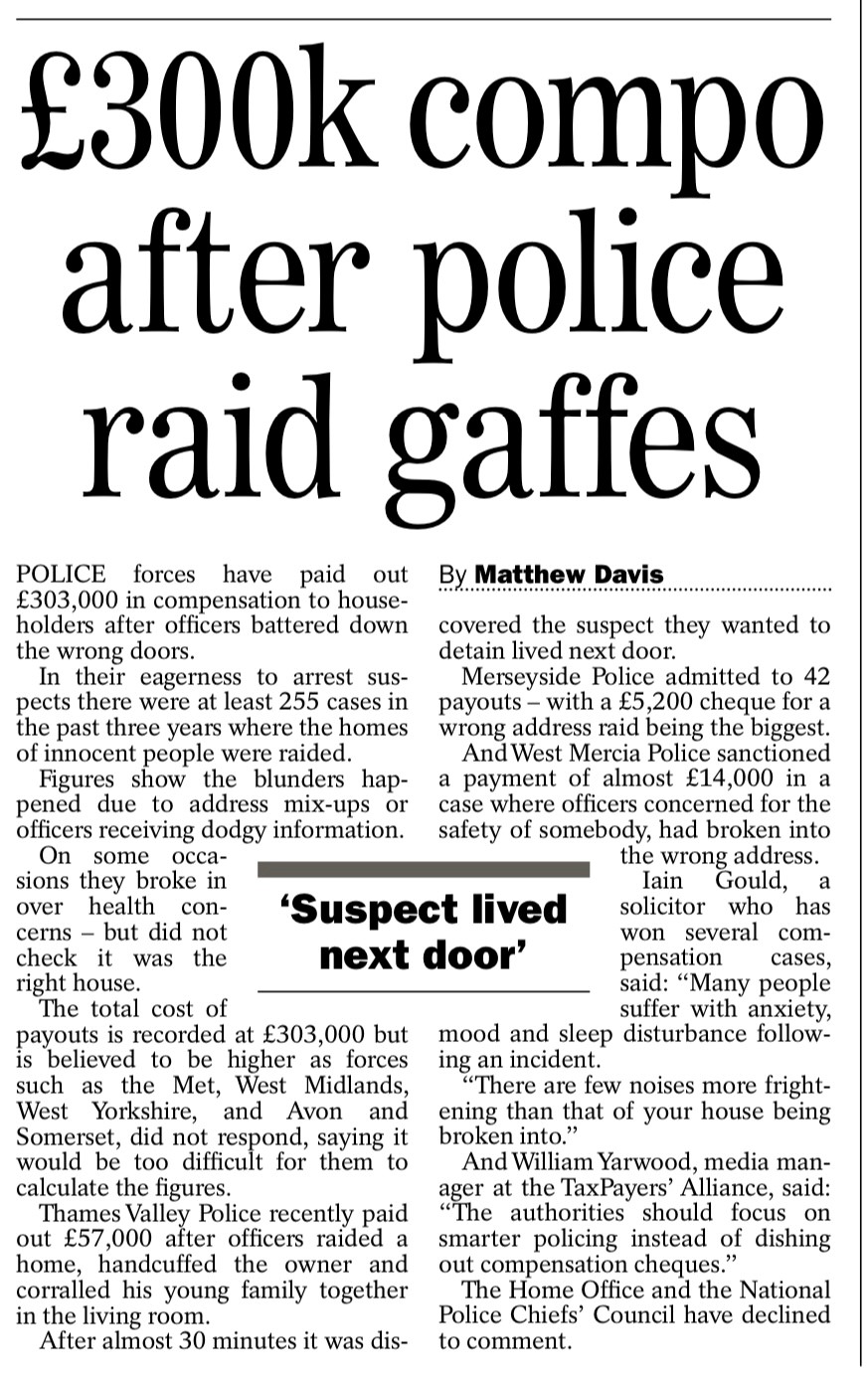



You must be logged in to post a comment.