
Stop and Search: How the Police Misuse their Powers (Part 1)

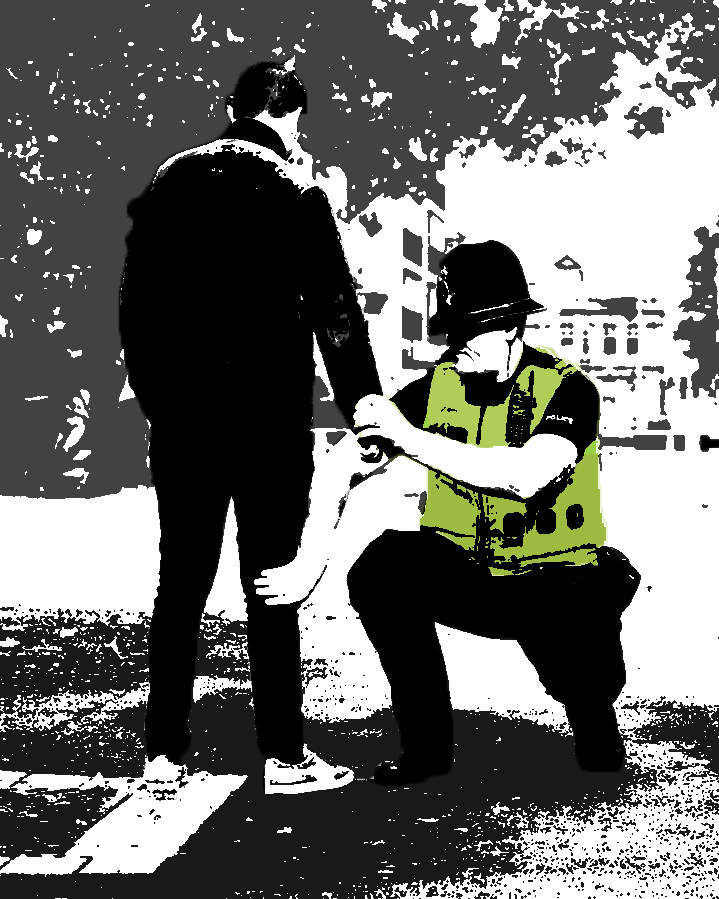
Banksy's Portrait of Basquiat being welcomed by the Metropolitan Police - an (unofficial) collaboration with the new Basquiat show.
Banksy’s Portrait of Basquiat being welcomed by the Metropolitan Police – an (unofficial) collaboration with the new Basquiat show.

In this series of blog posts solicitor Iain Gould considers how the police are misusing their stop and search powers. As a specialist in civil actions against the police Iain represents people who have suffered as a result of the police’s misconduct. Giving examples from his clients’ cases, Mr Gould highlights issues with stop and search for lawmakers and the public alike.

At the recent Conservative Party Conference, the Prime Minister asserted (amid coughs and splutters, falling set design and a prankster brandishing a P45) that since 2014, government action meant that “the number of black people being stopped and searched has fallen by over two thirds”.

Whilst the number of black people being stopped and searched by the police has indeed fallen by two thirds, this is in fact since 2010-11 and not 2014.

Furthermore, the sad fact is that black people are still four times more likely than white people to be stopped.

The Metropolitan Police Commissioner recently went on record to defend the continuing use of stop and search and the Home Secretary later added her support saying that “we have given the police the powers they need and officers who use stop and search appropriately, within reasonable grounds and in a targeted and intelligence led way, will always have my full support.”

So what are these powers?

As is often the case, the powers available to the police to stop and search persons and vehicles are myriad.

Most – but significantly not all – are circumscribed by the requirement that there be reasonable suspicion that something prohibited will be found.  This will usually be under Section 1 of the Police and Criminal Evidence Act 1984 (PACE) – stolen or prohibited articles or certain articles with a blade or sharp point – or Section 23 of the Misuse of Drugs Act – controlled drugs.

Section 2 of PACE provides safeguards which govern the exercise of all but one pre-arrest search power (the only one exempt is Section 27 of the Aviation Security Act) namely that for a search to be lawful the officer must take reasonable steps to provide the following information:

a)His/her name and police station;

b)The object of the proposed search;

c)His/her grounds for the search; and

d)The availability of the search record at any time within the preceding 12 months.

The officer conducting the search is also required to create a search record recording the object of the search, the grounds for making it, date, time and place of conduct, whether anything was found and if so what, and any injury or damage to property which resulted.

The requirements of S.2 are strictly applied; if the officer does not comply, the stop and search will be unlawful.

An unlawful stop and search will almost inevitably give rise to a claim for false imprisonment (ie for the period of time that the individual is detained) and assault and/or battery (in respect of the apprehension and/or application of physical force) which can then lead to an award of compensation.

Here’s an example of a case that I concluded recently against the Metropolitan Police.

My client, Kaleb Godwin and his younger brother Santiago (both black males) were walking along a road in East London.  Santiago was going to a fancy dress party.  He’d borrowed some crutches from Kaleb and was going as a man who’d broken his leg.  As they got to a convenience store, Kaleb went in to get a drink.  As he was doing so, 2 PCSOs who had been following the pair, approached Santiago and began to quiz him as to why he was carrying crutches (given that according to the officers he had no discernible reason as to why he should have them).  Santiago explained that he was going to a party.  Kaleb came out of the store and challenged the officers as to their actions, explaining that the crutches were his and that his brother was going to a party. Kaleb took the crutches from his brother.  He accepts that he was annoyed and that he said, “What?  Is it a crime for a black man to be carrying a pair of crutches?”  The officers said it was suspicious but failed to explain why.

As a side note, it does beg the question why a person carrying crutches should raise more suspicion than a person carrying other items that they have no apparent use for, but I digress.

Kaleb was outraged.  He knew neither he nor his brother were carrying drugs and told the officers to “search the fucking crutches then”.

The PCSOs called for backup and told Kaleb that he was detained pending their arrival.  Kaleb continued to swear repeatedly saying “Search the fucking crutches”. When the officers refused, Kaleb sought to walk off but in response, one of the officers grabbed his arm to which Kaleb replied “Don’t fucking touch me”, and again, “Search the fucking crutches”.

After about 10 minutes or so, 2 police constables arrived, PC Woods and PS Hamilton.  The officers conferred with the PCSOs.  PC Woods was asked to search Kaleb because it was believed that he had drugs secreted on him or inside the crutch notwithstanding, as PC Woods later admitted, that crutches being used to conceal drugs “was a new one for him”.  PC Woods explained to Kaleb that the PCSOs believed he may have drugs on him, provided his details, what station he came from and how Kaleb could have a copy of the search record at the end.

By this stage, a group of people had gathered to watch events.  Both Kaleb and his crutches were searched under S.23 Misuse of Drugs Act and nothing incriminating was found. One of the PCSO’s began to write out a form which Kaleb believed to be a stop and search form which was then handed to him.  On checking however, Kaleb discovered that he’d been handed a fixed Penalty Notice for breaching Section 5 of the Public Order Act.  The officers then left without issuing a stop and search form because (they later asserted) to do so was impractical because of concerns that their continued presence was creating ‘a situation’.

Of course it is blindingly obvious that if the officers were able to issue a Fixed Penalty Notice for minor disorder, surely they were also able to issue a stop form, but they did not.

On review, the following issues were relevant to establishing liability for both false imprisonment and assault/battery.

  1. Under paragraph 2 of Schedule 4 of the Police Reform Act 2002, a PCSO has power to detain a person when they have reason to believe that person has committed a relevant offence and who fails to comply with the requirement to give their name and address.  ‘Reason to believe’ is of course a higher threshold than ‘Reason to suspect’.  In other words, it was not sufficient for the PCSOs to suspect that crutches could contain drugs; they needed information to indicate that Kaleb’s crutches did contain drugs.  Accordingly, there was no legal power for them to detain and physically restrain Kaleb from leaving.
  1. For the search of Kaleb to be lawful, PC Woods had to (as well as complying with Section 2 PACE) establish that he himself had reasonable suspicion that Kaleb was in possession of a controlled drug. Just because the PCSO told him of their suspicions was not good enough.  Accordingly, the search was unlawful.

In all, Kaleb was detained for approximately 15/20 minutes. He suffered no physical injury as such, but certainly did suffer insult to his feelings, being left with a hurtful sense of injustice on the basis of racial bias.

After a lengthy complaint process, I am pleased to confirm that, despite as usual making no formal apology or admission of liability, the Metropolitan Police were clearly persuaded by my argument that Kaleb had been unlawfully detained and assaulted and agreed to pay him £2,200 damages plus legal costs.

As is so often the case, Kaleb remains dissatisfied.  He believes that he and his brother were stopped because they are black. Such an assumption is understandable because there appears no other reason for the stop.

Whether the stop was conducted because of racial discrimination or not, the impression that Kaleb and his brother have is that the PCSOs were motivated by discrimination, whether conscious or unconscious and that they were targeted unfairly.

I leave you with a quote from the Editorial of the Times in April 2017; “Stop and search is an incendiary policing tool if not used with care….in practical terms the damage such apparent unfairness inflicts on community relations can eclipse any improvement in public safety”.

All names changed.

Use This Form to Contact Me:

By clicking “Contact Me” below, you consent to your personal information being collected, used, and disclosed in accordance with the privacy policy.

Taking British Transport Police to Task

Screenshot

Cases which go to Trial are by definition the most difficult to win; those in which your opponent thinks he has the best chance of success, refuses an out of Court settlement, and throws all of his resources – massive resources in the case of a Police Force of course – into defeating the Claimant; a real David and Goliath conflict.  For those cases to be pursued to a successful conclusion, it is essential for my clients and myself as their lawyer to have the courage and belief to see the fight through until the end, no matter what is thrown at us by the Police in every attempt to frustrate the course of justice.

My most recent victory was especially satisfying as my client had suffered so much as a result of Police abuse/ misuse of their powers, and had shown tremendous courage not to run away and hide but pursue the case even as far as the often traumatic experience of having to re- live events in front of a Jury whilst being subject to hostile cross- examination from a Police barrister.

In the case in question, my client, Hayley Cunningham (details used with permission) and her husband, both hard- working teachers, had in May 2012 an opportunity for a rare night out together to celebrate her birthday, with grandparents looking after the kids. After enjoying a meal, during which time Hayley had only four glasses of alcohol, they commenced their journey home by underground train. Unfortunately, on reaching the platform they were advised by a station employee that they had missed the last train, and would have to catch a cab instead; my client and her husband were unfamiliar with the train station.  Hayley’s husband opened the nearest exit door.

The staircase in which my client and her husband found themselves was steep and poorly lit; they had to ascend over 160 steps to reach the main station concourse at ground level. Unexpectedly having to climb 160 steps would be an exhausting task for even the fittest amongst us, let alone Hayley who, naturally tired at the end of an evening out (which had followed a busy ‘end of term’ day in school), also suffered from a form of Lupus and from Raynaud’s disease, conditions which cause her to suffer episodes of joint pain, fatigue, low blood pressure and dizziness. It appears that just such an episode was brought on by the exertion of Hayley’s climb; by the time she neared the top of the stairs she was breathless and dizzy, and had to sit down to rest, her head ‘spinning’.  Hayley’s husband continued the short distance up to the concourse, to get help.

Unfortunately, the ‘help’ which Hayley’s husband encountered was in the form of PC T of the British Transport Police. PC T returned with Hayley’s husband to find her short of breath and in obvious distress, sitting down in the stairwell, but rather than approaching her with care and compassion the Officer was immediately aggressive and confrontational, accusing Hayley of being “inebriated”. Refusing to listen to her explanation of the situation, PC T spoke over Hayley in a rude and demeaning way.

Hayley managed to get to her feet and struggle up the remaining steps unaided, but on stepping out onto the brightly lit concourse, felt faint and dizzy once more and had to sit down, her vulnerable condition now being severely aggravated by the fact that PC T was berating her for alleged drunkenness and was trying to chase her out of the station on the grounds that it was closing soon, rather than simply allowing her a few moments to get her breath back. Hayley was understandably appalled by the Officer’s behaviour and spoke up to protest about his attitude – though at no point did she swear or use foul language. She managed to get to her feet again, reproaching PC T for his rudeness and trying to explain about her medical condition, to no avail. In any event, Hayley  and her husband were now making their way towards the station exit, and were only a short distance from the door when, possibly in response to hearing Hayley state that she was going to report him for his unprofessional behaviour, PC T escalated the situation beyond the bounds of common sense by producing a pair of handcuffs and proceeding to chain my helpless client’s hands together announcing to his colleague “She’s winding me up now, I’m arresting her.”

Hayley was in a state of total shock, distraught and sobbing. Her husband’s protests were to no avail as PC T and his colleague bundled her into a police car and drove her away, with her wrists in severe discomfort from the tightness of the handcuffs, which, even had there been justification to arrest her, were totally unnecessary. At no point had Hayley been violent or aggressive. Indeed, when I subsequently reviewed the CCTV footage from the station concourse I was shocked at PC T’s aggression towards Hayley given the massive disparity in their size and strength.  Hayley is a slightly built woman, only 4 foot 11 inches tall, whilst PC T, over 6 feet in height, looms over her, encased in his body armour. His use of any force against her was completely unjustified.

And so too was her arrest – PC T did not even inform Hayley what she was being arrested for, although we now know it was for alleged “drunk and disorderly” behaviour.

Hayley described her feelings at this point as follows –

“By the time I arrived at the Police Station I was shaking. I couldn’t breathe, it was as if I wasn’t in my own body, I just lost it. I was fading in and out of reality”

Hayley now faced the extremely traumatic experience of being processed in a police station as a suspected criminal, subjected to the indignities of a body search and being stripped of her possessions, before being locked, feeling isolated and intimidated in a cold and dirty cell (the toilet roll was floating in the toilet bowl). Her wedding ring and her dress had been taken away from her, and she was forced to wear an ‘all in one’ paper body suit. For a woman of impeccable character, with no previous experience of the criminal justice system, this was all the more traumatic.

Eventually, having been incarcerated all night, Hayley was released from custody the following morning. Prior to her release, the police asked her to accept a “fixed penalty notice” for drunk and disorderly behaviour – which she absolutely refused to do. She knew she had done nothing wrong; but this was the first point at which Hayley ‘s courage and strength of character were put to the test, for she knew that by standing up for what was right – and indeed she was brave enough to do that now, even after the mental torment of being imprisoned in a cell all night in humiliating and degrading conditions – she was exposing herself to a prosecution in the Magistrates Court at which she had every fear PC T would tell lies about her behaviour and try to deceive the Court .

Hayley made this decision to fight for justice, knowing full well that she and her husband would now face many months of litigation leading up to trial and that the trial itself would be a very stressful event likely to put even more pressure on her fragile state of health. She was aware she would not qualify for Legal Aid. She was aware that if she was ultimately convicted this could severely damage her career as a teacher, as the conviction would show up on an enhanced CRB certificate.

In my Hayley’s own words –

“The easy way out would have been to simply accept the notice and pay the fine. However, I was brought up with a strong conviction of what is right and wrong. My arrest was wrong. I was determined to fight”.

A Long Fight for Justice

Some six month after my Hayley’s arrest, her case went to trial at the Magistrates Court. The whole process of preparing for and then attending the trial was incredibly stressful for Hayley and there were times when she felt understandably overwhelmed and physically sick.

She felt as though her personality had been altered as a result of this incident; she found herself to be much more anxious at home and in work, and vulnerable to panic attacks, when previously she had always prided herself on being a strong and confident person. She had to take time away from work, and felt that she was letting down her colleagues and pupils as a result. Nevertheless, she fought on.

It became clear that PC T was going to maintain the lies he had told about Hayley, and was going to claim that she was drunk and had sworn at him, all of which she denied.

On the day of the trial itself, Hayley’s resolve was tested once again when the CPS prosecutor offered to discontinue the proceedings if she accepted a “bind over” (to be of good behaviour or to keep the peace). If she accepted, she was advised that no conviction would be recorded. Her own Barrister, who in fairness had only been instructed the night before disappointingly seemed to lack conviction in her case, and recommended that Hayley accept. She refused, knowing she had done nothing wrong and determined that PC T should not get away with what he had done. The trial went ahead and I will let Hayley tell you the result in her own words-

“After evidence, the Magistrates retired before returning to declare that I was not guilty.  I was so relieved.  I was tearful and emotional”.

But this was just the beginning of her fight for justice. Hayley had not given up, she hadn’t taken the ‘easy’ options – even when alone and vulnerable in the police station, even when advised by her barrister to take the ‘bind over’ – and she had cleared her name. But she knew she was still entitled to restitution, and she could have no proper sense of justice until she had held PC T to account for his actions. It was time for her to turn the tables and put him on trial.

The next step Hayley took, therefore, was to lodge a formal complaint with the British Transport Police about PC T’s behaviour. She was visited by an officer from the Professional Standards Department and gave a full statement about what had happened. The officer took this away, and an investigation was commenced; 6 months later, to Hayley’s total dismay, she received a 14 page report from the Police rejecting her complaint and totally exonerating PC T.

This was very much a case of hurtful insult being added to a deeply felt injury. Hayley was at this time still struggling to come to terms with the enormity of what had happened to her – locked in a police cell and dragged to court to face charges that could have wrecked her professional career – and already felt that she was no longer the person she had been before this incident. In her own words-

“I did not feel like me anymore, that somehow I had been stolen”.

Hayley’s sense of self worth, her pride and confidence, her relationship with her husband, children and friends were all affected by this shadow hanging over her. Although she had been found not guilty at trial, she couldn’t stop thinking about the injustice of what PC T had so casually and arrogantly done to her, and now – with the dismissal of her complaint by the PSD – it felt as though he had ‘won’ again, and all the bad feelings came back. Hayley continued to feel degraded as a person, and now almost gave up – burying her head in the sand and trying to forget about what had happened. This did not ultimately make her feel any better however; she was just bottling up these very hurtful feelings.

Hayley had in fact already contacted me about bringing a claim, but when the PSD report arrived, she was so demoralised that she almost gave up on the case, failing to answer my letters or telephone calls.

For many months I had no contact from her, but I did eventually resume contact and persuaded her to continue.

Notwithstanding the complaint findings, I knew from the papers I had seen that Hayley had a good case, and furthermore, I knew that she was an honest and truthful person who had suffered badly as a result of Police misconduct and deserved to see justice done. I also knew what she did not, from years of long experience, that Police internal complaint investigations are almost invariably biased in favour of the Officer being complained about and their raison d’etre is not a full and frank, impartial investigation into the facts – but an exercise in looking for excuses to cover up Police wrongdoing and let the guilty Officer off the hook.

For that reason, unlike my client, I knew the complaint report probably wasn’t worth the paper it was written on, and the fact that her complaint was dismissed certainly did not mean a claim in the civil courts, heard by a jury of her peers, would be.

Court proceedings were commenced and I set about obtaining medical evidence in relation to the psychological effects of this incident upon Hayley. When the proceedings were served upon the solicitors acting for the British Transport Police, we received no concession or offer of compromise to settle the case, but rather a bold and challenging letter making it clear that BTP intended to fight the case ‘tooth and nail’ all the way to trial –

“We have no doubt that your client is a highly regarded and respectable member of the community…………  However, on the evening of 25 May 2012 and during the early hours of 26 May 2012 your client had too much to drink whilst celebrating her birthday and acted in an uncharacteristic manner which was not befitting of an individual who does so much for her local community. 

Our client has no offers of compensation to make and liability is strongly denied.  Your client’s arrest was lawful and this matter will be vigorously contested. 

Given the strength of our client’s defence ……………… we will seek to enforce our client’s costs against your client in the event that this claim is continued.  If your client pursues a claim for psychological injury then we will regard this as a fraudulent exaggeration.”

With my encouragement and advice, Hayley was strong enough not to be put off by the Police lawyer’s ‘hard ball’ attitude and persevered despite the numerous besmirchments of her honesty and integrity which the Police threw at her as the case continued.

Whilst we had obtained medical evidence from an expert psychiatrist who confirmed that Hayley had suffered Post Traumatic Stress Disorder, the Police appointed their own psychiatrist who disagreed and did his best to play down the seriousness of her symptoms, arguing that she had only suffered a more minor ‘adjustment disorder’. Hayley felt that the Police psychiatrist had not listened to her properly, and his report contained a high number of factual mistakes, which were never corrected. Nevertheless, she persevered.

The solicitors acting for British Transport Police even went to the length of snooping on Hayley’s Facebook pages and putting together a dossier of social media posts – all from several years after the incident in question – in an attempt to ‘discredit’ her. Whilst Hayley and I were deeply disappointed by the Police lawyer’s invasion of her privacy in this manner, neither of us were concerned about what the Police had ‘found’. It was simply a number of posts – all years after the event- relating to Hayley participating in exercise classes. Nothing out of the ordinary at all; just run-of-the-mill (or should that be treadmill?) group fitness classes, which my client had participated in, in order, partly, to help build up her social confidence and mental health after the terrible effects of her arrest, imprisonment and prosecution. The Police were, in my opinion, quite unscrupulously, now trying to use these ‘posts’ to suggest that Hayley’s dizziness at the top of the railway station steps must have been due to drunkenness rather than constitutional/ health reasons – as if her ability to participate in a planned exercise class (‘on the flat’ in a gymnasium) years later had any relevance to how she was after climbing 160 stairs years before! It was palbable nonsense – but showed the lengths the Police were prepared to go to in order to frustrate Hayley ’s claim, and demoralise her.

But they failed entirely in that attempt; Hayley was not demoralised, but rather further energised by their unscrupulous antics, to fight on for justice. Indeed, I was then able to get the ‘social media’ evidence thrown out at a pre- trial hearing by the Judge, who quite rightly rejected it as irrelevant to the case. Still, the Police did not back down, but neither did Hayley, who after all she had been put through, including now almost 2 years of litigation in the civil courts was more determined than ever to hold the Police to account – and that meant not only PC T, but the whole organisation of the British Transport Police who seemed so determined to shield their Officer and to continue to try to oppress and humiliate Hayley, despite the clear evidence, in my opinion, that she was in the right. As we prepared for trial, Hayley had these words to say –

“I wonder how many people do the police do this to who can’t fight because they’re not strong enough or because of their past.  I feel it is right that I challenge the conduct of PC T on my behalf and for others. My husband and I had committed no crime. We were treated with rudeness and contempt when, if anything, I just needed a few kind words and a moment or two to get myself together. We were on our way out of the station causing no harm to anybody when I was arrested. It was all so unnecessary.”

Putting the Police on Trial

Hayley ‘s claim for compensation against British Transport Police finally went to trial at Liverpool County Court in June 2017. Again, the Police made it clear they had no intention of backing down. Hayley bravely relived the trauma of the experience of her arrest on the stand, and despite being brought to tears by the many unpleasant memories this stirred up, answered the Police barrister’s cross- examination with honesty, integrity and clarity.

Then, after PC T himself had given his evidence, on the fourth day of the trial, we applied for summary Judgment – on the grounds that PC T’s testimony that it was necessary to arrest Hayley “to prevent an offence against public decency” could not, on any reasonable analysis of the evidence, be true. It is not enough for an officer to honestly and reasonably suspect a person to be drunk before arresting her. The person must be behaving in a disorderly manner, not merely ‘drunk’, and furthermore – and crucially – the officer must have an honest and reasonable belief in the necessity to arrest that person, and to deprive them for however long of their liberty, and subject them to imprisonment, as opposed to dealing with the suspected offence by less draconian means.

Here PC T’s case was that Hayley simply had to be arrested to prevent an offence against public decency  – yet he had made no such allegation in his notes at the time of arrest, or when delivering Hayley to the custody sergeant in the police station, nor during the criminal prosecution of her. The first time he had made this assertion was in May 2017 as part of his defence to the claim brought by Hayley.

The criminal law guidelines in Archbold and Halsbury Law both define “offences against public decency” as being grossly scandalous behaviour described as “offending and disgusting”. Even on the Officer’s account of Hayley swearing at him – which she denied – her behaviour could never have amounted to this.

The Judge was persuaded by our arguments on the following key points;

  • That there was no reason for PC T to have suspected Hayley of being drunk – and certainly not of her being ‘disorderly’ – PC T had unreasonably dismissed the explanations given by Hayley and her husband.
  • That Hayley’s arrest was not driven by necessity under the law, or any reasonable apprehension of an offence against ‘public decency’ but rather PC T’s impatience and high- handedness, arising out of his rude, abrupt and dismissive attitude towards Hayley.
  • That any reasonable officer, in PC T’s position, rather than berating Hayley, would simply have allowed her a few minutes grace to exit the closing train station, in view of her clearly being unwell. His act of arresting her, was entirely unreasonable, disproportionate and unnecessary; as epitomised in the fact that he callously handcuffed my helpless client, who had offered no violence whatsoever to him – even on his own account of what occurred.

Accordingly, the Judge granted Hayley Judgment on the 5th day of the trial, bringing the proceedings which had been expected to run to a full 8 days to a conclusion there and then.

In English law, all imprisonment is prima facie unlawful unless and until justified by law. The burden of proof in respect of false imprisonment is therefore on the Police to prove that the totality of the Claimant’s imprisonment from the moment of the arrest to the moment of release was lawful. By cutting the trial short after hearing PC T’s evidence, the Judge found that the Police simply had no prospect of proving that any of Hayley’s imprisonment was lawful.

Hayley’s prime motivation was vindication, not compensation.   Having established liability, British Transport Police now put forward an offer of £25,000 to settle her claim.  Hayley had achieved her goal and rather than trouble the Court any further, decided to accept.

Hayley had won.  She had secured justice; my client knew that after all these years, she had been believed; that the system does work, and that wrongdoing by the Police can be put right. This was what she said to me after the conclusion of the case –

“Thank you so much for believing in me, you’ll never know how much that meant. Without people like you willing to offer support to those who have been wronged, justice would not be possible. The fact you believed in me offered me comfort and gave me the strength to challenge the inappropriate behaviour by people in power, who should be respectful, show integrity and protect. All of which were disregarded in my case causing me 5 years of considerable difficulties and greatly impacted upon my mental health. This not only affected me but also my family. You have now given me the opportunity to put this behind me and continue with my life from where it had stopped 5 years ago. I will always be forever grateful and long may you continue to ensure justice prevails for others who face similar challenges.”

But what I want to say to her is this: it is your self- belief, despite everything the Police threw at you, and all the disappointments and frustrations you suffered, and your bravery at facing up to the lies told by PC T not once but twice in both the Magistrates and then County Court proceedings that was ultimately the key to victory.

A Wake Up Call About Police Sexual Abuse

By Iain Gould, solicitor and specialist in civil actions against the police

I was saddened, but not surprised, by the conclusions reached this week by the Police ‘Watchdog’, Her Majesty’s Inspectorate of Constabulary and Fire and Rescue Services (HMICFRS) that more than half of the Police Forces in England and Wales have failed to implement plans to stop Police personnel abusing their positions for a sexual purpose.

This is a matter of grave concern to us all. As the introduction to the report states –

Police officers and police staff hold a privileged position within our society; they can use a range of coercive powers and under certain circumstances they are allowed access to people’s homes, businesses and personal information. Often members of the public are at their most vulnerable when they come into contact with the police. It is therefore imperative that all police officers and police staff act with the utmost integrity at all times and do not seek to take any personal advantage from the position they hold.

No one wants to believe that police officers and staff – whose primary function is to help the most vulnerable people in our society – would ever be involved in taking advantage of people in such a way. Nonetheless, such cases do occur, and when they do they can have a devastating effect on the lives of individual victims and corrode the trust and confidence both they and the wider public have in the police. Police forces must therefore work tirelessly to prevent and seek out this form of serious corruption and to pursue the perpetrators.

The National Police Chiefs’ Council (NPCC) has recognised the very serious nature of this type of misconduct and has defined the abuse of position for a sexual purpose as-

Any behaviour by a police officer or police staff member, whether on or off duty, that takes advantage of their position as a member of the police service to misuse their position, authority or powers in order to pursue a sexual or improper emotional relationship with any member of the public. This includes: committing a sexual act, initiating sexual contact with, or responding to any perceived sexually motivated behaviour from another person; entering into any communication that could be perceived as sexually motivated or lewd; or for any other sexual purpose.

Police Officers in the course of their duty are invested with a special trust – given a position of power and authority over members of the public, and access to the personal lives of members of the public when they are at their most emotionally vulnerable, in the aftermath of crimes of violence and abuse. Those Officers must therefore be held to the highest standards of behaviour. It is sickening that some Officers will not only fail to behave with propriety and respect towards victims of crime, but will go on to exploit them by turning a professional relationship into a sexual one. Of course, the vast majority of those cases involve male officers exploiting female victims of domestic abuse and sexual crime. HMIC statistics for the 2 years to March 2016 showed 436 reported allegations of abuse of authority for sexual gain against Police staff, 40% of the allegations involving victims of crime.

I can put a personal face on those statistics, having blogged previously about the cases of my clients “Kate” and “Clare” (and also here) who were the victims of Police officers from the Merseyside Police and West Mercia Constabulary respectively, who sought to use their positions as Officers investigating crimes committed against these young women, to initiate sexual relationships with them. Modern technologies such as personal mobile phones, text messages and social media, give these predatory Officers even more opportunity to harass and exploit their victims. It is unconscionable that Officers who have access to intimate knowledge about what domestic and sexual abuse victims have suffered then use their privileged position as the authority figure handling the case – their position in effect as ‘Protector’ of the victim to groom, seduce, assault and harass these women, thinking only of their own sexual gratification and not at all of the emotional and psychiatric harm they are causing to the woman who first came to the Police as the victim of a criminal or witness to criminal behaviour, and who now the Police are victimising in turn. This is a clear example of one of the worst types of ‘serial exploitation’ of vulnerable young women; almost as if the Police officers involved are collaborating with the original abuser, whose actions left this person at their mercy.

Of course, what compounds this problem – the bigger picture- is the failure of Police Forces to root out and stop these rogue Officers, and this issue is what HMIC’s most recent report is highlighting. Shockingly, despite well meaning statements such as that of the NPCC quoted above, fewer than half of those 436 allegations of sexual abuse perpetrated by Police staff, identified in 2016, were referred to the IPCC, suggesting that Forces were simply failing to appreciate the seriousness of this type of Police misconduct and might very well have a culture of toleration leading to abusers ‘hiding behind the Uniform’ effectively being allowed to ‘get away with it’.

These statistics clearly caused concern to HMIC who in earlier reports of 2014 and 2016 on the subject of abuse of position for a sexual purpose made the following very troubling conclusions –

  • Approximately 1 in 5 Forces were still failing to develop sufficient integrity and anti-corruption related intelligence gathering methods
  • More than half of Police Forces did not regularly monitor their IT systems for evidence of misuse
  • Almost 1 in 3 Forces did not have sufficiently well – resourced Counter Corruption Units (CCUs)
  • Many Forces needed to improve their ability to proactively seek out intelligence, rather than waiting to react to reports, so that they could intervene early to safeguard potential victims
  • Of equal concern to the problem of Forces not having the capacity/ capability to identify abuse of position, was a culture in some Forces of failing to recognise abuse of position for a sexual purpose as a serious form of corruption (indeed, in my opinion, failing to properly act when such crimes are discovered or suspected is surely more reprehensible even than failing to discover them in the first place). If such cases of sexual abuse were not routinely being referred to the IPCC then this spoke volumes about the lack of weight, or indeed even toleration, that some in the Policing community might be placing upon it. HMIC, in tandem with the NPCC and the College of Policing, called for changes to the IPCC’s mandatory referral criteria to include all cases of abuse of position for a sexual purpose.

Following on from these reports, the NPCC set out four main principles that they expect Forces to adopt as a strategy to deal with this problem –

  • Prevention – this covers vetting Officers, professional boundaries training, and guidance for supervisors;
  • Intelligence – this covers intelligence gathering, relationships with other agencies that support vulnerable victims, IT monitoring and audit, development of intelligence and the identification of intelligence gaps;
  • Enforcement – this covers recording cases as serious corruption, oversight of the force’s CCU, referrals to the IPCC, use of an investigative checklist, victim support and access to suitably trained specialist staff;
  • Engagement – this covers working with support agencies, internal and external communication strategies, raising awareness and learning organisational lessons from previous cases.

These are highly laudable principles – but are they now being followed in practice? That is the question which the most recent HMIC report is addressing, and the depressing conclusion is ‘not anything like enough…’

A culture of Police – if not toleration, then ‘oversight’- of this type of abuse and corruption by Officers appears to remain widespread.

26 (more than half) of the Police Forces of England and Wales have failed to fully act to develop plans to prevent this abuse. Whilst 15 Forces stated that they had come up with plans, but not actually implemented them (yet), 11 simply didn’t even respond properly to HMCI’s questions on this subject, demonstrating , in my opinion, a heinous disregard of such a serious problem.

Indeed, only 2 Forces (Derbyshire and Merseyside) were found to have all sufficient elements of a protection/ prevention plan in place and active practice.

Highlighting the seriousness of this problem HMI Mike Cunningham said –

When Police officers and staff abuse their position for a sexual purpose it has a devastating effect on the lives of victims and corrodes trust and confidence in the police.

It is of great importance that forces are prepared to seek intelligence on this type of corruption and when they find it deal with it vigorously and decisively.

The importance of public trust in the police cannot be understated, and forces need to do everything they can to ensure this trust isn’t eroded.

[quoted in Police Oracle 5/10/17]

Again, the work I do on a day to day basis brings me into regular contact with the real victims and real suffering behind the statistics and pious sentiments expressed by HMIC in their reports.

I currently represent two women who have been the victim of the same sexually predatory Police Officer, DC McMillian of Merseyside Police’s Family Crime Investigation Unit, who was subsequently dismissed from the Force for gross misconduct and convicted of Misconduct in Public Office, receiving a custodial sentence of 4 years.

My client ‘Josie’ turned to the Police for help in 2011 after being assaulted by her then partner, who strangled and hit her in the face.

Josie attended Southport Police Station in June 2011 and provided a statement to a female Police Officer. Her injuries were documented and photographed.

Several weeks later, Josie was contacted by DC Michael McMillan.  DC McMillan advised that her partner had been arrested and bailed.  It was suggested that Josie needed to respond to counter allegations made by her partner and in the circumstances, arrangements were made for her to re-attend Southport Police Station.

On attendance, my client was met by DC McMillan and taken into a side room where she was interviewed.

Several weeks later and in the early hours of the morning, Josie received a text from DC McMillan enquiring as to her general wellbeing.

Thereafter, Josie began to receive multiple texts from DC McMillan, who also became her ‘Facebook Friend’ and communicated with her further by the Messenger facility of Facebook and Whatsapp.

Over time, the communications from DC McMillan became of a sexual nature and content;  suggesting that Josie had deliberately worn provocative clothing for the meeting at the Police station; requesting photographs of her breasts.

Merseyside Police subsequently established that DC McMillan had sent over 50 text messages to Josie between September 2012 – February 2014.

Dc McMillan’s behaviour towards Josie was totally inappropriate and clearly exploitative, trying to take advantage of my client when her life was already difficult enough with ongoing issues including her violent ex- partner, her children and a court case involving her mother.

Sadly, Josie was not the only victim of crime who then became a victim of DC McMillan’s predatory behaviour.

Merseyside Police discovered the Officer’s wrongdoing in June 2014 when they were alerted by Cheshire Social Services to the case of a 17 year old girl who had gone missing, and whose phone was discovered to contain numerous messages from DC McMillan, who was apparently trying to get her to meet him for sex.

Subsequently Merseyside Police Anti- Corruption Unit (ACU) confiscated DC McMillan’s personal mobile phone and discovered a vast amount of data relating to his contact by text message and social media with many women, many of whom he had induced to send him pictures of themselves in states of undress and some of whom – just like Josie – he had specifically come into contact with in his role as Officer in Charge of their domestic violence cases.

I am also acting for another of these women, who had the misfortune to have McMillan assigned as the investigating officer in their case.

My client ‘Lisa’ approached Merseyside Police in 2012 reporting serious domestic violence at the hands of her partner, the father of her two children, including having been kicked in the stomach by him when she was pregnant.

DC McMillan was assigned to Lisa’s case and visited her repeatedly at her home address, ostensibly to take statements from her. He then began to send text messages overtly complementing Lisa on her looks and appearance. At first she felt flattered by this, at a time when otherwise her ‘life was on the floor’ and she felt a complete mess, with violent harassment from her former partner continuing.

McMillan’s text messages then became more blatant, referring to Lisa’s breasts and making sexual suggestions. He continued to visit her house, claiming that the CPS required further information before they could decide whether to charge her ex- partner. On one of these occasions he asked Lisa to kiss him, which she refused. Thereafter, he continued to pester her with requests for naked photographs or videos of herself, which again she refused, now in a state of considerable distress and confusion about the Officer’s behaviour.

Throughout all of this time, nothing was being done to prevent Lisa’s ex- partner from continuing to harass and threaten herself and her children. Lisa also discovered that DC McMillan was married and had children of her own, which made her feel even worse about being the victim of his predatory behaviour. Eventually, Lisa attempted to commit suicide, a terrible event to which McMillan had been utterly, callously indifferent as he exploited such a vulnerable woman for his own gratification.

To add insult to injury, Lisa later found out through Merseyside Police that there was no trace of all of the statements which McMillan had taken from her. He had been using the investigation as a cover for contacting her for his own ends, and at the same time was letting Lisa’s ex- partner get away with the crimes which he had committed against her. What a terrible situation when a woman tries to escape from one abuser only to find herself in the hands of another, this time wearing a friendly smile and a Police uniform.

I am currently bringing claims on behalf of both Josie and Lisa against Merseyside Police for Harassment and Misfeasance in Public Office, and I anticipate that they will both be awarded substantial damages, but both I am sure would simply rather these events had never taken place. Compensation can go some way to setting wrongs right after the event, but I call upon all of the Police Forces of England and Wales to ‘wake up’ to the very real and serious problem of predators like DC McMillan using their position of trust as Police Officers to exploit and injure vulnerable women, and to act immediately upon the recommendations of HMIC and the NPCC.

DC McMillan is clearly not a ‘one off’ case, yet the historical and indeed current conduct of our Police Forces in general, as highlighted in the current report, appears to be to not to treat the preventing of these sort of offences as a high priority. The Police exist to protect us from criminal behaviour; their first duty to some of the most vulnerable members of society must be to protect them from the criminals in their own ranks.

Update

Althought Merseyside Police denied liability, I am pleased to report that, following the institution of court proceedings, the police agreed a substantial settlement for both Josie and Lisa.

Police Search Warrant – Unlawful Entry Part 3

So far, I have explored circumstances where the Police have obtained a Search Warrant following application to a Magistrate and the Police have then either attended the wrong house (Part 1) or alternatively, have raided the right house but on the basis of faulty intelligence (Part 2).

What about situations where the Police have obtained a Warrant on the basis of up-to-date  and accurate intelligence and then raided the address identified in the Warrant but where they have then failed to execute  the Warrant correctly (and in accordance with Section 16 of PACE)?

Section 16 of PACE states as follows;

(1)    Execution of warrants.

A warrant to enter and search premises may be executed by any constable.

(3)    Entry and search under a warrant must be within three months from the date of its issue.

(3a) If the warrant is an all premises warrant, no premises which are not specified in it may be entered or searched unless a police officer of at least the rank of inspector has in writing authorised them to be entered.

(3b)No premises may be entered or searched for the second or any subsequent time under a warrant which authorises multiple entries unless a police officer of at least the rank of inspector has in writing authorised that entry to those premises

(4)    Entry and search under a warrant must be at a reasonable hour unless it appears to the constable executing it that the purpose of a search may be frustrated on an entry at a reasonable hour.

(5)   Where the occupier of premises which are to be entered and searched is present at the time when a constable seeks to execute a warrant to enter and search them, the constable—

(a)shall identify himself to the occupier and, if not in uniform, shall produce to him documentary evidence that he is a constable;

(b)shall produce the warrant to him; and

(c)shall supply him with a copy of it.

(6)   Where—

(a)the occupier of such premises is not present at the time when a constable seeks to execute such a warrant; but

(b)some other person who appears to the constable to be in charge of the premises is present,

subsection (5) above shall have effect as if any reference to the occupier were a reference to that other person.

(7)   If there is no person who appears to the constable to be in charge of the premises, he shall leave a copy of the warrant in a prominent place on the premises.

(8)   A search under a warrant may only be a search to the extent required for the purpose for which the warrant was issued.

Where the Police have executed a warrant, it is therefore necessary to check very carefully whether there has been compliance with the criteria.  In R v CC of Lancashire ex P Parker  the Court of Appeal decided  that the wording of S15(1) was such, that any non-compliance  would render the whole search unlawful.

In 2007, I successfully concluded a claim on behalf of my client David Khan against West Yorkshire Police.  I helped establish that he had been the victim of an unlawful arrest and assault by police officers employed by the force and he recovered £15,000 in compensation as well as a full apology.

Several years later, David contacted me again. In the early hours of the morning on 6 January 2012, David had been at home preparing  to shower whilst his two children were asleep in bed.  As he closed the bedroom curtains, he saw a bright light from outside shining directly into his bedroom.

David peeped through the curtains and saw what he thought were police officers armed with machine guns approaching the side of his home which is situated in a cul-de-sac.

He started to feel anxious and worried that he was about to be subjected to another wrongful arrest and assault.  He therefore went out onto the hallway and stood at the top of the stairs. From outside David heard a voice shout words to the effect of “Resident of number 24, come outside”.  David  made his way downstairs, unlocked and opened the door.  He could see a number of police officers pointing guns at him but did  not know why they were there.

Given that the police were armed, David did not want there to be any suggestion that he was in possession of a weapon and therefore placed his mobile phone on the floor and then stepped outside and stood in the front yard with his arms held up above his head.

Once outside, David also realised that a police helicopter was above the house.

David could see that there were two armoured police vehicles parked in front of the gates to his driveway and that the road was blockaded in both directions. He could also see that there was an armed officer leaning on the wooden fence of the adjacent premises. There was a third officer stood by the pillar to the gates who was also pointing a firearm towards him.

David was asked if he was ‘Richard Kimble’.  In response David said that he was not and that his name was David Khan and gave his date of birth.

Richard Kimble was his ex partner’s brother.  Richard had never lived at the premises and to the best of David’s knowledge had never used the address for any reason.

The officer asked David who had been looking out of the bedroom window.  David told the officer that it had been himself. The officer repeated his question and he repeated his reply.

The officer  then asked him if there was a child in the house and it then occurred to David  that he was referring to his younger son who was upstairs and who had obviously been awoken by the commotion.  As a result David told the officer that it was his son who was at the bedroom window.

The officer told David  to shout up to his son and tell him to come downstairs.  David did as he was asked and his son made his way downstairs and outside.

David then told the officer that his daughter was also upstairs in bed and he was told to go into the house slowly and call her downstairs.

During this discussion with the officer David noticed that the officer had a photograph of  Richard Kimble and that he appeared to realise David was not the person he was looking for.

David returned  into the house and went upstairs to his daughter’s bedroom. Fortunately, at that time she was asleep and had not witnessed events outside. He woke his daughter.  She was understandably dazed and disorientated and did not realise what was going on.  He told her that the police were outside wanting to speak to him and that they were armed with guns.

David’s daughter  became instantly upset and started to cry. She thought that David would be beaten up by police again as during the incident which led to David’s previous civil claim against the same police force.  David told her that everything would be alright but that she needed to come downstairs with him.  He took his daughter downstairs and both went outside and joined his son.

David was then searched by an armed police officer at the rear of one of the police vehicles  that was parked near his driveway and was then told to make his way towards a police vehicle parked a few metres away and to take his son and daughter with him.

The situation was extremely frightening and embarrassing.  Neighbours who had  become aware of the presence of the police had come outside to see what was going on.  It seemed as though the whole street was outside.

David and his two children sat inside the police van, still in shock and in the dark as to why the police were even at the premises.

There was no police officer in the vehicle with David and the children and the door was kept slightly open. David felt shock, apprehension and concern for his children’s welfare whilst his daughter sat on his lap, crying. They were kept in the van for about 30 minutes.

During this time, firearms officers performed a preliminary search of the house to ensure no one else was in the house and that it was safe for other officers to conduct a full search.

Eventually, the van door opened, David and the children were told they could go back inside if they wished.

By this time, the armoured police vehicles had left the scene, as had most of the police officers.

As they went back into the house, the only police officers remaining were two CID officers in plain clothes.

The officers told David that they would be carrying out a search of the premises.  They explained that they would be starting the search in the children’s bedroom so that the children could go back to bed once the search was finished.

One of the two police officers remained with David and the children in the lounge while the other carried out a search upstairs.

As and when the officer had finished searching the children’s bedrooms, the children were allowed back upstairs and went back to bed. The search lasted for about an hour. At this point, the officer said to David “This is a copy of the search warrant”.

Prior to the officer saying this there had been no mention that the police officers were in possession of a search warrant. Further, no copy of the warrant was shown to David prior to this moment.

The officer produced a document and requested that David sign it to confirm that nothing had been seized by the police.  David signed this document and a copy of the search warrant was then given to him.

The police officers then left the premises.

It transpired that two serious armed robberies had been committed at 02:21 hrs and 04.39 hrs on 4 January 2012.  In each case a gun was used and discharged.  Enquiries showed that the robber had used a particular motor car. At or about 5pm on 5 January 2012 a police officer identified Richard Kimble as a man shown on CCTV getting into that same motor car on 3 January 2012.

Officers applied for and secured  an ‘out of hours’ search warrant to search Mr Kimble’s last known address, namely David’s home address for firearms/ammunition.  This had been falsely given to the police by Richard as his home address when he was stopped in October 2011 and without David’s knowledge or permission.

David was at first concerned that the police raid was some form of ‘pay back’ because he had previously brought a successful civil claim against the force but in truth, the police decision to obtain and execute an armed search warrant was entirely legitimate.

So

  • Police were at the right address as detailed in the warrant.
  • Police intelligence clearly linked the offence to the house (even though David and his children were entirely innocent).

BUT, on close inspection, the police had failed to comply with the terms of Section 16; on David’s account, the officers had entered his home address without producing any search warrant to them and without supplying a copy rendering their entry unlawful since contrary to Section 16(5) of PACE.

It was on this discreet point that West Yorkshire Police subsequently admitted liability and my clients went on to recover substantial compensation for trespass, false imprisonment and assault.

As Parts 1, 2 and 3 show, it is imperative that for the police to establish a lawful entry/search of premises, they must

  • Get the right house.
  • Ensure the intelligence upon which they secured the warrant is up to date and as reasonably accurate as can be, and
  • Comply with the provisions of Section 16 of PACE.

“An Englishman’s Home is his Castle ?”

Reflecting on this case, I am very happy that I was able to secure compensation for David and his family after this highly distressing incident – but also I am conscious that some might think the award of compensation was only due to a ‘technicality’ i.e the family’s entitlement to damages did not arise in this case because of wrongdoing on the part of the West Yorkshire Police but purely because the officers involved failed to give David the search warrant at the start of the process, rather than the end. Had they given it to him at the beginning, the search would have been entirely lawful and no right to compensation would have arisen for David or his children.

Nevertheless, I think it is quite correct that David brought this claim, and it is absolutely right to hold the Police to account to the strictest ‘letter of the law’ when they are claiming entitlement to enter and search a private home, going through all of a family’s personal possessions and  in the process – effectively – holding the family (including children) captives and shattering the sense of peace and security that we are all surely entitled to feel in our homes – particularly children.

I wrote in my last blog on this subject about the importance of the Human Rights Act, enshrining the right to Privacy and Family Life, but of course the concept that a person’s home is their private space and is not to be infringed lightly by the forces of the State is far older than the Human Rights Act or the European Convention on Human Rights – it is one of the fundamental tenets of ‘British Liberty’  long upheld by the Common Law of England & Wales before the HRA was even dreamt of, and summed up by the famous expression “An Englishman’s home is his castle.” That is why it is quite correct that the modern law governing search warrants, as set out in PACE, sets strict guidelines with which the Police must comply before any entry into a private home can be deemed legal. To allow the Police to ‘get away’ with these strict guidelines, such as in this case a failure to produce the warrant for the person whose home was being ‘invaded’ by them, would be to remove an important safeguard  upon the power of Police officers as agents of the State, upsetting the balance between the rights of individuals and the power of government. We must not allow our fundamental liberties to be chipped away in this manner, and if the Police wish to exercise an extraordinary right – to come armed into your family home, and turn it upside down (often both emotionally and physically !), go through your private belongings – well then, they must be held to an extraordinarily high standard of behaviour, including the fair transparency required by the production of the warrant to the homeowner as an absolute condition before a legal search can go ahead.

As a former Prime Minister of this country, William Pitt the Elder, said in 1760 –

“The poorest man may in his cottage bid defiance to all the force of the Crown. It may be frail, its roof may shake, the wind may blow through it. The rain may enter. The storms may enter. But the King of the England may not enter. All his forces dare not cross the threshold of the ruined tenement.”

Long may the law continue to uphold these admirable sentiments, in their modern context, and I am sure Mr Pitt would be the first to cheer the safeguards and protections to all of our ‘cottages and castles’ built into the Police and Criminal Evidence Act.

(All names in this blog have been changed apart from the name of an Eighteenth Century Prime Minster)

Police search warrant, unlawful entry- Part 2

I previously blogged about situations where on the back of intelligence the Police execute a Search Warrant following application to a Magistrates’ Court.

In the last blog I referred to a case where the Police raided the wrong house, but what about situations where they attend the right house but the house is now lived in by a family wholly unconnected with the object of the search?

After months and months of saving up, my clients Anthony  and his partner Jane were able to purchase a 3 bedroom house in Liverpool.  The house was in something of a state and over a 3 month period, they paid for renovations before finally moving in in December 2015 with their 2 children.

Unbeknown to them on the 15 January 2016 a Search Warrant was issued by a  District Judge at Liverpool Magistrates’ Court upon Police application, permitting the entry and search of the said premises for cash, betting slips and mobile phones.

On the morning of the 28 January 2016,  Officers of Merseyside Police set out to execute the Search Warrant.

On this occasion, both Anthony and Jane were in bed at the premises asleep.  Their 2 children then aged 7 years old and 18 months were also asleep in adjoining bedrooms.

At approximately 06.59 hours 6 uniformed Police Officers attended.

Entry was gained to the rear garden by force to prevent any escape from the rear.  Entry to the house was then sought via the front door which was found to be locked.

In the circumstances, a ‘Method of Entry Team’ forced the door open with an Enforcer (basically a battering ram),  called “Breach” and officers then entered the property which they found to be in darkness.

Anthony and Jane were awoken  by the noise and got out of bed.

Such was the unexpected nature of the incident, Anthony and Jane initially believed that they were the target of dangerous criminal offenders.

Following entry, the officers proceeded upstairs and entered into Anthony and Jane’s bedroom where they were both  “secured”.  An officer asked “Where’s Bill Sykes?”   The officers then ordered that Anthony and Jane to dress and proceed downstairs.

Simultaneously, an officer entered the bedroom of their 7 year old son waking him and causing immediate and immense distress to the boy and another Police Officer entered the bedroom of his 18 month old brother, before removing him from his cot, resulting in an outburst of hysteria from the infant.

The whole family were understandably very upset and distressed.

Anthony and Jane proceeded downstairs as directed.  They were given a copy of the Warrant and realised that the officers were searching for the previous occupant of the premises.  Anthony and Jane explained that they had purchased the property from the main suspect’s mother in August 2015 and that they had moved in in December 2015.  Jane then produced documentation to confirm both her own identity and that of Anthony and their ownership of the premises.  After 20 minutes or so, it was apparent that the officers accepted Anthony and Jane’s account.

Despite Anthony and Jane providing the said evidence, the Warrant only being issued for specific evidentiary items and the officers realising  that Anthony and Jane  were the current owners of the premises and therefore  not who they were looking for, Anthony and Jane continued to be detained during which time  they were asked questions regarding their source of income, the nature of their employment and the purchase price of the premises.  Furthermore, checks were carried out on the premises’ utility meters to ensure that they were operating without interference.  To add further insult, one of the officers present  remarked that Anthony and Jane should regard themselves “lucky” that the search of the premises was not accompanied by television crews, a feature of other searches which had taken place that day. In all, Anthony and Jane were detained for approximately 1 hour.

Such was the force with which entry was gained, the front door was damaged beyond repair.  Anthony and Jane were required to purchase a replacement door at a cost of £900, money for which was not readily available and had to be borrowed.  As a result, it was not until 31 March 2016 that the front door was finally replaced.  Further, forced entry caused damage to the interior plaster around the door frame.  Damage was also caused to the back gate and fencing panels.

As a result of the trauma and anxiety which had been caused by the disturbance to the premises, Jane was unable to attend for work that day.  Likewise their 7 year old son had to be kept home from school.

The whole incident took place in front of Anthony and Jane’s neighbours causing further embarrassment particularly as the family had only just moved in to the house.

Subsequently Anthony and Jane discovered that the search at the premises and other addresses that morning was the culmination of a lengthy Police investigation, spanning several months.  Despite careful planning and preparation which might be expected for such an operation (part of which was being ‘televised’), there had been a complete failure to check and confirm current occupancy of the premises.

Begrudgingly, Anthony and Jane were provided with an apology from Merseyside Police.

Due to their outrage at the treatment they had received, Anthony and Jane instituted a formal complaint and contacted myself to pursue a claim on their behalf.

Ordinarily, the victim of such a raid could allege trespass, assault and false imprisonment (as in the case of Mr and Mrs S reported here), but here, the officers had entered and searched the correct address, the address that was identified in the Search Warrant and had executed the Warrant correctly.

In the circumstances, the Police could rely on Section 6 of the Constables Protection Act 1750 and were thereby protected from a lawsuit.  In short, in the absence of any information to suggest that the Warrant was in any way defective or that it had been executed incorrectly, the Police had a complete defence to any proposed claim for trespass and associated wrongdoing notwithstanding the fact that Anthony and Jane were completely innocent.

So if an action for trespass, assault and false imprisonment was bound to fail, how could Anthony and Jane  seek redress?  Following review, I advised Anthony and Jane to bring a claim under the Human Rights Act and specifically a breach of their right to private and family life as protected by Article 8.

Breach of Article 8 of ECHR

Article 8 provides:

Right to respect for private and family life.

  1. Everyone has the right to respect of his private and family life, his home and his correspondence. 
  1. There shall be no interference by a public authority with the exercise to his right except such as in accordance with the law and is necessary in a democratic society in the interests of national security, public safety or the economic wellbeing of the country, for the prevention of disorder or crime, for the protection of health or morals, or for the protection of the rights and freedoms of others. 

Once an interference with rights to private and family life and respect for the home has been proved, the public authority must then prove that the interference was in accordance with the law, in pursuance of a legitimate aim and necessary in a democratic society.

It was clear to me that if proper enquiries had been made and the facts of those enquiries had been properly reported, the Police would have concluded that in early January 2016, there was no reasonable or probable cause  to apply for a Search Warrant.  In other words, the Police had failed to carry out basic steps  to verify the connection between the address and the offence and suspect under investigation.  The resulting Police action which caused Anthony and Jane considerable fear and alarm was wholly unreasonable and disproportionate and sufficient to constitute an interference with Anthony and Jane’s rights under Article 8.

I’m sure that it was on this basis that following investigation Merseyside Police admitted the breach and agreed to pay compensation.

Both Anthony and Jane and their 7 year old son were traumatised by the incident and I was able to arrange for them to see a Psychologist who recommended that they undergo a course of CBT.  Subsequently, I am pleased to report that  settlement terms  have just been agreed with Anthony and Jane receiving total compensation of £17,500. Their son’s case is presently ongoing.

The Importance of the Human Rights Act

This case really brings home the important part which the Human Rights Act plays in the proper functioning of a modern democratic society.  We often hear negative comments about the Human Rights Act from Conservative politicians such as David Cameron  and Michael Gove and newspaper barons such as Paul Dacre of the Daily Mail, who wish to see it repealed on the basis  that it enshrines ‘political correctness gone mad’ and gives too many rights to criminals, suspected terrorists and others (although Mr Dacre’s list of undesirables probably also includes celebrities as he was particularly concerned about the Human Rights Act reinforcing peoples’ rights to privacy against snooping journalists).

However, I am confident that the Human Rights Act in the hands of the fair, balanced and generally conservative British judiciary  is overwhelmingly a positive rather than a negative tool, and this case I have reported above shows how it was absolutely necessary to ensure that a young family received fair and just compensation for the wrong they had suffered.

Stories such as that of Anthony and Jane showing the real benefit and protections to family and private life that are provided by the Human Rights Act are little reported, and indeed are probably deliberately overlooked by the Tabloids when they are whipping up the next round of fury against the legislation and supposed ‘PC – madness’ or ‘compensation culture’.

I would urge us all to be very careful about letting the Government abolish the Human Rights Act and thereby roll back some of the most important protections we have against unjust treatment by the State, or undue interference with our private lives.

After all, where did the European Convention of Human Rights, the founding charter which is implemented in British law by the Human Rights Act come from?  It was drafted in the immediate aftermath of World War II by a leading British lawyer and Conservative MP Sir David Maxwell-Fyle, with the express intention of ensuring the civil liberties necessary to protect effective political democracy against the dangers of fascism and the totalitarianism that were deeply rooted across the continent. These civil liberties arose from the strongest traditions of British liberty in the UK, going back to the Bill of Rights, Magna Carta and all that the English Common Law had done over many centuries to extend those rights.

So the Human Rights Act and the European Convention of Human Rights, and the European Court of Human  Rights (which has nothing, by the way, to do with the European Union) far from being alien to British justice were from their inception part and parcel of it, and remain a linchpin (as this case shows) of the proper functioning  of a just and peaceable civil society.

Don’t let anyone throw your rights away!

Police search warrant, unlawful entry – Part 1

Screenshot

A common sight in today’s media is news and photographs of an organised early morning Police raid on a residential home or series of homes, carried out in accordance with a Magistrates’ Court Warrant.

These stories are released by the Police to proclaim their success in terms of the seizure of drugs, firearms and/or cash and the arrest of key suspects.

What is often not publicised  is where frankly the Police ‘screw up’ in terms of planning or execution of these Search Warrants. Sadly, this happens more often than one might imagine and for all sorts of reasons.

Police get the wrong house!

I have just concluded a claim on behalf of Mark and  Emma Stephens who live at 43 Lake  Road, Liverpool L99 8BS with their 3 young children. (NB All personal details changed.)

On the morning of 2 August 2016, at approximately 06:45 – 07:00, Mark was showering in the upstairs bathroom, prior to leaving the premises to go to work.

Mrs Stephens was asleep in the matrimonial bedroom.

Unexpectedly, Mr Stephens became aware of activity outside, beginning with the noise of his dog barking and thereafter banging noises.

Upon looking outside from the bathroom window, Mr Stephens became aware of the presence of 3 armed Police Officers, who had forcibly entered his rear garden by breaking the back gate.

Mr Stephens called down to the Officers to ask what was going on. They looked up and one Officer pointed a gun directly at him and shouted to him ‘Where’s Cody?’ and instructed him to put his hands up. As he did so, his towel dropped. Mr Stephens tried to reach for his towel whereupon the Officer again shouted, warning him to keep his hands up. Mr Stephens was shocked and frightened. He replied that he did not know anyone by the name of ‘Cody’. He was ordered to go downstairs to the front door. Mrs S was roused from bed by the noise.

As Mr Stephens got to the front door, he  was confronted by 2 Officers one of whom was pointing a gun at him. He was still only wearing only a bath towel, and was again told to keep him hands in the air.

One Officer then said “That’s not him”. It was clear to Mr Stephens that the Officers had attended at the wrong address.

Mr Stephens questioned the Officers as to whether they had identified the correct address. The Officers ignored Mr Stephens and demanded his name which he gave. Mr Stephens was then asked as to who else was in the premises.  Mr Stephens advised that his wife was upstairs.

Mr Stephens was told to dress and to come back and to leave the front door open.

No search warrant or a copy was presented to either Mr or Mrs Stephens.

Mr Stephens returned to the front door and stepped outside. Mr Stephens could see that there was an armoured Police vehicle and several marked Police cars. An Officer who was pointing a gun at Mr Stephens told him to walk towards him slowly and to keep his hands visible. Mr Stephens was bare footed. There were various neighbours looking on. Officers told these neighbours to get inside and stay away from windows and doors. Mr Stephens was frightened he might be shot. He was ordered to walk to a Police armoured vehicle and to then get inside which he did.  Mr Stephens was then asked his wife’s name.

Mrs Stephens was then told to come outside. As she did, she saw an Officer pointing a gun at her and she was directed to put her hands in the air and walk towards the armoured vehicle and to get inside.

Both Mr and Mrs Stephens remained under armed guard in the Police vehicle during which time they were led to believe that the premises were being searched. During this process, they were obliged to provide their personal details. Both felt that they were in effect under arrest and were not free to leave.

Following a period of approximately 20/30 minutes detention, Mr and Mrs Stephens were advised that the Police had indeed misidentified their address and that they were able to return inside.

Notwithstanding their gross mistake, none of the Officers present offered an apology for the deeply traumatic events which had taken place. Mr Stephens spoke to an officer about the damaged gate and was told that someone would be sent “to sort it”.

As a matter of good fortune, Mr and Mrs Stephens’ young children had stayed the night with their grandparents. Thoughts ran through their heads as to what would have happened if their children had witnessed these events.

The arrival and presence of the armed Police Officers, the subsequent detention of Mr and Mrs Stephens and the subsequent search of the premises were all witnessed by their immediate neighbours, to their great embarrassment.

Such was the upset and stress which had resulted from the Police raid, Mrs Stephens was unable to attend for work that day.

Later that afternoon, a Detective Sergeant visited Mrs Stephens apologised for the mistake which had taken place and provided a bunch of flowers.

Despite the apology which was made to Mr and Mrs Stephens no explanation was provided, nor was any reassurance given that no repeat of the incident would occur in the future.

The incident was subsequently reported in the Liverpool Echo but there was no indication in the press coverage that the Police had attended the wrong address.

The claim

Having taken instructions, I was of the view that Mr and Mrs Stephens had viable claims for assault, false imprisonment and trespass.

Both Mr and Mrs Stephens had been caused to apprehend the immediate infliction of unlawful physical contact (the assault). Both Mr and Mrs Stephens had been unlawfully detained (the false imprisonment). The police officers had entered Mr and Mrs Stephens’ property without lawful authority (the trespass).

Following investigation, Merseyside Police admitted liability for all 3 heads of claim.  It transpired that the Police had secured a Warrant for 43 Lake Road, L99 4FU.

Unfortunately, once the Warrant had been obtained, a briefing pack was prepared that by human error now had the Warrant address as 28 Lakes Road, L99 8BS and on the back of this, firearm officers were deployed to the wrong (my client’s) home address.

Both of my clients were understandably traumatised by reason of what had happened and I referred them to a Psychologist who recommended that they undergo a course of CBT. Both clients then underwent a short course of treatment.

I then sought to negotiate settlement and following discussions, I am pleased to report that my clients received total damages from Merseyside Police of £21,000.00.

My clients were extremely distressed by the intrusion and disruption which this incident caused to their lives, particularly the embarrassment of having the event play out in full view of their neighbours.  But I think they were also conscious of how much worse it could have been were it not for the fact that Mr Stephens was already awake, despite the early hour, and was able to interact with the officers prior to them taking their next step – which presumably (given the threat the officers obviously imagined they might face from the occupant of the house) would have been to kick the door down and burst upstairs with weapons drawn. I am sure we can all imagine the shock of being woken in our bed by armed men shouting instructions and the risk of how the wrong reaction could result in fatal consequences.  An error no matter how small, by the police which results in an armed raid on your family, is not one to be shrugged off or forgotten lightly.

All names changed.

How the Police Can Further Reduce Unlawful Arrests

Recent Government statistics confirm the continuing decline in the number of arrests carried out by Police in England and Wales.  In the year ending March 2015, there were 950,000 arrests carried out by Police, a fall of 7% on the previous year and continuing the downward trend since a peak of 1.5 million arrests in year ending 2007. 

What is the explanation for this decline? Some would argue that the drop off is attributable to the fact that less crime is being committed generally.  Others, like Hampshire Police Federation Chairman John Apter put the drop off down to the reduction in serving Police Officers; “The reduction of numbers clearly shows the consequences of losing so many officers”.  

An alternative explanation is a gradual change in Police culture away from arrest now, investigate later to actively considering alternatives to arrests and in particular, to investigate by way of voluntary interview.  Such alternatives to arrest both spares the suspect the ordeal and distress of incarceration (for example, householders who use reasonable force in self defence against burglars and teachers/school staff facing allegations connected with their employment) and the Police the expense of keeping that individual in Custody (of particular interest in these lean days of austerity) and is of course particularly appropriate when dealing with low level criminality. 

This shift in culture away from seeing the sheer number of arrests made as a sign of success (for example see the Evening Standard’s report “Make more arrests or face punishment Police Officers told” has been encouraged by changes to Code G of PACE (implemented by the Police and Criminal Evidence Act 1984 (Codes of Practice) (Revision of Codes C, G and H) Order 2012 (SI 2012 No. 1798) implemented in November 2012. 

Code G contains the following provisions under the section headed ‘Introduction’ 

1.2       The exercise of the power of arrest represents an obvious and significant interference with the Right to Liberty and Security under Article 5 of the European Convention on Human Rights set out in the Human Rights Act 1998. 

1.3       The use of power must be fully justified and officers exercising the power should consider if the necessary objectives can be met by other, less intrusive means.  Absence of justification for exercising the power of arrest may lead to challenges should the case proceed to court.  It could also lead to civil claims against police for unlawful arrest and false imprisonment. When the power of arrest is exercised it is essential that it is exercised in a non-discriminatory and proportionate manner which is compatible with the Right to Liberty under Article 5. 

Then the section headed ‘Elements of Arrest under Section 24 PACE’ at paragraph 2.1: 

2.1       A lawful arrest requires two elements: 

A person’s involvement or suspected involvement or attempted involvement in the commission of a criminal offence; 

AND 

Reasonable grounds for believing that the person’s arrest is necessary. 

·         Both elements must be satisfied, and

·         It can never be necessary to arrest a person unless there are reasonable grounds to suspect them of committing an offence. 

2.2       The arrested person must be informed that they have been arrested, even if this fact is obvious, and of the relevant circumstances of the arrest in relation to both the above elements.  The custody officer must be informed of these matters on arrival at the police station…

 Necessity criteria 

2.4       The power of arrest is only exercisable if the constable has reasonable grounds for believing that it is necessary to arrest the person.  The statutory criteria for what may constitute necessity are set out in paragraph 2.9 and it remains an operational decision at the discretion of the constable to decide: 

·                     Which one or more of the necessity criteria (if any) applies to the individual; and

·                     If any of the criteria do apply, whether to arrest, grant street bail after arrest, report for summons or for charging by post, issue a penalty notice or take any other action that is open to the officer…

 2.8       In considering the individual circumstances, the constable must take into account the situation of the victim, the nature of the offence, the circumstances of the suspect and the needs of the investigative process. 

2.9       When it is practicable to tell a person why their arrest is necessary, the constable should outline the facts, information and other circumstances which provide the grounds for believing that their arrest is necessary and which the officer considers satisfy one or more of the statutory criteria in sub-paragraphs (a) to (f), namely: 

(a)    To enable the name of the person in question to be ascertained …. 

(b)   Correspondingly as regards the person’s address …. 

(c)    To prevent the person in question: 

(i)                 Causing physical injury to himself or any other persons…

(ii)               Suffering physical injury ……

(iii)             Causing loss or damage to property ……….

(iv)             Committing an offence against public decency ……..

(v)               Causing an unlawful obstruction of the highway ……… 

(d)   To protect a child or other vulnerable person from the person in question ……. 

(e)    To allow the prompt and effective investigation of the offence or of the conduct of the person in question.

This may arise when it is thought likely that unless the person is arrested and then either taken in custody to the police station or granted ‘street bail’ to attend the station later, further action considered necessary to properly investigate their involvement in the offence would be frustrated, unreasonably delayed or otherwise hindered and therefore be impracticable.  Examples of such actions include:

 (i)                 Interviewing the suspect on occasions when the person’s voluntary attendance is not considered to be a practicable alternative to arrest, because for example: 

·      It is thought unlikely that the person would attend the police station voluntarily to be interviewed.

·      It is necessary to interview the suspect about the outcome of other investigative action for which their arrest is necessary, see (ii) to (v) below

·      Arrest would enable the special warning to be given in accordance with Code C paragraphs 10.10 and 10.11 when the suspect is found:

Ø  In possession of incriminating objects, or at a place where such objects are found;

Ø  At or near the scene of the crime at or about the time it was committed.

·      The person has made false statements and/or presented false evidence;

·      It is thought likely that the person:

Ø  May steal or destroy evidence;

Ø  May collude or make contact with, co-suspects or

Ø  May intimidate or threaten or make contact with, witnesses. 

(ii)               When considering arrest in connection with the investigation of an indictable offence (see Note 6), there is a need: 

·      To enter and search without a search warrant any premises occupied or controlled by the arrested person or where the person was when arrested or immediate before arrest;

·      To prevent the arrested person from having contact with others;

·      To detain the arrested person for more than 24 hours before charge.

 (iii)             When considering arrest in connection with any recordable offence and it is necessary to secure or preserve evidence of that offence by taking fingerprints, footwear impressions or samples from the suspect for evidential comparison or matching with other material relating to that offence, for example, from the crime scene.

 (iv)             When considering arrest in connection with any offence and it is necessary to search, examine or photograph the person to obtain evidence.

 (v)               When considering arrest in connection with an offence to which the statutory Class A drug testing requirements …….. apply, to enable testing when it is thought that drug misuse might have caused or contributed to the offence.

 (f)    To prevent any prosecution for the offence from being hindered by the disappearance of the person in question.


By way of illustration of the importance of considering alternatives to arrest, and how a failure to use a reasonable alternative can render an arrest unlawful, let me set out the facts of a case I have recently settled.

 Jack Godwin was a 75 year old retired gentleman of exemplary character.  He lives in a bungalow in rural Suffolk and had done so for the previous 8 years.

 At the rear of Mr Godwin’s property is an area of land belonging to the District Council in which pine trees grow.

 Throughout the period that Jack had lived at his address, he had experienced difficulties with the trees at the rear of his property, specifically the mass shedding of needles, which collected in and around his garden and caused associated problems such as blockage of drains.  Mr Godwin was of the opinion that the mass shedding was attributable to ivy that was allowed to grow on the trees.

 Jack made a number of complaints spanning several years to the District Council, as regards the problems he was experiencing with the trees, but on each occasion the Council failed to act upon his complaints.

 On or around 1 April 2015, Mr Godwin received an unsolicited visit from a local “odd job man” offering his services.

 Jack agreed to pay for the man to carry out some work at the rear of his address specifically requesting that the male cut and trim the ivy off the Pine Trees.

 Mr Godwin made it extremely clear to the man that no work should go beyond the cutting of the ivy, so as to protect the integrity of the trees.

 Unbeknown to Mr Godwin, the District Council received information as regards the maintenance work on the trees. 

 On or about the 17 May 2015, Jack was visited at home by a PCSO who was making enquiries as to the work on the trees.

 Mr Godwin openly accepted that he had paid for work to be carried out on the trees.

 On the morning of the 10 June 2015, 2 Police Officers attended Mr Godwin’s address and arrested him on suspicion of criminal damage.

 As a result of the arrest, a search under Section 32 of the Police and Criminal Evidence Act 1984 was carried out and a number of items received/seized including Mr Godwin’s laptop, mobile phones and chainsaw.

 Jack, who was still in his pyjamas, was allowed to change his clothes and was then transported to and detained at Bury St Edmunds Police Station.

 The circumstances of arrest were recorded in the Custody Record as “Detained Person is alleged to have cut some trees down at the rear of his address between 1 April and 8 May 2015, which belong to the District Council”.

 The reason to arrest was said to be “To allow the prompt and effective investigation of the offence or of the conduct of the detained person”.

 The reason for detention was said to be “to obtain evidence by questioning”.

 The grounds for detention were on the basis that there was “insufficient evidence to charge.  Detention necessary to obtain evidence by way of questioning and then to decide on the best means of disposal”.

 Mr Godwin was searched and subjected to a risk assessment and he was then obliged to provide his fingerprints and DNA sample.  Jack was then taken to a cell.  He was aware of a camera on the ceiling of the cell and a slot in the cell door but no window.  Mr Godwin was particularly upset at being treated like a common criminal. The stress exacerbated his asthma which was aggravated further because the Police refused to allow him to have the inhaler in his cell and having to ring the bell when he needed it to use it.

 Mr Godwin was subsequently interviewed under caution, whereupon he denied any responsibility for criminal damage. At the conclusion of the interview, the interviewing officer advised Mr Godwin that the interview was “simply to gain an account from yourself as to what happened”. 

 As a result of an evidential review, a decision that no further action would result was eventually reached and after 8 hours, Mr Godwin was released from custody. 

Following his return home, he found he was initially unable to sleep and spent the majority of his time thinking about his arrest and the injustice of what had happened.

 Mr Godwin carried out a search on the internet and having established my credentials instructed me to pursue an action on his behalf.

 Whilst it appeared to me that the Police might be able to establish that the Officers had a reasonable suspicion that an arrestable offence had been committed, I could not for the life of me understand how they could argue that there was any necessity to arrest, as opposed – for example – simply inviting Mr Godwin to attend a voluntary interview at the police station.

 I intimated a claim. True to form, the Police denied liability leaving my client no alternative but to issue Court proceedings.

 Following issue, the Police filed a Defence, again denying liability.

 Notwithstanding this repeated denial, the Police made an offer to settle.  Following negotiations, I settled Mr Godwin’s claim for £10,500.

 So, my own experience, as demonstrated by this case, is that despite the revision of Code G and the statistical evidence of fewer arrests occurring, there still remains ingrained in Police culture a strong tendency to arrest without consideration of other options.  Therefore, it is imperative that Police Officers be trained (or re-trained) to highlight the law as it stands, and perhaps equally important that when mistakes are made, both individual officers and their Force generally learn from their mistakes.  Hopefully, thanks to both less crime being committed generally and increased compliance with Code G (and hence unnecessary arrest being avoided) we will continue to see arrest figures decline in years to come.

All names changed.

Harassed by the Police

Iain Gould solicitor
Iain Gould, solicitor

By Iain Gould, solicitor

According to a joint report just published by Her Majesty’s Inspectorate of Constabulary (HMIC) and Her Majesty’s Crown Prosecution Service Inspectorate (HMCPSI), people who have suffered harassment or stalking are often being let down by the Police and Crown Prosecution Service.

The publication of the report is timely in that I have just settled a claim for a young woman who suffered harassment by a Police Officer whom she had turned to for protection.

In or around April 2011, my client who I will call Kate began working as the personal assistant to the owner of an escort agency.

During the course of her work at the agency, Kate became aware that some of those working for the agency were underage. Further, Kate became aware that the owner of the agency was committing sexual offences against a number of women and girls who worked for him, behaving in a threatening manner towards them and otherwise exploiting them. Kate also discovered that the owner of the agency was involved in forging documents for some of the women and girls who worked for him.

On 6 January 2012,  Kate bravely reported matters to Merseyside Police notwithstanding that she was scared of the owner of the agency and of the potential consequences i.e. the retribution he might take against her.

The information that Kate provided to the police led to an investigation into the owner of the agency. DS David Stubbs of the Merseyside Police Public Protection Unit (“PPU”) was allocated to the investigation.

Thereafter, DS Stubbs visited Kate at home. During the course of this visit, Kate tried to provide DS Stubbs with relevant information but DS Stubbs asked Kate a number of personal questions instead. Kate felt that DS Stubbs was behaving unprofessionally towards her and did not feel as though she was being taken seriously. Kate’s laptop and personal mobile telephone were seized from her, along with a laptop and two mobile telephones that belonged to the owner of the agency. Kate later gave a video recorded interview in relation to the criminal activities of the owner of the agency.

Thereafter, DS Stubbs visited Kate on a number of occasions, made a number of telephone calls to her and sent her numerous text messages from both his work mobile and his personal telephone. In total, DS Stubbs sent 264 texts to Kate including between 14 February 2012 and 29 February 2012, 73 texts without reply. This included, (for example) between 23:23 on 15 February 2012 and 00:37 on 16 February 2012, 15 texts sent by the Officer without reply and at a time when he was actually on annual leave. The manner in which DS Stubbs would communicate with and treat Kate was personal and/or sexual in content and nature.

For example, in or around February 2012, DS Stubbs sent Kate text messages in which he said that he was divorced and had children. DS Stubbs also said that he would like to take his dog for a walk with Kate.

Subsequently, DS Stubbs sent Kate a text message in which he said that he would like to take her to Cornwall and see her in a bikini. DS Stubbs said that he realised that he “should not be doing this” but that he could not help himself.

In or around March 2012, DS Stubbs sent Kate a message at or around 01:00 with words to the effect of:

I shouldn’t be saying this to you but you’re gorgeous, you’re a beautiful person inside and out and should be proud of what you have done.

On another occasion, DS Stubbs sent Kate a text message, saying words to the effect of:

…hope someone is spoiling you rotten like I would be.

Increasingly disturbed by DS Stubb’s conduct, Kate told DC X, another female officer involved in the investigation into the escort agency, that she would prefer not to have any further contact with Stubbs. Thereafter, the contact from DS Stubbs decreased. However, Kate would still receive the occasional text message from DS Stubbs, such as:

Hello trouble, how’s you ;)

The last time DS Stubbs contacted Kate was on or around 20 August 2012.

Due to DS Stubbs’ conduct, throughout the course of the investigation into and prosecution of the owner of the agency, Kate felt as though the police were using her and testing her. In or around January 2013, after having attended court one day, Kate had a conversation with DC X, whilst being given a lift home. Kate informed DC X of DS Stubbs’ conduct towards her. DC X urged Kate to pursue a complaint about DS Stubbs and advised her that someone would be in touch with her. DC X informed Kate that there had been other complaints about DS Stubbs’ conduct.

Kate did subsequently report matters and attended a video interview where she gave a detailed account of DS Stubbs’ conduct towards her. Around the same time, the owner of the agency was convicted of a number of offences. Kate’s initial report to the police had been central to those convictions being obtained.

Following Kate’s video interview, she received no follow-up or information from the police as to what was being done in respect of the information she had provided on DS Stubbs’ conduct. Consequently, Kate once again began to feel used by the police. After repeated enquiries, Kate was eventually informed that the Crown Prosecution Service (“CPS”) had decided that there was insufficient evidence to pursue a criminal case against DS Stubbs but that there would be an internal investigation into DS Stubbs’ conduct instead and that he had been suspended from his duties.

That internal investigation ultimately culminated in a full disciplinary hearing in September 2015. Despite DS Stubbs having used his work mobile telephone to send text messages to Kate, the content of the personal and/or sexual text messages could not be retrieved and so were not available to the disciplinary panel.

The Disciplinary panel found that even though the specific content of the texts could not be proven, they were satisfied that the volume and timing  of the messages was way above what could reasonably be expected from an Officer discharging his professional duty. DS Stubbs could offer no reasonable explanation for this, claiming they were for work purposes but offering no record, rationale or evidence as to what this Police purpose was.

Ultimately, DS Stubbs was dismissed for gross misconduct.

Whilst Kate was pleased with the outcome of the disciplinary proceedings, and comforted by the thought that DS Stubbs would not be able to exploit or harass other vulnerable young women, she was dismayed and deeply disappointed at the extent to which she had been ‘shut out’ of the investigation process, being kept entirely in the dark for long periods of time as to what was going on. For example, between March 2013 – May 2014, for over a year, Kate received no contact from Merseyside Police and when she did finally manage to get through to someone, she was coldly and uncaringly informed that for the purpose of the investigation into DS Stubbs she had been classified as a ‘witness’ not a ‘victim’ and hence had no right to expect to be kept updated, and no business contacting the force.

The Police also used a bureaucratic excuse not to formally record Kate’s initial report about DS Stubbs as a public complaint, further allowing them to keep her shut out of the process and thereby denying her entitlement to receive a formal written response/ apology for what had occurred.

DS Stubbs’ dismissal was reported upon by local and national press.

As part of a BBC 5 Live investigation, Kate was interviewed as to her experiences. Here is her account:

During the disciplinary process Kate contacted me for advice in relation to her situation.

DS Stubbs’ behaviour in my opinion clearly constituted harassment contrary to the Protection from Harassment Act 1997. Section 1 of this statutory tort provides that:

1. A person must not pursue a course of conduct –

a. Which amounts to harassment of another; and

b. Which he knows or ought to know amounts to harassment of the other.

  1. For the purposes of this section, the person whose course of conduct is in question ought to know that it amounts to harassment of another if a reasonable person in possession of the same information, would think the course of conduct amounted to harassment of the other.

‘Harassment’ is not precisely defined in the Act, although it states that references to harassing a person ‘include alarming the person or causing the person distress’.

As well as showing that the behaviour complained of amounts to harassment, a Claimant must show that the Defendant knew or ought to have know that it amounted to harassment. The test of whether the harasser should have perceived his or her conduct in that way is an objective, rather than a subjective one. So, the Claimant need not show that the harasser appreciated the nature of his or her behaviour, but rather that any other reasonable person would have done so.

The Claimant also has to show that there was a ‘course of conduct’. This must involve conduct on at least two occasions.

A civil claim for damages may be brought in relation to conduct that amounts to harassment as defined by the Act. Damages may be awarded for, among other things, anxiety caused by harassment and for any financial losses resulting from it.

By reason of DS Stubbs’ conduct, Kate suffered anxiety, humiliation and distress; specifically DS Stubbs’ conduct towards Kate caused her to feel helpless, frightened, confused, suspicious and paranoid. At times Kate felt that DS Stubbs was questioning her credibility as a witness. DS Stubbs’ suggestive personal comments to her caused Kate to feel dirty, used, humiliated and embarrassed.

As a result Kate lost confidence and began to hate herself. She developed symptoms of severe anxiety and began to have panic attacks. Kate stopped socialising and disliked being in the company of others. She felt nervous and vulnerable, without any guidance or victim support.

Kate even had thoughts of self-harm and began to have involuntary movements at night, which resulted in her causing injury to herself. She suffered sleep disturbance, including waking during the night and vivid dreams and nightmares of acts of deliberate self-harm.

Kate lost trust in others, especially the Police. Contact with male Police Officers would cause Kate to experience severe anxiety, which could develop into panic attacks, and she became reluctant to speak to the Police.

Following DS Stubbs’ dismissal for gross misconduct, Kate began to fear that he would take revenge, which caused her to feel even more anxious and distressed, particularly when alone at night.

In light of DS Stubbs’ conduct, I was satisfied that Kate had a viable claim. I intimated a claim on her behalf against Merseyside Police and issued protective Court proceedings.

Following investigation, Merseyside Police denied liability (as a matter of course?) and yet indicated that this was a claim that they wanted to (quite rightly) settle. Police Forces are very often reluctant to admit liability, even when in reality they know that they are liable for the wrongdoing of their officers.

In November 2015, as part of her legal case for compensation against the Police I referred Kate to a Psychiatrist, who recommended that Kate undergo a course of Cognitive Behavioural Therapy, after which her condition could be further reviewed. Kate went on to have 18 sessions of CBT.

Following further review, it was concluded that Kate had suffered an Anxiety Disorder, which was caused at least, in part, by DS Stubbs’ conduct, which we might rightly call the selfish and callous exploitation of an already vulnerable woman.

At this point, I was able to assess the value of Kate’s claim and Merseyside Police agreed to a Joint Settlement Meeting. After protracted negotiations, Merseyside Police agreed to pay Kate £25,000 compensation plus costs.

The HMIC report, therefore, is welcomed in that it highlights serious cases of Police neglecting the victims of harassment and stalking (whether in person, or increasingly in the ‘digital’ age, on-line) and a culture of, frankly, not treating harassment as a ‘proper’, indeed very threatening and sinister, crime.

What I would also call upon the Police to recognise and tackle as an equal priority is the danger posed to clients such as Kate (and sadly I know from personal experience that her case is far from rare) who are being exploited and harassed by Police Officers themselves, who are abusing the special trust that has been placed in them and seeking, frankly, to take sexual advantage of vulnerable victims of crime. This in itself was highlighted in yet another report published in December 2016 by HMIC reported that abuse of authority for sexual gain was the “most serious” form of corruption facing Police in England and Wales.

One additional factor of concern, highlighted by this case, is the lack of support Kate received from Merseyside Police after making her complaint about DS Stubbs. Whilst her evidence was crucial in helping the force to weed out and remove a rogue, indeed predatory, officer, the Force seemed to have no concern for Kate herself during the long drawn out process. Kate was apparently no longer needed once the Force had her evidence, and the disdain with which they then treated her, apparently failing to recognise her absolutely legitimate interest in the investigation (in which she was the victim and had initiated the complaint) and simply to show her some support and compassion rather than simply ignoring her, added greatly to her emotional anxiety and depression during this very stressful time in her life.

The Force eventually did the right thing in regards to DS Stubbs, but failed to do the right thing by Kate – even to the extent of treating her as an inconvenience or even enemy when she tried to get information about what had happened to her complaint.

Sadly, Kate is not the first victim of crime subsequently subjected to exploitative behaviour by a male Police Officer, and nor do I believe will she be the last; but we can at least hope that in light of the recent reports, Police Forces as institutions will move more swiftly to identify and remove such officers and to treat their victims with proper respect and support.


The Price of Justice

I was pleased to be given the opportunity to speak on Channel 5 last week regarding the case of my client Ivan Martin in the documentary series “Where there’s blame, there’s a claim”.

I think it was understandable that the programme concentrated on the level of damages awarded to Ivan, and the other victims of serious personal injury claims (including the horrific Alton Towers roller coaster crash) who were featured in the episode, as obviously there is widespread interest in the amount of money people can recover in such cases, but I would like to take this opportunity to stress that pounds & pence are far from being the be- all and end- all in these claims, particularly in actions against the police which I handle, as opposed to negligently caused accidents. The victims of police misconduct have very often suffered not as a result of an unintended ‘mistake’ (no matter how catastrophic) but rather quite deliberate conduct – such as the misuse of police powers of arrest or a deliberate assault (in Ivan’s case, being shot in the back with a taser gun in his own home) and have then seen this wrong against them compounded by the officers involved – often as a team or institutionally – trying to deny my client justice by telling quite deliberate lies about their conduct,  lies which if believed might result in a criminal conviction and even incarceration – such as the threat Ivan faced when, after being shot by the Officers who came to his home, he was then prosecuted for allegedly assaulting them!

The victims of car crashes or other accidents will first go to hospital to receive treatment, before commencing their fight for compensation, which may or may not be straight forward. My clients will frequently first – after their visit to hospital for injuries inflicted upon them by the Police – have to face prosecution in the Magistrates or even Crown Court on false charges of resisting arrest, obstructing or even assaulting a constable. Only after they have dealt with months of stress and worry, and have cleared their names in the Court, can they bring their own case against the Police in the civil courts.

My clients also often have to go through a lengthy and demoralising process of pursuing a complaint with the relevant Police Force’s professional standards department, resulting most commonly in what feels to many of them distinctly like a ‘whitewash’ of a report – exonerating the investigating officer’s colleagues, and turning blame back onto my client – only to see the same Police Force admit liability/ speedily settle the claim once civil proceedings are commenced, begging the question of the honesty and integrity of the original complaint investigation. Very rare indeed is the apology any Force will offer for the misconduct of its Officers no matter how heinous.

All of this is why I want to stress that whilst compensation in terms of the monetary award of damages is important, the sense of justice being done is always my client’s priority. I think this is in danger of being lost sometimes in media coverage of civil claims which focus only on the amount of “compo”. Indeed, the very title of the Channel 5 series runs the risk of belittling the stories of the deserving people portrayed within it. Yes, we live in a capitalist society where “money makes the world go round” – this is true about everything – jobs, politics, science and medicine – but it does not mean that we only work for money. There is nothing indecent or opportunistic in pursuing a compensation claim after you have been injured or wronged any more than there is in expecting to be paid for the job you do, but in both cases it is about far more than that. We work because we can derive great pride and personal satisfaction from our achievements, irrespective of how much we are paid for them; likewise my clients pursue claims not with pound signs in their eyes, to “grab the money” but for those incalculable but absolutely important things which would otherwise be denied to them – vindication in the eyes of society; self- pride and self- worth; being able to hold to account those invested with special powers over the rest of us, which is absolutely crucial in any liberal democracy; the sense of a wrong being righted and justice being done by the Courts, without which a civil society cannot function, and would run the risk of breaking down into anarchy; to get a fair and proper hearing of their legitimate grievances; to be believed.

This is why I have clients who are prepared to risk exposure to substantial costs in order to pursue a claim where the damages might be only a fraction of that amount – because they are not looking at this ‘claim’ in economic terms but as a matter of principle; they want the feeling of justice won, not money.

This is why another of my clients said these words to me at the conclusion of a very long running and hard- fought case, resulting in a successful outcome at trial after years of stressful litigation –

“thank you so much for believing in me, you’ll never know how much that meant. Without people like you willing to offer support to those who have been wronged, justice would not be possible. The fact you believed in me offered me comfort and gave me the strength to challenge the inappropriate behaviour by people in power, who should be respectful, show integrity and protect. All of which were disregarded in my case causing me 5 years of considerable difficulties and greatly impacted upon my mental health. This not only affected me but also my family. You have now given me the opportunity to put this behind me and continue with my life from where it had stopped 5 years ago. I will always be forever grateful and long may you continue to ensure justice prevails for others who face similar challenges. ”

And this is why Ivan Martin, in his Channel 5 interview wanted to make clear what his priority was in pursuing his claim. Getting that sense of fair play; of those to blame being punished, not a claim rewarded. I will leave the last words to him –

If I was in a job and I done something wrong, there would be consequences for me, so why should they get away with it? I know the rules, they know the regulations, we both should be singing off the same hymn sheet. They do something wrong, consequences for them, end of.

How to Claim False Imprisonment Against a Taxi Driver

By Iain Gould, solicitor

Over the course of my career I have helped hundreds of  people to bring claims for damages arising out of a situation in which they have been unlawfully deprived of their liberty, whether for minutes, hours or days.  Many of these cases naturally involve abuse or misuse of Police powers – what is colloquially known as a ‘wrongful arrest’ but which is classed in the English Common Law as the tort of False Imprisonment, this being the detention or confinement of a person without lawful excuse.  It does not depend upon a person being handcuffed or locked in a cell (or any other room)  – which are perhaps  the most blatant and obvious forms of imprisonment – but covers any situation in which a person is deprived of their freedom to come and go as they please, with or without the application of physical restraint.  For example, verbal threats or commands which unlawfully stop a person from leaving a place, would amount to false imprisonment.

 So, although many claims for false imprisonment are against Police officers who have improperly used their power of arrest, I have also represented individuals who have suffered deprivation of their liberty in other situations – for example being detained by members of staff in a supermarket on a false accusation of shop lifting or being dragged to the door of a restaurant and thrown out by a security guard, this latter amounting to both an assault and a period of false imprisonment. 

As I have said above, however, it is entirely possible for a person to commit the tort of false imprisonment against you, without actually laying a finger upon you, and that is what happened in a case which I have recently settled on behalf of a young lady from the Merseyside area who was, effectively, kidnapped by her taxi driver. 

Jane Foster (name changed) had been out with a group of friends in Liverpool for a meal/drinks and was making her way home with two of her friends by Hackney Cab. At first the journey was entirely normal.  Janes’ two friends were dropped off first, and then the taxi driver continued towards Janes’ home, where she lived with her boyfriend.  

At this point, watching the taxi meter going up, Jane realised that she was not going to have enough to pay the full fare when they arrived at her house.  Unfortunately, she had forgotten to take into account that because this was a night over the Christmas holiday period, the taxi fare was being charged at a higher rate. 

Realising she was going to be approximately £4/£5 ‘short’ my client therefore used her mobile telephone to call her boyfriend (who was at home) from her seat in the back of the taxi, asking him to get some additional cash so as to meet her when the taxi arrived and pay the driver the shortfall.  She then also told the taxi driver about what her intention was, although he made no reply to that.  

The taxi then arrived in Janes’ road and pulled up a short distance away from her house.  Jane removed her seatbelt and leant forward to pass all the money she had through to the taxi driver in the front of the cab, explaining as she did so that although she was short her boyfriend would be there within a few moments to pay the balance of the fare (for she had called him again on her mobile a second time as they were pulling into the road). The shortfall in the fare, as anticipated by Jane, was around £4. The total fare was around £30, the majority of which Jane immediately paid. 

The taxi driver however, perhaps suspecting – quite wrongly – that Jane was about to jump out of the taxi without paying in full, reacted in a bizarre and aggressive manner, shouting “I have F____ing had enough of this!” and throwing the taxi into gear, accelerated away… 

Jane had prior to this point made no attempt to exit the taxi but had instead sat back in her seat, looking towards her home address and had just seen her boyfriend exit the house and start to proceed towards them, when the taxi driver suddenly pulled off.  

The taxi driver performed a violent u-turn and then accelerated hard along the road away from Janes’ home, much to the shock and horror both of herself and her boyfriend who was witnessing this.  

As a result of the sudden u-turn manoeuvre Jane, no longer wearing her seatbelt, was thrown from her seat and landed on the floor of the taxi, banging her head and shoulder against the partition between the passenger area and the driver’s cab.  

In shock and distress, Jane tried to regain her seat.  However, the driver then swung his taxi to the left following the bend of the road, and then to the right as he pulled out onto another road and she was jolted about on the floor of the taxi and was unable to pull herself back up into her seat. Jane was having to use her hands to support herself in an awkward sitting position on the floor of the taxi and she told me that it now felt like the driver was doing about 60 miles an hour as he raced along the road. 

The taxi driver now announced to Jane that he was taking her to the police station – although she had no idea of knowing whether this was true or not.  She implored the driver numerous times to slow down, but was ignored, and in panic used her mobile to call her boyfriend. 

Her boyfriend answered his mobile and confirmed that he was now in his own car following the taxi.  

Approximately 5 minutes later the taxi driver arrived at the local police station, and it was only as he slowed down on pulling into the car park that Jane was finally able to regain her seat in the back of the taxi.  She was in a state of total shock and watched as her boyfriend’s car also pulled up and her boyfriend got out to confront the taxi driver who had now exited his vehicle. 

Two Police officers then approached my client’s boyfriend and the taxi driver as they were arguing and after quickly ascertaining the brief facts as to what had happened, ordered everybody to sort this out between themselves, as the Police had ‘better things to do’. 

In order to see an end to this very distressing incident as quickly as possible, Janes’ boyfriend then gave money to the taxi driver (more in fact that he was entitled to), assisted Jane out of the taxi and drove her home. 

Falsely Imprisoned by a Taxi Driver 

The taxi driver had negligently inflicted injury upon my client by the manner of his driving, causing her to be thrown from her seat, and thrown about on the floor of the taxi sustaining injury – fortunately her injuries were bruises rather than broken bones, and therefore not too serious, but the driver had also subjected her to a period of False Imprisonment from the moment he sped off from outside her home until she was released from his taxi at the police station.  The biggest effect which this incident had upon Jane was, of course, not physical but emotional. 

Jane was a young woman, on her own, being driven away at speed by a stranger who had locked the doors of his taxi and was, to all intents and purposes, kidnapping her.  His actions were entirely unlawful, and Jane was entirely right to seek legal advice, when she consulted my firm. 

When Jane instructed my firm she did not know that she would be able to bring a claim for false imprisonment and instead thought that she could only claim for the injuries she had sustained by being thrown about in the back of the taxi as a result of the driver’s violent u-turn and speeding.  

One of my colleagues identified, however, that this was far more than just an accident claim arising out of negligent driving, and brought the file to my attention – because as well as compensation for her injuries Jane could also bring a claim for the very deliberate, albeit thankfully short, period of time in which she was held prisoner in the back of the taxi, being driven away to an unknown destination against her will. 

This meant that on top of the basic damages for pain, suffering and loss of amenity which Jane was entitled to in regards to her injuries (which are simply assessed in the same way they would be if those injuries had been sustained in a routine, accidental collision between two vehicles) Jane was also entitled to damages for false imprisonment.  

The governing guidelines when assessing damages in false imprisonment claims were set by the Court of Appeal in the case of Thompson and Hsu v the Commissioner of Police of the Metropolis [1998] QB 498,515 as follows:- 

“In a straight forward case of wrongful arrest and false imprisonment, the starting point is likely to be about £500 for the first hour during which the Plaintiff has been deprived of his or her liberties.  After the first hour, an additional sum is to be awarded, but that sum should be on a reducing scale so as to keep the damages proportionate with those payable and personal injury cases and because the Plaintiff is entitled to have higher rate of compensation for the initial shock of being arrested.  As a guideline, we consider, for example, that a Plaintiff that has been wrongfully kept in custody for 24 hours should for this alone normally be regarded as entitled to an award from about £3,000.  Subsequent days, the daily rate would be on a progressively reducing scale”.  

The above figures must, of course, be updated by inflation, and would therefore now equate to around £940 for the first hour and £5,640 for 24 hours detention.  

This Case Law is applicable to all incidents of false imprisonment and it is not relevant in that regard whether the imprisonment was at the hands of the Police or a ‘rogue’ taxi driver (as in this case).  The ‘sliding scale’ set by the Court of Appeal means that the first hour, and indeed the first few minutes, of any period of false imprisonment are worth more than later minutes/hours on a reducing basis, because it is at the beginning of the false imprisonment that the person experiences the severe shock of the realisation of the deprivation of their liberty.  Even so, Janes’ period of false imprisonment was for only around 5 minutes so the actual value of her false imprisonment claim, taking into account the Court of Appeal guidelines and allowing for inflation, was arguably not more than £200.  

However, there was another very good reason to pursue the false imprisonment claim, despite the fact that on the face of it, it would only increase my client’s award of damages by a couple of hundred pounds. 

The Claim for Aggravated Damages 

Aggravated damages are awarded where there are special features which would result in a person not receiving sufficient compensation, if the award were restricted to basic damages only.  Lord Woolf in the case of the Commissioner of Police of the Metropolis v Thompson and Hsu [1997] 2 All ER 762 CA described aggravating features as follows:- 

“Humiliating circumstances at the time of arrest or any conduct of those responsible in the arrest or the prosecution which shows that they had paid in a high handed, insulting, malicious or oppressive manner either in relation to the arrest or imprisonment or in conducting the prosecution.  Aggravating features can also include the way litigation and trial are conducted”. 

Whilst Lord Woolf was making those comments in the context of a claim for false imprisonment against the police, they of course equally apply to claims for false imprisonment against ‘ordinary’ members of the public, including the taxi driver in this case, whose conduct towards Jane was undoubtedly oppressive, degrading, humiliating and very distressing.  

Aggravated damages cannot be awarded in personal cases which only involve a negligent act or omission (i.e accident claims), but can and frequently are awarded in cases involving deliberate False Imprisonment. 

The Court of Appeal in the case of Thompson and Hsu recommended that if aggravated damages were appropriate the minimum award should be not less than £1,000 (now around £1700 once updated for inflation) whilst the maximum award could be twice as much as basic damages. 

It was therefore undoubtedly in Janes’ interest to pursue a claim for false imprisonment, because although the basic damages awarded for the short period of time for which she was actually imprisoned (around 5 minutes) were likely to be modest, the fact that false imprisonment could be proved then opened the door for her to receive an additional award of aggravated damages, more properly reflecting the seriousness of the Defendant’s wrong doing towards her.  

I have to say that I think a lot of practitioners, who do not have my specialist experience of pursuing claims against the Police, might have sadly overlooked Janes’ entitlement to damages for false imprisonment (and hence aggravated damages) and simply treated this as a mere claim for negligently inflicted injuries only.  

I presented Janes’ claim for both personal injury and false imprisonment to the taxi driver’s solicitors by way of written letter, and then, when they failed to admit liability for any aspect of the claim, commenced County Court proceedings against the taxi driver.  

Although his solicitors quickly filed a very short Defence denying any wrongdoing whatsoever on the part of their client (although failing to advance any explanation at all as to what his justification was in thinking he could drive off with a person imprisoned in the back of his taxi) they quickly started to make offers of settlement to my client.  

The solicitors initial offer to my client on behalf of the taxi driver was £5,000 damages, which I had no hesitation in advising her to reject.  

This might, indeed, have been an appropriate settlement if her claim was confined to the injuries which she sustained only, as her physical aches and pains had lasted for a few months only, but taking into account the claims for false imprisonment and aggravated damages I knew her claim was worth considerably more than that. 

I therefore negotiated further with the taxi driver’s solicitors and within 4 weeks of the initial offer had got the Defendant’s solicitors to increase their offer of settlement first to £7,100, then £9,100 and finally £10,000, which was acceptable to my client. 

By correctly identifying and pursuing the claim for false imprisonment (and hence opening the door to an award of aggravated damages not recoverable in ordinary personal injury claims) we had doubled the amount of compensation achievable by Jane, a very satisfactory result which I hope goes some way to helping her to put this unpleasant incident behind her. 

The taxi driver’s motivations remain, of course, ultimately unknown, although it seems likely that he thought he was entitled to take the law into his own hands when he suspected (albeit without due cause) that my client was trying to ‘short change’ him for the journey he had undertaken.  

However I was able to use my specialist knowledge of claims for false imprisonment to make the law work at its best for my client, and put her in the driving seat.

Can the Police detain you without arresting you?

By Iain Gould, solicitor

Do the Police in England and Wales have a power to ‘detain’ you without formally arresting you?  The answer to this question is not as straight forward one might think.  A lot of members of the public – and apparently some Police Officers themselves – assume that the Police can detain a person without arresting them, perhaps whilst they consider whether to formally arrest them or not.  However, with a few limited exceptions, the police do not in fact have such a power.

This was made clear in the case of Walker v The Commissioner of Police of the Metropolis [2014] EWCA Civ 897 in which a Police Officer had blocked Mr Walker in a doorway, preventing Mr Walker from leaving whilst the Officer sought to question him, but without the Officer intending or purporting to arrest Mr Walker.  The Officer in his statement said “I did not touch the Claimant but I made it very clear to him that he was not free to move”.

When the matter came to Court, the Police accepted that Mr Walker’s initial detention in the doorway was not for the purpose of arrest, but rather for the purpose of pursuing enquiries only. When this matter came before the Court of Appeal, the Court considered an earlier case of Collins v Wilcock in which a Police Officer took hold of a woman’s arm for the purposes of asking her questions, but without any immediate intention to arrest the woman.

The woman resisted the Officer and was initially convicted thereby of assaulting an Officer in the execution of her duty – but the conviction was overturned on appeal when the Court concluded that, unless exercising a power of arrest, a Police Officer has no greater powers than a member of the public does to detain another person, and therefore anything that went above and beyond ordinarily accepted physical contact (eg tapping someone on the shoulder to get their attention) constituted unlawful assault and battery. Hence in Collins v Wilcock because her act was unlawful, the Police Officer who was seeking to detain the woman for questioning was not acting in the execution of her Police duty. It was right then that the woman’s conviction for resisting therefore be overturned.

Robert Goff LJ’s Judgment in Collins –v Wilcock concludes as follows (at 11.78D-H) –

“If a Police Officer restrains a man, for example by gripping his arm or his shoulder, then his action will also be unlawful, unless he is lawfully exercising his power of arrest.  A Police Officer has no power to require a man to answer him…accepting the lawful exercise of his power of arrest, the lawfulness of a Police Officer’s conduct is judged by the same criteria as are applied to the conduct of any ordinary citizen of this Country.”

There are 3 exceptions to the general rule that a Police Officer grabbing hold of a person or impeding their freedom of movement (even without physical contact) to ‘detain’ them without arresting them (and any arrest must of course be in accordance with the provisions of the Police and Criminal Evidence Act 1984 which provides that no arrest is lawful unless the person arrested is informed of the ground for the arrest at the time of, or as soon as practicable after, the arrest) is unlawful except in 3 particular situations – firstly, if an Officer is using his statutory power of ‘Stop and Search’, or secondly if the temporary restraint/detention of the person is necessary in order to prevent an imminent breach of the peace –

“Every citizen (whether Policeman or not) in whose presence a breach of the peace is being, or reasonably appears to be about to be committed, has the right to take reasonable steps to make the person who is breaking or threatening to break the peace refrain from doing so; and those steps in appropriate cases will include detaining him against his will short of arresting him; ‘Albert Lavin [1982] AC 546, HL’ Archbold 2014 paragraph 19-429.

The third exceptional situation, is when the Police are conducting a lawful search of premises eg your home, and the question arises whether, and to what extent during the search the Police can lawfully detain you and the other occupants of the house.  I shall come back to this question in more detail below, as it was the key issue in a case which I have recently successfully concluded on behalf of a family detained by the Police but not arrested, during the search of their home.

To recap however, before we deal with the specific situation of search warrants at premises, the law is quite clear that unless an Officer is arresting you, or he has reasonable grounds to carry out a stop/search upon your person (eg for drugs for weapons or stolen goods) or he has reason to believe that you are about to be involved in a breach of the peace (ie that you are actually causing or imminently likely to cause harm to a person or his/property) then the Police have no more right to manhandle you or deprive you of freedom of movement than any other member of the public.

Most cases of such illegal ‘detention’ by Police Officers involve physical contact such as the case of Wood v DPP [2008] EWHC 1056 (Admin) which once again involved an Officer taking hold of a person by the arm in order to question, but not arrest them (even if the questioning was in order for the Officer to form a view as to whether or not the person should be arrested).

Such unlawful physical contact by a Police Officer would constitute assault and battery, even if no injury as such was sustained, whilst an Officer detaining a person without touching them but without the threat of force (actual or implied) or, as in the case of Walker by blocking a person’s route of ‘escape’ from a confined space, then this would amount to false imprisonment, and likewise give rise to a claim for compensation.

False imprisonment is a tort (civil wrong) which can of course be committed in any circumstance where a person is deprived of their liberty and cannot freely go about their business and it therefore applies just as much to a situation where a person is handcuffed in the street, or otherwise held by a Police Officer, or is locked in a police car as it does to actually being placed ‘behind bars’ in a police cell.

The amount of compensation that can be awarded, might, however, be fairly minimal if the detention only amounted to a ‘technical’ false imprisonment for a very short period of time.  This was actually the conclusion reached in the ‘Walker’ case, as Mr Walker’s detention in the doorway only lasted for a matter of seconds, before he then became violent himself and was legitimately arrested.

The damages awarded to Mr Walker by the Court of Appeal was therefore only £5!

As you will see, the case in which I have recently represented a family subject to unlawful detention during a Police search of their home resulted in a much more substantial award of damages, which in my view, for all the reasons set out below was only right and proper.

Detained by Police but not arrested during a house search

My clients, Mr and Mrs Wilson and their son Ryan (who was 15 years old at the time) were at home on the morning of 28 January 2015 when Officers from Wiltshire Constabulary burst into their home, startling my clients who were in bed.   The Officers had come in order to execute a warrant to search the premises (and its occupants) under the Misuse of Drugs Act.  The warrant arose from intelligence that drugs were being dealt from the house.

Several officers immediately went to the bedroom of 15-year-old Ryan, who was in bed, and they then handcuffed J informing him that he was to be detained whilst the search of the premises took place.

Ryan asked the Officers several times whether he was under arrest but his question was ignored.  In fact, at no point did any Officer purport to formally arrest Josh, but that did not stop them handcuffing him and taking him outside to a police van, in which he was then detained for approximately 2 hours whilst the Police searched the house.

Shortly afterwards, Ryan’s father (Mr Wilson) was also removed from the house by the Police and locked in a separate van.  Both vans were parked in a community car park close to the local bus stop. Again, the Officers did not arrest Mr Wilson for any offence, they clearly had no grounds to, but nevertheless, like his son, they kept him imprisoned in a van for 1 ½ hours until he began to ask to be allowed to contact a solicitor for advice as to the legality of his detention.

During his detention Mr Wilson was aware that several of his neighbours and other passersby and bus passengers could see him being detained in the van, which, in his own words made him feel ‘like an animal in a zoo.’

Eventually Mr Wilson and half an hour later his son were released from the vans in which they had been locked, and the Officers departed the premises, having found no drugs or any other illegal material, and no further action was taken against any of the family in connection with this matter.

The Wilson family were understandably aggrieved by what had happened to them.  The family initially sought advice from criminal defence solicitor Paul Cantril of Albin & Co. Paul was of the view that the Police action was unlawful and intimated a claim.  Following investigation Wiltshire Constabulary denied liability suggesting that Mr Wilson and Ryan were disruptive and aggressive towards the attending officers and in order that the warrant could be “executed safely and effectively”, both Mr Wilson and Ryan were “placed” within a police van located outside the property.

The Wilson family disputed that they had been disruptive and aggressive and on that basis, Paul felt the actions of the Officers in detaining Mr Wilson and Ryan were unlawful notwithstanding the denial of liability. Having referred a number of claims to me over the years, he asked if I would take the case on.  On review, I agreed that the Wilson family had a case and agreed to act.

It soon became apparent that the Police had arrived at the Wilson’ property on the day in question with the intention of immediately removing Mr Wilson and Ryan from the property ‘in order to prevent them from interfering with the search unless they demonstrated a willingness to cooperate.’  There was however no evidence that Mr Wilson or his son had in any way actively sought to frustrate or interfere with the search and the allegation that Mr Wilson and Ryan had been ‘aggressive and disruptive’ were dropped.  If they had been disruptive, then the Police could lawfully have arrested my clients for obstructing the Police in the execution of their duty.  As I say however, there was no evidence that any obstruction had occurred, the Police did not attempt to justify the detention of Mr Wilson and his son by reference to a lawful arrest, instead they took what appeared to be an entirely pre-emptive action to lock the two of them in confined spaces in the back of police vans in a public road for a period of around two hours.

I was of the view that this action was draconian, unnecessary and an illegal act on the part of the Police.

So the question arises, do Police Officers executing a search warrant at premises have a power to detain some or all of the occupants of the premises whilst the search is carried out, if those occupants are not doing anything which would otherwise amount to reasonable suspicion of a criminal offence, and thereby justify a lawful arrest?  To what extent are Police Officers who behave in the way that they did towards the Wilson family behaving outside the bounds of the law, and subjecting people such as the Wilson to false imprisonment?

There is extensive case law in regards to this issue.

Sedley LJ in the case of Thames Valley Police v Hepburn [2002] EWCA Civ 1841 gave Judgment as follows (para 14):-

“If a person obstructs a Police Officer in the execution of his or her duty an offence is committed and a power of arrest arises.  That, and not an implied power to detain or manhandle people who are doing nothing wrong, is how the law protects Officers executing a search warrant from interference.” 

 Whilst I wholeheartedly endorse that statement of the law, the Court have in other circumstances put a different interpretation on the powers of the Police whilst carrying out search warrants which might seem to justify limited acts of ‘detention without arrest’ during a search.

The apparently clear-cut definition given by the Court of Appeal in the case of Hepburn was however somewhat ‘diluted’ by a later Judgment (albeit from the High Court, which is a lower tribunal than the Court of Appeal) in the case of DPP v Meaden [2003] EWHC 3005 (Admin) [2004] 1 WLR 945 at paragraph 29 of the Judgment Rose LJ stated as follows:-

“The crucial distinction between Hepburn’s case and the present case … is that the search warrant in that case was limited to the premises, whereas here the warrant applied to both the premises and to any persons found there”.

 The Judge further went on to state, at paragraph 32:-

“Here the warrant authorised a search of premises and persons for controlled drugs … it could not be effective, particularly in premises on 2 floors, presently occupied by a number of people, if the occupiers were permitted to move about freely within the premises while the searches were going on.  Although I accept that it is for the Police to show, and the burden upon them is a heavy one, that the use of force was necessary and reasonable, it seems to me to be entirely reasonable that Officers should seek, by no more force than is necessary, to restrict the movement of those in occupation of the premises while those premises are being searched.”

I therefore anticipated, that in response to the claim of my clients (the Wilson family), the Police might well seek to rely upon the Judgment in the case of Meaden, and although that was a decision by a lower Court than the Court of Appeal Judgment in Hepburn there was also an earlier decision of the House of Lords (therefore outranking the Court of Appeal decision) which I knew the Defendant could rely upon.  This was the case of Murray v Ministry of Defence [1988] 1 WLR 692.

In the case of Murray Army Personnel entered a house in Northern Ireland in order to search for a terrorist suspect.

The Soldiers conducting the search directed all the occupants of the house to assemble in one room until the person who they had come to arrest was identified and could then be formally arrested and removed from the house.

In his Judgment at page 700B Lord Griffiths states as follows:-

“That very short period of restraint when they were asked to assemble in the living room was a proper and necessary part of the procedure for affecting the peaceable arrest for the Plaintiff.  It was a temporary restraint of very short duration imposed not only for the benefit of those affecting the arrest but also for the protection of the occupants of the house and would be wholly insufficient to found an action for unlawful imprisonment.”

 This implied power of Officers, whether of the Army or the Police to temporarily restrict the liberty of the occupants of the premises where a search is being conducted was also endorsed by the Court of Appeal in the case of Connor and Others v Chief Constable of Merseyside Police [2006] EWCA Civ 1549.

This case involved a search of premises by the Police for firearms believed to have been involved in ‘gangland incidents’.  During the search the adult male occupant of the house, Mr Connor, was handcuffed and detained in a police car for less than an hour before then being brought back into the house to accompany a specialist firearms search team as they carried out their search.

Mr Connor brought a claim for false imprisonment against Merseyside Police in relation to his period of detention in the police car, which was dismissed by The Court of Appeal.

The Judgment of Lady Justice Hallett (at paragraph 72) was as follows:-

He was detained in a warm police car and only for so long as was necessary to conclude the first part of the search …  His period of restraint may not have been as short as it was in the case of Murray but it was a restraint of relatively short duration … imposed not only for the benefit of those affecting the search, but also for the protection of those in and about the house.  In my view, it is simply unarguable that on the facts of this case his detention was unnecessary and disproportionate.”

 On the basis of the decisions in Murray and Connor it does appear unarguable that the Police have got a power, when executing a search warrant, to temporarily restrict the movement of people in the premises being searched without necessarily having any grounds or requirement to formally arrest them.

However it is equally clear from the careful wording which each of the Judges have used in those cases, that this power is not a ‘cart blanche’ to allow the Police to do whatever they want with the occupants of the premises.  It is clear that any detention imposed whether by handcuffing, locking a person in a police vehicle, or even restricting their movement to one room of the house, must be reasonable and proportionate and must go on no longer than is absolutely necessary for the police to safely and efficiently carry out the search.

It will be noted that both the cases of Murray and Connor not only involved far more serious circumstances – one was a search for a terrorist suspect, the other was a search for firearms connected with gangland incidents, and both searches carried a real risk that the people involved might be injured, or even killed, in an armed confrontation, whereas the search of the Wilson family property was in connection with suspicion of low-level distribution of drugs and the Police had no reason whatsoever to believe that Mr Wilson or any other member of his family were terrorists or gangsters, or in any other way armed and dangerous.   Furthermore, the detention in both of the far more serious cases was significantly shorter than that of the case of my clients.

In Murray the detention was only for a matter of minutes, whereas in Connor, even in the circumstances of it being a firearms search, the detention was for less than an hour.

In my client’s case however, both Mr Wilson and his teenage son were detained for over twice as long as the suspected gangster Mr Connor was.

I therefore had every reason to advise my clients that their detention was almost certainly unlawful on the grounds of it being unnecessary, and even if it was necessary, prolonged to a duration which was completely unreasonable.

There was also no need for the detention to have been carried out in the confined space of police vans parked on the public highway.  I see no reason why the Wilson family couldn’t simply have been asked to assemble in one room and kept there under supervision while the rest of the house was searched.  I agreed with the opinion of Mr Wilson, which that the Police had chosen to publicly humiliate him and his son by treating them in the manner that they had.  There was no reason at all why the search could not have been safely and efficiently carried out with the Wilson family being allowed to remain in the privacy and comfort of one room of their house whilst it was conducted.

As is so often the case, the Police initially disputed my client’s claims and filed a Defence alleging that they had correctly exercised their power to detain Mr Wilson and Ryan.  Notwithstanding their denial, I believe that the Police knew full well that the Offices involved had gone too far in imposing such a draconian detention, and indeed shortly prior to trial the Police backed down and agreed to pay my clients damages of £7,250 plus legal costs.

In my opinion this was the right outcome, and it is entirely right that the Court protects the liberties of individuals not to be detained by the Police without arrest save in special circumstances and carefully regulates the conduct of the Police in those special circumstances to ensure that the power of detention accompanying a search warrant is not abused or exploited by the Police.

Of course, I agree that it is entirely sensible that the Police should have powers to restrict people’s movements during a search, or to briefly detain them in ‘common sense’ situations where otherwise the search cannot be carried out in an orderly manner, or particularly if the safety of people involved is at risk, especially when the search is for firearms or particularly dangerous suspects.

In the case of the Wilson family however none of those special criteria applied – the detention was not a brief one, it was not based on any actual disruption to the search on the part of Mr Wilson or his son (only a suspicion by the Police that they might be disruptive) and the search was for illegal drugs, not firearms with the Police having no reason to suspect violence would be offered to them by the occupants of the house.

I feel that it is important that cases such as those of the Wilson family should be pursued through the Civil Courts as an essential part of the checks and balances which maintain our civil liberties.  If claims as such as those of the Wilson family were not brought then I believe it is likely we would see the Police incrementally extending their use of detention without arrest powers and subjecting more people to unlawful detention in circumstances which do not have to be justified by the strict criteria which are quite rightly applied to formal arrests.  The policing of Police powers through the Civil Justice System is essential to the functioning of a free and healthy democratic society, and I am proud to play my part in that.

All names changed.

How you can help me

I hope that you have enjoyed reading this week’s blog post and the many others available on this website. If you have, then I would like to ask you a favour – in a world in which large and non-specialist law firms (generally from a personal injury background) are increasingly throwing huge marketing budgets into online advertising in order to ‘capture’ Actions Against the Police clients – I need your help to ensure that those in need of real expert advice come to the best place for representation. If you value the insights and expertise which I share on this blog, and the results which I have achieved for the people whose stories are recounted here, please post a positive review on Trustpilot to get the word out. Every 5 star review I receive makes a big difference in helping those who need the right advice to come to the right place. Thank you!

New Criminal Offence: Shopping Whilst Black

By Iain Gould, solicitor

I have just concluded two cases that were due for trial this month.  In both cases, my clients had been arrested in similar circumstances whilst seeking to establish their ‘consumer rights’

In both cases, each  police force had robustly denied liability forcing my clients to issue court proceedings and press for trial.  Only on the eve of  trial was settlement agreed a five-figure award of compensation plus legal costs in both cases.  Of significance,  both clients are black men.

Arrested for complaining about a pair of shoes?

My first client Mr M had recently purchased a pair of trainers from a well-known national Sports Shop chain which transpired to be faulty.  Along with his wife, he returned to the store with the trainers, the original box and receipt, hoping to receive a refund or credit note.

Mr M spoke to an assistant and then the manager.  The manager  refused to provide a refund or credit note. He advised my client that the trainers could only be returned if they had not been worn or if they had a manufacturing fault. Mr M  was of the opinion that if that was the policy adopted by the Store then such was plainly unlawful, and he forthrightly told the manager ‘That’s BS’.

Mr M and the manager argued about consumer rights and the Sale of Goods Act. My client said the shoes should be returned to the manufacturers.

Mr M was told to leave the store. He refused to do so unless a refund was given.  My client was warned in terms that the store’s security staff would be called.

Two security guards then attended. They asked Mr M to explain his position, which he did calmly. The guards refused to intervene.

Mr M returned to the counter and told the manager  that he would not leave the store until a refund or credit note was proffered.

The manager responded, ‘I’m not talking to you any more, I’m not interested. That’s it’. The Police were called.

Two police officers of West Midlands Police then attended the store. They were PC K and PC A.  They spoke to the manager who told them that he didn’t wish to make any complaint against Mr M. Rather, he just wanted Mr M to leave the store.

Mr M spoke to PC K and explained his position. Whilst he did so, three other officers attended the store.

PC K pointed out to Mr M that this was a civil dispute and that Mr M would have to take it to Court. Mr M advised PC K that to go to Court for a dispute over trainers costing £40.00 would be impractical.

Exasperated,  my client then decided to leave the store and said to his wife, ‘Forget it, love, let’s go’. As Mr M proceeded to walk away, PC K obstructed his path, put his hand up and pushed my client who immediately stepped back and asked why the officer had assaulted him.

PC K then told Mr M that the police required his details so as to effect an arrest.  At this, PC K sought to seize hold of Mr M’s arm. Mr M pulled his arm up so that the officer could not restrain him. A second officer then sought to intervene. Both officers then pushed  Mr M up against a glass counter. PC K said, ‘Take him to the floor’.

Mr M shouted in response, ‘Get the fuck off me’. Mr M was held, pinned down by the two officers using their body weight, across the counter. CCTV footage of the incident showed the  two officers pushing Mr M against the counter.

Mr M was then pulled away and, as a result of the officers’ continuing use of force upon him, felt his legs go from underneath him. He fell to the floor face down with his arms underneath him. Various officers sat astride him, holding him down.

One officer, whom Mr M believes to have been PC K, was shouting, ‘Release your arms’ but Mr M was unable to do so because of the weight/pressure of the other officers, which they continued to use against him.

The other officers began to get off Mr M and simultaneously PC K punched Mr M as hard as he could’ (as he later admitted) to the right shoulder. Mr M was able to release his arm from under himself whereupon his arms were seized and he was handcuffed to the rear by PC A.

Whilst being handcuffed, PC K pushed  my client’s face down onto the floor, which caused  an injury to the right side of Mr M’s forehead.

Other officers assisted Mr M to get to his feet. Mr M was then escorted from the store to a nearby police vehicle and thereafter transported to Sutton Coldfield police station.

The custody record in respect of the ‘Circumstances of Arrest’ indicated;

‘Officers were called to a report of a male and female acting aggressively within the store. Upon arrival at the store, spoke to the store manager who stated that he had been approached by the person in custody in the store who was making a complaint about a pair of trainers. he explained to the person in custody that it was not a manufacturing fault with the item. he claimed the person in custody became verbally aggressive towards him and he felt threatened by his manner. He was happy for matter to be dealt with by prop crime recording. Spoke to person in custody, tried to ascertain his details to carry this out. However he became agitated and tried to walk past me and refused his details. I put hand up in front to prevent him from leaving and then he accused me of assaulting him and refused details. Arrested for section 5 public order for original matter. became rigid and obstructive and refused to comply. Was taken to floor by the counter and struck twice with closed fist on back’.

Mr M was taken to a cell and sometime later also arrested for resisting a constable.   Again, the Custody Record recorded the circumstances of arrest: “During the original arrest, the person in custody became violent and had to be restrained by force”.

Mr M was later interviewed in which he gave a detailed account, denying any criminal behaviour.  Towards the conclusion of the interview, the interviewing officer explained to Mr M  that instead of arresting him, the matter could have been dealt with by an apology, that is why officers were trying to obtain his details.

After a lengthy period of detention, Mr M was released on bail. Upon answering bail several weeks later,  my client was charged as follows;

Words/behaviour-harassment alarm distress; used threatening abusive or insulting words or behaviour or disorderly behaviour within the hearing or sight of a person likely to be caused harassment, alarm or distress thereby Contrary to section 5(1) and (6) of the Public Order Act 1986.

 And

Resisting or obstructing a constable contrary to Section 89(2) of the Police Act 1996.

 Mr M later attended Court as required and pleaded a not guilty.  Some 4 months later, Mr M attended Court for the trial.

At the trial, PC K  gave evidence on oath against Mr M to the effect that;

(a)  Mr M had, when asked for his name and address told PC K to ‘fuck off’;

(b)  PC K had given to Mr M a reason for the arrest and for its necessity;

(c)  PC K informed Mr M about resolving the issue by ‘Local Resolution’.

Following evidence, the Magistrates retired to consider the issues. After consideration, Mr M was acquitted.

Shortly after his arrest, Mr M lodged a complaint.  By reason of sub judice, the Police refused to investigate  his complaint until he conclusion of criminal proceedings.    As is so often  the case , the complaint was the subject of  what was in my opinion a poor and lack luster investigation, the conclusion of which was that no officer was culpable of misconduct.

My client did not realise that he could take a civil action against the Police for his arrest and prosecution until several years later following telephone contact.  I agreed to represent him and brought proceedings just in time.

At the time of the incident, Mr M had been employed as a security guard. This brought him into frequent and respectful contact with the Police and made him aware at all times of the need to act reasonably and within the law.

Notwithstanding the passage of time, Mr M had good recall of the incident and presented as a calm and reliable witness and his wife.  Notwithstanding the very different factual accounts of the incident provided by the Police Officers,  I felt that my client’s account was more likely to be believed than the officers.

Irrespective of the different factual accounts, what struck me was that ultimately  this was a dispute over a £40 pair of trainers and the actions of the Police were wholly disproportionate to that dispute.  Quite simply they had made a mountain out of a  molehill.

White Staff Member, Black Customer, Guess Who Gets Arrested?

This suggestion of excessive use of power/force was also evident in the case of my second client, Mr Mc.

Mr Mc had recently purchased a car wax product for £15.00 which he considered to be of poor quality.  He  attended the store and spoke with the manager and asked to exchange his purchase The manager told Mr Mc that the store policy did not allow an exchange once a product had been opened.

Mr Mc had read up on his consumer rights and was of the opinion that he had a statutory right to take another product of equal value to that which he had purchased.  Mr Mc selected another car wax and proceeded to walk out of the store. He left his receipt and the item he had previously purchased on the counter.

The manager informed Mr Mc that he would call the police.  My client replied that he should call the police. Mr Mc was no abusive to the manager at any stage.

After 1 or 2 minutes, Mr Mc returned to the store.  He anticipated that the police would be able to resolve the dispute and decided to await their arrival.

When Mr Mc re-entered the store, the manager was on the phone.  Mr Mc asked the manager , “is that the police?” which the manager eventually confirmed.  Mr Mc told the manager that he would await the arrival of the police.

While Mr Mc was waiting at the till area for the police to arrive, he saw the manager dispose of a piece of paper in the bin under the counter.  Mr Mc asked the manager if the paper was his original receipt, which the manager denied.

Mr Mc was concerned that the receipt was his only proof that he had previously purchased the item from the store. Without his receipt, he would not be able to prove to the police that he was entitled to an exchange.

Mr Mc asked the manager where the original receipt was.  The manager replied that he did not know. In the circumstances, my client walked around the till area and began searching through the bin for his receipt.

The manager did not ask Mr Mc to step away.  He remained with my client behind the till before walking away and leaving Mr Mc searching the bin.

Mr Mc then moved from behind  the till area to the side of the counter.  He was joined  by the manager.  At this point,  Mr Mc had noticed the original receipt  inside the purchase bag which had been moved to the side of the counter.

PC H of the Metropolitan Police arrived at the shop at this time. PC H immediately walked directly towards Mr Mc at a brisk pace.  As he did this, he said “Right, you’re under arrest, put your hands together”.

Mr Mc was perplexed at this.  He immediately presented his hands above his head, palms facing outwards in a stance of ‘surrender’.  Mr Mc asked the officer why he was being arrested.

In response, PC H pushed Mr Mc backwards.  With handcuffs in his hand, PC H grabbed hold of Mr Mc’s arms and hands and attempted to handcuff him.

Mr Mc was forced backwards  against the wall.  He still had his hands up by his sides in a non-threatening, passive stance.  Mr Mc did not know the reason or grounds upon which he was being arrested.  He repeatedly asked PC H to tell him why he was being arrested.

PC H said, “Stop resisting, put your hands together and bend down on the floor”. PC H restrained Mr Mc by holding his arms.

PC H refused to explain the grounds or reason why he was detaining and/or arresting my client.

At this point, PC H suddenly drew out his baton.  Mr Mc asked PC H why he had deployed this weapon and explained that he just wanted to talk with the officer.

Suddenly, PC H then struck Mr Mc with his baton on the lower thigh, just above his knee. At no stage had Mr Mc been violent, aggressive or threatening towards PC H.  There was no reason for this use of force. PC H then struck my client in the same place again with the baton at which point, Mr Mc instinctively struck PC H back with his left hand causing.   Mr Mc did this to defend himself from PC H.

PC H then tackled Mr Mc to the floor and he was restrained  on the ground.

At this point, two other officers entered the shop and assisted with restraining Mr Mc.

Mr Mc was handcuffed and transported to Chiswick police station.

At the police station, Mr Mc was strip searched and placed in a cell.

Mr Mc was later interviewed.  He provided a full account and repeatedly asserted during the interview that PC H would not tell him why he was being arrested, despite repeatedly asking and that he had punched PC H instinctively in self-defence.  Eventually, Mr M was released on bail on condition that he later return to the police station.  Mr Mc was subsequently informed that no further action was to be taken against him.

Once again, Mr Mc lodged a complaint within a few days of his arrest.  Once the Met Police had decided to take no further action against him, the complaint was investigated.  Once again, the complaint was dismissed.  This time, Mr Mc lodged an appeal to the IPCC.  Unfortunately, following what appeared to be to the IPCC upheld the original be a fairly cursory review investigation decision finding that “PC H’s account that he was unable to hold sufficient conversation” with my client when he entered the store was satisfactory and instructed me to act for him.

My client’s only redress now was to bring a civil claim.  Following review, Solicitors acting on behalf of the Met denied liability.  So as to advance the claim, I then issued Court proceedings on behalf of Mr Mc for damages for both false imprisonment and assault and/or battery.

As part of the criminal investigation, some (but not all) of the store’s CCTV footage was secured.  Although there was no sound, the footage verified my client’s account and showed in my opinion unreasonable behaviour by the Police Officer.

The footage showed that upon arrival, PC H  immediately attempted to detain my client with almost no dialogue before PC H attempted to handcuff Mr Mc.  This does not support PC H’s assertion that Mr Mc was aggressive and/or uncooperative.  In fact, the footage showed Mr Mc clearly adopting a submissive gesture with his hands up and palms facing outward.

Once again, the Police Officer’s reaction to a relatively trivial consumer dispute was heavy-handed and completely unnecessary. In both of those case when met with a black man who did not become immediately completely submissive but who tried to set out his version of events in a reasonable manner, the Police Officers involved responded with pure and naked aggression.

It is hard to imagine that the skin colour of my client was not a factor in each case.  We know, for example that black and ethnic  minority people are three times as likely to have taser guns deployed against them by the Police, and by reasonable analogy this presumably applies to other forms of violence as well, for which clear statistics are not so readily available.

At their least both of these matters were minor disputes over in one case a pair of shoes with £40 and in the other a bottle of car wax worth less than that which ended up taking tens of thousands of pounds of tax payer’s money in the time and costs of prosecution, complaint and civil claim and  which could have been diffused and resolved by a few polite words on behalf of the officers included.  Instead the officers jumped to the conclusion and to physical violence almost immediately “seeing red”.

Or should that be “seeing black”?


Why Claims Against the Police are About More Than Just Compensation

By Iain Gould, solicitor

Some people would have you believe claimants involved in civil actions against the police are only interested in financial compensation. As this blog post shows, they’re not.

Recent news reported the enactment of the Policing and Crime Bill under which approximately 49,000 gay and bisexual men found guilty of decades old sexual offences in England and Wales have been posthumously pardoned.  In addition, the new law will allow approximately 15,000 living men who were found guilty of sex acts that are no longer illegal to apply to the Home Office for a pardon.

The offence of gross indecency was created by Section 13 of the Sexual Offences Act 1956 at a time of intolerance to the practice of homosexuality between men. The offence of indecency between men (colloquially known as “gross indecency”) was referred to, together with the offence of buggery, as  “an unnatural offence”.   Society did not recognise or approve of the practice of homosexuality between men until the Sexual Offences Act 1967, subject to limitations.  However, the legal recognition did not correspond, entirely, to attitudes.  Since 1956, there has been an evolution in the attitude towards homosexuality between men, it being noteworthy that there  was never  any corresponding offence of homosexuality between women.  Effectively, a gender distinction existed until the introduction of the Sexual Offences Act 2003, whereby the concept of “indecency between men” was finally abolished.

This development reminds me of a case in which I was involved in a short time ago. My client was the victim of serious Police Misconduct and pursued a complaint (that was not upheld) and a subsequent civil claim (for which he secured substantial damages and an apology). In line with the complaint findings, and following receipt of a formal letter of claim, the offending police force denied liability.  In the circumstances, it was necessary to issue Court proceedings.

My client considered himself a man of good character and I described him as such in the Statement of Claim. In response to the claim, the police force filed a Defence in which they  denied that my client was a man of good character on the basis that in July 2002, received an adult caution for an offence of “gross indecency” (a consenting homosexual act with another man aged between 18 – 21).

Indeed, my client accepted that he had received a caution in 2002 for Gross Indecency, a year before the final abolition of that offence.  In truth, he (like many) believed the caution to be spent and “scrubbed” from the records.  He was outraged that reference had been made to the caution which was clearly done to blacken his name and intended to scandalise.

I prioritised  my client’s ongoing claim.  Following settlement (my client received substantial damages and a formal letter of apology) I sought to have removed from both local and national police records, details of the index arrest but also of the caution for Gross Indecency.  The deletion of records pertaining to the index arrest was straightforward.  Deletion of the caution for Gross Indecency  was not. My client had been arrested by British Transport Police but processed by another force. Following enquiries with this other force, I lodged an application for deletion with British Transport Police.

The grounds on which the application was based were not only that the caution was for an offence that had since been abolished, but also  because of  a failure to adhere to Guidance on the issuing of cautions.

The Guidance for the administration of a simple caution provides that the following criteria must be satisfied:

  1. The offender has made an admission of guilt.
  2. The offender understands the implications of accepting a caution.
  3. The offender consents to accept the caution.

For the purposes of clarification, the Guidance provides that an admission is “A clear and reliable admission to committing the offence or offences for which the simple caution is being given”.

As the Guidance makes clear, “Accepting a simple caution has potentially significant implications for an offender all of which must be explained to the offender before he or she is invited to accept it and the simple caution is administered”.

Specifically, the implications include:

  1. A simple caution is an admission of guilt to committing an offence and forms part of an offender’s criminal record.
  1. The simple caution forms part of an offender’s criminal record and a record will be retained by the Police for future use.  It may also be disclosed in Court in any future proceedings.
  1. A simple caution may be disclosed to a current or prospective employer in certain circumstances.
  1. All information relating to simple cautions is retained on the Police National Computer (PNC).

Finally, the Guidance recognises that before the administration of a simple caution, a Police Officer should ensure that the offender has had the opportunity to receive free and legal independent legal advice in relation to the alleged offence.

On behalf of my client, I submitted the following;

  1. He did not, at any time, make any admission of guilt which would amount to “a clear and reliable admission to committing the offence”.  Specifically, he disputed that the relevant conduct was such as to amount to an act of “gross indecency”, accordingly, on that basis alone my client was not eligible to be offered a simple adult caution.
  1. The full implications of accepting a Police caution were not explained to him.  Specifically, my client was advised that a caution represented a “slap on the wrist”. Further and more worryingly, my client was told that the caution would last for “between 5-10 years”, which is clearly wrong, when the period is indefinite.  The Guidance, by recognising that a simple caution has “potentially significant implications for an offender” repudiates the suggestion that a caution can ever be regarded as a “slap on the wrist”.  Moreover, my client was not advised that the caution would form part of his criminal record, that it would be retained by the Police for future use, that it may be disclosed in any future Court proceedings, that it may form part of a disclosure to a current or prospective employer or that it would be retained on the Police National Computer.  The failure to advise my client in these terms was a derogation from the accepted practice and misled my  client into believing that it would be no more than a “slap on the wrist”.
  1. He was not at any stage given the option, at any time of receiving any legal advice.

After numerous reminders, my client finally received confirmation that his caution was deleted 12 months after submitting the application.  My client was delighted; “Words can’t express how thankful I am to hear you had the caution successfully removed for me.  I can now continue my life without the thought of it hanging over me”.

My job goes beyond winning compensation in the case I am instructed to pursue.  Vindication, an apology, and removal of erroneous data from the Police database are of significant importance to my clients.  In this case I was proud to be able to help remove the stain on my client’s name and good character caused by an improperly administered caution based on an ‘offence’ of sexual relations between consenting adults which we as a society have thankfully recognised is no crime at all.


Choosing the Right Lawyer (Part 2)

This is a guest post by my colleague and fellow solicitor, John Hagan.

Further to my recent post about the importance of appointing a specialist Actions Against the Police lawyer to represent you in a claim where you believe you are the victim of Police misconduct I will now discuss the other recent case which I settled against West Midlands Police on behalf of my client Alex Newham, who received a compensation award of £15,000.

Alex, a young man of exemplary character, was cycling to his local Tesco in March 2012 when he was stopped by a lone West Midlands Police Officer (PC Y) who directed him to stop using his patrol car’s blue lights. Mr Newham, who had been cycling entirely properly along the road, duly pulled his bike over to the side of the road and waited whilst the Officer pulled up alongside him. Alex’s account of what then happened is as follows: He asked the Officer if he had done anything wrong.

PC Y stated No, there had been a lot of car crimes in the area and that he wanted Alex’s name and address. As stated above, Mr Newham is a man of good character who has no criminal record. He did not feel he had done anything untoward to warrant the Officer’s suspicion, had simply been cycling along a public road and did not wish to be processed through a computer when he had done nothing wrong. Alex therefore, quite correctly, exercised his right not to give the Officer his name and address.

Police Officers do not have the authority to require members of the public to provide their name and address if they are simply being subjected to a stop/search and have done nothing else to warrant suspicion of a crime. PC Y appeared to become tense and agitated at Alex’s refusal to give his personal details and exited his car and came towards Mr Newham. Alex felt intimidated by the Officer’s demeanour and behaviour but told PC Y “You can search me if you wish, I have nothing to hide.” At this point Alex was standing less than a yard from the kerb, in the carriageway, with his bicycle between his legs and he voluntarily handed his bag to PC Y so that the officer could search it. PC Y dropped Mr Newham’s bag as soon as it was handed to him and then produced handcuffs. Alex was understandably shocked at this serious and unjustified development. PC Y – who even on his own account of events had no justification whatsoever to arrest Alex -stated that he was going to handcuff Mr Newham for the purposes of carrying out the search. As Alex had not been physically resisting the Officer and had actually offered himself to be searched, there was, in my opinion, absolutely no justification for him to be handcuffed and both Mr Newham and I agree that this appears to have been a deliberate attempt by the Officer to intimidate Alex and to make him feel ‘powerless’ in an attempt to get him to answer the Officer’s question as to his name and address which he was not in fact obliged by law to do.

Matters now began to escalate quickly out of hand. Alex describes how PC Y, threw the handcuff onto Mr Newham’s right wrist and then tugged very hard on the chain, twice backwards, pulling Alex off his bicycle, causing the bike to fall to the ground.

Mr Newham described how the handcuffs were tightly pressing around his wrist and that PC Y then used the handcuff chain as if it were a ‘leash’ to pull Alex violently from side to side, repeatedly. Mr Newham was in utter shock at the Officer’s violent behaviour. As a result Alex experienced significant pain and to his wrist and hand.

PC Y, then took Mr Newham in a body lock and threatened to use a CS gas spray against him ¨Do you want me to spray you?¨Alex stated “I do not know what you want me to do!”; and with that PC Y picked him off his feet and then threw him hard to the ground. Mr Newham landed on his knees and fell forward bumping his forehead on the road surface. Alex then felt PC Y lifting his right arm up behind his body and felt the handcuff being pressed very hard into his already injured right wrist, which caused him to cry out in pain. Alex felt PC Y applying increased pressure to the handcuff which was digging into his right wrist. PC Y repeated a process of applying, releasing and then re-applying the pressure on Mr Newham’s wrist approximately 6 or 7 times, each time causing Alex to cry out with pain. The whole time no commands were given by the Officer other than to ¨Shut up!” as Mr Newham cried out.

PC Y then finally handcuffed both of Alex’s hands together behind his back and pulled him up onto his knees. Mr Newham felt considerable pain in his left knee as his tibia had been fractured from when PC Y originally threw him to the ground.

PC Y then stood Alex up on his feet and demanded of him “Now you have to give me your name and address.” Mr Newham who was fearful of being assaulted again and was desperate for the excruciatingly tight handcuffs to be removed, did so.

It appears to me that PC Y had lost control in a moment of madness and had launched into a vicious assault against an innocent man who had committed no crime whatsoever and who had not even attempted to argue with the Officer, save for exercising his lawful right to withhold his name and address.

Needless to say PC Y’s subsequent search of Alex’s bag revealed nothing incriminating. However Mr Newham had to remain standing in the road, still handcuffed for a further 20 minutes.

More Police Officers soon arrived and a discussion took place during which PC Y asserted that he had lost the key to the handcuffs. After repeated polite pleading for the cuffs to be removed, eventually, a key was produced, he was then released, given a plaster for the wrist bleeding and told that he could go on his way from the scene.

At the end of the incident, Alex stated to all the officers ¨I want to make a complaint¨. They Refused to take down any notes and even refused Alex a biro so that he could make notes of the car plates and collar numbers.

PC Y issued Mr Newham with a stop/search form pursuant to Section 1 Police and Criminal Evidence Act 1984 (PACE). It stated on the Stop Form – Suspicious male in high crime area, evasive towards Officer.

Legal action

Understandably suffering from both the physical and psychological after effects of this shocking incident Alex instructed a firm of Solicitors, who purportedly specialise in claims against the police. Mr Newham noticed this company at the top of a google search because it paid for an advertising slot.

On 30th July 2012 the Solicitors agreed to act on behalf of Alex in relation to his claim against the Police on a no win, no fee basis without any enquiry as regards his eligibility for legal aid. They also took out a legal expense insurance policy on his behalf to protect Mr Newham from having to pay Police legal costs if his case was lost at Court. Unfortunately, I think that Alex made the wrong choice of Solicitor, as although his Solicitors held themselves out as Actions Against the Police specialists their subsequent conduct of his claim shows that they did not have the requisite knowledge to deal confidently with a claim against the Police and nor to correctly assess the merits of Mr Newham’s case.

Alex, advised by his Solicitors, filed a complaint with West Midlands Police against PC Y.

Regular readers of this blog won’t be surprised to read that the complaint investigation report by West Midlands Police exonerated their Officer and made no findings of wrongdoing against PC Y whatsoever. However, as I have said before, this is neither a legal nor really a practical barrier to making a civil claim for compensation in the County Court. Very often, in my experience, the Police Internal Complaint investigator will give the benefit of the doubt to his uniformed colleague rather than the victim/complainant and will look for reasons to dismiss the complaint rather than impartially and objectively assess all of the evidence.

I am therefore not perturbed by the conclusions of complaint investigation reports, which often appear to me to be half baked, lightweight and lacking in thoroughness compared with the proper, forensic examination and objective weighing up of the evidence which will take place before a Judge and Jury at the Court.

I see the complaint procedure primarily as a means for my client to give initial vent to his feelings of hurt and frustration at what the Police have done to him, and also as a means by which accounts of Police Officers can be obtained, but I am not ‘scared off’ if a complaint report ultimately comes back and concludes that the Police did nothing wrong.
In my opinion, the rejection of a complaint usually does not mean that the Officer involved did not do anything wrong; it just means his case was being assessed by a fellow Police Officer. I can understand why, in the stressful field in which they operate, the Police often do develop a mentality of ‘us versus them’, each force considering itself as a gang with an internal code of honour to protect its own members – and I am not the first to use that comparison, in 2012 Chief Inspector Ian Kibblewhite of the Met gave this warning

You might have 100 people in your gang – we have 32,000 people in our gang. It’s called The Metropolitan Police.

But that does not make it right. The Police complaints system is really a much wider subject for another day. Suffice it to say here that I have the requisite experience to take a Police force’s rejection of my client’s complaint with far more than a pinch of salt. Other lawyers who are not Police claim specialists however, may place far too much weight on the conclusions reached by such a report.

So what action did Alex’s first Solicitor take on behalf of him?

Initially and correctly they sent a letter of claim to the Chief Constable of West Midlands Police in October 2012, 3 months after Alex initially contacted them, setting out the basis of Mr Newham’s claim although they only appeared to be seeking damages for the assault and injuries which Alex had suffered, overlooking the fact that he also had entitlement to damages for false imprisonment for the 20-25 minutes during which he was handcuffed and deprived of his liberty by PC Y.

Thereafter, in accordance with the pre action protocol which is designed to attempt to resolve claims without the need for Court proceedings, the Police should have provided a detailed response to the letter of claim confirming whether or not they admitted liability, what their version of events was if liability was denied, and providing disclosure of relevant documentation, within a reasonable amount of time, usually between 1- 3 months.

The Police did provide a short reply to the Solicitors in February 2013 which indicated that their enquiries would shortly conclude. Rather than pressing West Midlands Police to comply with their obligation to confirm or deny liability and to provide full disclosure, Alex’s Solicitors then allowed themselves to be side tracked into encouraging Mr Newham to pursue a disciplinary complaint against PC Y, at the suggestion of West Midlands Police Professional Standards Department. Thereafter there was little or no progress on the file, with the Solicitors failing to actively pursue the Police for the necessary response to the claim for damages.

Alex was concerned by how long the complaint process took – he was not interviewed until 18 months after the event, during which the time the officer who assaulted him continued on active duties. Mr Newham also felt let down by his solicitors, who had initially agreed to be present at his complaint interview, but ultimately did not attend, leaving Mr Newham and his aged parents to deal with the investigating officer.

Alex felt that at the interview the investigating officer was not being even-handed but was biased against him, and was already trying to make excuses for PC Y’s behaviour including the ‘lost handcuff key’ incident.

Perhaps unsurprisingly, the Complaint Investigation Report was published in January 2014, concluding that there had been no wrongdoing on behalf of PC Y.
This appears to have unduly demoralised Alex’s Solicitors whose lack of experience of dealing with Actions Against the Police claims was then, in my opinion, demonstrated by the fact that the Legal Executive who had conduct of the claim felt it necessary to seek an advice from a Barrister as to whether or not the complaint outcome should be appealed to the Independent Police Complaints Commission. In my opinion, a properly experienced claims against the Police specialist Solicitor should not require guidance from a Barrister on a straightforward point such as this.

In January 2015 – with the 3 year limitation date for commencement of County Court proceedings now looming (the third anniversary of the incident was 17th March 2015), Alex’s solicitors now again turned to a Barrister, to ask them what to do.
The Barrister expressed a view, it appears primarily on the basis that this was “a case of one word against another”,that there were insufficient prospects of success to justify taking Alex’s case to Court. I subsequently read the Barrister’s advice and felt that the Barrister gave far too much credence to the Police Officer’s (uncorroborated) account of events, jumped to conclusions about Mr Newham’s credibility without having taken the time to actually speak to Alex in person (which is absolutely critical for assessing how likely a person’s account is to be believed) and placing too much weight on an entry in Mr Newham’s medical records far back in 2007 which related to him expressing strong views about vegetarianism and environmentalism(!).

It appeared to me that in plucking one single entry out of Alex’s medical history, simply because it related to him being assertive about his moral beliefs to an NHS worker, when there was no evidence available to suggest that he had any kind of unduly aggressive personality, or was of anything other than good character, the Barrister was actively looking for a reason to reject the case.

Mr Newham´s solicitor also stated that the barrister was “..an extremely experienced barrister¨ and that his opinion was of the highest level. Alex assumed by this statement that the barrister surely should be someone with experience of at least 20 years. However, Alex researched the barrister and found he was actually a young man who had recently come out of university.

Inevitably, Mr Newham’s Solicitors, who appeared in their conduct of this case to rely entirely on the opinion of external Barristers rather than forming their own view, then decided to ‘sack’ Alex’s case. Accordingly Mr Newham’s Solicitors then wrote to Alex on 4th March 2015 – less than 2 weeks prior to the expiry of the 3 year limitation period for commencing Court proceedings– stating that because of the Barrister’s advice they were no longer able to continue acting for him on a no win, no fee basis.

His Solicitors did at least take the action of issuing a Claim Form on behalf of Alex which in effect registered his claim against West Midlands Police with the County Court and gave him a further 4 months in which to find and instruct specialist lawyers who were willing to take on his case and prepare all the Court documents necessary to accompany it including the Particulars of Claim, medical evidence and any schedule of financial expenses.
Mr Newham was so deeply disappointed by the prevarication and apparent lack of belief in his case demonstrated by his first solicitors, who he felt had not properly listened to him, nor fully investigated his case, that he lodged a complaint against them with the SRA.

Alex had really been left high and dry and feeling absolutely worn out and demoralised by the litigation process in a situation where many people would struggle to find another Solicitor.

For obvious reasons Solicitors are not keen to take on cases where the limitation period is about to expire, or indeed already has expired, and the clock is ticking to serve Court proceedings, especially where other Solicitors and Barrister have already rated the client’s chances of success as poor.

Fortunately, Alex came to my firm and after an initial discussion with him and review of his former Solicitor’s file of papers we quickly identified that his claim did have merit, and agreed to act for him. We were also able, unlike his former solicitors, to obtain Legal Aid to fund his claim against the police.

Mr Newham came across to me as a very honest individual and there was clear evidence in the form of medical records and photographs of the seriousness of the injuries he had suffered to his wrist and his knee, which to me was simply not justifiable in the circumstances of a straightforward stop and search.

We subsequently served the Court proceedings along with full medical evidence and began to prepare the case for trial. We brought the County Court claim not only for damages for assault but also for false imprisonment, which, as I stated above, his first Solicitors overlooked as a course of action. False imprisonment arises from any complete deprivation of an individual’s liberty no matter how long it actually lasts for nor where it takes place. An inexperienced Solicitor (or as here a legal executive) might well imagine that false imprisonment can only occur if an individual is formally arrested and transported to the Police Station.

However this incident in which Alex was handcuffed in the street for 25 minutes just as much constitutes false imprisonment as if he had been locked behind a cell door for that period of time. It was remiss of his former Solicitors to have overlooked this. The grounds for Mr Newham’s claim in false imprisonment and assault were as follows –

  • The stop and search of Alex amounted to a complete deprivation of his liberty and therefore to imprisonment.
  • The said imprisonment lacked lawful authority because it was imposed upon Mr Newham in the absence of reasonable grounds for suspecting that he was in the possession of stolen or prohibited items.
  • No authority other than Section 1 of PACE 1984 was asserted by the Police Officer as justification for the stop and search. No other lawful authority existed.
  • PC Y did not honestly and/or reasonably suspect that Alex was in possession of stolen or prohibited items.
  • Alternatively, even if a power of search existed, the use of handcuffs upon Mr Newham was unjustified, irrational and unlawful and PC Y failed to properly exercise any discretion as to whether Alex should be handcuffed.
  • Furthermore PC Y did not comply with the provisions of PACE by informing Alex of the grounds of the search as soon as practicable, nor identifying himself to Mr Newham by name, rank or station.
  • The force used in taking hold of and/or handcuffing Alex constituted assault and was unlawful on constituted trespass to Mr Newham’s person either in every respect or as involving the use of excessive and unreasonable force.

Furthermore, in addition to the claims for assault and injury I brought on Alex’s behalf a claim for an award of aggravated damages on the following basis –

  • The conduct of PC Y was a gross affront to Mr Newham’s personal dignity and integrity.
  • Alex was subjected to gratuitous, unprovoked and violent force by PC Y which amounted to arbitrary, high handed, intimidating and oppressive conduct.
  • PC Y ignored or refused Mr Newham’s repeated pleas to loosen his handcuffs.
  • The conduct of PC Y was vexatious and deliberate and amounted to an abuse of the power of stop and search.
  • The conduct occurred in a public place.
  • PC Y applied excessive force upon Alex in order to compel him to provide details (his name and address) which he was legally entitled to withhold during a search.

The Claim Form which had been issued by his previous Solicitors on behalf of Alex had stated that he was bringing a claim for personal injury and financial loss “as a result of negligence and/or breach of statutory duty” on the part of the Police. Legally, this was incorrect. The claim was for the tort of deliberate or reckless assault (not negligence) and neither the commission of assault nor false imprisonment (which in any event had been overlooked by his former Solicitors) amounted to a breach of statutory duty. Both of those civil offences are torts (civil wrongs) under the common law, they are not statutory offences.

Furthermore, as well as overlooking the entitlement to claim damages for false imprisonment, and confusing a claim for injuries inflicted by assault with a claim for negligently inflicted injuries, his former Solicitors had failed to state on the Claim Form that aggravated and exemplary damages would be sought which again suggests to me that they simply did not fully understand the law in this area and/or lacked the necessary experience to properly interpret it in that they had wrongly advised Alex as to his prospects of success and they had failed to properly utilise all legal mechanisms by which the fair and just amount of compensation could be won.

I am pleased to report that after initially fighting the Court proceedings, West Midlands Police, backed down before it was necessary to go to trial and agreed to pay Mr Newham £15,000 damages in compensation plus his legal costs.

This was a fair and just outcome for Alex, and I believe that had he instructed me on day one matters would have been resolved much quicker than they were.

However he had been misled by his previous Solicitors publicity material into believing that they had the requisite experience to properly handle a complex claim against the Police such as this. I will leave the final words in regards this matter to Mr Newham himself who sent me this kind message when the case was concluded –

I feel very lucky to have found you when I did. I was literally almost out of time in 2015 …. Finally some genuine decent help after 3 years of struggle.
Thank you very much. There was definitely some luck in our meeting but also a lot of great work, skill and patience by yourself for the win.

My client’s name has been changed.

What Everybody Ought to Know About Arming the Police

iain-gould-at-bbc

By Iain Gould, solicitor

I was pleased to have the opportunity to discuss on BBC Television last week an issue which I think we should all be paying ever greater attention to, namely the increasing ‘armament’ of our Police Force.  My colleague John Hagan also had an opportunity to debate this issue with BBC 3 County’s morning talk show host Jonathan Vernon Smith last month, and I have attached an audio file of John’s interview on the JVS show below:

What I believe I am seeing is an agenda by Police Forces which, if they have their way, will likely result in the full armament of our Nation’s Police Officers not only with taser guns, but perhaps even more deadly firearms raising the spectre that Police Forces in England & Wales could soon resemble the US Police in the routine usage of deadly firearms.

I have long warned about the dangers of creeping ‘militarisation’ of the Police as by steady increments we move from a Police Force which 20 years ago was virtually gun free to one in which potentially every Bobby on the Beat might be packing ‘heat’ (as they say…).  This began with the introduction of taser guns back in 2003 and then the steady ‘roll out’ of tasers to more and more Officers, until we stand on the verge of entire Police Forces looking to equip their Constables with tasers as a matter of standard kit.  Once we have Police Forces where all of the Officers are carrying taser guns, it will no longer seem such a dramatic step to move towards increased, and then eventually perhaps universal armament of Officers with bullet firing guns capable of delivering the kind of deadly force which, in the US in 2015 saw 1146 people killed by Police Officers (figures from The Guardian).

This was exactly the issue which I was called onto BBC Humberside to discuss – because Humberside Police Federation is even as I write this pushing to arm all of its Officers with taser guns.  Likewise there is currently a survey being conducted by The Metropolitan Police Federation, which is asking all of its members if they wish to carry tasers and/or bullet firing guns.   Although the Met Police Fed has tried to present its survey as a ‘neutral’ fact finding enquiry, I fully believe that the Federation’s agenda is to get a strong ‘yes’ vote from its members in order to assist its efforts in lobbying the Home Office to arm the Metropolitan Police.  An Ipsos Mori poll in December, suggesting that 71% of the public back more police getting taser guns, was seized upon by Steve White, Chairman of the Police Federation who said “We know Officers support the use of taser … and now we have the evidence that shows the public do as well”.

The Police Federation has already written to all Chief Constables and Police Commissioners across England and Wales urging them to support the wider roll out of tasers.

Whilst I do not object to Police carrying taser guns in principle, as I fully accept that there are situations where taser use is appropriate and can significantly reduce the risk of harm to both Police Officers and civilians caught in a violent situation – the fact is that increased taser ‘roll out’ must go hand in hand with a careful training program and a recognition that not every Officer may be temperamentally suited to carry this weapon.  A fast ‘blanket’ roll out of taser guns that does not go hand in hand with proper training and screening of the Officers that are going to carry these weapons runs a significant risk, in my opinion, of creating a situation of more harm than good, given the potential for these weapons to be misused.

A second significant issue for me, as I have expressed above, is that if we do move to a situation where whole Police Forces are carrying tasers, then we have not created so much a ‘back door’ as a wide open front door for the next ‘logical’ policy step being full armament with bullet firing guns.

One thing that concerns me about the results of the survey carried out in December 2016, indicating 71% support amongst the public for more taser wielding Police Officers is that the public does not necessarily have the full information to properly judge the risk of this weapon.  We must not romanticise, or even fetishize  the taser as if it were some kind of 100% reliable, 100% safe science fiction ‘stun gun’.  It is a weapon which delivers a massive surge of electrical volts to a person’s body, running in every case a risk of fatality, and causing at the very least a temporary paralysis and burst of extreme pain to the person subjected to it.

Whilst the public is aware of the – fortunately small number – of fatalities which have occurred when taser guns have been deployed on people, one of the most notable recent occasions being the death of former Aston Villa footballer Dalian Atkinson in August last year, what the public is not generally aware of, but I am as a Solicitor who handles Police Misconduct claims, are the lower level – but much more frequent – incidences of taser misuse, which whilst not resulting in fatalities, can nevertheless cause significant long-term hurt to the people involved.

I have blogged before on some of the numerous cases in which I have been involved concerning taser misuse including a black man shot in the back with a taser gun in the hallway of his own house and another man, who also in the hallway of his own home,  had a Police Officer turn a taser gun upon him during a minor dispute as to whether or not he had knocked the wing mirror of a Police car.

What was deeply concerning to me were the comments of the Police Officer in that last case who said as follows in regards to shooting someone with a taser gun:-

…it’s worth raising that people’s perceptions of use of taser is that it is quite serious and it’s quite high up on the scale of things, and in actuality it isn’t, it is quite low down, it comes in at the same level as just putting your hands on somebody…” 

These comments were made by the Officer in response to the internal disciplinary investigation launched after this incident.  They are clear evidence that some Police Officers at least are not being properly trained to use the weapon appropriately and are not fully aware of its potential lethality.  Clearly, unless you are some kind of mutant super hero (or villain), placing your hands on somebody is in no way the same as shooting them with a weapon powered by 50,000 volts of electricity.

I was also concerned that these incidents show how easy it is for some Police Officers to use a taser gun not as a weapon of last resort but as a ‘short cut’ to resolve a dispute – even a non violent dispute – in the Police Officer’s favour before other less violent methods of conflict resolution – for example talking and reasoning  – have properly been exhausted, either because the Officer has lost his temper, or even, frankly, because he is being lazy.

These incidents, because they do not result in fatalities, are little reported by the media and hence most people are simply not aware of them.

Indeed, it is not only Lawyers such as I who handle Police Misconduct claims who are trying to sound a note of caution against the increased deployment of tasers.  Some Police Officers themselves are.  The following comes from an article written for the Guardian on 16/8/16 by Janet Hills, President of the National Black Police Association, in the aftermath of the death of Dalian Atkinson –

As a serving Officer I know what it is like to face a man armed with a knife.  I have seen the dreadful consequences of knife crime in our communities.  What I want is for the taser to be used to reduce the number of tragic incidents, not increase them.  Officers are trained to consider the most appropriate option in the circumstances but ultimately it remains the responsibility of Officers and those who employ them to justify their use of force.  These decisions are underpinned by legislation but the law can only ever be a starting point.  We must train Officers to understand behaviour, to consider all the options, and in critical situations, to be able to give the vital aftercare that is needed. 

As President of the National Black Police Association, I am clearly concerned about the disproportionate use and the impact that taser use has on our communities.  Increasing their use may seem an easy option, but we must always be aware of the concern tasers are causing in communities already filled with mistrust and fear towards the Police. 

Statistics bear out this sense of concern which non- white members of the public may well have regarding an increasingly heavily armed Police Force.  Home Office data covering the period 2010 – 15 shows use of tasers against non- white people is disproportionately heavy – a taser is 3 times more likely to be used against a black person than a white person.

That statistic alone, as Janet Hills points out, calls into question the effectiveness of the current training and screening program which Forces have in place when arming their Officers with tasers.  Surely incidents of inappropriate taser use are going to rise as the number of taser guns on our streets increases?  There are real risks of ‘trigger happy’ officers unable to psychologically handle the responsibility of carrying a gun being unleashed upon the public, especially in a time when Government policy dictates massive reductions in police budgets across the country  – Officer numbers are down a staggering 20,000 since 2010 in this ‘age of austerity’. Where on earth would the financial resources for properly training and regulating entire Forces armed with (at least) taser guns come from ?

You may also remember the shocking footage which was revealed last year showing a black motorist having the windscreen of his car smashed to smithereens by a Metropolitan Police Officer who had clearly lost control of his temper and had turned his baton upon the man’s car in a futile outpouring of rage.  I do not think it is going too far to say that situations like that in the US, where of course all Police Officers routinely carry firearms, often result in the fatal shooting of the black ‘suspect’.  If the Metropolitan Police Federation has what I suspect is its wish, and pushes for not only taser guns but actual bullet firing guns in increasing numbers into the hands of its Officers I fear we could see a similar pattern of fatal Police shootings as occurs in the US.

What I would ask everyone to do is to stop and think about whether they really wish to see what would be a fundamental change in the way our society polices itself,  moving from a non- firearm carrying Police Force to one in which all Officers routinely have at least a taser gun on their person.  As the old saying goes, if the system is not broken, why try and fix it – or certainly why make dramatic changes involving placing a significant increased amount of potentially lethal fire power on our street, albeit, in the hands of Police Officers?

The fact is that we live in a more peaceful society than we did 20 years ago.  The statistics which prove this are indisputable.  Our streets are safer than they were two decades ago. In the 12 months to March 2016, Officers had to discharge firearms on only 7 occasions, and this in a UK population of over 60 Million people. There is less violence in society and the number of incidents involving serious injury, or even death to Police Officers is thankfully minimal. The Police Roll of Honour Trust records in the 3 years 2013- 15 only two officers in the whole of the UK dying as a result of aggressive action by criminal suspects (and in both of those tragic cases, the police officer was run down by a car). Police officers are already, as a matter of routine, equipped with stab vests, truncheons and incapacitant sprays. A significant number of them already have tasers, and there are of course armed response units available to every Force. Why do we need to ramp up the militarisation of our Police any more ?

Once again, it is not only lawyers such as myself sounding this warning, but also serving or former Police Officers. Interviewed by the Daily Mirror on 10/1/17, former Metropolitan Police Chief Superintendent said this

I feel uneasy seeing armed officers where they are not needed. We have officers trained in firearms who are used when and where intelligence says they are required. I’m all for reinforcing those numbers if statistics and safety say you should. But no one has shown me that statistically they are currently not able to cope.

One thing which my colleagues and I have noticed as a disturbing and repeated theme in this ongoing debate about arming the Police over the last year and more is how those who wish to see the Police carrying more guns will invariably invoke the bloodstained spectre of Terrorism. For example, the current Met Police Federation survey refers to this as a factor.

This is notwithstanding the fact that since 2006 there has been only one terrorism related killing in the UK (that of the highly publicised case of Lee Rigby). Whilst of course, the July 2005 attacks in London tragically killed 52 people, none of those bombings could have been prevented by taser or firearm carrying officers, and, indeed, the only involvement of firearms officers in the aftermath of those attacks, resulted in the shooting dead of an innocent man, Jean Charles de Menezes.

It is true that there have in the last 2 years been multiple terrorist attacks in France, and another recently in Germany, but those countries already have a routinely armed police force, and clearly that failed to stop any of those attacks from being carried out. The fact of the matter is that the way to stop terrorist attacks is to fund our Intelligence Services, who can discover and prevent the plots before they are implemented; that is where our anti- terrorism resources should be going, not into arming the police.

People are scared, however, almost certainly out of proportion to the real risk of them being caught up in a terrorist attack, by the deeply upsetting nature of these events. However, good policy must surely be dictated by a dispassionate analysis of the actual facts and statistics, not an emotional ‘gut’ response to tragedy.

Terrorists want us to be frightened.  They want us to fundamentally change the character of our society.  Terrorists would no doubt be pleased to see the UK change itself from a society with an essentially unarmed Police Force to one where all the Police carry guns thereby increasing the levels of violence in society both as a result of accidental, angry or otherwise inappropriate or disproportionate use of firearms by Police Officers on members of the public, and the risk that criminal elements in society and/or those communities which feel more excluded from mainstream society or victimised and targeted by the Police are then likely to respond by arming themselves with increasing number of firearms escalating us towards a US style firearms society.

Paranoia and fear about terrorists potentially lurking on every street corner is not a sound basis for the formation of policy or fundamental changes to the character and nature of our Police Force.

Guns in America are responsible for approximately 30,000 deaths a year.  No terrorist campaign has come remotely close to causing that amount of harm to our society over many decades (and let us not forget that this is not the first terrorist campaign that we have faced as a Nation).

Let us not do it to ourselves.  The only way the terrorists will win, is if we allow ourselves to be terrified.  They want us to change.  Do not give in to them.


Reflections on 2016

Iain Gould solicitorGreetings to all of you as we come to the end of another busy year; a time for reflection on what we have done and what we hope to achieve in the year to come. I trust that your year, like mine, has been a challenging but rewarding one and a healthy and happy one but if it has not, then here’s hoping that next year will bring you better fortune.

The major political upheaval of 2016, the “Brexit” vote has caused repercussions in the legal sector as we enter a period of great uncertainty ahead but this has not stopped the government’s intended plan to “reform” the Personal Injury sector in favour of the giant insurance companies who contribute so much to the war-chests of the Tory party. We are currently in a ‘consultation’ period which could see people stripped of the right to obtain legal representation in claims worth less than £10,000, and indeed significantly reduce or even bar the recovery of damages for certain types of ‘soft tissue’ injury.

This is clearly going to have a knock-on effect in the area in which I specialise, actions against the police, as it will add another line of argument with which Defendant police forces can try to (effectively) strip Claimants of their right to legal representation by seeking to get cases allocated to the Small Claims track of the County Court. This is something which Defendants in my experience are seeking to do with increasing frequency but which I am pleased to say I have successfully opposed on many occasions. This is because the monetary value of a claim is not the only factor which the Court will consider when it comes to deciding whether a case is suitable for the Small Claims process. Strong reasons why actions against the police Claimants should (in my opinion) always be allowed the benefit of legal representation include the importance of the actions themselves. These types of cases which revolve around not mere ‘accidents’ but often very deliberate abuses of police power including assault, false imprisonment and malicious prosecution, as well as the complexity of the legal issues and the number of witnesses/ length of trial which police claims involve.

So whilst ultimately the changes to the Small Claims limit may not prove a major obstacle to future claims being brought by my clients, other obstacles in the path of access to justice remain which have also been scattered there as indirect consequences of the government’s reforms over the last 5 years (which might also be characterised as their “war on personal injury claims”).

For example, the government’s abolition of the right to recover the costs of your legal expenses insurance policy as part of your claim continues to cause major obstacles to those who are wealthy enough not to qualify for legal aid (most working people) but who are not lucky enough to be amongst the top 1% of the country who could fund a legal claim out of their own pockets with no concern over having to pay tens of thousands of pounds to the Defendant if they lose. A mechanism to protect losing Claimants in personal injury claims – Qualified One Way Costs Shifting (QOCS) – exists and was specifically brought in to recognise the fact that otherwise thousands with valid claims would be ‘scared off’ making a claim if they did not have insurance to cover the other side’s costs if they lost (and the cost of that insurance outweighing their likely damages made it simply not economic to obtain). However, despite repeated calls from police claim lawyers such as myself and indeed the Civil Justice Council itself, the government appears to have no intention of extending ‘QOCS’ to cover those who have suffered significant wrongs (such as loss of liberty) at the hands of the police, but who may not also have suffered an injury. This leaves other claims which do involve injury allegations, but also other aspects including wrongful arrest, in a difficult ‘half-way’ house situation and it is dispiriting for me not to be able to advise my clients with certainty that they will have QOCS protection for their claims. As a result, I have seen clients with valid claims becoming ‘frightened off’ pursuing the matter because their inability to obtain practical insurance cover, coupled with the likely costs of paying the Defendant if they lose, makes it too risky an option for them financially.

One might cynically conclude that even if the government didn’t intend this side effect of its ‘root and branch’ reform of the personal injury sector, they are indirectly benefiting from it and are highly unlikely to change it for reasons of political expediency. If you are in the process of slashing police budgets (officer numbers down 20,000 since 2010) so as to cut central government costs, you are unlikely to enact a law to make it easier for valid claims to be pursued against the police (and by extension the public purse) even though it is undoubtedly the right thing to do.

Another side effect of the government’s anti- personal injury claims agenda has been to drive more and more accident claims practitioners to look for alternative sources of work. Lawyers without the specialist experience which I have in this area are therefore starting to ‘dabble’ in police claims which can have severe adverse consequences for their clients. You need somebody who knows what he is doing!

The government has also signalled intent to impose a system of ‘fixed costs’ across claims of all types and values which will also have an adverse effect upon access to justice for those who have been the victims of police wrongdoing. ‘Fixed costs’ really means ‘Capped costs’ and restricts the amount of legal costs a lawyer can recover from the Defendant even if all the work he has done to win his client’s case is entirely reasonable, necessary and proportionate. Inevitably, lawyers will be less willing to take cases on if they are not going to be fairly recompensed for the significant amount of time and resources they have to put into a legal claim against the police which are claims often fought ‘tooth and nail’ by police forces who have far more resources at their disposal than any single individual who has suffered at their hands. ‘Fixed costs’ will not prevent the police ‘throwing the kitchen sink’ at a clam if they wish to (exacerbating the ‘David v Goliath’ situation) which already faces anybody who wants to bring a claim against what is effectively a State institution. The resources available to a police force (financially and in terms of access to legal representation) are so much greater than those of most members of the public and the police very often adopt antagonistic attitudes towards claims, displaying a mentality of not wanting to admit wrongdoing. They may be prepared to ‘over spend’ in the defence of a claim to purposely ‘stringing it out’ by making the litigation process as difficult as possible so as to exhaust the financial resources (and more importantly the willpower) of the individual Claimant.

Nobody could think that this is right; checks and balances between

a) the rights of individuals without major financial resources, and

b) richer and more powerful individuals or state agencies,

appear to be being systematically dismantled by the government’s ‘reform’ process. Checks and balances established over many centuries during which time our legal system grew to be one of the fairest and most admired in the world. But what now lies ahead?

So we are undoubtedly in the middle of an era of fundamental attacks to our justice system and in particular access to justice, changing fundamental tenets of the age-such as old Common Law of this country and including the right to recover damages for personal injury and to be put financially back in the position you would have been had the wrong against you not been committed in the first place. This situation is unlikely to improve if, as part of the Brexit process, the government abolishes the Human Rights Act (as it has previously threatened to do) stripping a whole layer of additional protections and civil liberties from the citizens of this country.

But the fight for justice will go on. There are obstacles but we can overcome them. The judiciary recently took action to disapply ‘fixed costs’ rules in personal injury cases where a Claimant beats a settlement offer he has previously made. This is certainly a step in the right direction and one which may be echoed by a higher court ruling in regards to QOCS to establish that the protection given to that law does apply to claims against the police even if only very minor injuries were suffered. After all, we do not live in an autocracy and regardless of the government’s agenda, the legal profession, (especially in the persons of the higher judiciary) can fight back to modify the law and establish new precedent to set parties back on a more level playing field.

And personally, I’ve fought against the odds on behalf of my clients before and won, and I believe we can continue to do so despite the obstacles in our path. The determination of the Hillsborough families in their 27 year campaign for justice shows that setbacks and obstacles are what they are, but are not the end.

This year I and my clients have celebrated several noteworthy victories in diverse, challenging and interesting cases:

  • 6,500 awarded to a London man arrested and incarcerated by the police despite voluntarily attending for interview at a police station
  • £35,000 for a man who was asleep in his bed only to wake to find himself under attack and being dry stun tasered by officers who unlawfully had invaded his home
  • £26,000 for a young mother who was falsely arrested on suspicion of sexual abuse of her own 3-year-old daughter as a result of a reckless police investigation
  • £17,500 for a Birmingham City Fan smashed in the head with a police riot shield
  • £13,000 for a young football fan bitten without cause by a police dog
  • £25,000 for a victim of domestic abuse groomed and sexually exploited by a police officer
  • £15,000 plus destruction of his personal data (including DNA sample and fingerprints) of a young man arrested without reasonable suspicion for rape (in my opinion, the police never suspected he was the culprit at all but reprehensibly wanted to use the ‘pressure’ of the arrest to make him provide them with a statement regarding the person they really suspected)
  • £22,500 for a disabled young Black man wrestled to the ground by two police officers after a ‘routine’ traffic stop (in my opinion, a traffic stop that was in the first place without any foundation other than that of ‘driving whilst Black…’)
  • £63,500 for a man who fled to this country to escape persecution at the hands of Robert Mugabe’s tyrannical regime in Zimbabwe, who suffered a severe beating at the hands (and feet) of British police officers after speaking up on behalf of another young man who was being assaulted by bouncers.

I continue to relish the challenge and the fight. I derive immense satisfaction from these victories which always go so far beyond ‘mere’ monetary compensation in what they give back to my clients such as the sense of justice, restored dignity, faith in society, personal satisfaction which they absolutely deserve.

Most of us aspire to do something meaningful with our lives, to serve something greater than them, to have something to look back upon with pride at the end of each and every year. I consider myself immensely privileged and fortunate to represent people who have been mistreated by the police; to be able to fight on their behalf and secure for them the vindication that they deserve and to help them hold the police to account for the greater good of the individual and society, to play my part in making the system fairer.

It goes without saying but deserves to be said at this time of year in particular, that I couldn’t do what I do without the bravery and determination of my clients who have overcome the trauma of their suffering at the hands of the police to come to me in the first place and have the strength of their convictions and the character to see through to the end what can often be a bitter and hard-fought but ultimately rewarding legal battle.

So at this time of year, as ever, I just want to say to all of my clients – past, present & future – that you have my utmost respect and I am proud to be continuing the fight for justice on your behalf into 2017 and beyond.

The Untold Story of Police Detention

Iain Gould solicitorBy Iain Gould, solicitor

According to a recent report, hundreds of people have killed themselves shortly after being released from police custody in England  & Wales over the past 7 years.

The Human Rights watchdog, the Equality and Human Rights Commission (EHRC) has said that it had “unearthed serious gaps” in the care of people who had been arrested and taken into custody. Over the past 7 years, 400 people in England and Wales have killed themselves following release from Police custody. Almost all the deaths happened within 48 hours of release.

David Issac, Chairman of the Commission, said “When the state detains people, it also has a very high level of responsibility to ensure they are safely rehabilitated back into their communities, particularly those who may be vulnerable”.

The Home Office acknowledged that while the figures showed a slight fall in the last year, every death in or following police custody “represents a failure and has the potential to dramatically undermine the relationship between the police and the communities they serve”.

Much effort has been made in recent years to reduce deaths in Police custody but in my experience, little consideration is given to the welfare of individuals following their release from custody.

Many of those arrested will undoubtedly feel high levels of shame and social exclusion because of what they have been accused of, for example sex offenders. In my experience however, several will experience similar emotions simply because of the very fact of the arrest and their treatment by the arresting and/or detaining Police Officers.  This is especially true for those who are innocent, of good character and who perhaps  are not what the law terms  “a person of customary phlegm” or normal fortitude, i.e. they have a history of anxiety and depressive symptoms and are therefore at risk of a further depressive episode in the course of their  lifetime.

It is difficult for those of us who haven’t personally experienced it to comprehend the sense of utter dismay felt by an innocent person upon arrest and detention.  You are brought into a custody suite through doors with special locking devices and presented to the Custody  Sergeant. There, you are advised of the reasons for your arrest in very brief terms, stripped of your possessions, interrogated as regards your personal health and welfare and then led to a cell for an indeterminable  length of time. The cell is a bare room with bars on the window, a wooden bench, and a lavatory possibly not maintained to the highest hygienic standard.  There is a small grating in the door and you are obviously locked in, and very much alone, in a totally alien environment.

You’ve got no shoes on by this time and your belt has been taken away and so have all your possessions including your watch and phone – you no longer feel in control of yourself, you are under somebody else’s control and authority.

This is clearly an intensely stressful and depressing situation to find yourself in.  Most people can cope with such an experience but for some, those without ‘customary phlegm’, their resolve may not be so robust.

I recently concluded a claim on behalf of an elderly gentleman of exemplary character from Brighton who I will call Brian.  He was accused of assaulting another man some 7 weeks earlier.  Police Officers attended his home address and invited him to attend the Police Station which he did the following day ‘for interview’.  Upon arrival, he was formally arrested and held for several hours during which time he was interviewed.  He was released on Police bail, and upon his return was again locked up for several hours, re-interviewed and finally charged.

The subsequent prosecution brought against him failed (it was discontinued shortly before trial).

I am satisfied that Brian was entirely innocent.  Notwithstanding this and the fact that Brian was confident he would be acquitted at trial, Brian found the fact of arrest to be overwhelming and his life turned upside down.

Having taken lengthy instructions and intimated a claim against Sussex Police, I commissioned a report from a Psychiatrist  to comment upon my client’s experience and impact on his life.

What follows are extracts from the Psychiatrists report;

PC Brown came from the back and arrested the Claimant.  They took him through to the custody suite. There they ‘processed’ him, as they put it.  Everything seemed to be numb.  He felt that it could not be happening.  It was surreal.  He was going through the motions. 

In the meantime, his solicitor had a meeting with PC Brown.  His solicitor then spoke to the Claimant and told him what the accusation was.  He was told that they  were prepared to offer him a caution.  The only further detail was dates and the detail of the allegation which was that he had ‘head-butted’ someone. They did not identify the victim. 

Then they interviewed him.  They talked about the area where the assault occurred.  He admitted that he did frequent the area.  In the latter part, he was shown two photographs of the injured party.  He could not see any injuries and he did not recognise the person.  PC Brown said that he matched the description (although subsequently they found out that he did not).  He was then put in a cell.  He was in and out of the cell during the night. 

Then it was suggested  that he should take part in an identification parade.  In order to confirm his innocence, the solicitor suggested that he should participate.  This involved having his photograph taken. It was as the Claimant was about to leave that he saw the details of the alleged assailant on a document in his solicitor’s hand and pointed out that the description did not match him. 

On 25 August he was taken back to the police station and charged.  On this occasion he was put in a cell for longer as his solicitor had not arrived. They laughed when they charged him.  He did not think that it was very funny. 

Initially everything seemed a bit of a blur.   He was still going to work.  His faith in the system was such that he believed that it would resolve itself.  So up to December 2010 he continued to work. Then he realised that he was not coping and things were getting on top of him. 

He then went downhill.  All he could do was watch television.  He was not doing any housework. His personal hygiene was being affected. 

His sleep was dreadful.  He would nod off during the day as he was so exhausted.  He would sleep for only short periods and then wake churning it all over in his mind.  His appetite was all over the place.  He was referred to a dietician.  His libido became non-existent.  His concentration was dreadful.  He could easily wander off.  Sometimes he would forget what he was doing and go and do something else. 

He is better but he still gets a physical feeling inside when the doorbell rings – his stomach twists.  He thought that he had overcome the problem with police cars.  When they were on holiday in Spain a police car pulled up and he found himself trembling, he felt a knot in his stomach and he thought that they were coming for him again. 

His sleeping pattern is still not good.  There are times when he falls asleep exhausted and then wakes in the middle of the night wide awake with his mind rushing over all sorts of things.  At the weekends if he does not have work, he wakes at the normal time but he feels too tired.  He still feels quite lethargic.   It is now an effort to do anything.  His libido is getting better but it is helped by tablets.  He has not recovered his interests. 

When he is asleep, he has occasions when things flash though his mind such as police cars or police officers or something to do with being enclosed in  the cell and not being able to get out.  The main thing is feeling trapped, enclosed and unable to get out.  He has sometimes woken from such experiences with a start and quite clammy and sweaty. 

Anything official, he does not trust.  He cannot shower any more as he is having panic attacks.  He has not flown anywhere as they shut the door on the passengers.  He sleeps with the bedroom door open. 

Whenever he sees a police car he thinks they are coming to get him again.  He gets this awful feeling in his stomach.  He feels that they want to do him harm and not help him.

 It is almost every night that he has dreams about the incident as it is not behind him yet.  He then referred to “the shutting of the cell door and the dank coldness, blank concrete walls”.  He referred again to how seeing a police car or a police officer or police community support officer can trigger ‘it’.  By ‘it’ he means that his stomach knots and he has a feeling like almost the opposite of goose bumps over the whole of his body and it feels terrible.  This happens a couple of times a day.  It can take half an hour or more to recover.  It may involve walking in the opposite direction to the stimulus. 

I asked if he had changed.  He said that he had been avoiding social events, meetings and in particular anything  confrontational in case people think that he is a bad person, “I automatically think that they may think I am a bad person.” 

If someone disagrees, he thinks that he has done something wrong whereas previously he would stand his ground.  He does not have the confidence that he had previously.  His confidence is less than zero. 

He is afraid that no one will believe him.  He is held back from saying things that we know are correct.  He would have an opinion previously but he does not have one now.

 Previously he enjoyed his work.  Now it is a chore.

 3 months after  the initial arrest, the Claimant attended his General Practitioner complaining of anxiety and panic attacks.  He was having episodes of swearing and shallow breathing.  When taking a shower he felt as though he was being smothered.  He had palpitations.  His sleep was disturbed by panic attacks.  The general practitioner prescribed anti-depressants. (He continued to see his GP on a regular basis until he was referred to his local community mental health team).

Brian’s therapist subsequently reported as follows –

Before 2010, Brian saw himself as a principled man, who helped everyone and used to interact widely with other people. Since the trauma, he said this had altered his self-identity where he now sees himself as incompetent, weak and bad.

In a later session, the therapist reported that – I provided psychoeducation about the memory in PTSD, and attempted to normalise his experiences.  He described himself as a law-abiding and principled man, who had a strong sense of right and wrong. The trauma has jeopardised his sense of identity and shattered his world, what his identity is – and the people he expected to keep him safe, had not done so.

At present validation is very important to Brian, he fears not being believed by others still and this had led him to imagine that people will accuse him or expect the worst of him.

Fortunately this was a case where, with the help of his partner, his GP and his local Community Health Team, Brian was able to get back on his feet.  After 6 months of treatment, my client’s therapist referred to him as having improved immeasurably. However, it is a salutary  insight into the kind of trauma which people  experience when that cell door is closed upon them, and how many need time, help and the right support to  escape  from the feelings their imprisonment has burdened them with – long after the cell door is physically unlocked, many people remain mentally trapped and isolated within it and those whose cry for help  is not heard or who lack the right support may indeed take extreme action to escape those feelings.

Despite rejecting his complaint, following my intervention, Sussex Police admitted liability for false imprisonment. This was a case in which there was simply no need to arrest  and incarcerate Brian, as he had voluntarily attended for interview and therefore his arrest and detention was unlawful and his claim settled for £30,000 which reflected his period of unlawful incarceration, his psychiatric  injury and lost earnings whilst incapacitated.  Brian was in my opinion fortunate to receive the support that he did otherwise he too could have been one more number in that deeply sad statistic with which  I opened this blog.

Contact me for help with your actions against the police using the form on this page.


Birmingham City Football Fan Assaulted by Police Officer

Iain Gould solicitorAccording to latest figures, Birmingham City supporters top the league of shame when it comes to football related arrests. The club’s fans were arrested more times than any other club in the top five divisions of English football.

In light of that statistic, one can imagine the pressure, both internal and external on the officers of (invariably) West Midlands police force to maintain law and order before, during & after any league or cup game.

It no doubt encourages greater pre match preparation on the part of the Police, consideration of “intelligence”, identifying violent troublemakers or “Nominals” as they’re known and ensuring sufficient resources and manpower are available to escort fans to and from and during the game.

It certainly does not however justify wanton, casual violence against any Blues supporter as one officer of West Midlands is now finding out to his cost.

PC Smith was deployed as a football spotter at a local derby game and was attached to an Operational  Support Unit responsible for escorting Birmingham City Supporters from a nearby Train Station to the match.  His specific role was to gather evidence of public order offences by spotting and identifying known high risk “nominals”.

My client on this occasion was one of the Birmingham City Football fans who PC Smith was escorting and who was going to the match.  He had a ticket and was looking forward to supporting his team. He is a man of good character and was not a “known high risk nominal”.

As the crowd of fans neared the ground, they were stopped by a line of Police Officers adjacent to a large set of double gates which led directly into the ground.  PC Smith was one of the officers.  My client began using his iPhone to film the situation.

Whilst standing filming, suddenly he felt a sharp pain as his left hand was struck by something hard. The force of the impact caused him to drop his iPhone and caused damage to his watch.  The strike came from his left hand side and as a consequence, he turned and saw PC Smith standing directly to his left holding a baton.   My client knelt down to pick up his phone and immediately noticed that his left hand was bleeding.  He entered the ground and approached a different Police Officer to report the incident.  The Officer refused to record his complaint.  He then sought medical attention.  The following day, he attended hospital for treatment.  He was diagnosed with a fracture to his left hand. As a consequence of the injury, he was unable to work.

Fortunately, my client had the footage from his iPhone which showed the incident.  Specifically the footage shows a line of Police Officers involved in crowd control, when an Officer’s baton is then seen coming towards the phone in an overhead downward motion.  The filming stops abruptly as the phone is dropped.

My client lodged a complaint to the Independent Police Complaints Commission who launched a full investigation.  All available evidence was gathered including other footage from hand-held video cameras and body worn video of various Police Officers from both West Midlands and British Transport Police.  Owing to the serious nature of this incident the investigation was carried out by the IPCC themselves rather than being delegated to the police force whose officer was the subject of the complaint (West Midlands) as is usually the case.  I have blogged before about the often unsatisfactory nature of a complaint investigation process where the police ‘police’ themselves.

The footage which was gathered showed my client intermittently in the crowd.  He clearly had a device in his hand (the phone) and whilst the crowd around him was pushing him towards the officers, he was not acting in an aggressive or confrontational manner.

My client can be seen standing at the front of a crowd of supporters. A shout of ‘hold the line, hold the line’ can be heard from the Police.  This is then followed by a Police shout of ‘Show of force, show of force’.

PC Smith can be seen with his baton in his right hand, raised above his right shoulder with his left arm outstretched making a pointing gesture towards the supporters.

PC Smith can then be seen to raise his baton in the air and to swing it in a forceful downward movement.

The IPCC carried out an extensive investigation, reviewing all evidence that had been gathered and interviewing all witnesses.

As part of the investigation, PC Smith himself was interviewed under caution.

He reported that he had attended a pre-match briefing where officers were informed that it was believed that 250 known violent Birmingham City Supporters would be amongst the crowd and as such a “zero tolerance” approach would be taken in relation to these individuals.

He recalled that he found himself present in a line of officers that was stood between a crowd of Birmingham City Supporters and the insecure gates to the ground. The officer felt the situation was very volatile and that supporters were trying to rush against the line of officers in an attempt to break the police line.

PC Smith was aware that a command had been given by the OSU Inspector to show a use of force.

The officer stated that he feared for his own safety and felt particularly vulnerable.

He reported that whilst focusing on a known violent nominal at the front of the crowd, he suddenly became aware of a light shining in his eyes.   The light, such as it was, was in fact coming from my client’s phone as he filmed the scene, but was alleged by PC Smith, in my opinion entirely over dramatically to be like a ‘flash bang’ or ‘smoke bomb’ (not a known feature of Apple products in my experience).

PC Smith says he then made the decision to make an overhead baton strike to remove the light from his field of vision.

In doing so, he accepted that he had hit my client’s hand and noted afterwards that he saw a mobile phone on the ground with the light still shining.

PC Smith denied that he had used excessive force.

The appropriateness of PC Smith’s baton strike in the general direction of an illuminated light source must be questioned.

Was the use of such force necessary and proportionate in the circumstances?

Unlike the Police Officers confronting them, the football fans, including my client were not wearing any protective head-gear.  In lashing out at an unknown target with an over-head strike, in response to the provocation which at best can be described as ‘glare from a phone screen’ PC Smith was literally endangering life and limb of my client and other people around him.

Don’t just take my word for it, these are the comments of the IPCC investigator:-

[The overhead downward baton strike luckily connected with a green strike area, could just as easily have connected with a red area and resulted in a fatal injury]

Fortunately my client suffered only a broken bone as a result of the strike.  However, even this took a number of months to heal.

Following review of all the evidence the IPCC have concluded that PC Smith has a case to answer, and he will now face a misconduct hearing.  This in my opinion is only right and proper.

In the meantime, on behalf of my client I have intimated a claim against West Midlands Police.

Following investigation and no doubt cognisant of the findings and recommendations of the IPCC case worker, West Midlands Police have admitted full liability and have agreed to compensate him for his injuries and losses.

I am now in the process of commissioning medical evidence which will identify the full nature and extent of my client’s injuries and assessing and determining my client’s losses.

PC Smith’s fate is presently unknown but at least my client now knows that he will be compensated.

In the meantime, I reflect on other similar cases I have dealt with involving the mistreatment of Birmingham City supporters by West Midlands Police, including that of my client Chris in which an officer delivered a deliberate head strike with the ‘blade’ or edge of his riot shield.

When shields and batons are being used in this fashion against non-violent fans, amidst police cries of “Hold the line!” and “Show force!” reminiscent of macho dialogue from the film Gladiator, we have to question the mentality and training of some elements of the West Midlands Police Force who seem to be casting themselves in the role of Romans versus Barbarians, and using militaristic tactics against unarmed and unarmoured opponents.

Contact me for help with your actions against the police using the contact form on this page.

Choosing the Right Lawyer (Part 1)

This is a guest post by my colleague and fellow specialist in civil actions against the police, John Hagan.

When instructing a lawyer to represent you in a claim against the police it is very important that you appoint someone who has the specialist knowledge and breadth of experience necessary to achieve regular success in what can be a complex area of litigation.

There is a certain overlap between claims against the police and general personal injury cases, but I would urge you to beware of putting your case into the hands of a personal injury solicitor, who deals day-to-day with accidental injuries, and who may only be ‘dabbling’ in the area of Actions Against the Police.

Rather, you need a police misconduct claim specialist, and I am pleased to say that I have a 20 year track record of success in these cases.  The experience that this has given me and my specialist team in assessing and analysing police claims means that unlike other lawyers who are less experienced, we do not prevaricate.

If I think you have a good case then I will tell you so, and I will push ahead with the case as swiftly as possible.  Equally if I believe your case will not succeed I will tell you that as early as I can and I will tell you it straight, and I will not allow the limitation period for your claim to be used up by any faint heartedness or hand wringing on my behalf.

I would like to demonstrate these points by reference to two cases which I have recently settled for £20,000 and £15,000 damages respectively.  Both cases involved hard-fought legal battles against West Midlands Police, but I was always confident that we would be successful and was prepared to see both cases through to trial if necessary.   Prior to my involvement, as you shall see, both of my clients had in fact consulted other solicitors who, in my opinion, did not have the relevant experience or knowledge to properly analyse and progress the claims as a result of which both clients suffered from delay, indecision and eventually rejection by their solicitors who – WRONGLY – told them that their claims would not succeed…

The case of Ezeji Jackson 

My client Ezeji Jackson is a black man who was stopped by the police in 2011 on suspicion of drink driving.

As Ezeji exited his car outside his home address he was approached by 7 police officers who questioned him in a hostile and aggressive manner and almost immediately laid hands on him.  Mr Jackson attempted to talk to the officers in order to explain his point of view ie that he did not believe he was over the limit (although he accepts that he had had an alcoholic drink) and that he did not believe that he had been driving dangerously.

Ezeji was a man of good character who worked long hours for the NHS as a mental health care assistant and he was shocked and upset by the immediately hostile attitude of the officers who confronted him.  He was completely outnumbered by the 7 police officers and denied displaying any violence towards them whatsoever – the truth of his account in this regard is surely borne out by the fact he was not charged with any offence of assaulting a police officer and nor did any of the officers involved in his arrest end up with as much as a scratch upon them.

Mr Jackson, on the other hand, suffered far worse than a scratch.  Given that the officers had almost immediately laid hands upon him and had not properly attempted to talk or reason with him, Ezeji tried to pull away from their grasp in order to avoid being handcuffed.  The officers moved in on my client and although what happened in the next few seconds differs between the accounts of Mr Jackson and the police officers, the end result was the same. My client felt a sudden pain in his upper left leg which caused him to scream out in agony, and which felt to him as if someone had kicked him from behind with extreme force.  All of the officers involved in fact denied kicking Ezeji’s leg, but six of them admitted that they had simultaneously laid hands on him (three men on either side of my client) and had pulled him to the ground.

My client was left lying on the ground face down, with a cut to the right hand side of his face and enormous pain in his upper left leg.  My client’s femur, one of strongest bones in the body, had in fact been broken as he was manhandled to the ground by the police.  As a result of this extremely serious injury my client had to undergo two operations and was unable to work, unpaid for the majority of his time off work, for nine months. He and his family suffered considerable financial hardship as a result.

My client initially instructed a firm of personal injury solicitors. That firm subsequently went out of business and in March 2013 Ezeji’s case was transferred to a second firm of personal injury solicitors, who agreed to take his case on a ‘no win no fee basis’.

This second firm subsequently wrote to Mr Jackson in October 2013 advising him that, in their opinion, his prospects of succeeding in the claim were less than 50%.

This decision was said to be based on the following factors:-

  • That the incident had been investigated by the West Midlands Police Complaints Department who had found that the officers involved had no case to answer in regards to assault.
  • That it was Ezeji’s word against the statements of seven police officers who were all arguing that the use of force against him was reasonable and required in the circumstances.
  • That Mr Jackson had been convicted of having been driving whilst over the limit on this occasion.

This was extremely disappointing news for Ezeji to receive.  The second firm of solicitors did correctly advise Mr Jackson that the limitation period for his claim would be the third anniversary of the incident ie September 2014.  If Court proceedings were not issued by that date, then the right to proceed with the claim would effectively be lost as the limitation period in English Law for a claim involving personal injuries is three years from the date of the incident.

This meant that Ezeji now had less than 12 months in which to find a third firm of solicitors, and one willing to act despite the second firm’s rejection of the claim.  Many would be disheartened by being left in such a situation, but fortunately, Mr Jackson got in contact with my firm and instructed us to investigate and pursue his claim.

As Police Claims Specialists we soon determined that Ezeji’s case had merit and we agreed to act on his behalf by way of a ‘no win, no fee’ retainer.

How was it that we were able to come to the CORRECT determination that Mr Jackson’s case in fact did have greater than 50% prospects of success, and why were we not dismayed by the same factors that had put the second firm of solicitors off the case?

Police Complaint

The rejection of our client’s police complaint by the West Midlands Police was known by us to be a ‘par for the course’ in that the vast majority of successful claims in which we represent clients start off with disciplinary complaints being rejected, and then go on to result in an award of damages being made to the Claimant.

There is a simple reason for this and it is that the complaint process is not independent but is handled by an Internal Disciplinary Investigation Team within the police force concerned, whereas a civil claim for compensation will go to Court and be heard by an entirely independent judiciary.

Long experience has taught me that the Police Internal Complaints Procedure is not fit for purpose, and that its agenda often seems to be to attempt to brush complaints under the carpet, with police officers, perhaps naturally, inclined to take the side of other police officers (colleagues in the very force with which they serve) and to favour the accounts of officers on almost all occasions over those offered by the victims of police misconduct.

In my opinion therefore, the second firm of solicitors had put far too much weight on the rejection of our client’s complaint by the police.

The number of police witnesses

Over the years I have represented many clients in successful claims where it is their word alone against that of one or more police officers and I know that it is not simply a numbers game of adding up the witnesses on each side.

We carefully assessed Ezeji’s evidence and concluded, I believe quite rightly, that he would come across as an honest and credible witness.

We carefully analysed the statements of the seven officers involved and noted that whilst all the officers denied delivering or witnessing any kicks or strikes to our client’s leg, none of them were able to offer any alternative explanation as to how he came to sustain such a severe fracture to his upper leg.  The officers accounts in regards to how Mr Jackson came to injure his leg were extremely vague and in certain respects contradictory.  All of the officers denied either striking or holding the Claimant’s leg as he was taken to the floor by the combined efforts of six police officers, but could offer no explanation as to the fracture of his leg.  Furthermore, despite the officers accounts of a violent struggle with a muscular and well built individual, none of the officers had sustained any injury whatsoever (as highlighted above).

Two of the officers alleged that Ezeji was flailing or waving his arms aggressively prior to any attempt being made to handcuff him, but the other five officers present did not apparently see this.

One of the officers stated that Ezeji fell to the ground in an uncontrolled manner, whereas the other officers described our client being lowered to the ground whilst being held by several of them.

Three of the officers described hearing a snapping or popping sound as Mr Jackson was being overpowered and before he was lowered to the ground.  The statements of the other four officers however did not say anything about this.

I also crossed referenced the officers’ statements with the accounts given by the police to the doctors at the hospital where Ezeji was transported by ambulance from the scene of the incident.  In those records it states:-

According to police, was being restrained on front, legs crossed behind him and then forced him to flexion at knees.  Then sudden crack/pain”.

I noted that this account was completely contradictory of the accounts given in the police officers statements, none of whom talk about the Claimant’s legs being flexed whilst he was restrained on the ground.

So by utilising my experience of cases of this nature, and by a careful and detailed analysis and comparison of the evidence, I was able to come to the conclusion that simply because it was the word of seven men against one did not mean that the police would be exonerated.

Conviction for drink driving

Of course the fact that Ezeji was convicted of having been driving on the night of the incident whilst over the legal blood alcohol limit did present a real problem for the case.  I was not proud of my client for having committed this offence, albeit that he had no prior convictions, and he was clearly in the wrong when he committed that offence – however that did not justify the behaviour of the police towards him, and specifically he did not deserve to end up with a severely fractured leg leaving him with permanent pain and scarring as a result of his actions.

The fact of my client’s conviction presented a legal obstacle which it is likely that a solicitor who is not experienced in police misconduct claims, might consider insurmountable.

Section 329 of the Criminal Justice Act 2003 prevents a claim for assault being brought by a person who suffered the assault whilst in the process of being arrested for the commission of an offence for which he was subsequently convicted (in this case drink driving).

The only way this hurdle can be overcome is to demonstrate to the Court that the assault suffered by the injured person was grossly disproportionate or that the police officers carrying out the assault did not believe that it was necessary in order to prevent the commission or continuation of an offence or to apprehend the person who had committed the offence.

Again, drawing on my experience of similar cases where I have had to deal with the obstacle presented by Section 329 of the Criminal Justice Act before my client’s case can proceed to trial, and also by reference to my detailed analysis of the evidence, I was satisfied that there were sufficient grounds for the Court to grant Mr Jackson permission to proceed with his claim and to reach a finding that in all the circumstances the police officers acts in causing a fracture to his upper left leg were grossly disproportionate given that:-

  • The offence which he was suspected of having committed had already come to an end.
  • The threat posed by Ezeji was minimal given that he was not armed with any weapon, he was outnumbered 7-1 by the police officers who were in attendance, and on the evidence of those officers he did not strike or land any blows upon any of them with any part of his body.
  • That none of the officers involved in Mr Jackson’s arrest were injured in any way, whereas Ezeji sustained a fracture necessitating multiple hospital operations and a 9 month absence from work.
  • There was nothing in Mr Jackson’s medical history or records as considered by the Orthopaedic expert who I appointed to prepare a report in his case to suggest that Ezeji was a particularly vulnerable individual who suffered from any medical condition which would have pre disposed him to suffering fractures more easily than any other person in the general population.
  • A leg fracture in the circumstances of this arrest, is a highly unusual injury to be sustained and spoke in itself of disproportionate force being used.  The femur is manifestly one of the longest and strongest bones in the body, and a fracture of the femur, is by common knowledge, an unusual injury to sustain.

Other crucial evidence

In a general personal injury claim there may be only limited classes of documents to obtain, eg hospital records and, if the accident occurred in the course of someone’s employment or at a public place, an accident report form.

In claims against the police numerous documents are generated relating to the arrest of the individual client and the actions of the police officers both before and after the arrest, in the form of computer logs, audio recordings, Custody Suite CCTV footage, interview tapes, police officer notebooks and statements, force medical examiner records etc.

Again, having a solicitor with the appropriate experience to identify all the different categories of document that should be produced by the police in a case such as this, and making sure that none have been overlooked (or deliberately withheld) is crucial.

I sought and obtained from the Defendant disclosure of the Association of Chief Police Officer’s ‘Use of Force’ manual which was the training manual used by West Midlands Police in regards to ‘take down’ techniques at the time of the incident in 2011.  This helped to demonstrate, that in my opinion, if a proper technique had been used it is likely that Ezeji’s leg would not have been fractured.

I also obtained the police radio log which showed that only 3 minutes had passed between officers first arriving at the scene and Ezeji being reported as on the floor with a broken leg.  Three minutes does not seem a very long time for the officers to have exhausted all avenues of resolution eg talking/reasoning with Mr Jackson– before resorting to violence in a situation in which the crime for which Ezeji was suspected was not itself one of violence, and nor had he assaulted any of the officers present.  In other words, was it necessary for the officers to handcuff/lay hands upon Ezeji at all?  Again I know from long experience that officers are trained to resolve conflict situation first by none violent methods of communication and negotiation with a suspect unless they are truly threatened with immediate danger which simply could not have been the case here.

I felt that this was another strong factor in my client’s case and gave me the confidence to assure him that we would see his case through to trial if necessary.

The progress of the Court proceedings

As stated above, my firm was instructed by Mr Jackson in October 2013 after his other solicitors had rejected his case.

After analysing the second firm’s file of papers we formally agreed to act on Ezeji’s behalf in December 2013 and set about gathering further evidence from the police.

We sent a formal letter of claim to the Chief Constable of West Midlands Police on behalf of Mr Jackson in May 2014.

In August 2014 West Midlands Police replied denying that any police officer had kicked Ezeji and requesting disclosure of his medical records in order for the case to be further investigated between the parties.  There was no admission of liability.

Owing to the approach of the limitation date (September 2014) my firm then issued a Claim Form in the County Court Money Claims Centre to protect Mr Jackson’s right to proceed with the case.

Medical evidence was obtained from an Orthopaedic Consultant in regards to his leg fracture in October 2014.

With the Defendant still having failed to admit liability, despite disclosure of the Claimant’s medical records we accordingly served the Court proceedings, along with the Orthopaedic expert’s report in December 2014.

A Defence was then served by the police in January 2015 in which all liability for Ezeji’s injury was denied and in which the Defendant stated that Mr Jackson should not be allowed to continue with the claim on the basis of Section 329 of the Criminal Justice Act (as discussed above).

Accordingly we had to issue an application to satisfy the Court that permission to proceed with the claim for assault against the police should continue, notwithstanding Ezeji’s conviction, and I am pleased to confirm that this was granted by the Court in April 2015.

Thereafter the case proceeded over the following months with the normal steps of exchange of documentary evidence, witness statements and questions to the medical expert with the police continuing to completely deny liability.

On a number of occasions we invited the police to attend a Joint Settlement Meeting with us to attempt to narrow the issues between the parties and secure an out of Court settlement, thereby saving legal costs for all concerned, but this was rejected.

Eventually, the case was listed for a 5 day trial to take place in October 2016.

Then in June 2016 the police put forwards an offer to my client to ‘drop hands’, ie that he discontinue his claim on the basis of no order as to costs.  In effect all that was being offered was that my client would be allowed to walk away from the case as if he had lost, without getting any damages but without having to pay any legal costs to the Defendant.

With my support my client quite rightly rejected this offer.  I identified the fact that the offer had been made as the first chink in the Defendant’s armour.

Indeed, in July 2016 the Defendant then made an offer to settle my client’s claim for a payment of damages but only in the sum of £3,000.

I advised my client that this was a very low offer in view of the extremely serious nature of the fracture he had sustained to his leg and the permanent damage it had caused to him, even taking into account the litigation risks of him not winning at trial.

Once again with my support therefore, Ezeji rejected the Defendant’s offer.

We however put forwards a counter offer in August 2016 to settle his claim for the sum of £20,000 damages.

We then continued to prepare the case for trial and were only a few weeks away from the trial when at the very end of September 2016 the Defendant accepted our offer and agreed to pay Ezeji £20,000 in compensation for the injuries which he suffered.

It had been a long hard fight over the course of no less than 5 years for my client to achieve justice, but working together with the right firm of solicitors he was able to do so.

Specialist Knowledge

Confidence and perseverance are required to see a challenging case such as Ezeji’s through to successful conclusion.

I am glad that he came to me before it was too late, and that he was not put off by the unduly pessimistic advice he received from his former solicitors who in my opinion did not have the requisite experience to realise that they had a winning case on their hands.

Mr Jackson now has 20,000 reasons to tell his former solicitors why they were wrong!

Calculating Compensation in a Claim Against the Police: A lesson in Damages.

Iain Gould solicitorI have previously blogged on the cases of Chris and Claire, both involving serious police misconduct in very different circumstances.

Chris brought a claim for assault against West Midlands Police having been injured by a Police Officer slamming his shield against his head.

Claire brought a claim for misfeasance in Public Office against West Mercia Police having been the victim of sexual exploitation by a Police Officer.

At an early stage in both cases, liability was admitted and an offer of settlement was made.

Notwithstanding the admission and offer, ultimately it proved necessary to issue Court proceedings and against the Police.  Why?

In both cases, the Defendant Police Force refused to put forward realistic offers of settlement and in the circumstances, it was necessary to issue proceedings so as to bring the respective forces to the negotiating table with the threat of a trial.

So how do we go about valuing such cases which at face value are so different?

Basic Principals

There are three types of damages available to victims of Police Misconduct; Basic, Aggravated and Exemplary.

  • Basic damages

Basic damages are designed to provide basic compensation for the loss and injury suffered as a result of the incident. They encompass:

a. pain, suffering and loss of amenity resulting from the wrongdoing (essentially the physical and psychological injuries inflicted);

b. any identifiable financial losses, for example loss of earnings, medical expenses, etc.

  • Aggravated damages

Aggravated damages are awarded at the Court’s discretion in addition to basic damages in exceptional cases where;

  • The Police have acted to aggravate the basic loss by causing injury to feelings, for example by insulting, humiliating, degrading, distressing and/or outraging the Claimant: and
  • It could result in the Claimant not receiving sufficient compensation for the injuries suffered if the award was restricted to a basic award only.

Accordingly, aggravated damages are usually only awarded in serious claims of wrongdoing.

The Court have given guidelines on the circumstances which might justify an award of aggravated damages including;

i. humiliating circumstances at the time of the incident: or

ii. any conduct of those responsible which shows they have behaved in a high-handed, insulting, malicious or oppressive manner.

iii aggravating features can also include the way litigation and trial are conducted.

Other factors which might found a claim for aggravated damages include;

a. if the conduct took place in public;

b. a lack of apology from the Police;

c. if the Claimant was physically or verbally abused;

d. if the Police were motivated by prejudice;

e. if the Police attempted to obstruct the investigation of a complaint by the Claimant;

f. any other feature of the Police’s conduct throughout the case.

Aggravated damages start at around £1,680 and go up to a maximum of about twice the award for basic damages according to the lead case of Thompson and Hsu v The Commissioner of Police of the Metropolis.

  • Exemplary damages

An award of exemplary damages is even more exceptional than an award of aggravated damages, as the object of exemplary damages is to punish the Police rather than to compensate the Claimant.

Exemplary damages can only be awarded if the Police’s wrongdoing constituted oppressive, arbitrary and/or unconstitutional action.

Exemplary damages will not normally be awarded at less than £8,400 according to the guidelines set out in the case of Thompson and Hsu.

Chris’ case

I have previously provided a full description of Chris’ case in my blog. (Read it here.)

As a result of the Police Officer’s actions in smashing his shield against Chris’s head, Chris suffered injuries as follows;

  • A superficial laceration of several centimetres to his right temple that required closure with surgical glue that was tender/painful for 6 weeks and which left a small indented scar that was only visible on close inspection.
  • Headaches for several months, initially as a consequence of the direct blow to the right side of the head and subsequently as a result of the tension caused by the stress of the complaint process.
Are police the real football hooligans? This photo of a riot shield injury shows the damage they cause.
Photo of Chris’ injury caused by a police officer’s riot shield.

By the time I was instructed, Chris had made a full recovery from his injuries.  Although he had immediately attended the hospital following the incident, he had not sought any further medical treatment.

In addition, Chris’ jacket had ripped in the melee, he missed some time off work and he had incurred some normal expenses.  All in all, his additional losses totalled £250.

  • Basic Damages

Notwithstanding the violent nature of the assault and how serious his injuries could have been,  Chris’ injuries were relatively modest.

So as to value Chris’ claim for Basic Damages, I referred to the Judicial College Guidelines which provide appropriate brackets for awards of damage for personal injury.  Of relevance was the guideline for “trivial scarring” (£1225 – £2250) and “minor brain or head injury – headaches” (£1575 – £9100).  I valued Chris’ claim for personal injury to be worth in the region of £3500.  Together with his claim for additional losses (£250), I therefore valued his claim to be worth £3,750.  So, how did Chris end up recovering £17,500?

  • Aggravated Damages

I was satisfied that this was a clear case where aggravated damages should be awarded, particularly in light of the relatively low award of basic damages Chris would receive for personal injuries (which as I have stated above,  were surprisingly minor notwithstanding the officer’s violent attack).

Why?

Sergeant A attacked Chris with his shield which he used as a weapon, specifically he turned his shield and hit Chris with the edge of his shield, a technique known as ‘blading’.  This is a technique taught in public order training specifically to be used only when encountering serious levels of violence or to quote West Midlands Police’s own complaint investigation report, “as a last resort”.

Further Chris was struck to his head (on what West Midlands Police describe as the “final target area”) and his injuries could have been so much more serious.

The incident occurred in full public view and could in fact have caused a far bigger public disturbance because both Chris and a number of his friends were angry and began to remonstrate with Police Sergeant A and other officers.

The officer’s conduct amounted to a gratuitous attack; it was deliberate rather than accidental.

The officer (and several of his colleagues) told lies about Chris’ behaviour, stating that Chris was abusive, aggressive and threatening.

Yet further, the conduct of Police Sergeant A was condoned by his supervising Inspector who stated that “from the start of the police operations, officers had been instructed to be robust but fair in their policing style and he believed that Police Sergeant A had performed his role in exactly the manner in which he expected”.

Furthermore, an additional aggravating feature of the case was in my opinion the Defendant’s Professional Standards Department deliberately failing to investigate Chris’ complaint adequately and objectively and perversely concluding that the actions of Police Sergeant A were lawful, necessary and proportionate.  Such a failure and conclusion upset Chris and exacerbated his legitimate sense of grievance.  The Defendant’s response to his complaint was designed to improperly shield (sadly no pun intended) Police Sergeant A from a finding of misconduct or other legitimate criticism.

Overall, I felt that the Court would award aggravated damages around twice the amount of basic damages ie something in the region of £7,500.

  • Exemplary Damages

Somewhat exceptionally, there were a number of features of this case that I considered made it an appropriate case for an award of exemplary damages.

On Chris’ account and that of Sergeant X (the Officer who lodged a separate complaint against the offender Sergeant A), Sergeant A had deliberately attacked Chris.  Notwithstanding that the officer was in no danger throughout the incident and therefore the force used was excessive and disproportionate.  Such action was clearly oppressive and arbitrary.

Furthermore, there was in my opinion a real prospect that Chris would establish at trial that the complaint process overseen by an Inspector was in reality a cover up.

By this stage, I had assessed Basic and Aggravated Damages combined to be worth in the region of £11,500.

I was of the opinion that the Court would consider this to be inadequate compensation for what Chris had been through and award exemplary damages in the region of £8,500.

Conclusion

I considered Chris was likely to recover approximately £3,750 in basic damages, £7,500 in aggravated damages and £8,500 in exemplary damages, ie a total of £20,000.

At an early stage of the case and without sight of any medical evidence, West Midlands Police offered £750 settlement.  On my advice, Chris rejected this offer.  After medical evidence was commissioned and full details of his claim presented, West Midlands Police offered £3,000 maintaining that his “needs are more than adequately met by a basic award”.  Notwithstanding West Midlands Police’s admission of liability, there was still a significant dispute as regards Chris’ demeanour at the time (according to West Midlands Police, “argumentative”, “abusive” and “argumentative”), and whether the complaint investigation had been pursued improperly and/or inadequately and whether the decision of the Professional Standard’s Department as regards the complaint was perverse, as I argued, or simply “within a range of reasonable conclusions arising from the material available”.

Allowing for litigation risk, I advised Chris to put forward a counter offer of £15,000.  16 months later and just 1 month before the trial window, the Defendant (in my opinion to avoid embarrassment of its officers at trial and a storm of adverse publicity), put forward a revised offer of £17,500.  Allowing for (significant) litigation risks, I had no hesitation in advising my client to accept.

Claire’s case

Claire was the unfortunate victim of sexual exploitation by PC Jordan Powell.  I have blogged about her case previously which you can find here.

As a result of PC Powell’s exploitation, Claire suffered psychological injuries specifically;

i) Immediately following the incident, she experienced disturbed appetite, disturbed sleep, low mood and a degree of weight loss.  She also lost confidence, which affected her self-esteem.

ii) Further, she felt “dirty”, “used” and “stupid” and as though she had done something wrong.  She felt that PC Powell abused her trust.

iii) Claire’s view of the police was also affected by the incident and she experienced negative thoughts towards the police.

In the circumstances, I felt it appropriate to commission a report from a Psychiatrist.  Following examination, the Psychiatrist concluded that; Despite the abuse Claire had suffered at the hands of her ex-husband, there was no evidence of significant psychiatric history.  However following the relationship with PC Powell, Claire had experienced marked psychological disturbance.

Prior to the expert’s assessment, Claire had received numerous counselling sessions for between six and nine months which she found to be helpful and beneficial.

The expert found that Claire was not experiencing any symptoms of acute mental disorder at the time of his assessment but that she had experienced some degree of psychological disturbance directly related to the incident with PC Powell, which led to issues that required addressing in formal therapy.  The expert opined that Claire experienced features of an Adjustment Disorder, with predominant disturbance of other emotions.  Although these acute symptoms resolved around two months after the end of the relationship with PC Powell, Claire had continued to express negative thoughts towards men and the police, which had been exacerbated by the incident, and continued to experience problems with confidence and self-esteem, although she was coping well and her capacity to work, care for her children and carry out activities of daily living had not been affected.

In respect of prognosis, the expert concluded that  it would be favourable if Claire received a further course of therapy, specifically Cognitive Behavioural Therapy (“CBT”) to fully treat her residual symptoms.  The expert was of the view that Claire should make a full recovery within four months of commencing treatment.

Claire subsequently underwent nine sessions of CBT.  In the discharge report, the CBT therapist confirmed that Claire had engaged well with treatment and she had  achieved a full recovery.

Basic Damages

Once again, I referred to the Judicial College Guidelines. According to the Guidelines, there are a number of factors to be taken into account in assessing psychiatric claims, namely: the injured person’s ability to cope with life and work; the effect on relationships with family, friends and those with whom they come into contact; the extent to which treatment would be successful; future vulnerability; prognosis; and whether medical help has been sought.  In respect of claims relating to sexual and physical abuse, the fact of an abuse of trust is relevant to the award of damages.

The Guidelines provided that for minor injury, the appropriate  psychological bracket was £1290 to £4900.  For the application of this bracket, the level of award would reflect the length of the period of disability and the extent to which daily activities and sleep were affected.

There were a number of features of Claire’s case that were relevant to determining the appropriate level of award; she obviously struggled with a number of symptoms, particularly in the first two months when she displayed symptoms of an Adjustment Disorder and the injury was most acute, and thereafter with the ongoing effects but overall her ability to cope with life and with work was not significantly affected. Further, Claire’s relationships with her family, including her children, and friends were not affected.  However, her relationships with men in general were affected, as was her relationship with the police. Recommended treatment was successful and Claire made a full recovery within 3 years.

I determined that there was a basis for saying that this was a sexual abuse case because, notwithstanding that the sexual contact between Claire and PC Powell could potentially be viewed as ‘consensual’, PC Powell’s abuse of power was a sexual abuse of power, in that he improperly commenced a sexual relationship with Claire.  There was undeniably an abuse of the trust that members of the public ought to have in the police.  It was also relevant to take into account that Claire did not necessarily recognise or acknowledge the abuse of power until just before or shortly after the relationship had come to an end.

Taking all matters into account, I assessed damages for Claire’s personal injury to be worth approximately £4000.  In addition, there was a claim for treatment cost and travel expenses of just under £1,000.  So Claire’s claim for Basic Damages was valued at £5,000 – £8,000.  So, how did she end up with £25,000?

Aggravated Damages

In my opinion, this was again a clear case where aggravated damages should be awarded,  particularly in light of the relatively low award of basic damages Claire would receive for personal injuries (which in some ways reflected the fact that Claire was of strong character and for which she should not be inappropriately penalised).

Why?

PC Powell targeted Claire because of her status as a vulnerable victim of domestic abuse. Further it was relevant that at the time the improper relationship started, Claire was in fear of her ex-husband and had sought the protection of the police.

It was also relevant that the incidents took place in Claire’s private sphere, including exploitation of her personal mobile telephone number, which she had provided to the police for contact in relation to the reports she had made to them, and progressed into her home, where Claire lived with her children, who were also vulnerable by virtue of their age.

The sheer number of messages Claire received and their explicit content was relevant, as was the fact that PC Powell was on duty during the course of much of his contact with Claire and at least on some occasions he was in uniform.

It was also an aggravating feature of the claim that Claire was the one to end the relationship, not PC Powell, which suggests that the relationship would have continued but for Claire’s realisation that the relationship was an abuse of PC Powell’s power.

In the circumstances, I concluded that this was an appropriate case for an award of aggravated damages around  twice the basic award and therefore expected Claire to recover between £8000 and £10,500 in aggravated damages.

Exemplary damages

There were also a number of features of this case that I considered made it an appropriate case for an award of exemplary damages.

While potentially the type of conduct involved in this case could give rise to exemplary damages on its own since an admission of liability for misfeasance in public office necessarily amounted to an admission that the officer acted with malice or bad faith, what really strengthened Claire’s claim for exemplary damages was the fact that PC Powell had abused other victims, which suggested that he was allowed to act with impunity, by his superiors  and further that PC Powell had a previous similar misconduct finding against him from 2008 but was nevertheless still serving, and yet further that rather than setting up a complicated ‘honey trap’ operation West Mercia could and should have contacted Claire much earlier so as to prevent or at least minimize PC Powell’s involvement with her.

This means that not only did PC Powell abuse his power but West Mercia Police knew that there was a risk of him doing so and took no or no appropriate action to prevent PC Powell from serving and/or protecting women to whom he posed a risk.  It appears no steps whatsoever, beyond the bare misconduct finding, which amounted to a ‘slap on the wrist’ had been taken to ensure that PC Powell would be prevented from abusing his powers and causing harm to vulnerable women.  It beggars belief that PC Powell was permitted not only continuing as a serving police officer but was specifically allowed to deal with vulnerable victims of domestic abuse on his own, taking into account his history.

In the circumstances, I concluded that despite the exceptional nature of the award, there was a real prospect that a Court would award exemplary damages to reflect the clear abuse of PC Powell’s power and the failure by West Mercia Police to prevent PC Powell from abusing his powers, in spite of his known history, and furthermore for the length of time it took for PC Powell to be investigated and thereafter convicted, which necessarily caused further distress to Claire. I felt that Claire could well recover exemplary damages of around £10,000.

Conclusions

I considered Claire was likely to recover between £4000 and £7000 in basic damages/damages for personal injury, £1000 in special damages. £10,500 in aggravated damages and around £10,000 in exemplary damages, i.e. a total of £25,500 – £28,500.

Settlement

At an early stage of the case and without sight of any medical evidence, West Mercia Police offered £3,000 in settlement.  On my advice, Claire rejected this offer.  After medical evidence was commissioned and full details of her claim were presented, West Mercia Police failed to  respond.  In the circumstances, I issued court proceedings. West Mercia Police instructed external solicitors and over several months, further offers of settlement were made (and rejected) – £9000 and £15000 – until eventually I was able to successfully negotiate a settlement of £25,000.

Both Claire and I were incredibly frustrated by the drawn out process that West Mercia Police forced us to adopt, in Claire’s words “rubbing salt in the wound”, but ultimately delighted with the settlement.   I am really pleased that having achieved justice in what she described to me as a ‘David & Goliath’ situation she is now able to move on with her life.

Calculating Compensation

As can be seen from the above, calculating compensation in a claim against the police is not straightforward, and could be a minefield for a person who does not have the advice of a specialist police claims lawyer.

Awards of ‘basic’ damages are often modest in cases of police misconduct if the physical injuries inflicted are not severe, notwithstanding the reprehensible nature of the wrongdoing, and therefore it is essential that the tools of the civil law, in the form of an injured person’s right to ‘aggravated’ and ‘exemplary’ damages are fully utilised to achieve a fair and just amount of compensation.

After all, an injury suffered ‘accidentally’ is not the same as one deliberately inflicted through police assault, abuse, false imprisonment or other form of misconduct.

As the conduct of both West Midlands and West Mercia police show in the cases of Chris and Claire, the police will normally start by offering a low award of ‘basic’ damages only to try to buy the case off cheaply, and the advice and assistance of an experienced practitioner in this area of law, such as myself, is essential to understand how to obtain aggravated and exemplary awards, and properly hold the police to account for their wrongdoing.

Contact me for help with your civil actions against the police compensation claim by completing the online form on this page.