As a specialist Actions Against the Police Solicitor, I pursue numerous claims on behalf of my clients for damages under the tort of False Imprisonment ie compensation for my clients being subject to unlawful detention whether that detention is 5 minutes, 5 hours or 5 days (etc). By their very nature, the majority of these cases are brought against police forces who routinely subject people to deprivation of their liberty whether relatively briefly during a stop on the street or for much longer periods, by holding people in police cells for several hours/days.
It is therefore natural for claims for False Imprisonment, sometimes colloquially referred to as “unlawful arrest”, to be associated primarily with the Police.
However, just as any of us can be the victims of False Imprisonment, so equally any of us can commit this tort, whether we are Police officers or not, if we subject another individual to deprivation of their freedom of movement without a legal basis to do so.
I have previously blogged about a case in which I successfully recovered damages from a taxi firm after one of their drivers locked my client in his cab because she had insufficient money to pay the fare.
Another, and even more common example, of a False Imprisonment claim where the Defendant is not the police is the case I am going to talk about today, where my client was detained and then ejected from a Burger King restaurant by a Security Guard.
It is of course perfectly valid for any of us – whether it is in the course of our private lives, or through the course of our employment (such as security personnel) – to use force to restrain, detain or eject a person from premises if there are lawful grounds for doing so such as self defence, or to prevent that person from committing a criminal offence or a Breach of the Peace, or to restrain them until the police can arrive (the so-called ‘citizen’s arrest’).
It is, for example, valid for security guards to detain a suspected shop lifter, provided there are reasonable grounds to suspect that such an offence has been committed.
However, in the case I am blogging about today, it was quite apparent that there were no reasonable grounds for the security guard’s actions against my client.
My client, who I shall refer to as Rebecca, was a young woman out with a group of friends, attending a music concert in Liverpool City Centre.
In the early hours of the morning, having left the concert my client and her two female friends entered the premises of the Burger King restaurant.
My client and her friends, in good spirits, ordered and were served food and sat down at a table in order to eat.
The Burger King restaurant was at the time being patrolled by a Security Guard in a high visibility jacket.
Whilst sitting and eating her food, Rebecca was aware of some other young women (whom she did not know) who were sitting at an adjacent table.
One of the girls at this other table then threw some food (believed to be a single French fry) towards the Security Guard who was standing at the food service counter, with his back turned to the customers.
During the subsequent course of the claim, I obtained the CCTV video footage of this incident from the restaurant’s security cameras, and from this footage it was clear that the security guard did not and could not have seen who had thrown the chip at him, but on turning around he immediately marched up to my client in the apparent (mistaken) belief that it was her. There was no objective reason why the Security Guard should have picked my client out from amongst all the other customers who ‘could’ have thrown the chip at him. Sadly, he had jumped to the wrong conclusion and was ignoring the real culprit.
My client tried to explain to the Security Guard that it was not her who had thrown the food at him.
The Security Guard refused to listen to Rebecca and instructed her to leave the premises.
As it became clear to Rebecca that the Security Guard was not going to accept what she was saying, she stood up, and picked up her handbag with the intention of leaving the premises, albeit under protest.
Rebecca did continue to protest her innocence to the Security Guard, understandably frustrated at being treated so unfairly, but did not refuse to leave the premises. She was now on her feet, and having collected her coat (which had been laid on the table) was preparing to leave, whilst making it very clear to the Security Guard that she had not thrown the food and she felt his behaviour to be entirely unreasonable.
The interaction between the Security Guard and Rebecca had not lasted very long – from the CCTV footage it is clear that no more than 2 minutes past since the initial ‘chip throwing’ incident- when the Security Guard, apparently unhappy at Rebecca’s continued protests of her innocence, suddenly and without warning seized hold of her by her left arm.
Rebecca instinctively tried to pull away but the security guard’s grasp was too strong and powerful and she could not escape from his grip.
The Security Guard then twisted Rebecca’s arm up behind her back and force-marched her towards the exit from the restaurant.
Rebecca was immediately aware of pain in her left arm and recalled calling out in pain but the Security Guard would not release his grip upon her.
The Security Guard kept hold of Rebecca, before ushering her out of the door onto the street.
Rebecca’s two friends, who had tried to come to her assistance in view of the assault being perpetrated by the Security Guard, were then also ejected from the premises by him.
In a state of understandable shock and distress, and experiencing pain and discomfort to her left arm, Rebecca then took a hackney cab to the Accident and Emergency Department at the local hospital for medical treatment and advice.
Whilst it is immediately apparent from these facts that Rebecca would have a claim against the Security Guard (and hence his employers) for assault and battery occasioning personal injury (the Guard’s manhandling of her left arm) I also knew at once that Rebecca had a valid claim for False Imprisonment. This arose from the moment the Security Guard laid hands on her and compelled, or force-marched, her to go towards, and then through the door from the restaurant into the street outside. During this period – albeit that it lasted less than a minute – she was completely deprived of her freedom of movement; loss of liberty is not just when you are held in one place -classically a locked cell with no means of escape- but also applies if you are being forced to move by a person against your will.
I advised Rebecca that it was correct for her to bring a claim not just for personal injury, but also for False Imprisonment as although the damages payable for a loss of liberty of less than a minute are not especially high, a successful claim in the tort of False Imprisonment also gives rise to a potential higher tier of damages known as Aggravated damages.
Aggravated damages apply where a person has suffered a gross affront to their personal dignity and integrity and/or has suffered from arbitrary, intimidating and oppressive behaviour, and includes compensation for such things as injury to feelings, public humiliation, distress, indignation and other mental suffering not amounting to psychiatric injury.
Pursuant to the case of Thompson & Hsu v The Commissioner of Police of the Metropolis [1998] QB 498 the level of an aggravated damages award begins at £1,000 (to be updated for inflation since 1997) and can rise as high as twice the ‘basic’ amount of damages (ie the ordinary compensation awarded for the other elements of the claim such as injury and the duration of the False Imprisonment itself).
It is a discretionary award and is not granted in every case but I felt that Rebecca had a strong argument in view of the unpleasant treatment that was meted out to her.
In response to the claim which I brought on behalf of Rebecca, the Security Guard’s employers initially denied any wrongdoing on his part and refused to offer compensation. I subsequently issued County Court proceedings against them and I am pleased to report that prior to trial we achieved a settlement of £7,100 on behalf of Rebecca which I believe reflected fair compensation for the wrongs which had been committed against her.
If you have suffered False Imprisonment at the hands of staff members or security personnel in a store or restaurant please contact me for advice. As in Rebecca’s case, it could well be worthwhile in pursuing a claim even if the period of False Imprisonment was not especially long. Everybody is entitled to respect for their bodily dignity, integrity and personal liberty and it is through the enforcement of valid False Imprisonment claim such as Rebecca’s that these standards are upheld throughout society.
A few months ago I blogged about the case of my client Mr Bush (name changed for privacy purposes) who was unlawfully arrested by Sussex Police after he refused to allow Bailiffs into his home.
In summary, bailiffs (whose legal title since 2007 is in fact Enforcement Agents) only have a right to force entry to a person’s home on their first visit to the premises if they are there to collect unpaid Magistrates Court fines arising out of criminal convictions. They cannot use force to gain entry to your home if they are pursuing a civil debt only, such as (in Mr Bush’s case) money owed (or allegedly owed) to a utility company.
I explained in my previous blog how Mr Bush was unlawfully arrested by Police Officers after he himself had first called the police because bailiffs in the form of an Enforcement Agent and his assistant were trying to force their way into his home.
Mr Bush had refused entry to the Enforcement Agent, but then when attempting to close his front door found that the Enforcement Agent’s assistant had wedged his foot across the threshold, thereby preventing closure of the door. In my experience, this is a common place, and entirely illegal, bailiff manoeuvre.
Once the bailiffs had been refused peaceable entry by Mr Bush, they should have turned and walked away, but instead they used force to prevent Mr Bush from closing his front door, which he was in fact perfectly entitled to do.
As reported in my previous blog, I successfully recovered damages of £9,000 for Mr Bush for False Imprisonment from Sussex Police who, after receipt of a letter of claim, fully accepted that the Enforcement Agent had not been acting lawfully, and that under those circumstances any person obstructing the bailiffs ie Mr Bush was not committing any offence under the Tribunals, Court and Enforcement Act 2007 and there was therefore no power for the police to have lawfully arrested my client.
Whilst it was pleasing to achieve this victory, that was not the end of the matter because not only had my client been handcuffed and taken from his home by the Police, and locked up at a police station for several hours, but the bailiffs had also (at the time Mr Bush was being detained by the Police) entered his home through the front door which the Police had left open behind them and thereafter remained on the property for several hours, during which time they walked around Mr Bush’s home, threatened to remove goods and extracted by means of those threats a payment of £2,800 in regards to the alleged debt, from Mr Bush’s relatives.
This payment – it should be noted – was subsequently refunded in full by the Bailiff company, but they initially denied any further liability for Trespass to my client’s home.
The Bailiff company initially tried to argue that enforcement of the High Court Writ (the Order in regards to my client’s debt) was carried out in accordance with the Tribunals Court and Enforcement Act 2007.
In response I pointed out that the bailiffs present at my client’s home on the day in question, had manifestly failed to comply with the law, in that they illegally used force in the form of the ‘foot in the door’ manoeuvre to prevent my client from closing the door to them. The fact that this type of action by bailiffs is unlawful was well established in the cases of Vaughan v McKenzie [1969] 1 QB 557 and Rai and Rai v Birmingham City Council [1993].
Mr Bush had made it expressly clear that he was not granting the bailiffs any permission to enter his premises, and at no point did his actions amount to the offence of obstructing an Enforcement Agent. My client was at all times acting within his rights, and displayed no aggression or violence towards either the bailiffs or indeed the Police Officers who subsequently attended.
In my opinion, the bailiffs must have known that they had no right to force entry to my client’s property, and furthermore they were clearly aware that they had refused them entry and that nevertheless (as set out above) they had illegally used force to prevent him from closing the door.
Notwithstanding this, in full knowledge of the fact that my client had refused permission for them to enter his premises, the two bailiffs immediately did so as soon as my client was (unlawfully) arrested and removed from the doorway by the Police Officers who attended.
In such circumstances, it was laughable to suggest that the bailiffs had been granted ‘peaceable entry’ to the property, or that the open doorway left behind when my client was forcibly removed by Police Officers who were using their own powers illegally, was in any way an implied licence for the bailiffs to peaceably enter the house.
In fact the bailiffs must have known that they had expressly no licence to enter my client’s premises, but nevertheless chose to do so as soon as the Police had conveniently moved him out of the way.
I also made strong representations to the Bailiff company that their Enforcement Agent had breached paragraph 20 of the Taking Control of Goods National Standards Guidelines 2014, by falsely implying or stating that a debtor refusing a bailiff entry to a property is a criminal offence (it is not).
Indeed, the illegality of the bailiff’s actions was even worse than that, as when I studied the Sussex Police incident log I noticed that the Enforcement Agent was recorded as having expressly informed the Police that Mr Bush had physically removed him (the Enforcement Agent) and his assistant from the premises – which was entirely untrue. No force whatsoever was used at any point by Mr Bush upon the bailiffs who, indeed, had never actually been on the premises at that point (let alone ejected from them) with the exception of that illegal ‘foot in the door’.
When I pushed back against the Bailiff company’s denial of liability and threatened Court proceedings, I am pleased to report that the Bailiffs quickly came to the negotiating table and agreed to pay to my client a total sum of £2,400 – in addition to the earlier refund of the £2,800 they had illegally extracted from his relatives.
This was a good result, and I am pleased that justice was done without there being any need for protracted Court litigation. The early resolution of this claim was no doubt helped because my client Mr Bush had a very clear understanding of his rights as a home owner and the limits and restrictions which apply to Bailiff’s powers of entry and enforcement; furthermore his partner had made a video showing his interactions with the Bailiffs, and the Police Officers who attended had body worn cameras which also recorded a lot of what proved to be useful evidence regarding the interactions between my client, the Bailiffs and the Police.
It is not always that straightforward. In the absence of video evidence showing ‘what really happened’, and where people who are not so sure of their rights are confronted by Bailiffs who are prepared to ‘bluff’ about the extent of their powers – or indeed even tell bare faced lies about their rights of entry – many people in what is an overwhelming and frightening situation can back down in the face of bailiff threats and may be unaware that the bailiff’s subsequent actions amount to trespass both to their home and their possessions.
I am writing this blog to try to highlight some of the illegal tactics which these Enforcement Agents will use to try to gain entry to private property, and how you in turn can assert your rights either to prevent them from committing trespass, or to seek compensation when they do, whether or not that trespass is with – as in this case – the inadvertent, but not uncommon, connivance of the Police.
It is just over 30 years since the Police and Criminal Evidence Act 1984 (PACE) and the codes of practice came into force. The Act provides a core framework of powers and safeguards around arrest, detention, investigation, identification and interviewing suspects and helps ensure that the police remain subject to the rule of law.
Whilst PACE was undoubtedly a major step forward from the bad old days of poorly regulated policing (think ‘Life on Mars’…) one flaw in the Act is that it only provides after the event remedies for people who have suffered from unlawful police behaviour. There is no mechanism by which the citizen can stop the wrongdoing being perpetuated against him by the police; all he can do is bring a complaint or civil claim for compensation, after the damage has already been done.
I was reminded of this issue when instructed by a young Liverpudlian man, ‘Michael’ (name changed) who was arrested in December 2012.
Michael’s account
On the day in question, Michael was at home with his (then) 2-year-old son when someone caused damage to the front door. He immediately contacted the police to report the incident. Earlier that week, Michael had an argument with his girlfriend’s brother and erroneously assumed that he was responsible.
After a short time, Michael’s girlfriend returned to the house. Michael decided to go for a walk to clear his head. He left with his dog. Whilst out and about, he was contacted by the police on his mobile phone and also spoke to officers in a patrol vehicle. Michael then returned home.
CCTV of the road in which Michael lived captured Michael returning to his home walking along the road with his dog before entering the house.
Michael entered the lounge area where he saw two police officers, PC A and PC B. Michael spoke to his girlfriend and asked what was going on. One of the officers jumped up and said to him “Who the fuck are you? Get the fuck out”. Michael replied “Who are you swearing at?” One of the officers then lunged towards Michael and attempted to seize hold of him. Michael protested, insisting that he had done nothing wrong, and that he was quite properly in his own home. Michael moved towards the hallway. The officers pursued Michael and chased him outside to the road.
PC A told Michael he was under arrest for breach of the peace. Michael put his arms into the air, again protesting that he had done no wrong. PC A and PC B then took hold of Michael and punched him on a number of occasions. Michael was in genuine fear for his wellbeing. He was punched further on multiple occasions, twice to the back of his head and on either two or three occasions to the side to the head. He was then forced onto the bonnet of the police vehicle and there subjected to at least two knee strikes. Michael was then dragged from the police vehicle and forcibly taken to the ground. Michael had his arms pulled backwards and was pinned to the ground by means of a foot placed on his back. In desperation, Michael managed to extricate himself from the officers and made off along the road.
As Michael proceeded along a neighbouring road he was approached by PC C who pulled up alongside him and requested his name. Michael told PC C that he was wanted and Michael surrendered himself. As he did so, he said “I just hope you’re not like the other officers”. PC C asked Michael to turn around which he did. PC C then handcuffed Michael and forced him up against some nearby steel railings, resulting in bruising to his chest. The officer then threw Michael to the ground and he fell heavily onto the right side of his face. Michael was then struck to the head on two occasions by what felt like punches.
Michael was then transported to a police station where the custody record indicates that he arrived at 18:05h. According to the custody record Michael ‘was arrested for Breach of Peace’.
The circumstances of the arrest were recorded as:
‘Breach of the Peace – officers dealing with incident at an address when DP (Detained Person) attends and is abusive, DP warned to calm down and leave but refuses DP removed from property continues to be abusive to officers refusing to leave location as such DP cautioned and arrested. DP becomes aggressive on arrest makes off and is detained restrained by officers detained’
Michael complained to the Custody Sergeant about his various injuries, requested to see a Solicitor and stated that he wished to make a complaint against the officers. Michael felt incredibly vulnerable and upset and advised the custody officer that he felt as if he would hang himself whilst in custody. Accordingly, the custody sergeant directed constant supervision. Meanwhile arrangements were made for Michael to see a Health Care Professional.
In an entry timed at 18:36h the custody record indicates:
‘DP has now been further arrested for resist/obstruct police – no reply’.
At 19:20h the custody record records that the Claimant was taken to see a health care practitioner who recorded that Michael was ‘calm and pleasant throughout’. In relation to his injuries, she noted that ‘he had red circular marks around both wrists. That his skin had been broken on his left wrist, where there was a graze. I noted that he had a small laceration to his 4th finger at the knuckle closest to his hand. That there was approximately 3mm of skin loss. I noted that he had grazes to his right inside knee area. I noted that he had grazes to his lower face, chin area on the right side. I lastly noted that he has 2 lumps to the back of his head on the left side and that there was redness seen at these sites. No other injuries were noted’.
At 20:49h, Michael’s nominated solicitor was contacted and advised that the police were ready to interview Michael. The solicitor advised that he would attend within 30 minutes and indeed he attended at 21:19h. Upon arrival, the solicitor requested a copy of the custody record which was handed to him and he then attended upon Michael. Michael denied any allegation of wrongdoing. The Solicitor advised Michael to give a full account in interview. The Solicitor then advised the police that Michael was ready for interview. Only then did the police announce that in fact contrary to what they had said at 20:49h, they were not ready for interview. The custody sergeant recorded as follows;
The DP’s solicitor ‘did not appear happy’ that officers were not ready for interview and had ‘already questioned another officer re: delay. ‘I then informed him that the delay was due to CCTV being obtained, officers mg11s (witness statements) and that officers had to see a medical professional re: injuries received during arrest. I also informed him that the DP had only been in custody for approximately 3 ½ hours’.
At 22:30h the custody record was endorsed to the effect that a new custody officer was now on duty and that continued detention was authorised.
At 23:01h, the Solicitor was contacted again to be advised that the police were ready to interview.
At 23:08h a review of detention was carried out by an Inspector who endorsed the custody record as follows:
‘DP makes the following representations, he has no issues with the treatment of the custody staff but is considering making a complaint against the arresting officers ….. Continued detention is authorised as being necessary in order to secure and preserve evidence relating to the offence for which arrested and to obtain such evidence by questioning’.
At 23:33h, the Solicitor re-attended the police station. CCTV footage of Michael going into the house and officers then chasing him outside was now available along with the statements of PC A, B and C. The officers gave very different accounts as to what had happened in the house and outside.
The Police account
In summary, the officers stated that they had attended Michael’s home address in order to take a crime report for criminal damage. As PC A began to complete the report, Michael walked into the house, pushed a pram across the room and immediately started shouting at his girlfriend saying “Your fucking brother is going to get it”. Both of the officers told Michael to calm down and to stop shouting and swearing. Immediately Michael became abusive and told the officers to “Fuck off, it’s my house”. Both constables warned Michael on numerous occasions to calm down however he refused to desist and his abuse continued. Michael was asked to leave the house whilst the officers dealt with his girlfriend, however again he refused.
As the officers felt that a further breach of the peace was likely should Michael remain in the house and as there was a 2-year-old child awake and present during the incident, PC B placed his right arm on Michael’s shoulder and ushered him towards the living room with the intention of guiding him out of the house. Michael began to resist and therefore the officer removed his hand. Michael then walked out of the property.
Somewhat remarkably, and according to the street CCTV footage, which showed that Michael was only out of sight and in the house for a very short period, all of this allegedly occurred in the space of 20 seconds.
On reaching the street, the officer alleged that Michael began to shout and swear again, waving his arms around and goading the officers saying “Am going to go fucking mad, what are you going to do now”. Such was Michael’s conduct, it was obvious that he was not going to leave the area quietly and should he remain, a further Breach of the Peace was likely as Michael was angry. On being told he was under arrest, Michael became even more angry and aggressive. The officers took hold of Michael who tensed his body and struggled. The officers placed Michael up against the police vehicle with a view to handcuffing him. Michael continued to struggle and in fear that Michael was about to headbutt one of them, PC A punched Michael with his right hand in the hope of disorienting him. Michael continued to struggle and pull away which resulted in the officers having to take Michael to the floor in a spinning motion. Due to the position Michael had landed it was difficult for the officers to get him into a ground pin position. Accordingly, PC B punched Michael twice to the rear of his right arm. By this time PC A was in genuine fear for his safety and that of his colleague and therefore requested urgent assistance. Meanwhile Michael was able to struggle to his feet and make off.
The available CCTV footage captured events outside the house. Notwithstanding that the officers had clearly viewed it (before preparing their statements?) the footage was overwhelmingly more consistent with Michael’s account rather than the officers’ account.
A short time later, PC C was driving in a neighbouring street when he spotted Michael. PC C approached him and asked for his name to which Michael replied, “You fucking know my name”. PC C told Michael he was going to search him and asked him to turn around. PC C then grabbed Michael’s wrist. In response, Michael tensed his body and began to pull away. Accordingly, PC C pulled Michael to the ground and secured the second handcuff. Michael continued to resist and struggle such that he tried to headbutt the officer. PC C was forced to strike Michael twice in the face with an open palm. Michael now tried spitting at the officer resulting in the officer having to hold onto Michael’s head.
By this time, PC’s A and B arrived and Michael was brought to his feet and placed into the rear cage of a police vehicle. Having already been arrested for Breach of the Peace, he was subsequently arrested for obstructing and assaulting a police officer.
Police interview
In interview Michael gave a full account of the force used upon him by the arresting officers, which he said in terms was unprovoked. He indicated that the statements of PC A, PC B and PC C were untrue. In summary, he stated:
‘To be honest I’m the innocent one. I haven’t done nothing wrong. My window got smashed and I was the one who got beat down…. I just got in the house to see what’s up and then the two officers came straight at me. Why would I wanna throw anything in that living room where my son is?’…..
Viewing the CCTV during the interview, Michael observed:
‘You’ll see me. As soon as I go in I say “What’s going on, have you found him?” The next minute two of your colleagues chase me out of the door as you can see there yourself. I run out…. If I didn’t get out of the house I proper thought they were gonna batter me. And they have battered me’.
And, significantly, his solicitor observed:
‘Michael, you’re out of the house in 20 seconds.’
The interview concluded at 00:43h. Michael was returned to a cell and his solicitor left the police station believing that his client would soon be charged and released on bail.
Charge
At 03:00h Michael was charged as follows:
(1) behaved in a manner whereby a Breach of the Peace had been committed, contrary to common law;
(2) resisted Constable A in the execution of his duty, contrary to section 89(2) of the Police Act 1996.
Although the police had now charged Michael, his detention continued for a further 7 hours and 18 minutes, so as to prevent a further Breach of the Peace.
The custody record at 03:09h was endorsed with an entry by an Inspector who conducted a review of detention, noting that:
‘detention necessary to prevent further Breach of the Peace, DP states that he will hang himself if he has to go back into the cell that he has been in for 11 hours and he can’t handle it, I have spoken to the custody sergeant and he will arrange officer for constant observation , DP sits in glass room waiting for officer’.
At 09:33h the Solicitor called the police station to establish what had happened after he left in the early hours of the morning. Although not surprised that in spite of the evidence, Michael had been charged, he was outraged to discover that Michael was still in custody and immediately made representations to the Custody Sergeant.
At 10:08h the custody record was endorsed as follows;
I have reviewed the statements as requested by the legal representative. The statements of the officers record a breach of the peace regarding an incident at [the Claimant’s home address} and the DP’s behaviour directed towards his girlfriend’s brother. He was not present at the time of the incident, or at least he was not present when the comments were made in the presence of the police officers.
The solicitor has made representations that his client is being held to prevent a breach of the peace, and has queried whether this detention is necessary. I have looked at the MG7 which does not provide a great deal of information regarding the reasons for keeping the male in custody, and central to this decision was to protect the girlfriend’s brother. The DP has not been arrested regarding any of threats made towards the girlfriend’s brother.
I have spoken to the girlfriend on the telephone and she has informed me that this is the first time there has been an incident regarding Michael and her brother. I have also been informed that the dispute revolves around an unpaid debt of £20, which she states can be sorted amicably.
Michael’s girlfriend is happy for the DP to return to her address, and has shown no concern to her own safety or that of her brother’s safety.
I am satisfied that the initial arrest of Michael was lawful and that his detention at the custody suite was necessary. I am now at a position to consider the representations made by the solicitor and I have to agree with him that further detention is not necessary to prevent a breach of the peace and that the threats made towards the girlfriend’s brother have not been taken any further in relation to any other criminal matters, such as threats to kill.
In light of this, I do not believe that there is a further likelihood of a breach of the peace reoccurring, yet I am satisfied that the DP should still be charged with a resist/obstruct police offences and can be bailed as the DP has a verifiable address.
Having spoken to the DP, my opinion is that he is not suicidal and he states that he stated he wanted to hang himself last night due to an inability to cope when in a police cell. DP has no previous self harm history, and having spoke to his girlfriend I am satisfied that DP can be released without any concern to his mental/suicidal state.
At 10:18h the day after his arrest Michael was finally granted bail to later surrender to the Liverpool Magistrates’ Court.
On the basis of Michael’s instructions and review of available CCTV footage, Michael had been the victim of Police Misconduct.
To Michael’s credit, upon arrival at the police station he indicated that he wanted to make a complaint against the arresting officers.
To the custody sergeant’s credit, cognizant of Michael’s injuries and perhaps of his complaint, he organised an early medical assessment.
To the Health Care Professional’s credit, she performed a thorough examination and made a careful note of Michael’s injuries.
To the Solicitor’s credit,
upon first arrival at the police station (having been told the police were ready to interview), he made representations as to the delay in the case progressing which he insisted should be recorded in the custody record;
he believed his client’s instructions of innocence (a prerequisite you may say but in my experience often missing), reviewed the police evidence available and challenged the police account and legality of arrest in interview and afterwards;
he encouraged Michael to provide a full account and rebuttal. There are times when criminal defence solicitors advise their client to go ‘no comment’. Given Michael’s assertion of innocence, it was in my opinion crucial for him to provide a contemporaneous account;
he made robust representations to the custody sergeant as regards the legality of arrest, detention and charge. As is often the case, here there was a conflict over the facts. In such circumstances, the custody sergeant is unlikely to decide in favour of the suspect and the solicitor. Notwithstanding this the representations were again recorded in the custody record, albeit dismissed;
he expedited other enquiries perhaps over and above what a standard criminal defence representative would do in the expectation that a complaint and/or civil claim would be pursued, for example he;
arranged for Michael’s Injuries to be photographed.
requested custody CCTV footage to be preserved as evidence of both Michael’s demeanour and what steps were taken at the police station as regards his arrest, detention and charge.
Michael later attended court where he pleaded not guilty and the case was adjourned for trial. Shortly before trial, the CPS issued a Notice of Discontinuance in relation to both charges.
Civil claim
Once the prosecution had ended, I was able to progress Michael’s case.
In light of my misgivings as regards the impartiality and effectiveness of the complaint process, Michael decided to pursue a civil claim only. The available heads of damages were false imprisonment, assault and battery, malicious prosecution and/or misfeasance in public office.
Once a claim was intimated, Merseyside Police investigated and soon advised that liability was denied, providing a very different factual account to that of Michael (see above). However, Merseyside Police clearly had concerns. Without prejudice, they advised that “as with all litigation, the Defendant is aware of inherent litigation risks”, and so offered to settle the claim for £4,500.00.
In light of Michael’s injuries, I commissioned evidence from both a GP (to report on Michael’s physical injuries) and a Psychiatrist (to report on Michael’s psychological injuries).
Thereafter, I issued court proceedings on behalf of Michael. As is standard practice, a robust Defence was filed and the case proceeded towards trial. Notwithstanding the contents of the Defence, Merseyside Police eventually put forward a revised offer of settlement and after negotiation Michael’s claim settled for £40,000.00 plus costs.
The success of Michael’s claim was multi factorial but part of it lay in the solicitor’s excellent representation both at the police station and immediately afterwards.
Sadly though, notwithstanding the excellent efforts made by Michael’s solicitor at the police station to highlight mistreatment of Michael and clear breaches of police rules and procedure in regard to his arrest and the unnecessary prolongation of his detention in custody, nothing could be done under PACE to get Michael released earlier, despite clear, ongoing breaches of the Act and the fact that each minute that he remained in the cell was clearly having a traumatic effect on Michael’s mental health.
In this, as in so many other cases, PACE failed to prevent police mistreatment and false imprisonment of Michael, and he was left afterwards to have to fight for compensation for the wrong that had been done and injuries inflicted on him, rather than being protected from those harms in the first place.
I was delighted to read that the two black men wrongly arrested at a Starbucks Cafe by Philadelphia Police last month have reached a financial settlement with the Police so quickly.
On April 12, Rashon Nelson and Donte Robinson arrived 10 minutes early for a business meeting at Starbucks in Philadelphia. Upon arriving, Nelson asked whether he could use the toilet and was told by the white manager of the store that the toilets were for paying customers only.
After Nelson returned to the table where Robinson was sitting, the manager approached them to ask whether they wanted to order. They declined.
Two minutes later, the manager called the Police to report “two gentlemen in my cafe that are refusing to make a purchase or leave”. Police Officers arrived a few minutes later.
The officers told Nelson and Robinson that they had to leave without any discussion. They were then arrested but without being told the reason.
Both men were handcuffed to the rear and escorted to the nearest Police Station on the basis of trespass and creating a disturbance. The arrest was captured on video.
After nearly 9 hours in custody, the men were finally released without charge because prosecutors advised that there was “a lack of evidence that a crime ….. (had been) committed”.
The arrests prompted a #Boycott Starbucks Campaign and protests at the particular store in Philadelphia. Such was the backlash, Starbucks apologised on Social Media and the Company’s Chief Executive issued a public apology. The manager who called the Police was sacked and the Company announced that it would close its stores on May 29 to give anti-bias training to all of its employees.
In response to allegations of wrongdoing, the Philadelphia Police Commissioner’s first reaction was that his officers had been “professional” and had done “absolutely nothing wrong. They followed policy; they did what they were supposed to do”. After further investigation however, he changed his tune dramatically, offering a personal apology and saying that if he had done anything to worsen race relations in the city, “shame on me”.
I mentioned at the outset that the two men and the Police have reached an out of court settlement just weeks after the incident. Both men will each receive a symbolic $1. In addition they have secured a commitment to fund a pilot program to help young entrepreneurs in underserved communities. One element of that program is training in financial literacy.
In response to the news of the settlement, Jim Kenney, the Mayor of Philadelphia said in a statement that he was “pleased” that the potential claims had resolved “in this productive manner” and that specifically that rather than spending time, money and resources to engage in a potentially adversarial process, Rashon Nelson and Donte Robinson approached the city and invited us to partner with them in an attempt to make something positive come of this”.
In my opinion, this was a fantastic settlement and a great credit to both the men and the Police Force.
In my experience, those unlawfully arrested by the Police are not normally seeking financial compensation to enrich themselves but rather a public recognition that they were wronged and ensuring that lessons will be learnt to prevent others from having to share their experience.
Sadly, such a positive and proactive approach to settlement is rarely, if ever, taken by Police Forces in England and Wales. I have previously written about the policies adopted in response to claims against the Police. (click here)
In fact, I am currently embroiled in an ongoing case for another young black man against the Metropolitan Police that exposes the significantly different approach adopted in this country.
On 22 December 2012 my client Zac Sharif-Ali was walking his dog in a park in London whilst having his lunch.
To his sudden surprise, Zac noticed a male proceeding towards him at a pace from across the park, waving his arms in an animated manner.
The male continued to approach Mr Sharif-Ali and stopped in very close proximity to him.
The male asked Zac what he was doing in the area.
Mr Sharif-Ali stated that he was simply having a sandwich while his dog exercised a short distance away. In response, the male replied, “Ok for that smart answer, I’m going to search you”.
At this time, Zac noticed that the male was carrying a Police badge in his hand and assumed that he was a Police Officer, albeit in plain clothes. Indeed, we now know that the male was PC B.
Although PC B appeared to be holding a warrant card, but this was not produced or shown to Mr Sharif-Ali nor did PC B actually identify himself as a Police Officer, nor did he provide his name or the station to which he was attached (details which he is required by law to give when carrying out a search).
Zac said to PC B words to the effect of “What have I done to warrant being searched?” PC B replied the words to the effect of “In my eyes you look suspicious” and “I believe that you’re concealing something”. Mr Sharif-Ali considered PC B’s justification to be unsatisfactory and Zac was of the view that the proposed stop/search was actually motivated by reason of racial profiling.
PC B proceeded to request further assistance via his personal radio. Zac queried with PC B as to whether it was genuinely necessary to request further assistance, as it appeared to him that such a response was wholly disproportionate. Mr Sharif-Ali pointed out to PC B that at no point had he refused to be searched, but that he had merely requested reasons why he should be searched. PC B asked Zac whether he would consent to being searched, to which Mr Sharif-Ali confirmed that he would, albeit that he had never refused in the first place.
PC B subsequently cancelled his request for assistance but instead requested that a patrol car pass by and check on him. PC B proceeded to carry out a pat down search on Zac. The search proved negative.
Once the pat-down search had been completed, PC B took hold of Zac by his arm and instructed Mr Sharif-Ali that he would not be permitted to leave until colleagues had arrived. Soon afterwards, two plain clothed individuals arrived at the scene, one male and one female. Zac now knows that these individuals to be PC S and PC T.
Upon arrival PC S and PC T, PC B advised Mr Sharif-Ali that he would be taken away for a strip search. Zac asked PC B why a strip search was necessary. Mr Sharif-Ali attempted to explain his concerns to PC B that his dog was wandering about, without supervision. PC B stated that his only concern was that of Zac himself. As Mr Sharif-Ali was attempting to converse with PC S, he was grabbed from behind by PC B in a chokehold manoeuvre, which immediately began to restrict his breathing. As Zac struggled for both breath and balance, he was aggressively forced to the ground, landing heavily on his chest, under the weight of PC B. PC B maintained the chokehold, despite the obvious distress exhibited by Mr Sharif-Ali. As he did so, PC B taunted Zac with goading remarks including “Look at you now” and “You’re nothing”. Finally, in an effort to relieve the pressure by PC B, Zac frantically tapped on the ground, indicating his ‘submission’. As a result, PC B slowly loosened his grip on Mr Sharif-Ali only to ask rhetorically “Do you give up?” Zac made it clear that he was offering no resistance to PC B who went on to retort “You’re not such a tough guy after all!”
Neither PC S or PC T made an attempt to stop or restrain PC B but simply stood back and watched.
Whilst on the ground, PC B applied handcuffs to Zac in the rear position before pulling Mr Sharif-Ali onto his feet. In the process, PC B caused Zac additional pain to his shoulder. Zac believes that he was on the floor in a chokehold for approximately 90 seconds.
Once on his feet, PC B attempted to usher Zac towards some nearby bushes. However, PC S finally intervened and stated to PC B that he had “gone too far” and escorted Mr Sharif-Ali towards an unmarked Police vehicle and then to the nearest Police Station.
PC B and PC S took Zac to a room where his handcuffs were removed and he was strip searched during which he was obliged to squat, turn around and then bend over. Zac understandably felt extremely embarrassed, humiliated and degraded. After, he was allowed to dress, he was issued with a Stop form and left the Police Station via the rear exit, after making it clear that he wanted to lodge a complaint about what had been done to him.
Within a few minutes of leaving the Police Station, Mr Sharif-Ali received a telephone call from PS A who stated that she was responding to his complaint.
Following ‘investigation’, PS A prepared a Complaint Investigation Report, under cover of correspondence dated 15 April 2013.
Not content with the conclusion reached by PS A, Zac submitted an appeal to the IPCC. Following an appeal assessment, the IPCC upheld Mr Sharif-Ali’s appeal and directed a reinvestigation.
In accordance with the IPCC decision, PS C was appointed to reinvestigate Zac’s complaints.
On 19 June 2014, PS C dismissed the complaints made by Mr Sharif-Ali in their entirety.
On 14 July 2014, the IPCC upheld the appeal and directed a further investigation.
DI D was subsequently appointed to have conduct of the third complaint investigation.
DI D reported on 13 February 2015, partly upholding the complaint on a limited basis, this being that compulsory records for the authorisation of the strip search were absent and that PC B had failed to provide his details to Zac. Aside from the limited findings in favour of Mr Sharif-Ali, DI D dismissed the majority of the complaint.
On 16 April 2015 the IPCC upheld, for the third time, a further appeal. On this occasion, the IPCC determined that further investigation by the Metropolitan Police would be inappropriate and appointed themselves to carry out an independent investigation.
By a report dated 12 May 2017, the IPCC concluded that PC B had a case to answer for misconduct.
On the 19 January 2018, PC B appeared at a misconduct meeting at which all allegations of misconduct were dismissed.
You’ll appreciate that this stop and search and then strip search at the Police Station lasted no more than an hour or so and yet the complaint investigation lasted more than 5 years. 5 years!
Throughout, the Met and their Solicitors have argued that Zac’s proposed civil claim for false imprisonment and assault/battery should be stayed, i.e. put on hold pending the outcome of the complaint process.
I have only recently been instructed. The civil claim is now underway and in response the Met have denied liability maintaining that the stop and search and strip search at the Police Station were perfectly lawful. Notwithstanding this, and no doubt conscious of realities, the Solicitors for the Met have in fact put forward an offer of settlement.
Had the Metropolitan Police adopted a proactive and conciliatory approach to this case shortly after it had occurred, I believe a prompt and proportionate outcome could have been achieved. Instead, after the unrepentant attitude and pro- police bias displayed in the long sequence of complaint ‘investigations’ (or should we say ‘rejections’) my client is left feeling more angry and resentful towards the Police and determined to pursue his case through the Courts. As the example in Philadelphia shows us, it is quite possible for early and amicable settlement of a claim if Police authorities are willing to hold their hands up and say sorry, rather than spending massive amounts of time and financial resources on shielding one rogue officer from criticism; sadly, as many of my clients know from bitter experience, the latter approach is almost always the Metropolitan Police’s playbook in response to misconduct incidents.
And this is going to end up costing them a lot more than 2 dollars.
Update
I am pleased to confirm that, after the institution of Court proceedings and an aborted 4 day Assessment of Damages hearing, the Metropolitan Police agreed an out-of-court settlement of £30,000 together with my client’s substantial legal fees. You can read more about Zac’s case here.
It is a requirement of Code C of the Police and Criminal Evidence Act 1984 that a detailed Custody Record, now generally computerised rather than handwritten, is kept throughout a person’s detention in Police Custody, from the moment their detention is authorised by a Custody Sergeant until they are released either without charge, on bail, or alternatively transferred to the custody of the Court.
The Custody Record is an invaluable tool for ensuring that a person’s rights are upheld whilst they are in detention and is there to ensure that those rights are not infringed and that everything is done ‘by the book’ in terms of ensuring that they are not detained for an excessive period without being charged, in ensuring their safety from illness, injury or self harm whilst in custody and that all of the rights to which a detained person is entitled such as access to a solicitor as well as the more basic human needs of being provided with food, drink and access to a toilet are maintained.
The purpose of the Custody Record is to ensure compliance with the law and that there is respect for the dignity of the detainee throughout.
Of course, it is not the detainee who completes or has any input into what is recorded in the Custody Record. All of the entries in the Custody Record are made by police staff, generally the Custody Sergeant, but also other officers, including Civilian Detention Personnel and higher ranking Officers such as Inspectors.
The Custody Record is generally the first document which I will obtain when I am instructed by a client who believes he or she may have a case against the Police, and I will check it to ensure that their rights have not been infringed and to see upon what grounds the police justified their arrest and detention.
Many times after reviewing this document with my clients, I have had clients say to me that they believed their Custody Record was not accurate, in that important information had been omitted or in fact that some entries had been falsified.
Sometimes, for example, the complaint which a client tells me they made against the Officers who arrested them, and who may have been heavy-handed towards them, is not recorded, or is not fully recorded to the extent that my client recollects.
Sometimes, my clients also report that the timings of various entries are inaccurate and that they were not (for example) visited as often as they should have been to check upon their welfare, or to update them as to what was happening with their detention etc, despite entries in the Custody Record claiming that such visits took place.
Whilst I have long suspected that the Custody Record is a one-sided document, and can sometimes be falsified to the advantage of the Police and disadvantage of the detainee, it is rare to be able to find concrete evidence of this. Such evidence however, has come to light in an ongoing claim which I am bringing on behalf of a client against Thames Valley Police.
My client was arrested and taken to his local Police Station, where he arrived at 03:04 on 11 July. He was suffering severe injuries having been bitten multiple times by a Police Dog prior to his arrest and a decision was then made to transfer him to Hospital at 03:25 on 11 July, where he remained until 18:52 on 13 July undergoing treatment.
In light of that information you may now be surprised to read the following entries which I have taken from the custody log, all covering the period whilst my client was in hospital –
11 July
05.31 Detained Person (DP) visited in cell, he was asleep, all was in order and he was breathing freely.
06.27 DP visited in cell, asleep, all in order and he was breathing freely.
10.03 DP’s detention had been reviewed by Inspector H, review was overdue due to operational commitments.
18.41 Inspector is aware of review but is currently having technical issues.
18.54 Remote review – late entry – I am aware that DP is currently in hospital to have an operation … and I am aware that his PACE clock is suspended but his detention is being reviewed … I authorized continued detention in order to establish of sufficient evidence to charge by way of interview.
23.34 Remote review – DP in hospital (essentially as above) – Inspector R .
12 July
08.28 DP had been visited in cell, was asleep all is in order and he was breathing freely.
08.47 With regards to above cell check entry – entered in error as DP still in hospital for treatment.
08.47 Review conducted by C. Inspector A… I am satisfied the arrest is lawful and proportionate and the investigation is being carried out diligently. The DP is not available at the moment because he is at hospital receiving treatment for dog bites …. Continued detention is authorized (etc).
17.59 Inspector K – DP is currently in hospital having an operation… when DP has returned from hospital he is to be informed of review and reminded of his rights … continued detention is authorized (etc).
13 July
00.21 Inspector K records that DP’s detention has been reviewed in the same terms as the entry timed at 17.59h above.
07.30 DP has been visited in cell. Was asleep, his breathing had been seen and all was in order.
07.53 Last entry recorded in error.
08.08 Inspector C – review of detention carried out. DP asleep. Continued detention is authorized … when awake DP to be informed of review and reminded of rights.
14.52 Inspector C– review of detention carried out. DP away at hospital. Continued detention authorized (etc).
18.52 DP returns to police station from hospital.
These entries are quite shocking are they not?
In no less than 5 of those entries it is falsely stated that my client had been visited in his cell, and observed to be asleep and breathing freely and all was in order. In fact when each of those entries was made my client was in hospital and therefore anyone seen asleep in his cell at that time must have been a ghost or figment of the Officer’s imagination.
Joking aside, this is actually a very serious matter. There is good reason why regular checks are carried out and why the Officer is supposed to ensure that they have observed the person breathing to make sure that they have not fallen victim to illness or injury, particularly in light of the fact that a lot of people who are brought into Police Custody are vulnerable individuals being placed in a very stressful situation – often people against whom violence may have been used (quite possibly lawfully) during their arrest, who may have injuries inflicted by the Police or other individuals before they came in, who may be drunk or under the influence of other drugs, who may have mental health issues, or who might suffer flare ups of existing health issues because of the anxiety inducing circumstances in which they have been placed (cardiac and asthmatic issues for example).
The impression gained from the entries cited above is that Officers were – perhaps routinely – not in fact carrying out the safety observations they should have been upon detainees but simply typing out false entries as a smoke screen to hide the fact that whoever should have been carrying out the review was in fact sitting with his or her feet up enjoying a cup of coffee and a donut …
The only other explanation is that the Officers were on each of the 5 occasions visiting the incorrect cell, which itself is quite shocking and no reason for reassurance. As I have stated above, one of the key reasons for carrying out these regular reviews is to ensure the safety of the occupant in each specific cell.
As I have said above, the fact is, that it is only because my client was in hospital throughout this time that these entries can be exposed to be the clear falsifications which they are. Many other times clients have expressed concern to me about entries in which it is stated they were asleep, saying that in fact because of the anxiety of their situation and uncomfortableness of the cell they did not sleep all night. This does lead me to wonder how many times Officers will take shortcuts and simply not carry out the reviews which they are supposed to by law to ensure the safety of the people they have taken into custody.
It will be noted that the last of the incorrect entries was made by an Inspector C at 8:08 on 13 July. For the very basic reason that it is falsely recorded that my client was asleep in his cell (when in fact he was in hospital) it does not appear that this review was genuinely carried out and this would in fact mean that even if my client had been validly arrested in the first place on reasonable suspicion of an offence, his detention would have become unlawful from 09:21 until the next time a genuine review by an Inspector was carried out (at 14:52). This is because Section 40 of PACE requires reviews of a person’s ongoing detention (whilst they are pending charge) to be carried out by an Officer of Inspector rank or above no more than 6 hours following the initial authorisation of detention, and then at intervals of no more than 9 hours thereafter. In my client’s case such a review should have been carried out by Inspector Coburn at 09:21, but the false entry at 08:08 indicates to me that the review was either not done at all, or improperly done.
This therefore gives me a strong basis to argue on behalf of my client that he suffered a period of false imprisonment amounting to just over 5 and a half hours on 13 July between the ‘false’ review and the real review.
This, the claim for false imprisonment, is only one aspect of his claim, which in fact centres primarily around the severe injuries he sustained when, in my opinion, an out of control Police Dog attacked him without justification. However I am happy to be pursuing the false imprisonment aspect as well, because it is very important that the police are held to account in regards to all breaches of the law which regulates the rights of detained persons and the proper conduct of the police towards people who they have in their power and control.
We must not allow it to become routine for the Custody Record to be manipulated by the Police, nor to be regarded by Officers as an unimportant form filling exercise. A true and accurate Custody Record, upholding a person’s rights to have their detention under regular review, and to ensure that their health and welfare is being properly monitored and maintained by the Police, some of the most important ways in which, in a boring and bureaucratic but also heartwarming way, we ensure the rights of all citizens are properly maintained and we do not slip towards the abuses of an unaccountable ‘Police State’.
A significant issue when considering taking action against the police or any other Defendant is legal costs; both the Claimant’s own and those of the Defendant which could become payable should the Claimant issue court proceedings and the claim ultimately fails.
There is a significant disparity in arms between the ordinary citizen who believes they have been wronged by a Police Force, and each of our regional Constabularies on the other hand, who naturally have access to significant legal and financial resources beyond the reach of the vast majority of individuals in this Country. One of the fundamental tenets of our Civil Justice system is to protect and correct against such disparities having a negative impact on the delivery of justice – as enshrined, in the text of the Overriding Objective of the Civil Procedure Rules (“…ensuring that the parties are on an equal footing…”).
In personal injury claims, to ensure access to justice, Claimants can bring a case to trial without fear of being ordered to pay the Defendant’s costs if their claim proves unsuccessful by reason of Qualified One Way Costs Shifting (“QOCS”).
However the remedy of QOCS does not cover claims for False Imprisonment, Malicious Prosecution, Trespass or breaches of the Human Rights or Data Protection Acts which are common causes of action against the police.
Legal Aid does still exist for claims involving false imprisonment or malicious prosecution, assault and battery and misfeasance in public office – torts which are central to upholding the citizen’s rights in the face of misconduct by agents of the State. But of course, Legal Aid is subject to a means test, and hence huge swathes of society are not financially eligible for it – i.e most of the working population. When Civil Legal Aid was reviewed in 2008, it was found that only 29% of the population qualified on their means, compared with 80% when Legal Aid was first introduced – and in the decade since, that percentage can only have declined further as eligibility criteria have been made ever more stringent.
Legal Aid gives those people who are eligible for it both a sword and a shield, in the sense that it will fund their legal costs and protect them from having to pay the legal costs of their opponent. In terms of actions against the Police, and associated matters, for those who are not eligible for Legal Aid funding (which as I say are clearly the vast majority of the population) it is not so much the loss of the sword than of the shield that is the real problem. In the absence of Legal Aid funding there is a viable alternative for those who cannot afford out of their income or savings the tens of thousands of pounds it often costs to bring a case such as this to a successful conclusion – lawyers such as me who specialise in this area will assume the risk of taking meritorious cases on a no win, no fee basis. So in that respect, access to justice is available for that swathe of the population between the very poor and the very wealthy – the middle class in general.
But what neither I nor other Actions Against the Police lawyers can replace is the loss of the ‘shield’ of Legal Aid. Most legal expense insurance companies simply do not offer cover for claims of such a complex and high risk area of the law as actions against the Police (as oppose to often much more straightforward accident claims against private individuals) and nor are they likely to as the commercial incentive is lacking. Prior to 2013 the claimant in an action against the police case could take out an insurance policy to protect themselves from the Defendant’s costs (payable if the case failed) and expect to recover the cost of that insurance (which could be in the region of £40,000 + if the case went all the way to Trial) from the Defendant if they (the Claimant) won. In 2013, the Government changed the law so that legal expense insurance policy costs cannot be recovered from the other party even if you win your case, meaning it is simply ‘not economic’ to take such insurance out, even if you could find an insurer willing to cover your case – as it would wipe out your damages.
It is quite normal for the damages award in a meritorious claim against the Police to not exceed £25,000 (bear in mind that the Thompson & Hsu v Commissioner of Police guidelines (allowing for inflation) set a ceiling of £5,640 for basic damages for 24 hours false imprisonment, and a maximum of £18,799 for a malicious prosecution going all the way to a Crown Court trial over a period of years). There are of course much wider benefits both to the individual Claimant and society as a whole conferred by the successful litigation of such a claim – vindication for the individual, the reinforcement of his or her sense that justice will be done and that the social contract is not dysfunctional and the holding to account those who abuse positions of power; by means of proper public and judicial scrutiny, ensuring that those invested with authority by government remain within the bounds of the law and thereby preventing, or reducing as far as possible, future incidents of misconduct. Thus, civil legal actions in this field are one important answer to the age-old question “Quis custodiet ipsos custodes?” or “Who polices the police?” As my colleagues in the Police Action Lawyers Group wrote in submissions to Lord Jackson’s Review of Fixed Recoverable Costs (2017) –
“These cases serve a crucial function in underpinning and upholding the rule of law by scrutinising the police and other state bodies with power to detain and prosecute. That scrutiny inevitably shapes how those bodies conduct themselves.”
It strikes me as bizarre that the remedy of QOCS which is in effect a ‘replacement’ for insurance policies is available only for those people pursuing personal injury claims arising from negligence and not for those who have suffered much more fundamental infringements of their rights – those who have been injured through targeted malice or deliberate infliction of violence by the police (rather than mere negligence), who have wrongly been subjected to the stress and torment of a drawn out criminal prosecution or who have wrongly been imprisoned in police custody, often for the very first time in their lives.
It is in my opinion clearly inequitable and unjust that Claimants in actions against the police claims do not have the same protection as is offered to road traffic accident victims by QOCS. Indeed, the application of QOCS in its current format appears in significant contrast to that which was envisaged by its ‘originator’ Sir Rupert Jackson in his Final Report on civil justice reform in January 2010 when he specifically endorsed claimants in actions against the Police as an example of those who might well merit protection under the QOCS umbrella, on the grounds of social policy and because of the strikingly asymmetrical relationship between claimants and defendants in such cases – manifestly undeniable in terms of litigation power and resources.
Sir Rupert spoke in his Final Report of a “coherent package of interlocking reforms, designed to control costs and promote access to justice” – yet the non- application of QOCS to actions against the Police and other State authorities, as matters currently stand, means we have been left, at least in this field of law, with incoherence and an obstruction of access to justice – one reform (the removal of recoverability of ATE premiums) being implemented without the complimentary other (QOCS) – so rather than a neat interlock of reforms, we are left with something that is broken and semi- dysfunctional.
This is not just a theoretical problem. In my practice I have seen clients scared away from pursuing what I believe to be strongly founded and meritorious claims against the police because they cannot take the risk of losing their house and savings if the claim does not succeed. Any action brought against an agency of the State by a private individual is clearly one in which the Claimant is fighting an uphill battle, but the gradient up which he must struggle has now been made dramatically steeper (and the risks if he fails significantly greater) because – as it appears to me – the law was changed at a stroke and left those who have suffered from police misconduct hamstrung by the wayside.
I myself have represented Claimants who, after considering these risks, have decided only to pursue a claim for assault against the Police, when they have equally meritorious claims for false imprisonment and/or malicious prosecution, because an assault claim involving personal injury “alone” has the full protection of QOCS. One such example is a case in which I represented a young man of good character who had been savagely bitten by a Police dog, requiring hospitalization – from which hospital he was taken under arrest to a Police station, charged with affray, and subsequently prosecuted over many months before his innocence was vindicated at a Magistrates Court trial. This young man was in regular employment and hence did not qualify for Legal Aid; when faced with the costs risk of pursuing his claim to Court he therefore took the decision to proceed with his personal injury claim only – a decision based not on the merits of his potential claims for false imprisonment and malicious prosecution which I felt were strong – therefore not on considerations of the applicable law or the facts – but simply because of the present defective state of access to justice. My client could have faced financial ruin if he pursued those heads of loss and failed, because they carry no QOCS protection. I felt that this was a grave injustice; when the Police eventually settled my client’s claim (shortly prior to the trial of his County Court action) they only had to compensate him for the injuries inflicted by the dog attack – and not for his loss of liberty nor the immense stress of the prosecution they had brought against him – and thus they escaped proper scrutiny of their actions. I strongly believed that my client had only been arrested, and then prosecuted, to provide a smokescreen for the unlawful actions of the dog handling officer, but these issues never came before the Court for adjudication, plainly and simply because of the absence of QOCS. If my client had been impecunious, or if, on the other hand he had been a millionaire, he could have pursued the full range of legal action open to him; but instead he was really left with no choice but to present an artificially shrunken and limited case to the Court – how can this be called “access to justice” ?
I consider allowing this situation to continue unchanged to be completely indefensible. It is obstruction of, not access to justice, that currently apply, certainly as they relate to actions against the police and the wider State. This is surely at odds with some of the fundamental principles of our common law – the right of redress for the citizen who has suffered oppressive, arbitrary or unconstitutional acts by government servants in the form of infringement of their personal freedom and security, their rights to property and freedom from search and trespass, all of which are rights which helped bring into existence modern liberal democracy and which are essential for its continuance and robust health.
The need to address this has become ever more urgent since the recent High Court case of Robert Jeffreys v the Commissioner of Police of the Metropolis (2017) made it resoundingly clear that on the ambiguous point as to whether QOCS protection applies to the whole of a claim which includes a personal injury element, or only to those costs which can be attributed to the personal injury claim, case law is coming down firmly in favour of the Defendant and is allowing the Claimant only a limited protection from QOCS. Mr Jeffreys brought claims for assault and battery, false imprisonment, misfeasance in public office and malicious prosecution – and was ordered to pay 70% of the Defendant’s costs when his claim failed, the Court determining that under the current framing of the rule, QOCS applied only and specifically to the costs of the assault claim. This is of grave concern as most police cases are hybrids involving, yes, on the one hand personal injury flowing from assault and battery, but also significant and complex claims for false imprisonment and malicious prosecution. As I have said above, this then leaves lawyers in an artificial position where they need to advise their clients to consider dropping – and many people then will, as in the example I gave above – all elements of their claim apart from the personal injury claim – potentially allowing Defendants to take away the liberty of individuals, and to subject them to significant psychological stress through false prosecution with impunity, because most people will not be able to take the financial risk of bringing claims in those areas of the law.
So what we are witnessing is a restriction of individual rights. Surely it was never the intention of those tasked with reforming – by which we must surely mean improving – our civil justice system, to give authorities such as a Police a type of ‘immunity’ from claims for false imprisonment, malicious prosecution and trespass ?
The Civil Justice Council did produce a report in March 2016 in which this very important issue was considered and I highlight the conclusions reached which were as follows:-
There are strong, if not compelling, arguments of principle –based on access to justice and on the asymmetry of the relationship between the parties – weighing in favour of extending the scope of QOCS protection (or something very similar) to claims against the police.
Principled arguments for not doing so do not appear to have been made out [There appears from the comments of the Working Group to have been a deliberate lack of engagement on this important issue by Police Forces and the lawyers who represent them – their silence speaking volumes I might say !]
Successive Governments have done a lot of tinkering with our civil law in recent years, a trend which looks set to continue; in regards to the issue I have set out above, I will continue to campaign for reform and fight for full access to justice for all victims of police misconduct.
In this respect, I recently met Sir Terence Etherton, the current Master of the Rolls and Head of Civil Litigation and specifically discussed this issue with him. Sir Terence accepted that he had not given this issue much consideration. In the circumstances, I subsequently wrote to Sir Terence and attach his reply here:
Sir Terence helpfully suggests that he will be taking the points raised in my letter up with the Government as part of the forthcoming review of Civil Justice in England and Wales. For the sake of access to justice, let us hope that any representations that he makes are both listened to and acted upon and that QOCS is extended.
Establishing malicious prosecution is both difficult and complicated and it is a fact that although thousands of people are acquitted of offences of which they were accused every year, only a relatively small proportion of those people will have a viable claim for malicious prosecution.
Unlike claims for false imprisonment and assault/battery, the burden of proof lies upon the Claimant, i.e. it is for the Claimant to prove by the evidence available that the criminal proceedings brought against him were motivated by malice.
Whilst it should be easy enough to establish that the Claimant was prosecuted, that the prosecution concluded in his favour and that the prosecution resulted in damage to his reputation or freedom, the Claimant must also establish that;
reasonable and probable cause were absent in the bringing of the prosecution; and
the police acted maliciously.
What does “Lack of reasonable and probable cause” mean?
This means a lack of either –
Actual belief in the guilt of the Claimant (a subjective evaluation; in other words, the Police knew the Claimant wasn’t guilty); or
Reasonable belief in the guilt of the Claimant (an objective evaluation; in other words, the Police should have known that the Claimant wasn’t guilty).
What does “Acted with malice” mean?
This means that the Claimant must show that the police were motivated by something other than a desire to bring the Claimant to justice, for example to conceal their own misconduct towards the Claimant.
Furthermore, Defendants are likely to robustly defend claims for malicious prosecution because of the political and reputational fall-out of conceding the action. The police are a public body and as such are rightly concerned not to be labelled “malicious”.
This discussion brings me onto a case that is presently ongoing.
On the day in question, my client Salman Khan attended at Barnsley Police Station in order to collect items of property which had been taken from him following his arrest several months before. Fortunately, what happened next was caught on CCTV.
Mr Khan proceeded in a normal manner to the enquiry desk where he spoke with an enquiry assistant who I’ll call Andrea, who advised that she would retrieve his items from the property store.
Thereafter Mr Khan waited calmly for the return of his property, spending the majority of the period outside the police station.
Upon her return to the enquiry desk, Andrea beckoned Mr Khan towards a secure corridor which separates the enquiry area of the police station from the Custody Suite.
In the corridor, Andrea provided Mr Khan with some property (in bags) and thereafter requested that he sign what was purported to be a property sheet.
Mr Khan noted that the document being offered to him was not the original property sheet, but a copy. Mr Khan requested production of the original property sheet (which he had seen previously). Mr Khan was particularly concerned because a substantial amount of money had been taken from him by the Police at the time of his arrest and not yet returned.
Andrea continued to insist that the document in question was the property sheet, albeit that she accepted that it was not the original.
Mr Khan asked to speak to the Property Officer who he had seen previously. Andrea refused. Mr Khan then requested to speak with an Inspector in order to complain. Again Andrea refused.
After several minutes of discussion Andrea refused to discuss the matter any further and closed the side window of her office, leaving Mr Khan standing in the corridor with the property bags.
As Mr Khan remained waiting in the corridor a police officer emerged from the Custody Suite, proceeding towards the enquiry/foyer area.
Mr Khan explained to the officer that he wished to speak to a senior officer but was simply directed to return into the foyer to continue waiting.
As Mr Khan returned to the foyer, he attempted to engage with enquiry desk staff but they continued to be uncooperative. Mr Khan, whilst asserting his unhappiness with the state of affairs (his missing property) and making it clear that he wished to speak to an Inspector,was neither shouting nor displaying any physical aggression. Indeed, his body language was relaxed and non-confrontational. All of this is clear on the CCTV footage.
Two officers, PC Darwin and PC Singh then emerged into the foyer and walked towards Mr Khan.
Upon receiving a call on his mobile phone, Mr Khan then moved towards the seating area which was adjacent to the entrance of the police station in order to use his phone.
PC Darwin then approached Mr Khan, stood over him and said to him “You’re in my grasp, you arrogant bastard.”
Mr Khan did not wish to argue with PC Darwin and therefore walked to an empty seat, still attempting to use his mobile phone, and sat down next to other members of the public who were waiting.
As Mr Khan was sitting down, he commented to PC Darwin “Go away” and in response PC Darwin pointed aggressively towards him and shouted “Get outside, get outside!”
In response Mr Khan said to PC Darwin that he was now in the presence of witnesses (in an attempt to get PC Darwin to desist from his unreasonable behavior). PC Darwin then attempted to grab hold of Mr Khan’s arms.
Mr Khan recoiled from PC Darwin’s grasp, and got to his feet in a natural attempt to escape PC Darwin’s assault. At no point, did Mr Khan in any way attempt to strike out at PC Darwin. PC Darwin then pushed/ shoved Mr Khan and pursued him in an aggressive manner towards the door.
PCs Darwin & Singh now attempted to put handcuffs on Mr Khan and also kicked Mr Khan’s leg. In response Mr Khan ran away from PC Darwin. He had no idea why the Officers were doing this to him. PC Darwin had not stated that Mr Khan was under arrest.
Mr Khan was now pursued across the grounds of the police station by PC Darwin and PC Singh and numerous other officers.
Mr Khan was sprayed with PAVA gas, handcuffed and returned to the police station where he was escorted to the Custody Suite.
During the pursuit, Mr Khan merely attempted to evade the officers by running behind trees and weaving to avoid their grasp, as if playing a game of ‘tick’ (albeit with sadly higher stakes than most playground games). He did not display any physical or verbal aggression to the officers and did not attempt to strike any of them.
Upon Mr Khan’s presentation before the Custody Sergeant, PC Darwin stated his grounds of arrest which were recorded as follows – “He has become aware of shouting and swearing at the front desk and has attended at that location with arresting officer and sees DP verbally abusing front desk clerks over matters to do with his property. DP is warned regarding his conduct but ignores requests to desist by continuing to shout, swear and bang on the counter. Arresting officer attempts to remove DP from the police station and in doing the DP attempts to strike the arresting officer. DP is restrained and arrested for disorderly behaviour contrary to Section 5 of the POA 1986, but runs away and tries to hide behind a tree”.
During his presentation of Mr Khan to the Custody Sergeant PC Darwin can clearly be heard to make the following false accusations against Mr Khan –
He started waving his hands about and towards me
He’s got up and come back towards me
He is throwing his arm out towards me again
I told him I’d remove him at which point he started throwing a fist at me
As I’ve pushed him out of the Police Station, he’s continued to throw his arms about
He started making a fist so I pushed him away
Mr Khan was detained for a few hours before being released on bail so that further enquiries could be made.
When Mr Khan did return to the police station, he was charged with an offence contrary to Section 4A of the Public Order Act 1986 and bailed to appear at his local Magistrates Court.
Mr Khan subsequently pleaded not guilty and the case went to trial, where he was formally acquitted. In their judgment, the Magistrates were highly critical of the evidence which had been offered against Mr Khan by police staff, describing that evidence as being “discredited by the CCTV footage”.
Mr Khan was advised to bring an action against South Yorkshire police.
Following an internet search, Mr Khan contacted me and asked me to take on his case.
On his behalf, I intimated a claim for false imprisonment, assault and battery, malicious prosecution and/or misfeasance in public office.
Notwithstanding the obstacles that he faces, Mr Khan has issued court proceedings. Indeed the Police have now admitted falsely imprisoning Mr Khan, but continue to dispute his claim for malicious prosecution. As I alluded to above, I believe this approach on the part of the Police is because they do not wish to admit that their officers or staff are guilty of telling deliberate lies as opposed to ‘merely’ making an error of judgment (as damages can be recovered for an unreasonable /incompetent arrest without needing to show it was malicious – unlike for a prosecution). The trial is a way off but in light of the available evidence I am confident that Mr Khan’s claim will succeed in its entirety.
Mr Khan’s case is a fairly classic example of a malicious prosecution, where the Claimant alleges that the prosecution case brought against him was based on concocted Police evidence. Fortunately for Mr Khan, early efforts were made to secure and preserve both the waiting room and custody CCTV footage, which I believe will weigh heavily in his favour as the claim proceeds. Not all such Claimants are so fortunate, and I am caused to reflect on the number of occasions Police Officers ‘fit’ someone up for an offence by telling deliberate untruths – often false allegations that they were assaulted or obstructed by the person – without being caught out by the unblinking eye of video evidence.
Please note that for the purposes of anonymity, all names in this blog have been changed.
Update
I am pleased to confirm that, after further delay, South Yorkshire Police agreed an out-of-court settlement of £27,500 plus legal fees – a settlement reflecting my client’s claims for false imprisonment, assault and battery, and malicious prosecution.
There is no generalised principle of liability for police failings only a series of specific torts and Statutory Provisions, each governed by its own conditions. In order to qualify for a right to compensation, Claimants must be able to present their claims in such a manner that they fit within the structure of an existing tort or law.
In the ‘Google age’ in which we live, because information on the web is so unfathomably plentiful, so readily available, and so disorganised, it’s easy for the layman to jump to conclusions as to what heads of claim are available to him. A lot of the legal information available for free online is, in fairness, accurate and reliable. The problem, however, is that even though that information is reliable, legal issues are complicated and someone without a legal background may come to the wrong conclusions.
This position is aggravated by the fact that some individuals who have been let down by the Criminal Justice System don’t necessarily trust the advice of solicitors and barristers that they approach.
A case in point is that of a client whose case is presently ongoing. He was arrested and during the course of his arrest was CS gassed, manhandled and then handcuffed before he was taken to the Police Station and detained for several hours before being released with no further action.
Here’s what happened.
On the date in question, my client was in the City Centre. At or around 14:35, he encountered his uncle, by chance.
Following a short conversation between my client and his uncle, my client and his uncle agreed to share a drink in a local park.
My client and his uncle purchased some cans of lager and made their way to the park where they sat on a public bench.
My client opened his can of lager and began to drink from it. As my client and his uncle were sitting on the bench, an unknown man approached and joined them.
At or around 15:00, my client became aware of the presence of two Police Community Support Officers (“PCSO”). One of the PCSOs approached the ground and requested that they refrain from drinking alcohol and mentioned that the area was a designated public place.
My client said that he was unaware that he was not allowed to drink in the area and asked if there were any notices in the area to inform members of the public of this law. The PCSO said that there were notices in the area but that he did not know where they were.
My client placed the open can of lager underneath the bench on which he was sitting. The PCSO did not at this stage ask my client to surrender the can of lager and my client did not consume any more alcohol.
The PCSOs stood some metres away from my client, his uncle and the third man, occasionally glancing over at them.
After several minutes, one of the PCSOs approached my client again and informed my client that he had a right to confiscate his drink. The PCSO then picked up the can of lager from beneath the bench on which my client was sitting .
My client, believing that he had complied with the PCSOs instruction not to consume alcohol, thought it unnecessary and inappropriate for the PCSO to attempt to confiscate the can.
My client therefore also took hold of the can of lager that the PCSO was holding.
Since my client and the PCSO both now had hold of the can of lager and were attempting to take possession of it, some of the contents of the can of lager spilled over my client and the PCSO. The PCSO eventually released his grip on the can.
My client proceeded towards a public bin, emptied the remaining contents of the can of lager into a flowerbed and placed the empty can into the bin. My client then walked back to the bench and collected his possessions.
My client announced that he was irritated and that he was leaving and began to leave the park.
The PCSO followed my client and told him that he had called the police to speak with him. My client then left the park.
As my client was crossing a nearby street, two police officers ran towards my client. Both officers were wearing plain clothes. What happens next is caught on police officer body cameras.
One officer, PC B introduced himself to my client.
Without identifying himself as a police officer, PC B told my client that he was under arrest for assault. My client was shocked and surprised and said, “Assault?”
The officers then began to try to handcuff my client. He was then told to hold out his arms or he would be sprayed with CS.
My client asked, “Who did I assault?”
PC B then deployed his CS incapacitant spray on my client, at an extremely close distance.
My client turned away from the CS spray, before turning back to face the officers. PC B then sprayed my client with the CS spray for a second time.
My client asked again, “Who have I assaulted?”.
The officers took my client to the floor and held him on the ground. My client told them, “I have assaulted no one”.
My client was handcuffed and then escorted to a police vehicle before being transported to the nearest Police Station. As he was led away, some members of the public who had gathered to watch queried the actions of the police officers.
At the Police Station, it was recorded on my client’s custody record that he had been arrested for ‘Assault Person Assisting Constable’.
My client was thereafter interviewed. He provided a full and detailed account, in which he denied assaulting the PCSO.
Both I and my client agreed that he had viable claims for false imprisonment and assault/battery but my client also wanted to bring a claim for other heads of claim.
What were those other heads?
Breach of Article 5 Human Rights Act, i.e. the right to liberty.
Yes, it’s true that my client’s liberty had been interfered with but he had a perfectly valid claim for false imprisonment so why bother with an additional claim under the Human Rights Act? People get very excited about establishing a breach of Section 6 of the Human Rights Act but the fact is that establishing a Common Law Tort, i.e. false imprisonment, results in a significantly higher compensation award than under the Human Rights Act (and there is no double recovery, i.e. you can’t recover damages for both false imprisonment and breach of Article 5 of the Human Rights Act in respect of the same act of imprisonment).
Misfeasance in Public Office
To establish misfeasance, my client (and the burden of proof lies on him as the Claimant) would need to show that the officers exercised a power; and that they intended to injure him by their acts; or the officer knowingly or recklessly (in the subjective sense) acted beyond their powers; and the officers’ act caused damage to the Claimant; and the officers knew or were subjectively reckless to the fact that their act would probably cause damage of the kind suffered by the Claimant. But in this case, there was no clear evidence of bad faith (or in other words, malice) by the arresting officer. In the circumstances, there was no merit in pursuing such a claim. The correct level of compensation can much more easily be obtained by suing in the tort of false imprisonment where there is no need to establish deliberate malice on the part of the officer/s (as opposed to incompetence, mistake or misjudgement).
Malicious process
My client realised that because it had been decided at the Police Station that no further action should be taken, he wasn’t prosecuted and therefore he couldn’t pursue a claim for malicious prosecution. Instead, he sought to persuade me that he might have a claim for malicious process. Malicious process is established where the Police instigate a process against an individual that falls short of a prosecution. The most common example is when the police apply for a search warrant. This did not apply to my client’s case. He was arrested by the officer who was using his general powers granted by the Police and Criminal Evidence Act.
Defamation
This enables an individual to sue a person or organisation for damage to his reputation. Here my client had been arrested (and therefore detained) and so compensation for damage to reputation is included in the claim for false imprisonment, and I therefore explained to him that an additional claim in defamation would be redundant /unnecessary.
Pursuing a claim should be a collaborative process between the client and his lawyer but it is essential in my opinion that ultimately the client heed and follow his lawyer’s advice.
Following a lengthy discussion, I am pleased to report that my client accepted my advice and accepted that his “self diagnosis” was inaccurate; his claim was rightly limited to false imprisonment and assault/battery only.
One final word on this issue. The Claimant who establishes some heads of claim but not all, can be penalised in costs, for the Defendant Police Force will assert that the Claimant was only partially successful and therefore should not be awarded his costs in full. There would then be a reduction in the award of damages to cover any costs awarded to the Defendant. In short, a wise claimant will pursue the strongest heads of claim only, following full and considered advice of his lawyer.
Update
The Defendant filed a robust defence and the case proceeded to trial. I am pleased to confirm that, after further delay, West Midlands Police agreed an out-of-court settlement of £12,500 together with my client’s legal fees – a settlement reflecting my client’s claim for wrongful arrest.
In my last blog, I focused on the offence of assaulting a Police Officer in the execution of his duty pursuant to s89(1) of the Police Act 1996.
It is also an offence to resist a Police Officer in the execution of his duty (s89(2)).
To resist is not defined in the Act. The Oxford English Dictionary defines the verb to “resist” as follows; stop or hinder the progress or course of …. strive against, oppose, refuse to yield to ….. refuse to comply”. Reported case law suggests that resisting a Police Officer entails a positive act on the part of the person being arrested. So, whether or not the defendant has ‘resisted’ is often not controversial.
The more contentious issue is often whether the officer at the material time was acting in the execution of his duty. Various actions may take an officer outside the course of his duty such as carrying out an unlawful arrest.
It is a well established common law principle that a person has the right to resist an unlawful arrest.
Take for example, my client Mike Black whose claim I have just settled.
Mr Black was in his front room at home when he became aware that his son was outside and being spoken to by Police Officers PC B and PC H.
Mr Black went outside to find out why the Officers had stopped his son who had been out driving.
He saw that PC B was speaking to his son and that PC H was in the front passenger seat of a police vehicle.
PC H told Mr Black that he was writing a ticket for ‘a dodgy light bulb’.
PC B told Mr Black’s son, “Wind your fucking neck in before I arrest you on section 5”.
Mr Black, whose arms were folded, raised his left forearm, pointed at PC B and said, “Don’t talk to my son like that”.
PC B replied, “Go away, it’s nothing to do with you”.
Mr Black responded, “It’s got everything to do with me, that’s my fucking son”.
PC B stepped towards Mr Black and in so doing stood on Mr Black’s left foot whilst simultaneously pushing him to the left shoulder. This force was used within seconds of Mr Black appearing on the scene and in the absence of any threat or difficulty posed by Mr Black.
Mr Black twisted to his left and as he did so, PC B seized hold of his left arm and forced him over the rear of the police vehicle.
PC B pressed Mr Black’s face down on the car so that he was under the complete restraint of PC B who had twisted his left arm behind and up his back.
PC B repeatedly instructed Mr Black to stop resisting arrest despite the fact that my client was not offering any form of resistance.
PC B then advised Mr Black that he was under arrest for “section 5”. (This is a reference to S.5 of the Public Order Act 1986).
My client then realised that his wife was standing nearby asking what was happening. PC B shouted “Tell him to calm down or I’ll pepper spray him”.
Mr Black sarcastically advised PC B to put his ‘toys’ away.
Suddenly and without warning or explanation PC B sprayed Mr Black to the face with captor spray causing him pain, discomfort, irritation and disorientation.
PC B then pushed Mr Black into the privet hedge outside the premises.
Mr Black then witnessed PC B forcefully push his wife to the chest, causing her to fall to the ground, whilst PC B continued to twist and force Mr Black’s left arm up behind his back. Suddenly there was an audible snapping noise. Mr Black realised that PC B had caused him a serious injury and believed that as a result of the said noise PC B knew this too. Mr Black told PC B that he had broken his arm.
PC B released Mr Black’s arm but continued to pin him to the ground with a knee to the back.
Other officers arrived on the scene. In order to protect his arm, Mr Black manoeuvred both arms beneath his chest. Mr Black’s feet were seized and forced back. A baton was used to prise his arms from beneath him.
Notwithstanding the obvious injury which had been caused to Mr Black, he was handcuffed to the rear and taken to a nearby police van.
At no point during the arrest had Mr Black kicked or attempted to strike out at PC B or at any other officer in any way.
Mr Black was taken to his local Police Station suffering much discomfort en route.
The custody record indicated the circumstances of arrest as follows; ‘Officers have stopped a vehicle …………… When speaking to the driver, suspect has intervened and became abusive and threatening. He refused to leave and was arrested for s5 POA. He then resisted arrest and kicked the arresting officer twice in the testicles’.
In interview without a solicitor Mr Black gave a very detailed denial of the allegations against him.
Notwithstanding Mr Black’s denials, he was subsequently charged with:
Using threatening, abusive or insulting words or behaviour or disorderly behaviour within the hearing or sight of a person likely to be caused harassment, alarm or distress therefore, contrary to s5 of the Public Order Act 1986;
Resisting PC B in the execution of his duty.
Mr Black was released from custody 13 hours and 9 minutes after his arrest and bailed to attend Court.
Mr Black instructed Solicitors, Messrs J.C. Wroe & Co who wrote to the Crown Prosecution Service, urging that the prosecution be discontinued on the following basis –
With regard to the allegation of threatening behaviour, it was extremely unlikely that an officer would be “harassed, alarmed or distressed” by a minor argument about a traffic incident. This was particularly true of PC B who was prepared to use sufficient force on Mr Black to break his arm, and who at the same time pushed Mr Black’s wife, who was at the time in poor health, to the ground.
With regard to the allegation that Mr Black resisted PC B in the execution of his duty, it was self evident that given the nature of the injury sustained by Mr Black that the officer was not acting in the execution of his duty. In PC B’s statement, he said that “he took hold of Mr Black’s left arm, using a reasonable amount of force under Common Law to protect himself. He then alleged that Mr Black resisted prompting the officer to say “don’t resist, just go away or you’ll get nicked”. It would seem therefore that the officer had accepted that at the time he took hold of Mr Black, he was not in the process of arresting him, and therefore there was no justification for the officer taking hold of Mr Black. The officer then purported to arrest Mr Black for a Public Order Offence and subsequently broke Mr Black’s arm.
Notwithstanding this persuasive analysis of the facts, the CPS nevertheless continued the prosecution and the case proceeded to trial. At the close of the prosecution evidence the charges against Mike Black were dismissed, following a submission of no case to answer.
The trial notes obtained from the Magistrates’ Court record the following judgment:
‘Having listened very carefully to the prosecution evidence, we do not accept that PC B, with his training, experience and physical advantage, could have felt harassment, distress or alarm by Mr Black’s behaviour given the very short period of interaction between them. We have also not heard evidence of anyone else in the immediate vicinity who would have felt harassed, alarmed or stressed at the time this led to his purported arrest.
We find that a tribunal properly directed could not convict Mr Black of a section 5 PO Offence.
By grabbing Mr Black’s arm and pushing him away within seconds of Mr Black’s appearance at the scene we find that PC B was not acting in self defence and as a result, was not acting in the execution of his duty.
We therefore find the charge of resisting or obstructing a police officer in the execution of his duty as not made out.
In conclusion, we find that there is no case to answer with respect to both charges’.
Mr Black and his wife lodged a complaint. Thames Valley Police investigated and dismissed the same. Mr Black appealed to the IPCC. As is standard practice, the IPCC dismissed his appeal.
Mr Black approached his criminal defence solicitors. They advised that their firm did not have the expertise to act in a civil claim for damages. Subsequently, Mr and Mrs Black instructed myself, as a specialist in actions against the police.
A claim was intimated and following investigation, Thames Valley Police denied liability. Mr and Mrs Black’s only redress was to sue. I commissioned reports from both an Orthopaedic expert and a Psychiatrist in respect of both of my clients. Once medical evidence had been approved, I issued court proceedings.
Thames Valley Police maintained their denial by filing a robust defence.
The case proceeded towards trial (sadly a drawn out saga because of considerable delays in the court process).
A pre-trial review was set for February 2019.
Notwithstanding the strength of the claims, Thames Valley Police continued to refuse to admit liability but did begin to ‘crack’. After protracted negotiations, Mr Black settled his claim for £30k and Mrs Black for £15k.
On case conclusion, Mrs Black kindly wrote to me as follows;
Once again thank you so much for helping us to secure such a brilliant settlement, you have done a far better job than any other solicitor would have attempted.
Until we found you we were mainly turned down by other solicitors who said we had very little chance of success.
We will never forget how supportive you and your colleagues have been and wish you every success in the future. May you long continue to test how robust these laws are.
In this case, it was clear to me – as indeed it was clear to Mr Black’s original criminal defence solicitors (and indeed the Magistrates who tried his case) – both that Mr Black was not “resisting” PC B nor was PC B acting “in the execution of his duty”. There were no grounds for lawful use of force by PC B upon Mr Black (nor indeed upon Mrs Black) and PC B was the aggressor, yet hid behind his badge of office as a Constable.
Sadly, the clarity of these facts was almost exactly matched by the unwillingness of Thames Valley Police to accept them.
As is often the case, the Police seemed determined not to ‘break ranks’ and to shield their officer despite his evident wrongdoing. This ‘wall of resistance’ causes many potential Claimants and their solicitors to abandon perfectly good cases.
I believe it is very important that experienced solicitors such as myself and determined clients such as Mr and Mrs Black continue to hold the police to account to ensure that officers do not abuse the special protections given to them by the law, something which is ever more important in what Mrs Black described to me as these “changing and challenging” times.
Only by actions such as this, as a necessary antidote to the institutional bias of the police in favouring their own officers against members of the public, can the robust health of our civil law be maintained and strengthened.
In my last blog, I discussed the offence of assaulting a Police Officer in the execution of his duty and highlighted how various actions may take an officer outside the execution of his duty such as carrying out a wrongful arrest.
Another action that may take an officer outside the course of his duty is if he was unlawfully on premises and therefore a trespasser.
A few years ago, I acted for Jack Harper in an action against Merseyside Police.
In the early hours of 29 January 2007, Jack was at home, in his kitchen talking and drinking with a neighbour, Mark. Neither man was drunk. Nothing was untoward.
At around 02.55h there was a knock on the front door, which opened into the kitchen. Jack opened the door and was shocked as uniformed police officers burst through without warning, invitation or explanation and attempted to barge past him.
Mr Harper immediately told the officers to leave and repeated that instruction on several occasions to no avail. He had no idea why the officers were there, and nor did they attempt to explain themselves.
Jack stood still and put out his arms to block the officers’ progress into the house. The officers attempted to push past him but couldn’t due to his defensive position within the narrow kitchen.
According to Mr Harper, this was the extent of the physical contact which he instigated with the officers. He did not himself push, hit or attempt to hit any officer. He was doing no more than standing his ground in response to what happened to be an unlawful ‘invasion’ of his home.
Jack was by this point shouting ‘Get out of my fucking house, this is my home’. Without any attempt at explanation or reasoning the police officers forced him to the floor and handcuffed him, causing immediate pain and discomfort to both of his wrists.
At no time did any officer comply with Mr Harper’s clear instruction to leave his property.
Jack was taken from his home to the local police station where he arrived at 03.14h. His detention was authorised at 03.22h. The custody record recorded that he had been arrested for assault upon a constable in the execution of his duty. Specifically that:
“Report of Domestic. On arrival IP states male had been causing problems banging on door. Male now believed at being at neighbouring address. When OIC attends address to speak to male door is opened up and DP immediately violent towards office striking and pushing. Arrested”.
At 14.30h Mr Harper was interviewed. In interview, he gave a full account and indicated that no officer had at any time told him why they had attended his home. He confirmed that there had been no conversation at all prior to the officers’ entry to the premises. The man who the officers were looking for was not Jack Harper, but his neighbour Mark who was visiting him at the time.
At 15.04h (therefore after 12 hours and 4 minutes in police custody) Mr Harper was bailed to attend the same police station at a later date. Jack was subsequently charged and bailed to attend Court where he pleaded not guilty.
At the subsequent trial, one officer gave evidence and claimed that Jack had pushed him twice to the chest then lunged at him in an attempt to punch him. A second officer claimed that Mr Harper pushed the first officer off a step, pushed him again, swung a punch and then pushed both palms to the officer’s face. A third officer claimed to have arrived later than the other two officers and to have seen Jack raise his arm in the kitchen. He and other officers pushed Mr Harper to the corner of the kitchen.
A submission of no case to answer was successful. The Magistrates ruled that there were so many inconsistencies in the evidence presented by the police officers that no Tribunal could properly convict Jack.
When I was consulted by Mr Harper, I was satisfied that he had strong grounds for a claim not only because of the clear inconsistencies in the evidence of the Police Officers but because it was equally clear that the Police were trespassers in his home, and as such could not claim to have been acting in the execution of their duty, thereby rendering Jack Harper’s arrest and detention on suspicion of assaulting a constable in the execution of his duty entirely unlawful.
An officer is not acting in the execution of his duty of he is a trespasser. The starting point for trespassing, is that without at least implied permission to enter onto someone else’s property, you are committing trespass if you do so enter.
Here, not only was there no implied permission to enter Jack’s home, but he was expressly instructing the officers to leave – in no uncertain terms – but they ignored him. They were clearly all trespassers.
In certain situations, the Police can rely upon Section 17 of the Police and Criminal Evidence Act 1984 (PACE) to ‘override’ the general rules of trespass and lawfully enter premises without permission. There are a number of specified situations where this power can be used e.g.
If the Police have a Warrant of Arrest.
In order to arrest a person for an indictable offence.
To re-capture an escaped prisoner.
To save “life and limb”.
To prevent an ongoing or imminent Breach of Peace.
(That is not an exhaustive list, but most of the other situations in which Section 17 PACE applies are fairly uncommon.)
In the present case, the only possible power the Police could have been using would have been Section 17(1)(b) – entry for the purpose of arresting a person for an indictable offence. An indictable offence is a serious criminal offence to which the right of a trial by Jury in the Crown Court applies, as opposed to a more minor ‘Summary offence’ which can only be tried by the Magistrates’ Court.
Here, although I did not know for certain what the Police wanted Mark for, given the entry in the custody record, I suspected it was likely to be a relatively low-level offence e.g. Common Assault which is not an indictable offence – and hence the Police had no lawful authority to enter my client’s premises and could not have been acting in the course of their duty.
An officer cannot be acting in the execution of is duty if he is committing trespass at the same time.
My suspicions as to the lack of any lawful basis for entry onto Jack’s premises were confirmed when, in response to my letter of claim, Merseyside Police admitted unlawfully arresting and detaining my client, and I was able to agree an ‘out of Court’ settlement of damages for his claim.
Sadly, Jack is far from the only individual I have represented who has been arrested by Police Officers acting either in ignorance or wilful disregard of the law of trespass.
I currently act on behalf of John Stokes who pursues a claim against Merseyside Police.
During the late evening of the 18 December 2015, John was relaxing at home, in the company of his two children.
Shortly after 11.pm, Mr Stokes heard a knock at his front door.
John Stokes, believing that it was his partner at the door, requested that his son (then aged 16) go to answer the door.
Soon after John’s son returned, and advised that a Police Officer was at the door.
Mr Stokes went to the front door where he found a uniformed Police Officer standing with his left foot over the door threshold, inside the house.
Neither John Stokes nor his son had granted the officer any consent/permission to enter the address. The officer simply took it upon himself to do so.
Unbeknown to my client, the officer was making house to house enquiries in respect of a serious road traffic accident which had taken place in the street earlier that day. This accident was nothing to do with my client.
Understandably, John Stokes was displeased with the actions of the officer in standing partially inside his address and immediately requested that he remove his foot from its position.
In response, the officer became immediately hostile/aggressive, stating that he could detect a smell of cannabis from the address and that he wanted to check for the presence of any substance. So as to reinforce his intentions, the officer then stood with both feet inside the house.
John Stokes, shocked at the arrogant and heavy-handed attitude of the officer retorted that there were no drugs within the premises and whatever suspicions the officer may have had in regards to the use of cannabis, these were mistaken. John went on to suggest that it may well have been a smell emanating from neighbouring properties.
The officer insisted to our client that he had the right to enter the property and search for drugs and that if he wished to do so, then he would.
Mr Stokes was not prepared to be overborne by the officer and insisted that no-one from his address had consumed any drugs and that there was no aroma of cannabis.
The officer then stated that he would be obtaining a warrant and requesting dogs to attend. My client understood the reference to dogs to mean dogs trained in the detection of controlled drugs.
Eventually, the patience of John Stokes came to an end. Accordingly, he explained to the officer that it was time for his children to go to bed, his partner was due home and the officer’s suspicions were unfounded.
John then used minimal and reasonable force to push the officer backwards before closing and locking the front door. Remember that the officer had not been invited onto the premises, and had no power to enter under PACE. He was therefore at all times a trespasser.
The officer then proceeded to kick repeatedly on the front door, demanding that it be re-opened.
Not only was John concerned by the very conduct of the officer itself, but was acutely aware that his partner, Julie was due to return home at any moment. For this reason, he contacted Julie on her mobile to warn her of the presence/conduct of the officer.
Prior to Julie’s return, the officer had requested assistance from colleagues, who arrived a short time later.
When Julie arrived she entered the family home, followed (uninvited) by the officer and his colleagues.
Not only did the officer have no consent to enter the address, he was not acting under any lawful authority/statutory power by entering.
Shockingly, the officers then proceeded to handcuff and arrest John Stokes.
Despite it being obvious that he was in the process of being arrested, Mr Stokes was not told at the outset the reason for his arrest.
Some 10 minutes later, John was told that he was under arrest for assaulting the officer and that he would be moved to a Police Station.
Following arrival at St Ann Street Police Station, John proceeded through the booking in procedure, was searched and lodged in a cell.
Later during his detention, my client was required to provide his fingerprints, DNA sample and be photographed.
The next morning, John Stokes was interviewed under caution, during which he denied all allegations made by the officer.
Notably, during interview, he was not asked any questions pertaining to cannabis.
During the detention period of my client, the officer prepared a witness statement under the provisions of Section 9 of the Criminal Justice Act 1967. This statement was used as the basis on which to charge my client with the single offence of assaulting the officer in the execution of his duty.
My client was bailed to appear at Liverpool Magistrates Court on the 15 March 2016.
At trial in September 2016 (having earlier pleaded not guilty), John Stokes was found not guilty, following a legal submission to the sitting Justices that the prosecution had failed to establish a case for my client to answer.
On the 6 December 2016, Mr Stokes submitted a formal complaint against the officer.
Following investigation, the complaint was upheld, in terms that John Stokes had been unlawfully arrested and subjected to unnecessary force.
Key findings of the Complaint Report are reproduced below:
“In the statement of the officer requests further patrols attend to assist with gaining entry into the property to arrest but does not stipulate for what offence. There is a radio transmission which states the female occupant has returned and is opening the door. In his statement he states that he followed her into the property as he wished to ascertain the safety and whereabouts of John Stokes and the 16 year old male and to arrest John Stokes for the assault. The female was shouting for the police to leave and get out of her house.
The officer was asked under what power he entered the property to which he responded that he entered under Section 17(1) (D) – to enter and search a premises for the purpose of recapturing a person, as John Stokes had been told he would be arrested by the officer after he had assaulted him.
Section 17 (1)(D) of the Police and Criminal Evidence Act 1984 (PACE) gives a power of entry to recapture any person whatsoever, who is unlawfully at large and whom he is pursuing.
John Stokes had not been detained, or arrested, for any offence and was not unlawfully at large.
At no point did he arrest John Stokes for drug related offences.
He had no power of entry to enter to arrest for Assault Constable in the Execution of his Duty as it is not an indictable offence, it is a summary offence only.
The officer had not been invited into the property, in fact in his statement he says that after explaining the reason to enter to Julie, she was shouting for the police to leave and get out of her house.
The officer had no power of entry, was not invited into the property and was asked to leave. Therefore, as there was no power of entry, the arrest and force used thereafter in the application of handcuffs was also incorrect.”
All entries into John Stokes’s home by the Police that night were unlawful and constituted trespass. Specifically, the officer had no initial consent or license to so enter and by remaining within the premises following a request to leave, his continued presence made him a trespasser. Thereafter, the subsequent Police entry for the purposes of arresting John Stokes was not permitted by law, neither Section 17 (1) (B) nor (D) of the Police and Criminal Evidence Act 1984 being operative. As stated above John Stokes had not previously been arrested (he was not an escaped detainee) and nor was the offence alleged by the officer an indictable offence, and nor in any event could the officer have been acting in the execution of his duty when he was in fact trespassing. When John Stokes pushed the officer out of his house (with minimal force) the officer was not, in the eyes of the law, a Police Officer on duty, but in fact a trespasser.
John Stokes’s claim is continuing and I expect him to recover substantial damages.
Please contact me for advice if you believe Police Officers have unlawfully entered your home. In my experience there are numerous occasions when the Police overstay their powers in such situations, thereby becoming trespassers and it is only right to use the full force of the law to hold them to account when they do so.
Update (re John)
I am pleased to confirm that Merseyside Police agreed to pay John an out-of-court settlement of £12,000 together with my client’s legal fees – a settlement reflecting his claim for wrongful arrest.
According to up to date Home Office statistics, there are approximately 23,000 assaults against Police Officers in the course of their duty every year. There are 124,000 Police Officers in England and Wales, but nevertheless that first figure might appear shockingly high.
But what does it mean to assault a Police Officer whilst on duty? And can you claim compensation if in fact you have been wrongfully arrested for assaulting an Officer.
By virtue of s89(1) of the Police Act 1996, a person commits an offence where he assaults a Police Officer in the execution of his duty.
‘Assault’ is not defined in the Act and so the Common Law definition applies; an intentional or reckless application of force (a punch, kick or even merest unwanted touching) or the fear of immediate unlawful violence to the person (even if that does not in fact then occur). So the first thing to point out is that the majority of arrests and prosecutions for this offence are not brought in respect of violent, unprovoked attacks on Police Officers but rather in respect of ‘technical’ assaults, for example placing a hand on the Officer or lightly pushing the Officer away. It is imperative therefore to put these statistics in context.
Be that as it may, whether the officer at the material time was acting in the execution of his duty is often the more controversial issue to resolve. Various actions may take an officer outside the execution of his duty such as carrying out a wrongful arrest or being unlawfully on premises and therefore a trespasser.
It is a cardinal principle of the common law that a Police Officer has no power to take hold of or detain a person in the absence of lawful authority (this would, of course, constitute an assault upon that person) and that a person who is unlawfully detained is entitled to resist such unlawful act provided he uses no more than reasonable force to do so.
I recently concluded a claim for Lee Fisher of Hampshire wherein the Court had to determine whether his arrest was lawful and therefore whether the officer was acting in the execution of her duty. (Lee and his wife, Carley, have kindly agreed to me using their details.)
At all material times, Mr. Fisher and Carley were the owners of a small food service business which ran a catering van which ordinarily parked up for business in the Southampton Market Precinct.
On the afternoon of the 7 June 2014, Mr. Fisher was at the van helping out, together with his wife.
At approximately 3:30pm, Police Constable S and Special Constables S and W arrived at the van.
PC S introduced herself and the two Special Constables. She explained that she had attended so as to issue a harassment warning to Mrs Fisher in respect of comments made on a local news website regarding a local business man, Mr. A.
Mr. Fisher and his wife were at that time embroiled in an ongoing business dispute with Mr. A.
Both Mr. and Mrs. Fisher took exception to the issue of the harassment warning, advising the officers that the Police were being manipulated by Mr. A in an attempt to assist him in the ongoing business dispute and that involvement of the Police was a waste of valuable public resources.
Mr. Fisher suggested that they all go and speak to Mr. A to resolve issues.
PC S warned Mr. Fisher that he would be arrested should he approach Mr. A or enter his place of business which was located on the High Street. Mr. Fisher replied that neither PC S nor any other Police Officer could stop him from going to the High Street.
Before the arrival of the officers, Mr. Fisher had intended to attend the local Argos Store with a view to purchasing a fan. The Argos Store was located within a short distance of Mr. A’s business premises on the High Street.
In the circumstances, Mr. Fisher left the van and proceeded towards the Argos Store. En route, he entered BHS so as to use the toilets.
Mr. Fisher then entered the Argos store and spent three or four minutes in the store browsing before collecting a catalogue and then leaving the store in the opposite direction to Mr. A’s business premises and intending to return to the van.
Having left the store, Mr. Fisher saw PC S, SC B and SC W outside.
PC S called Mr. Fisher over. He approached as requested. At the time, he was carrying an Argos catalogue in his right hand and a drink carton in his left hand.
PC S advised Mr. Fisher he was under arrest for breach of the peace, notwithstanding the fact that he was walking in the opposite direction to where Mr A’s business premises were located.
PC S directed SC W to ‘handcuff him’. SC W then grabbed Mr. Fisher’s left wrist and applied a handcuff to the wrist. SC W then sought to force Mr. Fisher’s left arm behind his back whilst PC S took hold of Mr. Fisher’s right wrist.
My client believed his arrest to be unlawful and resisted the officers’ efforts to handcuff him by holding on to PC S’s right hand. Mr. Fisher questioned the officers as to how he had allegedly breached the peace. PC S advised that Mr. Fisher had been warned not to go to Mr. A’s business premises.
At this point, PC S directed her colleagues to take Mr. Fisher to the ground. The Claimant shouted words like “Don’t throw me to the floor, I’ve just had knee surgery” and resisted. He was warned that he would be CS gassed. Mr. Fisher continued to protest his innocence and struggle.
SC B then performed a leg sweep manoeuvre taking Mr. Fisher down so that he fell forwards on to his front and landed heavily on both knees causing Mr. Fisher immediate pain and discomfort.
Mr. Fisher was then pinned to the ground with SC B kneeling on the back of Mr. Fisher’s lower legs. He was then handcuffed to the rear. Mr. Fisher immediately complained that the handcuffs were too tight and requested that they be loosened. This request was initially refused.
Much to Mr. Fisher’s embarrassment, the incident took place in a busy shopping area in front of numerous passers-by, some of whom were taking photographs and videos on their mobile phones, presumably believing that they were witnessing the arrest of a violent and dangerous offender.
Having been detained, Mr. Fisher was advised that he was now also under arrest for assaulting PC S. Other officers arrived and my client was escorted into a police van and driven to Southampton Custody Suite.
In the holding room of the Police Station, Mr Fisher was re-handcuffed from rear to front stack position. By reason of the handcuffs, Mr. Fisher was at this time experiencing excruciating pain in both thumbs, wrists, hands and arms.
Mr. Fisher was taken before the Custody Sergeant where he was advised that he was under arrest for breaching the peace and assaulting PC S.
The circumstances of arrest as recorded in the Custody Record were said to be as follows;
Police giving wife harassment warning. Male became angry and aggressive and said he is going to go down there. Police warned that if he went down there he could be arrested for harassment or breach of peace. He said “I’m going to go down there and stand outside, that’s not harassment – Police said “If you go down there I will arrest you in order to prevent a Breach of the Peace”. Male walked off saying he was going down there. Police followed male walking in and out of shops and male was next to aggrieved’s address. Male was arrested to prevent a Breach of the Peace. During arrest male assaulted Police Officer by gripping and bending wrists back and trying to head butt same officer.
At approximately 23:55, the Claimant was interviewed under caution in the presence of his Solicitor. In interview, he gave a full and detailed account and denied the offence. By approximately 1.00 on 8 June 2014 the interview had concluded.
At 01.24, a post interview update was carried out by the investigating officer who endorsed the custody record as follows;
“There is a statement of complaint from the victim [Police Constable S]. There are statements from the two witnessing Special Constables. There is apparently no visible injury to the victim [PC S].
The DP has been interviewed. He has given an account. He denies the offence but states that he took hold of the officer’s hand to prevent himself being handcuffed as he didn’t believe that he had done anything wrong. He denied trying to headbutt the officer.
Two other officers, PC B and PC K, attended to assist after the DP has been arrested and were present when the DP tried to headbutt the officer. Neither officer has yet made a statement. Both officers are on duty from 08.00 hours in the morning, 08/06/2014, and will be requested to make a statement.
The area of the incident is covered by City CCTV. However, they will not download the CCTV this evening. CCTV will be available to review in the morning, 08/06/2014.
PC S to be contacted in the morning to establish if any visible injury has developed.
The DP admits in interview to taking hold of the officer in order to prevent himself being handcuffed, although he denies committing any offence in doing so. The further enquiries documented above may be completed within the constraints of the Pace clock and would allow for a disposal decision to be reached.
The DP will remain in custody whilst these enquiries are completed”.
Later that morning, custody staff failed to give Mr. Fisher any breakfast notwithstanding an inaccurate entry on the Custody Record suggesting that at 07:14 Mr. Fisher was offered and accepted a hot meal. When challenged, custody staff suggested that Mr. Fisher had in fact had his breakfast which he disputed. Subsequently, Mr. Fisher was told “You’ve assaulted a Police Officer, that’s what you get”.
At 11:14, Mr. Fisher’s Solicitor rang for an update. The Custody Record states;
“The case is proceading (sic) but I do not have access to case/occurrence. Solicitor advised – he made representations about the delay as he belienved (sic) that all we were waiting for was CCTV. Sgt to be informed when she is free”.
At 12:00, a further update is recorded specifically;
“I have spoken to CIT in relation to the DP. I have also reviewed the statements. In short Fisher was detained for a BOP where he then resisted arrest and in doing so has injured the arresting PC. Mr Fisher has admitted to resisting arrest but states that he was in disagreement with the arresting officer. We have obtained statements from the arresting officer and also 2 other officers that were at the scene”.
At approximately 12.11, Mr. Fisher was charged with assaulting PC S whilst in the execution of her duty and released at approximately 12.14 on police bail to attend Court having been detained for over 20 hours in custody.
Mr. Fisher subsequently attended Court and pleaded not guilty. The prosecution against him was adjourned for summary trial. The first trial had to be adjourned by reason of court administrative errors and then again because of PC S’s unavailability. The trial eventually took place 10 months later. Following trial, Mr. Fisher was found not guilty.
The District Judge conducting the trial stated quite correctly that the primary issue to be determined was whether Mr. Fisher’s arrest for Breach of the Peace was justified.
The District Judge found that Mr Fisher was committing no crime by visiting the High Street and specifically was not committing any breach of the peace when the officers decided to arrest him.
Given that Mr. Fisher’s arrest for Breach of the Peace was unlawful, his arrest for assaulting PC S was also unlawful in that PC S was not acting in the execution of her duty.
Following an internet search Mr. Fisher contacted me. He provided a full account and some prosecution papers. I was satisfied that in light of the Court’s findings at the Magistrates’ Court trial, Mr. Fisher had a strong claim against Hampshire Constabulary for unlawful arrest, false imprisonment and assault and battery.
By reason of the incident, Mr. Fisher suffered both physical and psychological injuries. I commissioned reports from both a GP expert and Psychiatrist.
Following examination, the GP expert found that Mr. Fisher
“suffered contusion injuries and neuropraxia to the superficial radial nerve at the dorsum of the wrist and that he made a full recovery within 6 months and that he also “suffered contusion injuries to the knees and calves. Mr Fisher had suffered pre-existing chronic knee pain and the index incident resulted in aggravation of pain for the period of 6 months after the index incident”.
The psychiatrist concluded that
“Following the index events, Mr. Fisher suffered from an Adjustment Disorder (which was) likely to have lasted around 12 months and so having lasted beyond a 6 month period met the diagnostic criteria for Prolonged Depressive Reaction”.
Notwithstanding my confident assessment, Hampshire Constabulary failed to admit liability and it was necessary to issue court proceedings. As is often the case, the act of instituting Court proceedings concentrates the mind and the Defendant responded in a more positive manner. After a flurry of offers, I am pleased to confirm that Mr. Fisher’s claim settled for £20,000 plus his full legal costs.
As this case illustrates it is certainly not the case that all of those 23,000 recorded assaults upon Police Officers in the line of duty by the Home Office are in fact serious or substantiated. The present case is an example, where the officer in question may have mistakenly believed she was acting in the execution of her duty, when in fact she was not, and Mr Fisher lawfully resisted her in an attempt to protect himself from a wrongful arrest.
Another feature of cases involving allegations of assault upon Police Constables is that it is often – as we saw here – the suspect for the offence who has been left with serious injury and the alleged victim (the Police Officer) who shows little or no discernible injury.
In my last blog, I referred to a successful claim against the National Crime Agency where by reason of an administrative mistake my client had been wrongly arrested and then given onerous bail conditions for several months.
The National Crime Agency admitted, correctly, liability for false imprisonment and breach of Articles 5 & 8 of the Human Rights Act. However, any claim against the National Crime Agency in negligence would, in my opinion have failed. Why? Because as a general rule, no duty of care is owed by the National Crime Agency (and other prosecuting agencies) because of the “Hill principle” which established that the Police (and other prosecuting agencies) owe no duty of care to individual members of the public for acts committed in the course of investigating or suppressing crime.
The exception to that general rule is where the Defendant has assumed a responsibility towards a Claimant. That well-established proposition was most recently upheld by the Court of Appeal in An Informer v A Chief Constable [2013] Q/B/ 579 in which the Court cited with approval the decisions in Welsh v Chief Constable of Merseyside and Elguzouli-Daf v Commissioner of Police of the Metropolis and the Crown Prosecution Service.
Toulson LJ held:
A third category case where the Hill principle does not apply is where there is a special relationship between the parties, or, more specifically, an assumption of responsibility by the police to the Claimant.
Lord Brown in Van Colle considered that Swinney v Chief Constable of Northumbria Police Force [1997] QB 464, considered below, provided an example of such a case. Moreover, in Van Colle, Lord Hope referred to the fact that Swinney had been distinguished by Lord Hamilton in Gibson v Orr, and accepted that it fell outside the Hill principle (page 623A). The other members of the House, apart from Lord Bingham, agreed with Lord Hope.
An assumption of responsibility could also exist where the police take control of a situation, as where they hold a person in detention in a police cell.
An assumption of responsibility may be by express words. In the analogous field of the liability of the Crown Prosecution Service (“CPS”) to a defendant in a criminal case, this is established by Welsh v Chief Constable of Merseyside Police, to which Pill LJ refers at paragraph 139 of his judgment. Lord Brown also refers to Welsh at paragraph 135 of his speech in Van Colle. Welsh was itself distinguished by this court in Elguzouli-Daf v Commission of Police for the Metropolis [1995] QB 335. This also concerned the question whether the CPS owed a duty of care to a defendant in the conduct of the prosecution to convey matters to the court. This court recognised that a duty could arise if the CPS had voluntarily assumed responsibility to the plaintiff. In Welsh, Tudor Evans J held that there had been an express assumption of responsibility.
The courts may also find an assumption of responsibility on an evaluation of the facts: see the authorities cited by Pill LJ at paragraph 165 and 166 of his judgment. If there is on the facts a sufficient relationship between the parties, the Hill principle does not apply.
Instances of “assumption of responsibility” are relatively few, but one such case concerned my client, Mr. S.
In May 2011, Mr. S , then 19 years old, was lawfully arrested by officers of Merseyside Police when he was found to be in possession of a small amount of Cannabis, a controlled drug of Class B, in contravention of the Misuse of Drugs Act 1971.
Mr. S was taken to his local Police Station where he was lawfully detained.
A short while later, Mr. S was charged as follows:
‘On 10/05/2011 you had in your possession a small quantity of Cannabis, a controlled drug of Class B in contravention of section 5(1) of the Misuse of Drugs Act 1971’.
Immediately after charge Mr. S was bailed on condition that he surrender to the custody of his local Magistrates’ Court on 27 May 2010.
On the 25 May 2011, the CPS sent an email to Merseyside Police in the following terms;
‘Please see attached conditional caution authority. Please can you arrange an appointment with the Defendant? I note his phone number is on the charge sheet. If this can be done prior to first appearance please sent confirmation …….. The case can then be withdrawn at court without the need for the defendant to attend. He is due in court on 27 May. Otherwise the case will be adjourned for two weeks for this to be done.
Many thanks
[redacted name]
CPS Merseyside’.
On 26 May 2011 an officer of Merseyside Police attended Mr. S’s home address and advised him to attend his local Police Station in order to accept a caution and thereby avoid the need to surrender to the custody of the Court on the following day.
Mr. S as requested, attended at the Police Station where he was issued with a conditional caution and was informed that he was no longer required to attend the Magistrates’ Court on 27 May 2011.
Mr. S’s custody record was then indorsed by Sergeant J.D. as follows:
‘D/P attends stn and is issued with cond caution as per CPS. All relevant forms signed and issued. CPS, CJU and CMU informed’.
Sergeant J.D. at 15.37h on 26 May 2011 sent an email to the CPS as follows;
‘Mr. S has now been cond cautioned as req, PNC has been updated. Please see below for signed docs.
Cheers JD’.
Mr. S understandably relied upon the fact that he had accepted the caution with the effect that the prosecution against him was withdrawn. He therefore did not attend the Magistrates’ Court on 27 May 2011, having been assured by Merseyside Police that, in accordance with the email set out above, he did not need to attend.
On 27 May 2011 following Mr. S’s non-attendance, the CPS advocate in Court failed to inform the Court that the caution had been administered and the case against Mr. S. withdrawn. No information was before the Court to confirm that the caution had been administered.
The CPS advocate instead at 12.05h asked the Court to issue a warrant not backed for bail for Mr. S’s arrest, which it did. The Court register confirmed that the warrant for arrest without bail was issued on the following basis: ‘no appearance to answer to bail’.
The said warrant was then executed upon Mr. S at around 18.35h on 27 May 2011 by an officer of Merseyside Police who arrested him under no authority other than that provided by the warrant.
Mr. S was taken to his local Police Station where he arrived at approximately 18.50h and his detention was authorised at 19.02h ‘for the purpose of Warrant (no bail)’.
Mr. S was kept in overnight before production at the Court the next morning.
Mr. S explained that he had already been cautioned for the offence of possession of Cannabis and had been told that as a consequence the case against him had been withdrawn. The Court Register confirmed that Mr. S was then granted unconditional bail until 6 June 2011 for the CPS to make enquiries.
On 6 June 2011 the Claimant returned to Court and after some 30 minutes, he was advised that a mistake had been made and he was released.
Given those circumstances, I was of the opinion that the CPS had “assumed a responsibility” towards Mr. S and were therefore negligent. I argued that:
A duty of care in negligence existed because the CPS had assumed a particular responsibility towards M. S when by an email on 25 May 2011 it had requested Merseyside Police to administer a caution to Mr. S upon which it undertook to withdraw the case against him or, alternatively, because it would inevitably follow from the administration of the caution that the case against Mr. S would be withdrawn;
The CPS was (by the email from Sergeant J.D. on 26 May 2011) informed that the caution had been administered as requested. The said caution was administered that day;
The CPS was in the circumstances under a duty on the morning of 27 May 2011 to take reasonable steps to update the Police National Computer, and/or to inform its advocates and/or representatives and the Court that:
the caution had been administered such that the case was withdrawn;
Mr. S need not attend Court;
the Court was not seized of any offence in respect of Mr. S.
The CPS failed to take any such reasonable steps and therefore breached the aforementioned duty;
The CPS further breached the said duty when it caused the Court to issue a warrant for Mr. S’s arrest, which warrant caused Merseyside Police to arrest and detain Mr. S and to bring him before the Court on 28 May 2011.
As a result of the said failure, Mr. S suffered loss and damage specifically; loss of liberty from the time of the execution of the arrest warrant at around 18.35h on 27 May 2011 until the time of his release from the custody of the Court on the morning of 28 May 2011, a total time of approximately 16 hours and a further period of loss of liberty when he was obliged to surrender to the custody of the Court on 6 June 2011 for some 30 minutes.
Of course, the CPS disputed the claim and denied the assumption of responsibility and negligence.
Nonetheless I was satisfied with my assessment. On my advice, Mr. S issued proceedings. The CPS maintained its denial and the case was eventually fixed for trial.
This was an exceptional but by no means unique case and I was adamant that a duty of care did exist because the CPS had assumed responsibility to Mr. S ‘by express words’. Moreover, per Welsh and Eguzouli-Daf, that duty was to take all reasonable steps to convey information to the Court. There was plainly here a ‘sufficient relationship between the parties’.
The facts in Welsh v Chief Constable of Merseyside Police [1993] 1 All ER 693 were strikingly similar: the CPS had agreed to certain offences being taken into consideration when the claimant was before the Crown Court, but then failed to relay that information to the Magistrates’ Court who had been dealing with him for those offences, resulting in him being taken into custody.
The Court of Appeal’s discussion of Welsh in Elguzouli-Daf [1995] Q.B. 335 was also useful.
‘The judge approached the matter on the basis that the CPS assumed by conduct a responsibility to keep the Magistrates’ Court informed as to the fact that the offences had been taken into consideration’.
The existence and nature of the duty of care in Mr. S’s claim was abundantly clear from the contemporaneous documentation:
(i) The CPS by email asked Merseyside Police to administer a caution to Mr. S on the explicit basis that if he accepted the same the case against Mr. S would be withdrawn at Court and he would therefore not have to surrender to the Magistrates’ Court the following day, or on any other date;
(ii) An officer visited Mr. S’s home address to confirm this and Mr. S promptly attended the police station where the above position was again confirmed and the caution accepted.
(iii) Sergeant JD of Merseyside Police endorsed the Custody Record confirming that the caution had been issued ‘as per CPS’ which, confirmed, if further confirmation were needed, that it was the CPS who had taken the decision to offer to Mr. S a caution which would obviate the need to surrender to the custody of the Court, as per the email set out above;
(iv) Sergeant D then indicated on the Custody Record ‘All relevant forms signed and issued. CPS, CJU and CMU informed’. The CPS did not deny that it was indeed informed that the caution had been issued.
The existence of the duty of care here was therefore manifest: the CPS had sent an email assuming a particular responsibility to Mr. S and Merseyside Police acted on the CPS’s behalf in communicating that Mr. S need not attend Court because the case against him was withdrawn upon his acceptance of the caution on 26 May 2011.
Accordingly the duty of care imposed an obligation upon the CPS to inform its own advocate at South Sefton Magistrates’ Court on 27 May 2011 and also the Court that it had discontinued the case against Mr. S the previous day.
I assume that the CPS eventually realised the force of my argument ,as shortly before trial, I am pleased to report that the CPS agreed, albeit without a formal admission of liability, a substantial settlement.
As stated by Lord Justice Pill inAn Informer the “Hill principle” does not give the Police nor the CPS a “carte blanche” to mislead the Court.
There should be no expectation that the police or CPS can hide behind an ‘immunity’ from negligence claims in cases where they have not merely been careless or slow in progressing a case or evaluating evidence but were they have actively caused a person’s imprisonment by way of an obvious error.
I was recently asked to take on a case for a Polish man living in London, Mr Kendziorski. He’d been arrested on a European Arrest Warrant and held for just under a day and then granted bail with onerous conditions that lasted nearly 2 months before being advised that his arrest had been “a mistake”.
In June 2012, the Regional Court in Warsaw had issued a European Arrest Warrant, arising from the conviction of Mr Kendziorski on the 9 May 2006 for criminal offences.
In February 2013, the Serious Organised Crime Agency (now the National Crime Agency) certified the European Arrest Warrant, under Section 2 of the Extradition Act 2003.
In May 2013, Mr Kendziorski was arrested by Thames Valley Police under the European Arrest Warrant and subsequently detained at his local Police Station. He appeared in custody at Westminster Magistrates’ Court, whereupon he was granted bail, whilst the extradition proceedings were adjourned to a later date.
In November 2013, the extradition proceedings were formally discharged against Mr Kendziorski under Section 21(2) of the Extradition Act 2003 on the basis that it would be disproportionate to grant the Extradition request when considering the applicability of the Human Rights Act 1998 to Mr K’s circumstances.
On the 20 November 2013, a representative of the National Crime Agency emailed the Regional Court in Warsaw, providing a copy of the Court’s decision and confirmed that no appeal was to be pursued against the decision to discharge extradition proceedings.
As far as Mr Kendziorski was concerned, that was that. He got on with his life. Having put his past indiscretion behind him, he was focused on raising his young family and working hard as a self employed builder.
Sadly, because of administrative error, in November 2015, the very same warrant was re-certified by the National Crime Agency and on the 30 March 2016, Mr Kendziorski was arrested for a second time.
Mr Kendziorski was transported to and detained once again at his local Police Station, where his detention was authorised on the basis of the European Arrest Warrant. Mr Kendziorski was held overnight before once again, appearing in custody at Westminster Magistrates’ Court the next day.
During the hearing it was explained to the Court that the proceedings appeared to have been commenced in error, resulting from the re-certification of the same Warrant which had been discharged by the Court on the 12 November 2013. Proceedings were adjourned until the 19 May 2016 and thereafter the 31 May 2016 for the issue to be investigated.
Given the concerns which had been raised as to the lawfulness of the proceedings against Mr Kendziorski, the CPS did not oppose an application made for bail on behalf of Mr Kendziorski, which was granted, subject to the following restrictive conditions:
Reside each night at the family address.
Curfew between midnight – 04.00h (doorstep monitoring).
The surrender of Mr Kendziorski’s passport together with a prohibition on applying for any travel documentation.
To report at his local Police Station each Tuesday, Thursday and Saturday between 5.00 – 7.00pm.
To ensure that Mr Kendziorski’s mobile telephone was switched on/charged at all times.
Not to attend any Port, Airport or International Rail Station.
On the 19 May 2016, the CPS carried out a review of the proceedings and determined that the European Arrest Warrant (certified by the National Crime Agency on the 12 November 2015) was in fact identical to the previous European Arrest Warrant discharged on the 12 November 2013.
The reviewing CPS lawyer contacted and spoke to a representative of the National Crime Agency, who reviewed the National Crime Agency file and conceded that the European Arrest Warrant was indeed identical to the previously discharged Warrant, that a new European Arrest Warrant had not been issued and that the certification was in error. The National Crime Agency therefore did not oppose the CPS decision to apply to discharge the proceedings.
At Court on the 31 May 2016, the proceedings were formally discharged on the basis that no valid certificate was in force.
Mr Kendziorski understandably now wanted restitution for his unlawful arrest and found a firm of solicitors online who pay to be number one in the Google rankings and claim to be experts in such cases.
Sadly, despite claiming to be experts in this specialised area, Mr Kendziorski’s solicitors were fairly clueless as to who might be responsible; was it the Police who arrested Mr Kendziorski, the National Crime Agency who re-certified the Warrant or the Crown Prosecution Service for prosecuting the warrant?
The solicitors instructed counsel who following review determined that a claim be intimated against the Crown Prosecution Service. The solicitors accepted this advice and duly sent a letter of claim.
Following investigation, the Crown Prosecution Service (correctly) denied liability maintaining that they had no involvement in the offending Warrant’s re-certification nor in the Warrant’s execution and Mr Kendziorski’s arrest.
Upon review, the solicitors again sought counsel’s advice. Counsel agreed that the denial by the Crown Prosecution Service was justified and further advised that both the Crown Prosecution Service and the National Crime Agency “are essentially immune from the imposition of a duty of care” and that prospects of success were 50% or less. In the circumstances the solicitors were no longer willing to act and promptly closed their file leaving Mr Kendziorski ‘up the proverbial creek’.
Mr Kendziorski wasn’t prepared to give up. He established contact with me following an internet search for an experienced specialist lawyer. He provided a detailed history.
It was obvious to me that the only agency at fault was the National Crime Agency for it was they who had re-certified the Warrant in error. But what of the suggestion that the National Crime Agency (and the CPS) were “immune” from liability?
It’s true that when considering a claim for negligence, a Claimant can only succeed if he can establish that a duty of care existed on the facts of the case. As a general rule, no duty of care is owed by the NCA/CPS to those prosecuted by those state agencies. This follows from what has come to be known as the ‘Hill principle’ arising from the House of Lords decision in Hill v Chief Constable of West Yorkshire [1989] AC 53 which established that the police owed no duty of care to individual members of the public for acts whether they be suspects, or potential victims of crime for the way in which an investigation is conducted. Elguzouli-Daf v Commissioner of Police of the Metropolis [1995] QB 335 confirmed that the argument against imposing a duty of care on the CPS was even stronger because the work of the CPS involved the use of their discretion. The prosecutors were under a duty to treat defendant’s fairly but it did not follow that defendants should therefore be able to sue them for negligence. If such a duty were imposed there was a risk that prosecutors would be encumbered by seeking to protect themselves against such claims and valuable time and resources would be wasted. This principle applies without doubt to the NCA also. So, in short any claim for negligence was bound to fail.
But, Mr. Kendziorski had been wronged; a mistake had been made and he had suffered loss. Was there an alternative remedy?
It struck me that Mr. Kendziorski could bring an action for either false imprisonment or breach of the Human Rights Act.
False imprisonment
The normal test to identify the tortfeasor liable for false imprisonment is to ask who was ‘active in promoting and causing’ the detention. See Aitken v Bedwell (1827) Mood & M 68; Ansell v Thomas [1947] Crim LR 31, CA.
Here for the purposes of the claim for false imprisonment it appeared that the NCA was the instigator, promoter and active inciter of Mr Kendziorski’s arrest and imprisonment. That phrase is taken from the Court of Appeal judgment in Davidson v Chief Constable of North Wales[1994] 2 All E.R. 597.
It was the NCA who erroneously re-certified the Warrant that led to the issue of the Warrant and Mr. Kendziorski’s arrest and therefore the NCA who had instigated Mr. ’Kendziorskis imprisonment which lacked lawful justification and was therefore tortious.
Breach of Human Rights
I was also of the view that Mr Kendziorski might also have a claim for breach of the Human Rights Act 1998 (specifically his right to liberty under Article 5 and right to privacy and family life under Article 8 of the European Convention on Human Rights (“ECHR”).
It is unlawful for a public authority to act in a way which is incompatible with rights which arise under the ECHR (section 6(1) of the Human Rights Act 1998). The victim of such an alleged unlawful act may bring proceedings against the relevant public authority (section 7 of the 1998 Act).
Article 5 ECHR
Article 5 ECHR protects the right to liberty and security of the person, and holds that no-one shall be deprived of his liberty “save in accordance with a procedure prescribed by law”. Article 5(4) states that everyone who is deprived of his liberty by arrest or detention is entitled to take proceedings by which the lawfulness of his detention shall be decided speedily by a court and his release ordered if the detention is not lawful. Article 5(5) states that everyone who has been the victim of arrest or detention in contravention of the provisions of this Article shall have an enforceable right to compensation.
The case of Zenati v Commissioner of Police of the Metropolis [2005] EWCA Civ 80 is helpful in confirming that a person who has been deprived of liberty can bring a successful claim for damages for breach of Article 5, even where he cannot under the English Common Law either –
(a) bring a claim for False Imprisonment because his detention has been carried out pursuant to a warrant issued by a Judge; nor
(b) bring a claim in negligence because of the absence of an established duty of care (indeed the positive and repeated assertions of the Court that there is no duty of care owed in the circumstances – as per Hill and Elguzouli- Daf cited above)
As Lord Dyson said in his judgment in the Zenati case (para 50) “It is well established that where an imprisonment is effected through judicial proceedings, liability for false imprisonment virtually disappears”.
In Zenati, the Claimant had been detained on suspicion of having a forged passport, and was remanded in custody by the Magistrates Court. At the time of his arrest there was reasonable suspicion he had committed the offence, and the subsequent authorisation of his detention by the Court removed his right to sue for False Imprisonment even when the following events occurred – The National Document Fraud Unit (NDFU) established that the passport was in fact genuine on 19 January, but the Police failed to pass this information on to the CPS until 9 February (whereupon Mr Zenati was immediately released from custody).
Lord Dyson held that whilst Mr Zenati could not bring a claim for False Imprisonment (because the Court had authorised his detention, innocently unaware of the true state of the facts) he did have an arguable claim under ECHR 5.1(c) – that once it was known to the Police that lawful grounds for a person’s continued detention no longer exist, it is incumbent on them to obtain that person’s release as soon as possible – and also under ECHR 5.3 – that in failing to promptly convey the crucial evidence to the CPS and the Court, the Police were responsible for breaching Mr Zenati’s right to have his case investigated and processed with “special diligence” i.e without unnecessary delay.
In respect of the claim under 5.3 Lord Dyson even felt that Mr Zenati had an arguable claim relating to the period of his detention prior to 19 January, on the basis that the CPS were too slow to request a forensic examination of the passport between 10 – 31 December and/or that the Police were then too slow in referring the passport to the NDFU for examination between 31 December – 13 January.
As Lord Dyson concluded “In all the circumstances, I consider that it is arguable that the Claimant was in custody for an unreasonably long time as a result of the dilatory conduct of the CPS and the police”.
Interestingly, it appears that the result in Elguzouli-Daf may well have been different, had the Claimant in that case been able to present his case as a breach of the ECHR rather than just in negligence – but of course it predated the Human Rights Act 1998 which incorporated the ECHR into UK law.
Article 8 ECHR
Article 8 of the European Convention on Human Rights 1950 (“ECHR”) provides (emphasis added):
Everyone has the right to respect for his private and family life, his home and his correspondence.
There shall be no interference by a public authority with the exercise of this right except such as is in accordance with the law and is necessary in a democratic society in the interests of national security, public safety or the economic wellbeing of the country, for the prevention of disorder or crime, for the protection of health or morals, or for the protection of the rights and freedom of others.
In this case, Mr Kendziorski as well as being deprived of his liberty also of course had his right to free and full enjoyment of his family life infringed with by his detention overnight in Police custody and the onerous bail conditions then imposed upon him.
In the case of Keegan v UK (2007) 44 EHRR 33 the European Court of Human Rights held that a family’s Article 8 right had been infringed by a Police raid on their home because the Police had failed to make proper enquiries to establish if the person they were looking for still resided at that address (the Keegans had in fact moved in 6 months previous to the raid).
Once again, therefore ECHR rights were utilised to allow for a claim to proceed where, under the Common Law alone, there would have been no right to sue in negligence or for trespass (the latter because the search was carried out in accordance with a warrant of the court).
Arguably, if the NCA had taken reasonable precautions to check whether the warrant should have been re-certified in this case, the unjustified infringement of Mr ’Kendziorskis Article 8 rights could have been avoided.
Breach
In Mr. Kendziorski’s case the fact that the European Arrest Warrant was erroneously re-certified meant that there were no legitimate extradition proceedings in place.
In the circumstances of Mr. Kendziorski’s case, by failing to check (properly or at all) whether or not the warrant should in fact have been re-certified, the NCA failed to act with due diligence or to take reasonable precautions to ensure that Mr. Kendziorski’s rights under Article 5 and 8 ECHR were not infringed.
Mr. Kendziorski’s detention and the bail conditions he was subjected to were therefore, in my opinion, not in accordance with the law, and in breach of his rights as protected by Articles 5 and 8 ECHR.
In the circumstances, I was satisfied that Mr. Kendziorski had a good claim. Fortunately, Mr. Kendziorski had approached me just in time. I immediately issued protective proceedings because of the tight Human Rights limitation period (I year less 1 day). I then intimated a claim against the NCA who soon enough recognised the strength of Mr. Kendziorski’s case and admitted liability for both False Imprisonment and breach of the ECHR. Following negotiations, I settled Mr. Kendziorski’s claim for £11,500.00 plus costs and ensured settlement was on the basis that the NCA system was updated to reflect that any EAW issued against Mr. Kendziorski had been discharged and that he was therefore no longer at risk of any wrongful arrest.
To conclude, yes you can sue the National Crime Agency but this case demonstrates what a complex area of the law this is, and the importance of obtaining the right specialist legal advice from an experienced practitioner such as myself from the outset. Mr Kendziorski’s original solicitors had effectively been ‘scared off’ his case because they only half understood the law. They were correct to recognise the immunity from a negligence suit which applied to the NCA but they failed to see the strong alternative bases for his claim in the tort of False Imprisonment and under the Human Rights Act.
Thankfully, Mr Kendziorski came to me just in time, and I was able to ensure that justice was done. If you feel you may have a claim against the National Crime Agency, please contact me for advice.
An Englishman’s home is his castle goes the old saying, enshrined in law by the judgment of Lord Camden (who probably did live in a castle) in the 1765 case of Entick v Carrington:
Every invasion of private property, be it ever so minute, is a trespass. No man can set foot upon my ground without my licence, but he is liable to an action though the damage be nothing.
Of course, there was an important qualification to this, in the words of Lord Camden – “Distresses, executions, forfeitures, taxes etc are all of this description; wherein every man by common consent gives up that right, for the sake of justice and the general good” – or in other words, the right of legitimate agents of the State, principally bailiffs and police officers to enter private property in a number of situations which are carefully limited and controlled by the law.
What rights do bailiffs have to enter your home ?
The starting point for Bailiffs (whose correct legal description following the Tribunals, Courts and Enforcement Act 2007 is “Enforcement Agent” – quite a mouthful of a title replaced a historic but well understood term; I will use the two terms interchangeably in this blog) is that they have a right to peaceful entry of premises only i.e. they cannot force their way in, although they could open and go through an unlocked door. At the same time there is no obligation on you as the occupier of the premises to let the Bailiff in.
What a Bailiff cannot do (except in certain circumstances which are specified below) is break open a door or window, use a locksmith to pick a lock, or to force their way past someone at a door (the classic bailiff manoeuvre being to try to put their foot in the doorway to prevent the door being closed).
A Bailiff will only have a right to force entry to your home on a first visit if they are there to collect unpaid Magistrates’ Court fines.
Even then –
They are only allowed to use reasonable force i.e. a locksmith who will unlock the door – not a battering ram!
They cannot force their way past you if you are blocking the door (Paragraph 24 (2) of Schedule 12 of the Tribunals, Courts and Enforcement Act 2007 expressly states that “Power to use force does not include power to use force against persons”)
They can only enter through a door, not a window.
On a first visit in respect of enforcement of any of other types of debt however, the Bailiff is simply not allowed to use any force at all, eg –
Tax arrears
Credit card/catalogue debts
Parking fines
Money owed to Utility Companies (e.g. water, energy or telecoms).
I talk about a ‘first visit’ because if you do allow the Bailiffs into your home and they make an inventory of your belongings and/or you enter into a “Controlled Goods Agreement” (i.e. they agree not to remove your belongings provided you comply with a repayment plan to discharge your debt) then on their return visit the Bailiffs would be able to use reasonable force to gain re-entry to your property, notwithstanding what kind of debt was being recovered.
Visits by Bailiffs are obviously in their nature very stressful and tense affairs, often exacerbated by aggressive actions and behaviour from the Bailiffs, some of whom don’t know the limitations on their powers of entry and others of whom are prepared to abuse those powers in order to ‘bully’ debtors into giving them what they want.
Often, one or both sides to the dispute – the debtor and the Bailiff/Enforcement Agent will call the Police if matters become heated or a ‘stand-off’ occurs.
It is important to understand that the role of the Police is not to automatically side with the Bailiffs. The Police in attending any given situation should have as their priority preventing a Breach of the Peace, but if none is occurring, nor any other crime being committed, it is not their business to get involved. They are not supposed to function as ‘cavalry’ coming in to back up the Bailiffs and to help them get their job done. As explained above, there are many situations where the Bailiffs may be enforcing a valid warrant for a valid debt but nonetheless still do not have the right to come into your home unless you let them. Neither they nor the Police have the power to compel you in that situation to open your door and let the Bailiffs in.
It is open to the Bailiff to go back to the Court to seek permission from a Judge to use reasonable force to gain entry if this is denied to them, but as stated above on a first visit there are only a very limited number of situations in which they can resort to force without further permission from the Court.
On the other hand, if a Bailiff is operating within his legitimate powers and a debtor or other occupier of the premises obstructs them from carrying out their job then that can amount to a criminal offence in accordance with Paragraph 68 of Schedule 12 of the Tribunals Court and Enforcement Act 2007 (which codifies the law in regards to the powers of Enforcement Agents in England and Wales, as referred to above).
The question of course, as to whether the Bailiffs are acting within the boundaries of the law, and therefore whether your ‘obstruction’ of them is unlawful or not is the key question – a question often, in my experience, incorrectly answered by Police Officers who have attended at the scene under the mistaken apprehension that they are there as the Bailiffs’ ‘big brothers’.
And it is a question which was very much at the heart of a case I recently concluded on behalf of my client Harry Bush (name changed).
Unlawfully arrested for refusing entry to Bailiffs
Mr Bush instructed me to bring a claim for compensation against Sussex Police as a result of the following incident.
On the evening of the 25 July 2015 my client made an emergency call to Sussex Police to report that Bailiffs were attempting to unlawfully enter his home address in Eastbourne in order to execute a High Court Order (Writ of Control). It is understood that at about the same time one of the Bailiffs, a certified Enforcement Agent, Mr Neckett also contacted the Police requesting their assistance to enforce the Writ of Control.
The Writ of Control in question related to a debt owed by Mr. Bush to South East Water – and hence, it will be noted, was one of those types of debt in relation to which Bailiffs/Enforcement Agents do not have an automatic right to force entry to a person’s premises.
Furthermore, Mr. Bush had on the 1 July 2015 agreed a 30 day suspension of any enforcement action against him with the Bailiff Company.
Notwithstanding the fact that he had been given this ‘period of grace’ in which to arrange payment, and which should have took him up until the 31 July, two Bailiffs attended at his premises on the 25 July, only one of whom – Mr. Neckett was a certified Enforcement Agent.
My client explained to Mr. Neckett and his colleague that it had been agreed that enforcement action would be suspended against him until at least the 31 July, but not withstanding this Mr. Neckett insisted on being allowed into his premises. Hence the telephone call from my client to Sussex Police.
As Mr. Bush subsequently attempted to exercise his right to close his front door to the Bailiffs, Mr. Neckett’s assistant Mr. Ball wedged his foot across the threshold, thereby preventing closure of the door.
This use of force by one of the Bailiffs to prevent the door being closed was doubly unlawful, as explained above, in relation to the nature of the debt which the Bailiffs were seeking to enforce. They had neither the right to use force against the door, nor any person present (in this case Mr Bush, who was trying to close the door). The Bailiffs should not have done it. Mr. Bush was entirely within his rights to close the door to them and not to allow them on the premises if he chose not to.
Nevertheless (though probably unsurprisingly) when four Officers from Sussex Police then attended at the scene, they immediately took the side of the Bailiffs.
When the Officers arrived, Mr. Bush was still standing in the doorway, only being prevented from closing the door by Mr. Ball’s foot. As explained above, the Bailiff did not in fact have a legal foot to stand on (shall we say) but the Police chose to overlook this. I would suspect this is because of the Police Officers’ ignorance of the law surrounding the rights of Enforcement Agents and (probably of equal importance) their natural inclination to side with the Bailiffs against the debtor.
My client explained to the Police Officers that the Writ was supposed to be on hold for 30 days, but was ignored.
Furthermore, and in any event, my client asserted the right that he knew he could refuse entry to the Bailiff if he chose to do so. His conversation with the Police officers about this was recorded on one of the officer’s body cam, and throughout the conversation Mr Bush comes across as calm and entirely reasonable; he does not shout or behave in any way aggressively. He simply asserts the law which governs Bailiffs and which he fully understood – but which sadly, no one else present apparently did.
This resulted in a bizarre exchange in which one of the Police officers accepted that the Bailiffs had no right to force their way in – but then asserted that if Mr Bush did not let them in, he would be arrested.
Indeed, one of the officers then stated that he was arresting Mr. Bush for obstructing an Enforcement Agent (contrary to paragraph 68 of Schedule 12 of the Tribunals Court and Enforcement Act 2007).
The relevant provision states –
A person is guilty of an offence if he intentionally instructs a person lawfully acting as an Enforcement Agent.
Here of course, either overlooked or disregarded by the Police Officers, was the fact that the Enforcement Agents were not acting lawfully because they had attempted to use force to enter the premises, by way of placing a foot in the door. Furthermore, at the moment Mr Bush was arrested, the Bailiffs were standing outside the property, with no right to enter, and he could not therefore have obstructed them.
Sadly, the Bailiffs had overstepped their powers in using force to keep the door open, and now the Police Officers were overstepping their own powers in arresting Mr. Bush without an actual offence having been committed.
On a side note – but one which is not unimportant – the arresting officer handcuffed my client as soon as he arrested him despite no physical resistance being offered. All force including handcuffs must be proportionate to the situation, and Mr Bush’s calm and reasonable demeanour in no way justified tying his hands behind his back.
Whilst in handcuffs, Mr Bush tried again to make the arresting officer understand the law asserting “He [the Bailiff] doesn’t have the right to enter my house without me letting him in”. To this the arresting officer again agreed that the Bailiff’s warrant doesn’t give an automatic right to enter Mr Bush’s house without his permission, which begs the following question as asked by my client “Then why did you let them in?” (With the doorway now clear because Mr Bush had been handcuffed and taken into the living room by the Police, the Bailiffs had come into the house). The officer’s reply (which you almost couldn’t make up) was “Because you’re obstructing them from doing their job”!
In other words- the officer was agreeing that the Bailiffs had no right to enter without permission, but then asserting that if permission was refused, a criminal offence would be committed – which of course is exactly the same as saying the Bailiffs did have a right to enter without permission. With respect, it should have been blindingly obvious to the officer that what he was saying made no sense, something the officer perhaps reflected on when he then asked Mr Bush to stop asking him questions.
The arresting officer’s female colleague then offered her own interpretation of the law, telling Mr Bush the following –
“If they [the Bailiffs] can’t get in – they call us [see what I mean about Police Officers thinking they’re there as ‘reinforcements’ for the Bailiffs?] – we act to prevent a Breach of the Peace [at no point was Mr Bush ever arrested for Breach of the Peace] – and if you obstruct them we have legislation which entitles us to arrest you.”
Quite a jumble of misunderstood sections of the law, to which I would like to echo Mr Bush’s reply at this point to the officer –
“I’m really, really sorry but you’re wrong”.
My client was taken from his home in handcuffs to Eastbourne Police Station and there processed, including having to provide his fingerprints and a DNA sample.
He was held in a locked cell, interviewed under caution and not released until 2.35am the following morning after over 6 hours in Police detention.
Initially Mr. Bush was released on Police Bail, but on 2 September 2015 he was notified by the Police that they would not be proceeding with any charges against him.
Quite rightly upset by what had been done to him, my client submitted a formal complaint against the Officers who had dealt with his arrest, a complaint which he lodged on the very day he was released from custody. The complaint outcome was that management action was taken against each of the Officers who had attended the scene.
Furthermore, Mr. Bush pursued a complaint against the Bailiff Company, who after investigation confirmed that his account should have been recorded as suspended for a period of 30 days from 1 July, but had in fact been suspended for unknown reasons for a period of 7 days only, and he was offered a written apology from the company in this regard.
In my opinion, however, the key point on which this case turned was not the failure of the Bailiff’s company to properly record the agreement they had entered into with Mr. Bush, but the failure of the Bailiffs to comply with the law, i.e. their unlawful use of force and the subsequent failure of the Police Officers to understand the illegality of the Bailiffs’ behaviour. The prevailing confusion which was evident amongst the Officers at the scene of the arrest as to what rights the Bailiffs had, and what conduct by the homeowner amounted to a criminal offence, was also apparent during the wider Police investigation in the weeks following Mr Bush’s arrest – the investigating officer having to resort to an internet search, excerpting quotes from public advice websites, to find out what powers of entry Enforcement Agents had! It is really quite shocking that Police officers apparently routinely arrest people for ‘offences’ committed in relation to a law which they apparently haven’t been given the training to properly understand. Personally, I don’t think we should be conducting law enforcement by ‘Google’ search.
The Police Officer investigating Mr. Bush’s case, increasingly concerned that in fact no crime had been committed, eventually reached the following conclusion which is recorded in an Investigation Log entry dated 8 August 2015 –
Internet research has highlighted a common theme/issue when the EO’s put a foot over the threshold. This then enters the arena of ‘forced entry’ and an EO is not entitled to force entry to residential premises (they can however if dealing with a commercial property). Rai and Rai v Birmingham City Council 1993 held that a boot in the door was illegal. Essentially this act of putting a foot in the door is known as a ‘threshold manoeuvre’ and since 2008 this is not a recognised/lawful technique.
As I have stated above, the ‘foot in the door’ manoeuvre is also illegal contrary to Para 24(2), Schedule 12, of the Tribunals, Courts and Enforcement Act 2007.
The Investigating Officer also appears to have, albeit somewhat belatedly, taken into account the fact that on the evidence available, the force was only coming in one direction i.e. from the Bailiffs trying to force their way into the property, and the only ‘threat’ that my client could have been said to have made was his ‘threat’ to call the Police. Other than this, his refusal to grant the Bailiffs peaceable entry onto the property, and his argumentative but not threatening stance in regards to what he honestly believed to be a ‘suspended’ Enforcement Writ, could hardly be said to constitute obstruction of the Enforcement Agent’s lawful powers. Hence the decision not to prosecute my client, which was very welcome, but had sadly been preceded by all the unnecessary stress, time and expense of his arrest and imprisonment at the Police Station beforehand.
On the basis of the above I brought a claim for compensation for false imprisonment and assault (principally in regards to the unnecessary application of handcuffs to Mr. Bush, and the psychological effect which his incarceration had had upon him) in response to which Sussex Police accepted that they had unlawfully arrested Mr. Bush and that the placing of handcuffs upon him amounted to an assault.
After I had commissioned medical evidence on behalf of my client I was eventually able to negotiate a settlement for him in the sum of £9,000 plus legal costs.
If you feel you have been unlawfully arrested during a dispute with Bailiffs then please contact me for advice. As you can see, it is not only the Bailiffs themselves but often the Police Officers called upon to keep the peace who do not know or fully understand the law in this area, leading to the heavy-handed treatment and unlawful arrest of people that simply try to stand up for their civil rights.
I explained that of relevance to Police claims, the limitation period for claims for false imprisonment, assault and/or battery, trespass, malicious prosecution and/or misfeasance in public office is 6 years, or 3 years if personal injury is claimed (unless the Claimant is a child or a patient being treated under the Mental Health Act 1983).
Although the general limitation of 6 years is set in stone, if the Claimant pursues a claim for personal injury, section 33 of Limitation Act 1980 allows for an extension of the three-year time limit in circumstances where the court considers it equitable, having regard to the degree to which the Claimant is or would be prejudiced and the degree to which the Defendant would be prejudiced. In determining whether to disapply the limitation period, the court must have regard to all of the circumstances of the case and in particular to the length of and reasons for the delay, the extent to which the evidence adduced or likely to be adduced is or is likely to be less cogent, the conduct of the Defendant after the cause of action arose, including the extent to which the Defendant responded to requests reasonably made by the Claimant for information or disclosure relevant to the cause of action, the duration of any disability of the Claimant arising after the date of the accrual of the cause of action, the extent to which the Claimant acted promptly and reasonably once he knew that the act or omission of the Defendant might be capable of giving rise to a cause of action and the steps taken by the Claimant to obtain medical, legal or other expert advice and the nature of any advice received. In summary, we might call this a ‘common sense’ get- out clause, designed to operate in the interest of fairness.
Limitation operates as a defence to proceedings, not an absolute bar. Therefore, if the Defendant failed to plead a limitation defence, limitation would not be an issue in the proceedings between the Claimant and the Defendant. However, as I’ve pointed out elsewhere in my blog, Police Defence Lawyers will usually take any point available to them so rest assured, if there’s an issue to raise, the Police will raise it.
A case in point is that of my client Charles Quichaud. Back in August 2009, Charles, then aged 19 and a French national, came to visit his brother who was then living and working in London.
Charles stayed for 3 weeks, hanging out with his brother and sightseeing in the city. On the day before he was due to return home, Charles met up with some friends. They gathered in the park at Hoxton Square where they chatted and relaxed on the grass and benches for a few hours. There were no public toilets nearby, so Charles and his friends would discretely use the bushes to urinate. Unfortunately, Charles was spotted by two passing police officers. The Officers approached him. He was afraid and fled to a nearby bar where PC Caulfield followed him for a short time. He managed to evade the officer but when he later returned to the park, the officers were waiting. Fearing the worst, he began running to the park exit. PC Caulfield chased him down a dead end, forced him to the ground, and rained kicks and blows to his face and head. Charles did not fight back and tried to protect himself in the foetal position.
The attacking police officer broke Charles’ nose in the assault, left him with cuts around his right eye, and bruises to his face and body. The officer was uninjured.
Charles was handcuffed, but not formally arrested, and taken by ambulance to University College Hospital, where doctors diagnosed the fracture, stitched and glued his eye injury, and dressed his wounds.
The following day Charles went to Shoreditch Police Station where he was issued with a Fixed Penalty Notice for breaching Section 5 of the Public Order Act (1986).
While waiting at the Station, Charles says that he overheard a Sergeant advise the officer who assaulted him to “just cover your arse”. The arresting officer then completed an Evidence and Actions Book with a false account of the incident, which was not date stamped as required under standard procedure.
PC Caulfield’s female colleague was accused of writing a false account in which she claimed that a group of women ‘complained about the male who was urinating’.
Charles’ brother paid the Fixed Penalty Notice on his behalf, leaving Charles with a criminal record.
Charles returned home to France where he had an operation to repair the fracture on his nose. Unfortunately, the surgery was only partially successful in that Charles’ nose remained deviated to the left causing difficulties breathing. He was also left with facial scars and understandable low mood as a result of both the incident and his altered appearance.
A concerned member of the public reported the incident to the IPCC who took the unusual step of handling the investigation themselves. The IPCC investigators were unimpressed with the officers’ accounts and found that both officers had a case to answer for gross misconduct. First however, the IPCC passed the case to the CPS who decided to prosecute PC Caulfield for assault occasioning actual bodily harm. PC Caulfield pleaded not guilty, claiming that he acted in self defence. The case proceeded to trial in June 2011 at which time the jury failed to reach a verdict. PC Caulfield then faced a re-trial in November 2011 at which he was acquitted. Misconduct proceedings were then brought against PC Caulfield and at the subsequent tribunal hearing held in February 2013, PC Caulfield was sacked for using “unnecessary, disproportionate and unreasonable” force when arresting Charles and recording a “false, misleading and inaccurate” account of the incident in his notebook. PC Caulfield’s female colleague was issued with a written warning.
Throughout this saga, Charles cooperated with the IPCC, the CPS and the Metropolitan Police.
Charles was advised by the IPCC caseworker to pursue a claim for compensation. Charles initially consulted the Criminal Defence Solicitors who had advised him at the Police Station the day after his arrest. They had an ‘Actions against the Police’ Department and referred the case. By this time, Charles was back in London and working as a waiter. Although he was on a low income, his wage varied because of tips. His solicitors advised that he apply for Legal Aid but he soon found that both they and the Legal Aid Agency put unnecessary obstacles in his path when in reality, they should have just got on with his case. In October 2013, 14 months after the 3 year limitation period had expired, Charles contacted me following an internet search which had led him to my blog; he was impressed with my experience and proactive approach to claims like his.
On the basis of his instructions, I was satisfied that he had a claim for assault and battery, false imprisonment and misfeasance in public office including a claim for personal injury caused thereby and that prospects were good. But although his claims for false imprisonment and misfeasance in public office were still in time (6 years), his claim for personal injury (3 years) was not. In fact, he was nearly 1 ½ years out of time.
In this situation, the best course of action is to issue immediately and so, within a few days of instruction, I issued protective court proceedings on behalf of Charles.
At this time, I had the IPCC investigation report and a series of online news reports about his case only. This was enough to identify the key issues and draft and submit a letter of claim.
The Metropolitan Police adopted their standard litigation tactics;
First, they ignored their obligations to respond to the claim within the protocol period set by the Civil Procedure Rules. In the circumstances, I was obliged to force the issue and serve court proceedings.
Second, they denied liability. They filed an Acknowledgement of Service and confirmed that they intended to defend “all of this claim”. They followed this with their “Defence”, a bare denial of liability of each head of claim save this;
“The Claimant’s claim for assault causing personal injury is subject to a 3 year limitation period pursuant to section 11 of the Limitation Act 1980. The limitation period in respect of the assault claim expired on the 27 August 2012. The Claim Form in this action was issued on the 1 November 2013, approximately 14 months out of time. Accordingly, the Claimant’s claim for assault and personal injury should be struck out on limitation grounds”.
In the absence of settlement, a Court would have to make a determination as to whether to disapply the limitation period in respect of the claim for personal injuries.
I was convinced that the court would exercise its discretion pursuant to Section 33 of the Limitation Act 1980 for the following reasons;
The length of delay was 14 months. Charles was a naive young man and a French national. He had lodged a complaint himself, and he had fully cooperated with the Defendant, the IPCC and CPS in their investigations and the prosecution and misconduct proceedings.
The Defendant had not been significantly prejudiced by the delay, particularly given that the incident had been the subject of an extensive investigation by the IPCC who had submitted a report in April 2010 and all evidence had been preserved.
There was no reason to believe that the evidence available was likely to be less cogent.
The evidence relevant to the assault/battery claim would be very substantially the same evidence to be heard in the claim for false imprisonment and misfeasance. In the circumstances, there would be no detriment in permitting the claim for assault/battery to proceed: the case would proceed to trial anyway given that the other torts under which the Claimant claimed, were governed by a 6 year limitation period.
The issues in the proposed claim for assault/battery involved alleged abuse of power by a public authority. Such issues were of legitimate public concern as highlighted by the second criminal trial and the Misconduct hearing.
Applying the decision of Smith LJ in Cain v Francis, it would undoubtedly have been “fair and just in all the circumstances” to allow the claim to proceed to be defended on the merits.
Notwithstanding their denial of liability, the Metropolitan Police quickly made it clear (and understandably so) that this was a case that they wanted to settle albeit on a without prejudice basis. Following extensive negotiations, I am pleased to report that Charles’ claim settled for a substantial award of damages. However had settlement not been achieved, I am satisfied that the court would have agreed to disapply the limitation defence in respect of the personal injury claim.
Another case in which the Police raised a Limitation defence against one of my clients, was that of Hayley Cunningham v the British Transport Police – a case about which I have previously blogged here.
As I explained in that blog, Hayley was subjected to considerable mental stress and pressure as a result of her unlawful incarceration and the prosecution which was wrongly brought against her and which went all the way to Trial at the Magistrates Court before being dismissed. The effect which this had upon a hard working Mum and dedicated educational professional, with absolutely no previous experience of the custodial and criminal justice system can well be imagined.
Suffering from Post Traumatic Stress Disorder, Hayley was simply unable to contemplate dealing with the claim for a long stretch of time, and therefore did not give me instructions to commence County Court proceedings against the British Transport Police until after the 3 year limitation period for her injury claim had expired. The lawyers acting for BTP sought to take advantage of this (of course) by arguing that Hayley’s claim for physical and psychological injuries was ‘time barred’. I very strongly felt that this was an unjust and cynical move on their part given that it was the emotional impact of the wrongful arrest and prosecution, coupled with BTP’s biased internal investigation and rejection of her (legitimate) complaint, which had left Hayley in this state.
As Baroness Hale observed in the case of A v Hoare [2008] 1 A.C 844 (paragraph 60) the Court must in cases such as this seek to prevent “injustice to a Claimant who may be deprived of his claim…as a result of the very injuries which gave rise to it”.
Another good reason for overturning the limitation bar, as highlighted in the case of Cain v Francis [2008] EWCA Civ 1451 by Smith LJ (at paragraph 74), and certainly applicable to Hayley’s case (as well as that of Charles Quichard) was that “the Defendant knew that a claim was to be made against him and also the opportunities he has had to investigate the claim and collect evidence”.
In both Hayley Cunningham and Charles Quichard’s cases, the respective Defendants – BTP and the Met – had available to them contemporaneous statements and all the other documentary evidence (including CCTV footage in Hayley’s case) accumulated as a result of the criminal prosecution and/or lengthy internal investigation processes. Neither claim came ‘out of the blue’; in neither case was crucial evidence likely to have been lost or distorted by the passage of time.
Accordingly, on receipt of the Defence to Hayley’s claim I promptly issued an application to Court for permission to proceed with her personal injury claim, pursuant to Section 33 of the Limitation Act. My arguments clearly persuaded the Police, as (despite going on to fight Hayley’s overall claim all the way to a fiercely contested Trial) they conceded my application and (quite rightly) dropped the ‘Limitation’ aspect of their defence prior to the Court hearing taking place.
The lesson to take from this is that whilst it is very important to seek legal advice as soon as possible after you have suffered a wrong-doing at the hands of the Police, all is not lost if you have in fact exceeded the 3 year time limit, particularly if there are good reasons for your delay in bringing a claim and/or evidence that the Police Force as an organisation is aware of the circumstances of the wrong-doing against you and has investigated and gathered evidence in relation to it.
The 3 year personal injury limitation date is potentially a very serious obstacle to a claim – but with the right advice and representation, it can be overcome.
The law of England and Wales (specifically The Limitation Act 1980) imposes various time limits in which an individual can bring a claim. Once the limitation period has passed, the Defendant can argue that any subsequent claim should be struck out.
The rationale behind the imposition of time limits is to ensure justice is properly and promptly served; that it would be contrary to public policy if an individual or organisation is perpetually exposed to the threat of litigation for a wrongful act. The theory has it, that with the passage of time, memories fade, evidence can be lost, witnesses are difficult to trace and it is unfair to ‘ambush’ a proposed Defendant with a claim many years, or even decades, after the wrong allegedly occurred. Most people would agree to the ‘common sense’ basis of this approach; that it is right to require Claimants to ‘get on’ with their claims within a reasonable time frame, and if not, to draw a line under their right to claim, so that everybody has clarity and can ‘move on’ with their lives.
Of relevance to Police claims, the limitation period for claims for false imprisonment, assault and/or battery, trespass, malicious prosecution and/or misfeasance in public office is 6 years, or 3 years if personal injury is claimed (unless the Claimant is a child or a patient being treated under the Mental Health Act 1983).
I am often contacted by clients who have been wronged by the Police sometime in the past but who have for a variety of reasons not yet taken any action.
Irrespective of the facts or merits of the case, the first question I must ask myself therefore is, is the claim in time?
In late October 2016, Mr Bradshaw contacted me having read my regular internet blog. He had been arrested nearly 6 years earlier and wanted to bring a civil claim against the Police. The fact of his arrest still rankled him and as a man of hitherto exemplary character he was concerned that his personal data was still retained by the Police.
On 7 October 2010, Mr Bradshaw had been asked to give a young woman a lift. He barely knew the woman having only met her on one previous occasion. As far as Mr Bradshaw was concerned, the journey was uneventful.
Then a month later on the 4 November 2010, Mr Bradshaw was at home when two Police Officers of the Metropolitan Police attended and requested admittance.
Mr Bradshaw was told that the officers had attended to discuss information regarding the woman. Mr Bradshaw feared that the Officers were about to deliver unfortunate news about her well- being, however Mr Bradshaw was then told he was under arrest on the basis that the woman had reported to Police that in return for free lifts, Mr Bradshaw had tried to extract sexual services from her.
Mr Bradshaw was searched, manhandled and then escorted to his local Police Station where his detention was authorised. The Custody Record states that Mr Bradshaw had been arrested for breaching Section 5 of the Public Order Act.
Under Section 5 of the Public Order Act,
(1) A person is guilty of an offence if he—
(a) uses threatening [or abusive] words or behaviour, or disorderly behaviour, or
(2) An offence under this section may be committed in a public or a private place.
A person guilty of an offence under this section is liable on summary conviction to a fine not exceeding level 3 on the standard scale (currently £1000).
It is self evident that Section 5 will be used in cases which amount to less serious incidents of anti-social behaviour.
The circumstances of Mr Bradshaw’s arrest were said to be that “an allegation [had been] made by female who stated that on 7 October 2010, (Mr Bradshaw) gave her a lift in his car as a minicab. At the end of the journey (Mr Bradshaw) is alleged to have said that instead of payment “You can give me a wank”. This caused alarm and distress to the victim”.
The reason to arrest was said to be “to allow the prompt and effective investigation of the offence or of the conduct of the detained person”.
The reason for detention was said to be to “obtain evidence by questioning” and the grounds for detention were said to be “so the DP can be interviewed on tape regarding the allegation”. Mr Bradshaw was searched (again) and then obliged to provide a fingerprint and DNA sample before being escorted to a cell and later interviewed.
After over 7 hours in custody, Mr Bradshaw was released on conditional bail (that he not contact the woman directly or indirectly) and to re-attend on 22 November 2010, while further enquiries were carried out.
On the 15 November 2010, Mr Bradshaw was contacted by the investigating officer and advised that he would face no further action.
Mr Bradshaw’s first reaction to the news was sheer relief. Although Mr Bradshaw disputed the allegation, he recognised that it was his word against the woman’s and that the Police had a duty to investigate alleged crimes and that investigation could include arrest. Mr Bradshaw however felt wronged and he therefore set about investigating the criteria for a lawful arrest.
Following review, Mr Bradshaw was of a mind that he had an arguable case against the Met for false imprisonment on the basis that he shouldn’t have been arrested but instead dealt with by voluntary interview.
Sadly, at about this time Mr Bradshaw took ill and he did not feel fit enough to pursue a case until he contacted me nearly 6 years later.
Given the date of arrest, I knew that limitation was about to expire. Mr Bradshaw had been arrested on 4 November 2010. Limitation would therefore expire on 4 November 2016. His claim was therefore in time; but only just. But I also had to be satisfied that there was merit in his case. This necessitated an initial assessment as to prospects. Although I was satisfied that the Police would easily establish that they had reasonable suspicion to arrest, I struggled to see how they would be able to prove that objectively, it was necessary to arrest Mr Bradshaw.
According to the Custody Record, which Mr Bradshaw had applied for and kept, the Police said that the necessity to arrest Mr Bradshaw was to allow the prompt and effective investigation of the offence or the conduct of the detained person. The offence had occurred about 1 month before. My client did not know the woman’s name or where she lived. The allegation, whilst unpleasant, was not of an extremely serious nature. Mr Bradshaw was easily identifiable and traced. He was compliant and co- operative when approached by the Police. On that basis, why was formal arrest necessary? To my mind, it simply wasn’t and the arresting Officer had failed to consider if the necessary objectives could have been met by less intrusive means, i.e. voluntary interview.
Following instruction, I therefore immediately issued Court proceedings. Relevant papers were sent to the Court on 28 October 2016, received by the Court on 31 October 2016 and then issued on the 8 November 2016, so that proceedings were brought in time. (Although the issue date was 8 November, which was after the 6th anniversary of the arrest on 4 November, the relevant date for the purposes of the Limitation Act is the date on which the papers are received by the Court for issue – in this case, 31 October. This is to allow for the fact that Court backlogs often mean that it is weeks after a Claimant attempts to commence proceedings that the Court staff are able to get around to officially ‘opening’ the case).
Having issued Court proceedings, Mr Bradshaw had 4 months to serve those proceedings. That gave me sufficient time to finalise my investigations and draft and submit a formal letter of claim.
As is ‘par for the course’, following their own internal investigations, the Metropolitan Police denied liability.
Notwithstanding the denial, I was of the opinion that Mr Bradshaw had reasonable prospects of successfully establishing that his arrest had been unlawful and therefore with Mr Bradshaw’s authority, I served Court proceedings upon the Met.
Mr Bradshaw realised that by serving Court proceedings, he was exposing himself to the risk of a substantial costs order should the claim fail (indeed the Metropolitan Police subsequently advised that they would likely incur costs of around £15,000.00)
The Met filed a Defence and, as is their standard practice, liability was robustly denied. The case was transferred to Central London County Court.
Mr Bradshaw had been arrested and detained for only a few hours. Notwithstanding their denial, the Met Police subsequently offered to settle his claim for £1,250.00. Mr Bradshaw accepted. In truth, his claim wasn’t worth much in monetary terms. But financial compensation was not of significance to Mr Bradshaw. What was far more important was vindication and a sense of justice restored.
The fact of settlement will now greatly assist Mr Bradshaw in his efforts to have his personal details and data deleted from Police Record Systems.
Mr Bradshaw had approached me in the nick of time. In another 2 weeks he would have been too late to bring a claim. Furthermore Mr Bradshaw was able to rely upon my expertise and judgment. Many firms have a strict code which prevents them from taking on cases where limitation will expire within the next 6 – 12 months which means that perfectly meritorious claims are rejected and not pursued. I however always adopt a flexible approach, and assess each individual case on its own merits, no matter how close it is to the limitation ‘cut off point’.
Indeed, I have, when appropriate, taken on and won cases which have actually passed the 3 year limitation period for incidents of wrongful arrest or assault occasioning physical (or mental) injury. There is discretion in the law for such cases to be allowed to proceed if there are good reasons for the delay and I will write about these, and other exceptions to the Limitation Act, in my next blog.
To conclude this blog, however, I will leave you with the following kind words that Mr Bradshaw wrote to me –
“Although small beer for you perhaps, for me the positive settlement of this case draws a line under an unhappy episode and brings a sense of closure. Your initial judgment has been proved correct and I cannot recommend too highly the service I have received from you and your team”.
Attrition warfare is a military strategy consisting of belligerent attempts to win a war by wearing down the enemy to the point of collapse through continuous losses in personnel and material. The war will usually be won by the side with greatest resources.
Unfortunately attrition warfare is often employed by Police forces when presented with a claim for damages. To compound matters, such a strategy is often, albeit inadvertently, aided and abetted by an underfunded County Court system which suffers from significant administrative delays. A claim that I have just settled against the Metropolitan Police exemplifies the strategy and delays that ordinary Claimants can expect to face.
I acted on behalf of Mr Dali who is a Project Manager in the Construction Industry. On the afternoon of the 20 December 2012, plain clothed Police Officers attended at Mr Dali’s brother’s home address in North London. Both Mr Dali and his brother were of exemplary character and had had no previous encounters with the Police.
At the time, Mr Dali’s brother was at work and no-one else was present at the premises.
Using an enforcer (‘the Rabbit’), one officer forced entry to the external porch door, shattering the pane of glass within the door.
At this point, Mr Dali’s niece had been driving past the house and observed a group of men trying to force entry and so contacted my client, her uncle, to advise as to what was happening.
Mr Dali’s niece collected my client from his home address which is close by and drove him to the house. My client had a spare set of keys to the house and brought them with him. En route, Mr Dali telephoned 999 to seek emergency assistance, of course unaware that the perpetrators were in fact Police Officers themselves.
Upon arrival at the premises, my client saw that the external door had been forced in and entry gained to the front porch.
Mr Dali ended his 999 call having been advised that a response unit would be sent. He then spoke to a man standing outside and asked what was going on.
My client was asked who he was. My client advised that he was the brother of the owner of the premises, confirmed his personal details and that he had keys to the premises. By this stage, Mr Dali had formed the impression that the men were Police Officers. My client was asked to hand over the keys. My client asked for proof that the men were Police Officers which was eventually provided.
My client asked as to why the Police were in attendance and he was advised that they had a Search Warrant. He asked to see it, during which time another of his brothers arrived on the scene.
The officers asked around for the Warrant which was eventually produced and shown to my client. At this point, my client was directed to a senior officer, DS C who was said to be in charge. My client was asked a series of questions including who he was, what was his relationship to the Occupier, whether his brother lived alone, whether he had any tenants, etc.
Whilst my client was speaking to DS C, his brother called and spoke to DS C. Whilst DS C was talking to the home owner, my client became aware that other officers were agitating to use the enforcer again so as to force the interior door of the premises to gain access.
My client stepped forward towards the premises (but again not into the porch) to advise the other officers that the officer in charge was speaking to the occupier and that further damage was not necessary.
My client then turned to face DS C and as he did so he then heard the sound of the enforcer being used and turned to see the front interior door opening having been forced.
My client stepped further forward (but not into the porch) and said that such action was uncalled for. DS C approached having terminated his conversation with the occupier. My client remonstrated with him as regards the conduct of his officers. Other family members who had attended began to record events on a mobile phone.
On this recording, my client can be heard saying, “Got the keys, you didn’t allow me to use the keys, you smashed the door in”. An officer can be heard making references to a Warrant, whereupon the premises alarm activates.
The recording further shows the following; facing the mobile phone and standing next to DS C, my client states, “I had the key to the door …… this is the guy that I spoke to. I had the key. I’ve got the keys here to the house and what he said was, let me have a chat with him. In the meantime, his Police Officers got aggressive…….”.
At this stage, DS C attempted to snatch the mobile phone and a scuffle broke out. A male officer can be heard saying “I’ve had enough ……………..” and the footage ends.
My client was then taken hold of by two officers and handcuffed to the rear.
DS C returned the mobile phone whereupon filming recommences.
My client is filmed saying that the officers had been “aggressive” and that he had “Just been arrested for no reason”. My client is then searched. At no point was my client advised that he was under arrest or why.
My client was subsequently transported to a local Police Station. According to the Custody Record, his detention was authorised for “Obstructing Police”.
The circumstances of arrest were given as, “person detained deliberately obstructed officers who were attempting to carry out a search under a warrant. He was warned of his actions but persisted in preventing the officers completing their search.”
Some 4 hours later, Mr Dali was interviewed during which he gave a full account. Following review, it was decided to bail Mr. Dali for further investigation. He was obliged to return to the Police Station 7 weeks later.
Upon re-attendance at the Police Station, Mr. Dali was charged with “Wilfully obstructing a constable in the execution of his duty” and bailed to attend his local Magistrates’ Court. At his first appearance, he pleaded not guilty and the case was adjourned for trial.
Only a few days before the scheduled trial, the proceedings were formally discontinued by the Crown Prosecution Service, on the basis (quite correctly) that there was insufficient evidence to provide a realistic prospect of a conviction.
I was subsequently instructed by Mr Dali. I identified that he had prospective claims for false imprisonment, assault and battery, trespass to land, trespass to goods/conversion, malicious prosecution and/or misfeasance in public office.
As is common, the Metropolitan Police in response to Mr. Dali’s civil claim adopted their preferred strategy of attrition warfare.
The employed strategy consists of a variety of tactics:
Don’t comply with the protocol
At the commencement of a claim, both parties are obliged to comply with the Civil Procedure Rules and in particular, the Pre Action Protocol.
The protocols outline the steps that parties should take to seek information from, and to provide information to, each other prior to commencing Court proceedings. The purpose of the protocols is to encourage early exchange of relevant information and early settlement without the need for litigation.
There is no specific protocol for Actions Against the Police but most practitioners adopt the Personal Injury Protocol.
The protocol usually commences when a letter of claim is sent. This will contain a summary of the facts, stating why the Defendant is liable and the nature and extent of the loss claimed.
In response, the Defendant is expected to acknowledge the letter of claim within 21 days and then within the next 3 months, respond and confirm if liability is admitted or denied. If the Defendant denies liability, their version of events should be supplied and they should disclose documents in their possession material to the claim.
In Mr Dali’s case (after I had taken full instructions and gathered what documentation I could), a letter of claim was sent. Notwithstanding the protocol, the Defendant failed to acknowledge the letter of claim within 21 days despite the letter having been received by the Met’s Legal Department. After several prompts, we finally received a written acknowledgement 2 months later in which the Defendant advised that they expected (per the Personal Injury protocol) to respond within 3 months.
Needless to say, the Defendant failed to confirm its liability position and/or provide disclosure within that time period.
Pre-issue a Defendant cannot be forced to confirm its liability position. It can be forced to provide relevant (but not necessarily all) disclosure by an application to Court for Pre Action Disclosure. No doubt mindful of that and following my threat to issue such an application, the Defendant provided some disclosure 6 months after the letter of claim was sent and 1 month after the Defendant said it would respond. The Defendant did not, despite a number of reminders ever confirm its liability stance until after proceedings were issued. The net effect of these tactics is to keep the Claimant in the dark and make the expensive process of a Court claim his only recourse (other than just abandoning the claim). It is wholly contrary to the ‘cards on the table’ spirit of the Pre-Action Protocol.
Upon issue of Court proceedings deny liability
In the absence of any admission of liability or realistic offer of settlement, I was forced to issue court proceedings on behalf of Mr Dali and in response, the Defendant instructed Solicitors who filed a robust Defence, putting forward a very different factual account and denying liability. This denial was maintained to the very end of the case.
Take advantage of their greater financial resources
At an early stage of the proceedings, the parties are obliged to file a schedule of their incurred and predicted costs. Both parties anticipated that if this case proceeded to trial, the estimated length of hearing would be 7 days.
The general principle as regards costs in litigation is that the loser pays the winner’s costs. The Met Police asserted that it had a “strong defence” to this claim. Had it fought the case all the way to trial, the Defendant advised the Court that its total legal costs would be just under £32,000.
So if the Police continued to dispute liability and the case proceeded to trial and had my client lost at trial, he would have to pay the Defendant £32,000.
I was acting on behalf of my client by no win no fee agreement. Although such an agreement covers my costs, it does not protect my client from adverse costs (i.e. the Defendant’s costs if he lost). Further, my client had no insurance.
My client owns his own house and has some savings. Had he lost, his savings and possibly his home were therefore at risk.
This threat to my client exposes the usual asymmetrical relationship between the parties; despite ever tighter pressures on public finances, the Police are much better resourced than a Claimant. There is a significant disparity between a Police Force who can draw upon significant public funds to frustrate and defeat a claim and a Claimant, usually of modest means who will struggle to meet his own legal costs if he can’t find a Solicitor prepared to act by no win no fee agreement or be willing to expose himself to the possibility of substantial adverse costs should he discontinue mid-claim or lose at trial.
A Claimant is exposed in Court proceedings to potentially catastrophic personal economic consequences; the Police, whether intentionally or individually, simply aren’t.
Take advantage of the Court’s delay
Once the parties have filed a questionnaire about how they think the case should proceed, the court is expected to list the case for a Costs and Case Management hearing.
Upon filing questionnaires, Mr Dali had to wait nearly 6 months for the case to be listed. Half a year!
In reality certain steps could be taken to progress the case whilst the parties waited for the court to actively consider the case and set down a trial timetable.
But such delay is music to the Defendant’s ears. The longer the case drags on, the more fed up your average Claimant will become, and more amenable to a lower settlement or so despondent at the delays and frustrations of the process, that he/she will simply give up so as to move on with their life. For that reason, the Met refused to engage in activities that could progress the case claiming that no action should be taken until directed by the court (which is simply untrue).
Put forward a trickle of low ball offers of settlement
Notwithstanding the Defendant’s initial failure to either admit or deny liability until court proceedings were issued and the Defendant’s robust denial of liability thereafter, the Defendant put forward a trickle of low ball offers, starting with £2,000. A year later, the Defendant offered £3,500, stated to be their “final offer”.
Mr Dali had been arrested and detained for 10 hours. Whilst detained, his home had apparently been searched. Upon release, he was advised that his mobile phone would be retained as evidence. He was ultimately prosecuted over a 5 month period. Shortly before trial, he was advised that the CPS had discontinued proceedings. Subject to establishing liability, Mr Dali was entitled to substantial damages.
Following the issue of court proceedings and notwithstanding that the Defendant had a “strong defence”, the Defendant made further offers of settlement, first £8,000, then 4 months later £9,100. On my advice, these offers were rejected as were subsequent offers of £15,000 5 months later and £20,000 8 months later. Such offers were made pursuant to Part 36 of the CPR. Part 36 offers are a powerful weapon in a Defendant’s Solicitors’ armoury. If a Claimant rejects an offer and then does not beat that offer at trial, the court will impose severe cost penalties on the Claimant such that if for example Mr Dali had rejected this last offer of £20,000 but at trial, won and only recovered for example £17,500, he would almost certainly have forfeited most if not all of the damages awarded such that he would have achieved only a ‘pyrrhic victory’.
The court expects negotiation to be a two-way street and mindful of the risks of litigation and the ordeal of a 7 day trial at Central London County Court Mr Dali authorised me to put forward an offer on his behalf to settle his claim for £28,000. Belatedly (what else), the Defendant ultimately accepted my client’s offer just 1 month before the trial window opened. In addition, an Inspector of the Met’s Civil Actions Investigation Unit wrote to my client to apologise.
Faced with such tactics, only the strongest willed Claimants supported by the very best Solicitors will continue to fight for justice & for everything this entails. I believe that police forces continue to employ such a strategy quite deliberately because by doing so, they put off (or indeed ‘buy off’ cheaply) sufficient numbers of claims presented by weak and inexperienced solicitors, for the strategy in their eyes to be successful. What they fail to appreciate is that they harm themselves in the process causing yet more damage to their reputation as public servants and the confidence that society has in them.
Furthermore, such tactics will not work, and indeed will ‘backfire’ ultimately costing them far more financially when they are up against a solicitor who understands what their game is and how to beat it as I am proud to say the clients who I’ve represented will be able to tell you.
I have previously blogged about the continuing decline in the number of arrests carried out by the Police in England and Wales and the reasons for this, particularly the shift in Police culture away from arrest now, investigate later to properly and actively considering alternatives to arrest.
This decline was recently reported by the national press. Here’s the Daily Mail headlines:
I personally welcome the shift in Police culture away from ‘automatic’ arrest, especially for low level crimes where the suspect is of good character and the offence supported by the evidence of only the alleged victim, having represented too many people who should never have been arrested because there was simply no objective justification for their arrest as opposed to prosecution.
But if a person is not to be arrested and then charged in person, and instead they are going to be ‘charged remotely’ by delivery of a postal summons at a later date following a voluntary interview, then it is essential that the investigating officer properly records the suspect’s current address and ensures that any postal summons is sent to that address. Failure to comply with this elementary requirement could have serious consequences as my client, Jack Oliver unfortunately discovered.
On 24 June 2016, Mr Oliver was interviewed by Merseyside Police on a voluntary basis in respect of an allegation that he had committed a Section 20 Assault. At this time, Jack tendered his then home address. Following interview, Mr Oliver was advised that the investigating officer would be in touch. Several weeks later, Jack contacted the Police for an update and was advised that the case had been referred to the CPS for review and it could e weeks before a decision was made.
On 23 September 2016, Mr Oliver was the subject of a routine stop check. He provided his personal details and was advised that there was an outstanding no bail warrant for his arrest in respect of his failure to attend Court on 16 September 2016.
Jack advised that he had no knowledge of any hearing on 16 September 2016 and/or the said warrant having not received any notification from the police or notwithstanding his representations, Mr Oliver was arrested on the basis of the no bail warrant. He was transported to his local Police Station where he was kept in overnight to appear before the Magistrates’ Court.
Jack eventually appeared before the Magistrates whereupon the Court ordered further enquiries to be made. Mr Oliver was finally released at approximately 12.30h.
It subsequently transpired that following his interview in June, Jack was summonsed to attend Court on 16 September 2016. Unfortunately, an incorrect address was endorsed on the postal summons. The investigating officer gave the Court Mr Oliver’s old home address that had been extracted from Police records. In fact, he had not lived at this address for 10 years.
In all, Mr Oliver was detained between 15.25 on 23 September to 12.30 on 24 September 2016, a period of over 21 hours.
Jack contacted me to pursue a claim. I had to advise Mr Oliver that any claim for the tort of False Imprisonment would fail; Jack had failed to attend Court, the Court had issued a warrant and Merseyside Police had then arrested Mr Oliver on the basis of that warrant. Although the Police had in effect instigated the wrongful arrest by reason of failing to use Jack’s correct address, the warrant was still technically lawful and therefore they had a cast iron defence on the basis of Section 6 of the Constables Protection Act 1750, which provides (in somewhat archaic language) immunity from any claims arising out of arrest or search under warrant –
“No action shall be brought against any constable… or other officer, or against any person or persons acting by his order and in his aid, for any thing done in obedience to any warrant under the hand or seal of any justice of the peace…without making the justice or justices who signed or sealed the said warrant defendant or defendants,[and] that on producing and proving such warrant at the trial of such action the jury shall give their verdict for the defendant or defendants, notwithstanding any defect of jurisdiction in such justice or justices…”
Clearly, this seemed to leave Jack in a grossly unfair situation, given that the warrant which gave the Police protection was only issued because of Police administrative error. I therefore considered an alternative basis for Mr Oliver’s claim; one possibility was a claim in the tort of Malicious Process which requires 4 elements –
A warrant was issued
Without reasonable and probable cause
The person or persons responsible for procuring the warrant acted maliciously
The person subject to the warrant suffered damage thereby
In this case, 3 of the 4 elements of a successful claim were made out, but crucially not the one requiring “malice” or deliberate ill- intention; this was a serious error by the Police officer handling the case, but there was absolutely no reason to think he had done it deliberately. It was a mistake, albeit one with serious consequences.
That left the options of pursuing the Police on the grounds of the tort of Negligence or, at the opposite end of the spectrum from the archaic Constables Protection Act of 1750, the much more recent provisions of the Human Rights Act or Data Protection Act 1998. As I have explained in other blog posts, the Police enjoy a general immunity from suit in negligence claims connected with their investigative duties, but here I was of the opinion that a Court would find that the Police owed a duty of care to Mr Oliver and that they had breached that duty. The majority of cases in which it has been ruled that the Police cannot be sued for negligence relate to acts of omission rather than commission i.e where the Police have failed to do something rather than taking active steps which initiated the damage (as I firmly believed they had here, by sending the summons to the wrong address in the first place).
An example of this type of claim in practice is the case of Hough v Chief Constable of Staffordshire Constabulary (2001) Times 14 February, CA in which a False Imprisonment claim brought in negligence against the Police failed. Officers had arrested the Claimant in that case because of an incorrect entry on the Police National Computer system, but the officer actually carrying out the arrest had not made that entry and had no reason to believe it was not valid. The Judge in the case, Simon Brown LJ, suggested that the claim should have been brought against the Police either in negligence (on the basis of the mistake of the Police employee inputting the data) or, better yet, under the DPA (for mishandling of the Claimant’s personal data leading to loss and damage). In my own opinion (although apparently overlooked by the Judge) a claim could also have been brought under Article 5 of the Human Rights Act.
On behalf of Mr Oliver I was able to successfully argue that his arrest was attributable to the negligence of the arresting officer in that he had failed to update Jack’s address on the Police system. Following negotiation, I am pleased to report that Mr Oliver’s claim settled by MerseysidePolice for £5,300 together with his legal costs.
I was very pleased to be able to use my expertise in this type of case to help Mr Oliver successfully negotiate the ‘no man’s land’ filled with all sorts of legal obstacles that case law and legislation throw in the path of victims of this particular miscarriage of justice. The tightening of Police procedures around the issuing of postal summons, and ever more attention to the correct processing of sensitive and crucial personal data, will hopefully minimise the number of future victims.
Why is it harder to get the Police to say sorry and admit they were wrong, even just to show some compassion and consideration towards a person who has suffered – or claims to have suffered- at the hands of a Police officer – than it is to get them to pay tens of thousands of pounds in compensatory damages ? This to me is one of the most obvious symptoms of the unhealthy ‘us v them’ tribal mentality prevalent in many Forces which leads to a multitude of abuses and cover-ups, and which seriously undermines public trust and confidence in the Police.
Imagine if you had a case of a fireman who had been deliberately – or even negligently – causing arson. Would you expect the Fire Service as a matter of course to presume that the victims of the fire were in the wrong, and do their damnedest to either stop a complaint being brought or ‘whitewash’ the result? I think we would all be outraged; but this is actually what is happening as a matter of routine in Police Forces up and down the country.
I have recently concluded a hard-fought case against West Yorkshire Police which contains a disturbing example of this endemic problem.
My client Oluwatoyin Binta Shinnel Azeez has kindly given her permission to tell her story. On 22 April 2014 she was at her home in Bradford with her young children (aged between 1 – 13), when officers from West Yorkshire Police came to her property, demanding to speak to Ms Azeez’s lodger (the teenage son of a family friend), who was living with the family at the time. Previous visits to Ms Azeez’s home by the Police to check on the lodger, who was at the time under a curfew order, had passed entirely peacefully, but on this occasion the lead officer, PC H, forced his way into the premises as soon as Ms Azeez answered the door to him, pushing her to the floor in the process.
Ms Azeez is a law-abiding person of good character with no previous convictions. She had willingly answered the door to PC H, and the violence which he then displayed, in bursting past her into the house, was completely unjustified.
Ms Azeez, in a state of considerable distress, protested to PC H that he had no right to enter her house in such a manner. She was at the time, dressed only in a loose-fitting kaftan, having been showering when the Police first knocked at the door. She now asked PC H to leave, whereupon he pushed her in the chest, making contact with her breast, and again knocked her to the floor. Now even more outraged and distressed, Ms Azeez got to her feet and demanded that PC H leave; in response he viciously assaulted her, grabbing her by the neck and pushing her against the wall. All of this was unfolding in front of Ms Azeez’s young children, and the impact upon them can easily be imagined.
Injuries to Ms Azeez shown here.
The Azeez children pleaded with PC H to release their mother, to no avail. As Ms Azeez began to choke and feel lightheaded, PC H then escalated the assault by spraying CS incapacitant gas into her face at close range, and without warning. The gas spread throughout the close confines of the house, and also began to affect Ms Azeez’s young children, one of whom was a one- year old infant.
Injuries caused by a police officer.
PC H then dragged Ms Azeez outside and onto the pavement, causing her to fall and strike her head on the ground. Forcing Ms Azeez to keep her head down by kneeling on her back, PC H then handcuffed her arms behind her back and left her lying in the street. To the pain and degredation she was already suffering, was the added humiliation that she was wearing only loose- fitting clothing and felt exposed to the public view of her neighbourhood.
Assault injuries caused by a police officer.
PC H then returned and renewed his assault upon Ms Azeez, pulling her to her feet by her handcuffs and then pushing her back down, causing her to bang her head against her garden wall, and vomit. PC H then further tormented Ms Azeez by informing her that not only was she to be taken into Police custody (for no specified reason whatsoever) but that also Social Services would be called and her children taken away from her.
Ms Azeez was then transported in the cage-section of a Police van to Trafalgar House Police Station, still without any explanation as to what she was being arrested for, or even that she technically was under arrest.
At the Police station PC H falsely asserted that Ms Azeez had assaulted him, but after listening to his account, the Custody Sergeant refused to authorise detention of Ms Azeez on the grounds that PC H had not been acting in the course of his duty, as he had in fact had no right to enter Ms Azeez’s premises uninvited.
Ms Azeez was then told she was free to go, but was offered no explanation or apology. Given her obvious injuries, the Custody Sergeant advised that she should go to the Hospital, and implied that she would be given a lift. She was directed to wait in the public waiting area. She did so for over an hour, during which time she was completely ignored by Police staff – offered not even so much as a cup of tea- and becoming increasingly worried about her children, who the Police had informed her had been ‘given’ into the care of another Mum at her children’s school whom Ms Azeez did not know well, and who had never looked after the children before. This had been done by the Police without any consultation with my client. Eventually, finding herself being completely ignored, Ms Azeez had no choice but to just leave the Police Station and walk home in the paper custody slippers she had been given (which soon disintegrated), injured and without any money or a phone. After walking some distance, she had to accept a lift from a stranger to get back home, in itself far from an ideal situation; fortunately she was soon reunited with her children, but all of the family were deeply traumatised by what had happened, and the children as well as Ms Azeez were still suffering from the effects of the CS gas spray which PC H had discharged in their home.
Ms Azeez understandably brought an official complaint against the Police, but found the officers handling her complaint throughout to be generally unhelpful, rude and dismissive.
The first action she took was on the morning after the incident, after she and her children had been seen at their local hospital. She telephoned the Police to lodge a complaint but was rebuffed by being told that the Police apparently had “no trace” of the incident! Disappointed but undeterred, Ms Azeez then attended Trafalgar House Police Station in person, after dropping her eldest child at school, to make the complaint in person.
Her subsequent interactions with the desk officer constitute, in my view, a ‘text book’ example of the way the Police try to frustrate and deter complaints against them. Firstly the officer, who displayed a sceptical attitude to Ms Azeez throughout, tried to deter her by telling her that it was not easy to bring a complaint and that it could only be done via the internet (not true). He repeatedly tried to dissuade her from pursuing the complaint, before reluctantly agreeing to take her details (name and address) and go and “check” on the incident. Ms Azeez was now left waiting for over 2.5 hours – with her younger children and baby- before the desk officer informed her (and only after she approached him, not vice versa) that he hadn’t been able to find any trace of the previous evening’s raid on her home, or her arrest, and accordingly, had decided to do nothing – not that he had done her even the courtesy of explaining this to her!
Ms Azeez was absolutely “gutted” by this outcome, but after being encouraged by friends, was strong enough of character to return to the station the next day to insist that the Police listen to her and open a formal investigation into her complaint. Knowing the hostile attitude she was going to receive from them, Ms Azeez had the foresight to bring sandwiches, a flask of tea and blankets in order to ‘camp out’ at the station, with her children, for as long as it took to get the Police to allow her to bring her complaint. Once again, the first officer she spoke to was dismissive and tried to ‘scare her off’ by saying how lengthy and complicated the complaint process would be. Undeterred, Ms Azeez stood her ground and waited for the 2 hours it took for a Sergeant to finally come and take her statement, during which waiting time she had to feed her infant son and change his nappy. Throughout the process of giving her statement, she found the Sergeant to be negative and critical of her account; he clearly did not approach the process of interviewing her with an open mind, and only made arrangements for her injuries to be photographed when she prompted him.
We may well ask; what state would society be in if the Police displayed this sort of attitude to investigating complaints against members of the public generally, and why do Police officers so often get ‘special treatment’ like this when members of the public complain against them ?
Following an investigation which took over 15 months, it was concluded that although the officer did not have a lawful power of entry into Ms Azeez’s home he had “an honestly held belief” that he did. Accordingly, PC H did not have a case to answer in misconduct or gross misconduct but would “be given words of advice and appropriate training”.
Ms Azeez felt deeply hurt, not only because of the vicious assault she had suffered at the hands of PC H, but because of the total lack of help or sympathy offered to her by the West Yorkshire Police as a whole, who rather than supporting her as the victim in this matter, seemed to rally behind and protect PC H. She instructed me to represent her as a specialist lawyer in actions against the Police, and I commenced Court proceedings on behalf of Ms Azeez against West Yorkshire Police for assault and battery, false imprisonment, trespass to property and breaches of the Human Rights Act.
Following the institution of Court proceedings and just 2 weeks before trial, West Yorkshire Police agreed at a Joint Settlement Meeting on 29 September 2017 to a settlement of £25,000 in damages, plus Ms Azeez’s legal costs and, perhaps most importantly, and very rarely seen even in successful actions against the Police, a formal apology from the Assistant Chief Constable of West Yorkshire Police which is reprinted below.
I ask you to bear in mind that this apology- as fulsome as it seems- was only extracted from the Police after over 3 years of costly litigation, putting a significant dent in the ‘public purse’ which ultimately must pay for Police misconduct and abuse of power. How much time, expense and heartache could have been saved if the ACC’s letter had been written to my client in September 2014 rather than 2017 ? However, that kind of open and conciliatory approach appears to be utterly alien to the prevalent Police mentality.
Whilst the settlement terms achieved should go a long way to helping Ms Azeez put her life back together after this highly distressing incident, the memories of which have caused her to have to relocate her family from the Bradford area to London, I still feel that what happened to Ms Azeez and her family was truly outrageous.
Obviously, the assault perpetrated upon her by an armed officer in front of her young children was absolutely unconscionable, but to me, equally shocking and deplorable was the way in which West Yorkshire Police as an organisation callously turned their backs on Ms Azeez once they determined that they had been wrong to force entry into her home, assault and then arrest her. It would have been a simple and straightforward matter at that stage for a senior officer to have offered an apology, some words of kindness and arrange immediate medical treatment and thereafter a lift home. Even just an explanation as to what had happened. As it was Ms Azeez was left completely in the dark both as to the reason for her arrest and the reason for her release. It seems that the Force was only interested in her if they could classify her as a villain; they had no concern for her as a victim – the victim of one of their own officers indeed. Having been assaulted in her home, effectively abducted, separated from her children and taken across town against her will and without any just cause, she was then to all intents and purposes ‘thrown out’ onto the street to make her own way home. Further insult to injury was added by the Forces’ usual approach to a complaint against its officers: treating the complainant with contempt. Eventually they did the right thing, but also because my client had the courage and conviction to pursue a court claim to enforce her rights.
Should it really be this hard, and this rare, for the Police as an institution to be able to say “sorry”?
One of the things I cannot help but reflect upon as I have been writing this series of articles about Police Misuse of Stop and Search powers, is how most of the victims in these cases have been black.
I have commented at the conclusion of one of my previous blogs on this subject that, given the prevalence of those of my clients who have been subjected to unlawful Stop-Searches by the Police who are from an ethnic minority background, it is hard to avoid a conclusion that having a non-white skin colour, or a non-British accent is, in the heads of certain Police Officers, taken as an indicator of likely criminality. In this regard, my professional experience is borne out by the statistics that show that in 2015–16 black people were 6 times more likely to be stopped and searched by the Police than white people.
This leads me to what I consider to be one of the most flagrant examples of ‘routine’ racism in day-to-day Policing, a case I have recently concluded on behalf of two clients, a brother and sister of African heritage, in which, despite neither of them being the subject of the initial Police Stop and Search they were the only two people arrested at the scene whilst the white subjects of the Stop and Search were not arrested and were allowed to go free.
On the day in question in January 2013 my clients Ellie (then aged 23) and her brother Mark (then aged 21) were at home in the flat where they lived with their mother in Deptford, London.
Both Ellie and Mark were of Nigerian birth, but had resided lawfully in the UK for a number of years. Mark was a student and Ellie worked for the NHS.
Both Ellie and Mark were of impeccable character, and prior to the incident in question neither had ever been in trouble with the Police.
Ellie had earlier been out in the company of her Polish boyfriend Peter, and Peter’s friend Tomas (who is also Polish).
Peter had dropped Ellie back at her flat, so she could get changed, and then he and Tomas had gone to look for a parking space for their car. The intention was then that Peter, Tomas and Ellie would then travel by foot and train to Stratford Market.
However as Ellie left her flat she could see that Peter and Tomas were out of their car and the car was being searched by three men.
The three men searching the car were all white skinned and were wearing plain clothes, but as Ellie got closer she could see that they were wearing badges to identify themselves as Police Officers and they also verbally asserted that they were Police.
The three plain clothes officers finished searching the car and were now body searching Peter and Tomas. The situation was calm and Peter and Tomas were fully cooperating. Ellie walked to Peter’s car and put her handbag in the back of the car.
Ellie then asked the plain clothes officers what was going on and one of the officers replied that they were searching Peter and Tomas for drugs. Ellie replied, “Well they haven’t got any drugs, you’re searching the wrong people”. Ellie did not shout at the officers or try to interfere with the search; she knew that both Peter and Tomas were innocent and presumed the search would soon be over.
A fourth Police Officer, also a white male, now arrived at the scene and started to search Peter again, although Peter had already been searched.
Peter politely queried with this newly arrived officer why the Police hadn’t shown any ID badges and whether they needed a Warrant to search him.
In response, the newly arrived officer told Peter to “Shut the fuck up” and asserted that the Police could do whatever they wanted. The officer then made comments to the effect that drug taking was common in Poland.
Ellie was shocked by what she heard and spoke up saying that the officer should not talk to Peter in that way and that she had been to Poland and it was nothing like what the officer was trying to suggest.
The officer became irate at Ellie’s intervention going as far as to push her in the chest telling her to “Shut the fuck up”.
This officer then opened the boot of the car again (although it had already been searched) and Ellie approached to see what he was doing. The officer then slammed the boot lid shut in an aggressive manner, which caused the boot lid to strike a glancing blow against Ellie’s hand which was resting on the corner of the boot. Fortunately, Ellie was able to snatch her hand away so it was not trapped in the boot.
Peter then protested to the officer that he should be more careful.
Ellie’s left hand was now hurting where it had been struck by the boot lid. The officer had offered no apology for catching Ellie’s hand and when she now spoke to him angrily asking why he had slammed the lid when her hand was there the officer replied “That’s it, you know what, get into the car.”
The officer then started to push Ellie away from Peter’s car and towards a nearby, unmarked, Police car. Ellie protested to the officer “What are you doing?” The officer replied “You’re under arrest” but did not say what she was being arrested for.
The officer then grabbed Ellie’s hand in order to apply a handcuff, and Ellie pulled away from him. The officer took hold of Ellie and attempted to get her hands behind her back so he could handcuff her, hurting Ellie in the process.
The officer kept repeating to Ellie that she was under arrest but not telling her what she was allegedly being arrested for.
Ellie asserted that she would resist the officer until he told her what it was she was being arrested for.
A number of local residents and passers-by had now heard the commotion and were gathering around.
The officer managed to get a handcuff on one of Ellie’s hands and then dragged her towards the Police car, twisting her handcuffed hand as he did this.
The officer then attempted to push Ellie into the back of the Police car. Ellie was resisting being pushed and kept saying to the officer “Tell me what I’ve done”.
Ellie was attempting to hide her hands in her lap so the officer could not take hold of them. She was understandably extremely distressed by what was being done to her. The officer had launched an unprovoked assault upon her and was now appearing to attempt to arrest her for the ‘crime’ of having annoyed him.
The officer now seemed to lose his temper completely and said to Ellie “You black bitch can you put your hands so that I can handcuff you, stop resisting, you’re making my job harder”.
Ellie was now screaming at the officer to let her go and in reply the officer said “You bitch, you black bitch, you’re resisting arrest, that’s it, you gotta go, that is it”.
A second Police Officer then came over and helped the officer who was struggling with Ellie to push her face down onto the pavement, causing her to bang her head.
Ellie was now lying on her front on the pavement and one of the officers used his boot on Ellie’s spine to keep her head down whilst they handcuffed her hands together behind her back.
Whilst Ellie was lying on the ground she was able to see that amongst a crowd of bystanders was a young man who was recording what was happening on his mobile phone. Ellie did not know who this man was. However Ellie then also saw her younger brother Mark amongst the crowd and called out to him to record what was happening to her, and Mark took out his phone to photograph the incident.
Mark had been getting dressed in his bedroom when he heard a commotion in the road outside and recognised the voice of his sister.
Looking out of his bedroom window Mark had seen his sister being assaulted by the Police Officers and had therefore left the flat and had gone outside to see what was happening. Mark was naturally concerned for his sister.
He was extremely shocked when he came outside to see Ellie being held down on the ground, handcuffed by the Police Officers.
In response to Ellie’s request that he photograph what was being done to her, Mark did indeed take out his mobile phone and took one photograph of the scene, showing Ellie pinned to the floor by the Police Officers.
There was of course absolutely nothing illegal in him taking a photograph of this very public scene.
Neither now, or at any point, did Mark attempt to physically intervene in his sister’s arrest in any way.
Having taken the photograph, Mark did not attempt to approach his sister or any of the Police Officers.
However, one of the Police Officers then approached Mark and demanded that he hand over his mobile phone as the officer wanted to see what he had photographed or videoed. Mark refused.
The officer then said to Mark words to the effect that if he deleted the picture, then he would not be arrested.
Mark was in shock and asked the officer why he was saying this to him. He told the officer he would not delete the picture as he wanted evidence of what had been done to his sister.
The Police Officer then said to Mark that he was under arrest on the grounds of either obstructing or perverting the course of justice. He took hold of Mark’s arms and handcuffed him to the front.
Mark was in a state of distress and confusion and could not believe what was happening.
Both Ellie and Mark were now placed in separate Police vehicles (Mark in a Police car, Ellie in a van which had been called to the scene) and were driven away to Lewisham Police Station.
Peter and Tomas meanwhile were released by the officers at the scene and allowed to go about their business. The search upon them and their car had, of course, been completely negative.
In my opinion, even if the language used by the officer who was arresting Ellie had not been overtly so, the racist motivation for the arrest of Ellie and her brother would appear quite explicit in circumstances where neither of them were the target of the Stop-Search and the white men who were the subject of that search had been allowed to go free.
On arrival at the Police Station, Ellie was taken before the Custody Sergeant and was informed that she had been arrested for fighting an officer. This was the first time this had been said to her.
Meanwhile, Mark was brought before the Custody Sergeant and one of the officers accompanying him falsely alleged that Mark had been arrested for attempting to obstruct the Police from carrying out a Stop and Search. It was alleged that he had been told to get back by the Police several times before being arrested, which is simply not true. Mark could not believe what he was hearing.
Ellie and Mark were then locked in the Police cells for a period of over 13 hours before eventually being released. This was an extremely distressing experience for both of them, who had never undergone anything like this before.
Both of my clients were ultimately, and perhaps unsurprisingly, released without any charge whatsoever being made against them.
A review of the evidence prior to release by a Police Inspector in Ellie’s case is recorded in the Custody Record as follows –
There is nothing in these notes that identify this person stopping or preventing the officers carrying out the search.
Likewise, the same Inspector was obviously not impressed or persuaded by the evidence of the arresting officers against Mark as recorded in his Custody Record is the following comment by the Inspector shortly prior to release –
There is sufficient doubt over the arrest of the sister for this matter of obstructing that arrest to be NFA’d as insufficient evidence to obtain a realistic prospect of conviction in that if the sister’s arrest was without grounds then the officers were not acting in the execution of their duty and cannot therefore be obstructed.
This whole story, I’m sure most people would agree, contains quite a shocking series of events. Without meaning in any way to be flippant, rather indeed this is something we should take very seriously, it does appear to me that Ellie was arrested for the ‘offence’ of being black and annoying an officer, whilst Mark was arrested for the ‘offence’ of being black and refusing to hand over his phone (which the officer had no lawful power to demand).
One good thing to take away from this case is that the Senior Inspector who conducted the review had concerns about the evidence of the arresting officers and did the right thing in directing that Ellie and Mark be released without charge.
Nevertheless a considerable amount of harm had already been done. Both brother and sister had been deprived of their liberty for over 13 hours and their trust and confidence in the Police had been deeply shaken.
Ellie in particular suffered both physical and psychological injuries as a result of her arrest and incarceration which took months to resolve.
I pursued a claim against the Metropolitan Police on behalf of both Mark and Ellie seeking damages for assault and false imprisonment. Disappointingly, given the conclusions which had been reached by the Inspector in the Police Station, but perhaps not surprisingly, given the usual conduct of the Metropolitan Police when faced with civil claims, liability for both of my clients’ claims was initially disputed by the Police and we were forced to commence Court proceedings against them.
In response to those proceedings the Police asserted that the arrest of both Ellie and Mark had been justified and asserted that Ellie had interfered with the search of Peter, and that Mark had attempted to physically intervene in his sister’s arrest. These allegations did not cause me any great concern however, because I knew that both Ellie and Mark were telling the truth.
Ultimately, it appears that the Police Officers who were involved in this case were reluctant to go to Court to tell their lies on oath, as prior to trial the Metropolitan Police approached us with offers of settlement, and the claims of both Ellie and Mark were eventually settled for total damages of £15,000.00.
In response to this Ellie wrote me the following very kind letter –
I don’t know how to thank you and your team enough in helping me and Mark through this whole terrible incident that happened a few years ago.
I was totally worried the situation will remain unsolved and I didn’t know how I would feel by going to court and getting a biased Judge.
I was also left with so much anger as to why it happened to me because I am just a very calm person.
I am very happy that this is out of the way and I can focus on my future as this issue has really disturbed me for years.
And even speaking to you every time about it made me very emotional and cry but I’m going past it as time goes on because I have never experienced such.
I am glad with the outcome as I thought what they did was very wrong and I know they have done this to so many people who didn’t know the law and was quiet about it.
Of course it would not be possible without your help so I am saying thank you a million.
As I have said before in this blog, Justice is not just about the pounds and pence of the compensation award, but giving people a real feeling of restitution, that the powerful in society can be held to account when they do wrong and the principles of justice and fairness which it is essential that we can all believe in for society to properly function can be upheld and protected by the mechanisms of the law. This is especially important for any groups in society who are disproportionately targeted by Police abuses, as is clearly the case with illegal stop/searches of people of non-white appearance.





















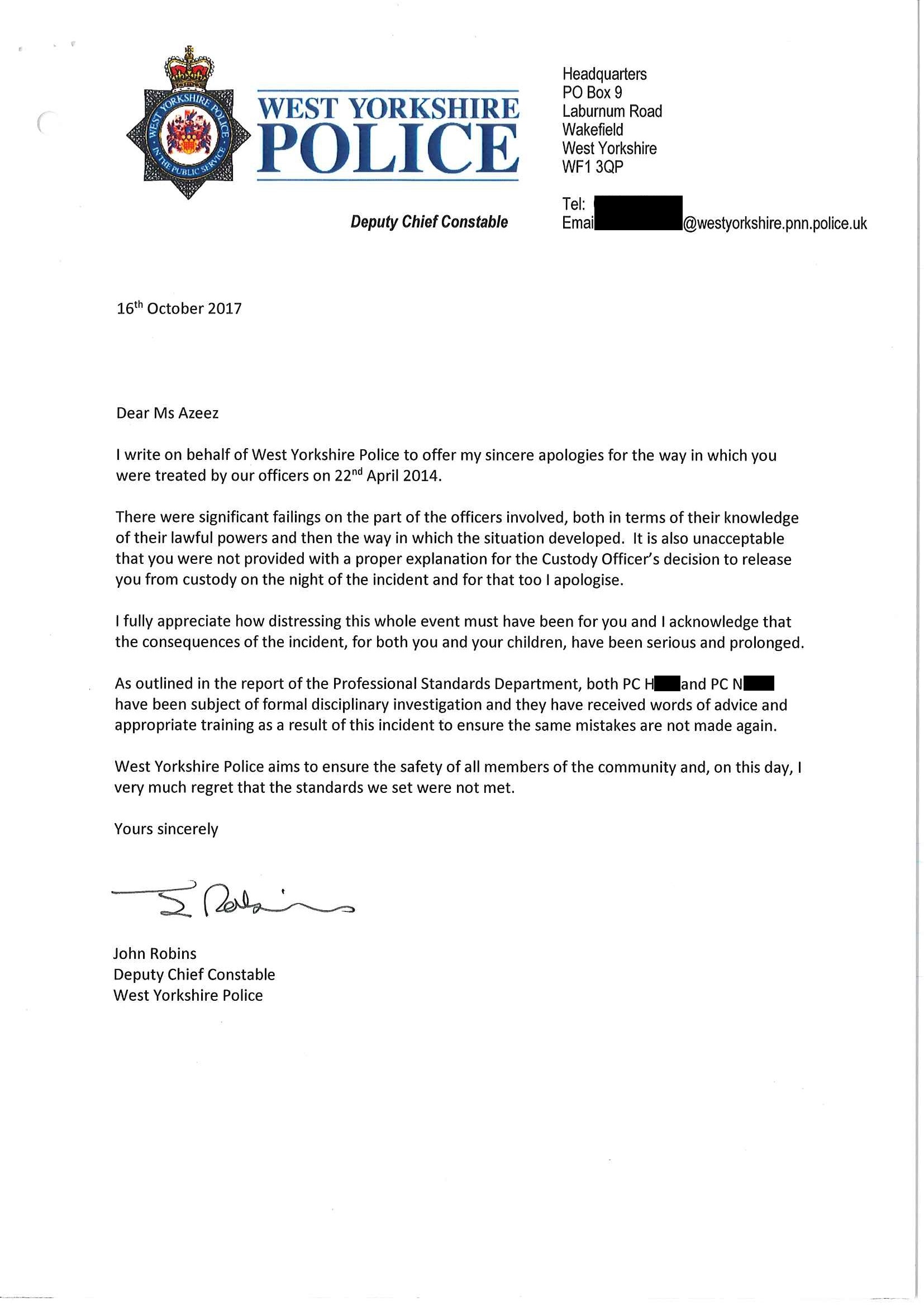

You must be logged in to post a comment.