
This blog post explains how I won significant compensation for a man who was arrested by West Midlands Police under a Crown Court Warrant which had already been dealt with.
After this particularly depressing form of ‘déjà vu’ occurred, I was able to use a combination of laws both ancient and modern – the common Law doctrine of false imprisonment and the modern provisions of the Human Rights Act – to help him recover £9,000 compensation, together with his legal costs, despite the fact that his detention did not last for more than 15 minutes.
Content Authenticity Statement
100% of this week’s blog post was generated by me, the human.
What powers of arrest do the Police have?
Police Constables in England and Wales have three main powers of arrest-
- An arrest for “Breach of the Peace” – deriving from the traditions of the Common Law, this is the ‘oldest’ Police power and it allows for a person to be temporarily deprived of liberty in order to stop ongoing violence (or the threat of such violence in the immediate future).
- An arrest based on the individual Officer’s own personal suspicion that you have committed a statutory criminal offence, utilising the powers granted to them by Section 24 of the Police and Criminal Evidence Act 1984 (abbreviated as PACE).
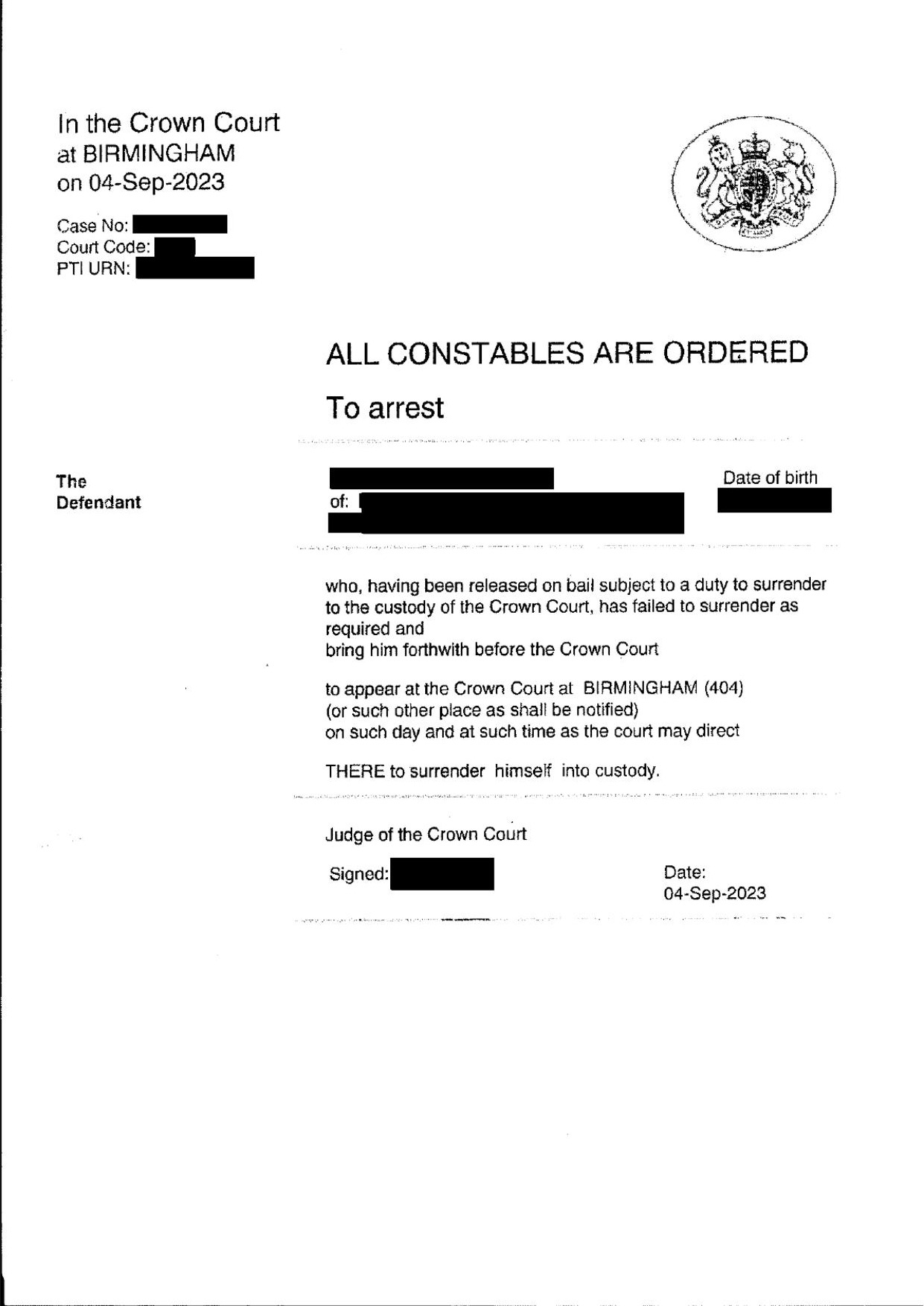
- An arrest in compliance with a Court Order, such as a Crown Court Warrant. See below an image of such a Warrant (with my client’s personal details redacted).
It is generally harder to sue the Police for wrongful arrest if they have arrested you under a Court Warrant, rather than under the common law or PACE. If they arrest you using their own powers under S.24 PACE they have to be able to justify your arrest on the grounds of –
- Reasonable suspicion that you have committed the offence; and
- One of the statutory grounds of ‘necessity’ for arrest (as it is presumed that some allegations of crime can and should be investigated without the arrest of the suspect).
I have explained the basis of both of those ‘limbs’ of a lawful arrest at length in previous blog posts, which you can read by following the links above.
Similar provisions of objectively reasonable suspicion and necessity (to prevent a renewed breach) also apply to the common law power to arrest for a breach of the peace.
When it comes to an arrest under a Court Warrant, however, the Police are, quite literally, able to claim that they are “just following orders”.
The Constable’s Protection Act of 1750 provides that Officers cannot be found liable for enforcing an Arrest Warrant issued by the Court. In such circumstances they do not need to provide evidence of reasonable suspicion or necessity to arrest – they can simply rely upon the warrant to do their thinking for them.
The Constables Protection Actis therefore a shield which has been relied upon by the Police down the centuries to defeat claims for wrongful arrest.
What neither the principals of the traditional English Common Law, nor the modern provisions of the European Convention on Human Rights (which was enshrined in UK Law in 1998 by means of the Human Rights Act,) allow is for the same Warrant to be used to arrest the same person twice.
When the Police are themselves the source of the problem, the Constables Protection Act can be circumvented. You can read here about one of the previous occasions when I have been able to help a client successfully sue the Police after a Warrant arrest, utilising my many decades of legal experience and expertise.
My latest case study of this type of claim, follows below.
How A Failure to Update Police Records Led to Wrongful Warrant Arrest
My client Michael is a French citizen living in the UK. He is of Afro-Caribbean ethnicity.
On 6 September 2023, Michael failed to attend Birmingham Crown Court and a Warrant was issued for his arrest.
On 10 June 2024, Michael surrendered to Birmingham Crown Court and was bailed.
Thereafter, on 13 June 2024 the Court emailed West Midlands Police (WMP) to state that the Warrant could now be removed from the Police National Computer system (PNC). Police Sergeant Allin of West Midlands Police replied on the same date to state
“The PNC marker will have been removed when [Michael was] arrested”.
Evidently, however, Sergeant Allin was wrong. The PNC had not been updated and the direct result of the Police’s failure to update their records, combined with Allin’s incorrect assumption, was the wrongful arrest of my client 3 days later.
On the afternoon of Sunday 16 June 2024, PC Lake and PC Rashid of West Midlands Police gained entry to my client’s home via the back door.
My client emerged from the bathroom, to be shocked by the sight of PC Lake ascending the stairs with his taser gun drawn. The Officer, having reached the landing at the top of the stairs, trained his weapon directly at Michael.
Conscious of the itchy trigger fingers which Officers can have in such situations, my client was immediately compliant and allowed himself to be handcuffed – despite realising that there must be some kind of mistake.
Michael queried why he was still “wanted”, and when PC Lake explained it was for failing to attend Court in September, Michael explained that he had emails on his phone which would prove that the matter had now been dealt with.
Initially disregarding this information, the Officers led Michael outside and detained him in a Police car, before returning inside and subjecting his house to an extensive search for unspecified reasons.
After the house had been searched, PC Lake returned to the Police car and carried out radio checks which established that the Warrant had indeed been withdrawn because it had already been dealt with. Michael was then released from the handcuffs, but not before his wrists had become sore.
Further distress and humiliation was caused to Michael by the fact that both during and after his detention the Officers questioned whether the ‘nice’ detached house that he had been found in, was really his own – and then actually decided that they needed to prolong his detention on the basis that he could not be allowed to return into a property which “might not” be his.
PC Lake’s intrusive questioning continued with the Officer asking Michael if he could prove occupancy of the premises by reference to a ‘Landlord’s’ details or a ‘bill’.
Michael was extremely aggrieved, suspecting that he was being treated this way because he was a black man with a foreign accent.
The Officers eventually conceded that they had no power to detain him and, somewhat reluctantly it seems, let Michael go. Michael was also conscious that a large part of his ordeal had taken place in the sight of several of his neighbours.

Why I was able to help Michael win £9,000 for 15 minutes detention
Following a referral from his criminal defence solicitors the Johnson Partnership, recognising my expertise in this type of matter, Michael instructed me to recover damages for his unlawful arrest on a no win, no fee basis.
I was able to help him in the following ways –
- Firstly, I analysed the evidence in order to establish whether blame for Michael’s wrongful arrest and false imprisonment lay with the Court or the Police.
- Secondly, having identified that it was the Police, I presented a detailed letter of claim, seeking damages for false imprisonment, trespass to land, assault and for violation of Michael’s right to private and family life (as enshrined under Article 8 of the ECHR) – and in response to which the Police admitted liability.
- Thirdly, I advised Michael how his claim for damages could be maximised, notwithstanding the presumption set by the leading case law authority of Thompson and Hsu v The Commission of Police of the Metropolis [1997] EWCA Civ 3083 that compensation for unlawful detention lasting less than an hour should not exceed £1,000 (updated for inflation).
In particular, in Michael’s case I was able to identify the following factors which could entitle him to receive a significantly higher award of compensation –
- The threat of the taser constituting an assault upon him (even though it was not fired – he was entitled to compensation for the fear that it would be).
- The interference with his bodily integrity caused by his handcuffing – even if the bruising to his wrists was only transitory.
- The extent of the psychological impact upon him, utilising medical expert evidence to establish the long term ramifications of this gross invasion of his privacy.
- The rude behaviour of the Officers – and in particular the disrespectful comments made regarding his habitation of the house – opening the door to an award of aggravated damages.
- The Officers’ unlawful search of his property whilst he was being detained in the Police car.
As a result of all of these factors, I was ultimately able to secure for Michael a highly satisfactory settlement of £9,000 plus legal costs, despite the fact that, looked at purely from a ‘stopwatch’ point of view, the whole incident had only lasted 15 minutes.
As a solicitor who has represented thousands of clients like Michael down the years, I fully appreciate how distressing the aftermath of even a short period of wrongful arrest can be and how destabilising of a person’s general happiness and wellbeing is that feeling of one’s liberty and home being carelessly or callously trodden on by the Police.
If the long arm of the law has overreached against you – whether, like Michael, you have suffered an unlawful arrest for a warrant that has already been dealt with, or for any of the other multitude of “Police abuse of power” sins which I have over the course of 15 years been addressing on this blog, please don’t hesitate to contact me for expert advice and assistance.
At the start of this year, I vow to keep on fighting for my client’s rights as I have for all those years gone by; in that respect, I can promise the Police their own, unpleasant, form of déjà vu – when I come knocking on their door.
My client’s name has been changed.
How you can help
I write this blog because I believe passionately in justice and in making specialist legal knowledge freely available. If you value and support that mission, I would be very grateful if you could take a few minutes to leave a 5-star review. Every positive review helps those searching for the right advice to find this site and hence the help they deserve. Thank you for supporting this work.
Contact the Expert Police Misconduct Solicitor
Iain Gould is a solicitor specialising in complaints, claims and civil actions against the Police. With over 30 years of experience and a national reputation, he has successfully sued all 43 police forces in England and Wales challenging abuse of power and securing rightful compensation.
If you believe you may have been the victim of Police misconduct, please contact Iain Gould here for advice.


You must be logged in to post a comment.