
I am grateful to Nick Stanage of Doughty Street Chambers for bringing to my attention the recent decision of a judge of the High Court, Mr Justice Ritchie, in the case of Dale Jamal Amadu- Abdullah v The Commissioner of Police of the Metropolis, a case won by his colleague Alison Gerry, also of Doughty Street – one of the country’s leading sets for actions against the Police.
Dale, a promising young footballer, was only 14 years old when he suffered life- changing injuries after being tasered by PC Adamson of the Met in February 2020. Officers had been called to an estate in Edmonton, London after a report of youths “running around and fighting” on the estate – Dale and his friends did indeed ‘scatter’ upon the arrival of the Police, but denied that they had been fighting, and asserted that they had only been playing.
Dale, like many boys of his age, dreamed of becoming a professional footballer – perhaps the dream was closer to reality for him than for others, as he had recently been issued with a 2 year contract by Leighton Orient Academy. Sadly, that dream was taken away from him by the events of this night.
The Laws that Govern Police Use of Force
Police use of force is governed by Section 3 of the Criminal Law Act 1967 and Section 117 of the Police and Criminal Evidence Act 1984 (PACE) which provide as follows-
“3. Use of force in making arrest, etc.
(1) A person may use such force as is reasonable in the
circumstances in the prevention of crime, or in effecting or assisting
in the lawful arrest of offenders or suspected offenders or of persons
unlawfully at large.”
“117. Power of constable to use reasonable force.
Where any provision of this Act—
(a) confers a power on a constable; and
(b) does not provide that the power may only be exercised with the
consent of some person, other than a police officer, the officer may
use reasonable force, if necessary, in the exercise of the power.”
Particularly appropriately in a case involving a taser gun, Mr Justice Ritchie went on to define the test as to whether any Police use of force was reasonable as having two steps – trigger and response – at paragraph 10 of his judgment:
“Firstly, the trigger: the Court determines what the police officer subjectively, honestly understood the facts to be which he asserts justified the use of force.
Secondly, the response: the Court decides objectively whether the use of force was reasonable on those facts. There is a finesse within step one. If the officer made a mistake as to fact he can only rely on it if the mistake was a reasonable one to have made.”
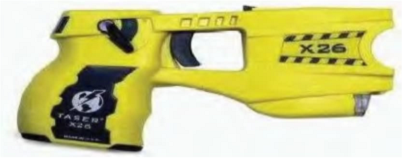
(Image of a typical Police-issue taser weapon)
In considering the specific facts of this case the Court also highlighted the following guidance on Police taser use issued in 2019-
“5.9 General
TASER will not be used as a compliance tool. This is to say that TASER is not to be used to impose the will of the officers on a subject who is failing to respond to their instructions. TASER must only be used in accordance with the NDM [National Decision Model].”
I really do not think those words can be emphasised enough, because so many cases of taser misuse, in my experience, come down to Officers behaving with apparently the opposite mindset – using taser as a ‘short-circuit’ to reduce a person into their power, either out of laziness, frustration or recklessness, jumping over other options for a less, or even non- violent, resolution of the situation.
College of Policing guidance published in 2020 lists the risks to the targets of taser use as including the following-
- Loss of voluntary muscle control, leading to head injuries from unexpected and unsupported falls;
- Intense pain, particularly from repeated or prolonged discharge of the weapon;
- Taser barbs embedding in sensitive areas such as head, neck or genitalia;
- Positional asphyxia (i.e collapsing into a position which restricts proper breathing)
- The exacerbation of pre- existing medical conditions.
As the case which we are discussing demonstrates, the effects of taser weapons can be devastating, meaning that it is all the more important that they are only used in a properly judged and measured way.
The High Court’s Findings
After considering all of the available witness and police body camera evidence, Mr Justice Ritchie concluded that Dale and his six friends had been “mucking around, shouting and making a lot of noise” but not fighting. Perhaps ill- advisedly (but we must remember that they were only children) they all ran when a Police vehicle unexpectedly pulled up. PC Adamson and other officers gave chase to the youths. As PC Adamson ran along a path through the estate, he saw Dale running on a route perpendicular to his own path. Dale was alone. PC Adamson shouted a single warning, and then within a second of doing so, quickly fired his taser at Dale, hitting the boy in the back of his left shoulder and causing him to fall to the ground, bashing his head in the process and sustaining injury.
PC Adamson’s justification for this use of force – the deployment of an electrocution ‘stun gun’ upon a 14-year-old child – was that Dale had a knife in his hand and was chasing several other youths, possibly intent on stabbing them. The Judge comprehensively rejected that account, finding that Dale was not chasing any one when PC Adamson tasered him, and that neither was he carrying a knife. This judgment was based on the following findings –
- PC Adamson gave no descriptive details of the youths that he alleged Dale was chasing;
- PC Adamson’s body worn camera footage not only contains no evidence of these youths, but also demonstrates that after tasering Dale the officer did not act in the way that would be expected if what he was saying was true – he did not call after the alleged youths (to check if they were ok, or to ask them to stop running) and nor, indeed, did he ever turn towards the direction in which the youths were supposed to have been running – indicative of there not actually being anyone there;
- The officer’s first mention of Dale chasing anyone was not until 23 minutes later, and even then, he referred only to “one kid” being chased by Dale, subsequently increasing this number to 2-3 youths in later accounts;
- Dale was a young man of the utmost good character;
- No knife was found either on Dale’s person or anywhere in the vicinity;
- In his immediate interactions with Dale, the officer neither asked him why he was ‘chasing’ anyone, nor mentioned the ‘knife’ he later claimed to have seen in the boy’s hand;
- Indeed, the first time PC Adamson mentioned seeing “something” in Dale’s hand was not until 23 minutes after the tasering, at which point the officer now knew that Dale was only 14, unarmed, had never been in trouble with the police before, and had sustained a head injury, which as Mr Justice Ritchie delicately put it at paragraph 39.6 of his judgment “…may have started the process in [the Officer’s] mind of needing to explain what had happened and why he had used his taser…”
For all these reasons, the Judge concluded that PC Adamson’s taser use was neither reasonable nor proportionate, and that accordingly he had assaulted Dale by firing the taser and knocking him over, causing injuries, without lawful justification under either S.3 Criminal Law Act 1967 or S.117 of PACE.
As I noted in the introduction, Dale had recently signed a two-year contract with Leyton Orient football club. He was “totally committed” to becoming a professional footballer. After being taken to hospital following the tasering, Dale was discovered to have suffered a fracture of his left eye socket, going into the left splenoid sinus and nasal bone. He had a cut over his left eyebrow and burn- style damage to his left shoulder, where the taser had hit. He suffered left optic neuropathy and visual defect. Off school for a month, Dale attended various outpatient appointments and did attempt to return to Leyton Orient practice sessions, only to be sadly let go by them after they saw his opthalmologist’s medical report. Dale’s left eye injury has permanently impaired his 3-D vision and also deprived him of left ‘peripheral field’ sight – i.e he cannot see people standing on his left or coming towards him from the left, which would obviously preclude a successful football career. He also suffered damage to his left colour vision.
Taking into account that there was no guarantee that Dale would ever have been successful in becoming a professional footballer, but that there was no doubt that his choice of future careers is now impaired by reason of his long- term vision problems, especially for someone whose skills and inclinations would tend to lead him towards physical, sports- related jobs (even if not as a professional sportsman), the Court award Dale damages totalling £131,984. 87, plus his legal costs. A four- year legal battle had been successfully concluded.
Lies, Damned Lies and Enhancements
Before concluding this blog post, however, I must make one further observation on the judgment.
Whilst I am naturally pleased that the right outcome was achieved in terms of the final verdict on liability, some of the judge’s comments on the evidence of PC Adamson serve as a reminder of the uphill struggle which Claimants so often face when the Defendant is such an established institution as the Police, and the benefit of the doubt which the Courts are inclined to give to Police Officers on questions of honesty.
Quite often, findings which in my opinion would lead a court to conclude that a witness was deliberately lying are, when they apply to a police officer, ‘defused’ by judicial dispensation, and are framed as ‘mistakes of recollection’ rather than dishonest fabrications.
I have already recounted how Mr Justice Ritchie firmly rejected PC Adamson’s account that Dale was armed with a knife, and was chasing other youths. However, the judge did not take the next logical step of finding that the officer had lied to him.
Despite noting that PC Adamson had initially said nothing about a knife, and that his account had progressively escalated – first becoming a vague claim of “something” seen in the boy’s hand, and then hours later “something shiny”, finally culminating seven months later the Officer’s description to the IOPC of a “4 inch blade” – the judge in place of the word ‘lying’ produced this fabulously polite circumlocution: “This expansion of the recollection undermined the veracity of it…” (para 39.6). Yet further, the judge passed serenely by the word ‘falsehood’ even when finding “I do not consider that objectively PC Adamson had sufficient evidence to form a genuine belief that the Claimant was about to attack another ‘kid’ in front of him.”
Mr Justice Ritchie instead expressed broad sympathy for how the officer “may have convinced himself that he saw “something” in the Claimant’s hand” (i.e after the event) and rather than finding that the officer had deliberately lied in order to cover up his infliction of serious injury upon an unarmed child, the judge referred to the officer’s beliefs being “later distorted by time and emotion” so as to become “…enhancements which I reject.”
This does rather leave one with the feeling that whilst ordinary citizens “lie”, Police Officers only “enhance” and is a reminder that succeeding in litigation against the Police is never straightforward.
Then again, they wouldn’t call it “the good fight” if it wasn’t a fight!


You must be logged in to post a comment.