There is an old, half jocular saying which goes “No good deed goes unpunished” and this was a lesson which my client Taha Ashour and his brother learned all too well one December night not very long ago, when their attempt to be good citizens and perform a seasonal act of kindness was met by a gang of Metropolitan Police officers with distrust, violence, assault and arrest.
On Christmas Day 2021, Taha’s brother found a Police Warrant Card belonging to PC Digby, a female officer. He contacted the Metropolitan Police that day to confirm that he had found the card and was advised that someone would make contact so as to facilitate return.
At approximately 1.00am on 26 December 2021, uniformed officers now known to be PC Hague, PC Langford and PC Digby attended Taha’s home address, asking for his brother.
My client’s brother was out at the time and Taha agreed to and did then call him and ask that he return. Mr Ashour’s brother advised him that he would return home shortly.
Taha relayed this information to the officers and courteously asked if he could get them a drink whilst they waited. The officers declined and instead asserted that unless his brother attended within the next 5 minutes, he would be in trouble. The officers then left and sat in a parked car on the opposite side of the road, effectively ‘staking out’ the address of these two good Samaritans.
Anxious for his brother, given the officers’ strangely hostile attitude, Taha called him again. His brother advised that he was on his way home (via taxi) and that he would be back shortly. Mr Ashour went over to the officers and updated them.
At approximately 1.30am, my client’s brother arrived. He had recently fractured a bone in his foot and was wearing a foot fracture brace. The officers immediately alighted their car and marched aggressively towards the house, shouting at my client’s brother and demanding that he get the Warrant Card (notwithstanding the fact that they had only just witnessed him return).
Taha’s brother went into the house to retrieve the Warrant Card and as he did so PC Langford completely unnecessarily threatened Mr Ashour, who had remained outside, with the words “If he goes in and locks the door we are going to have to force entry and make it very difficult for you mate.”
However, within a couple of minutes, Taha’s brother was outside again, with the Warrant Card, which he showed to the Officers. Having shown them the card, Mr Ashour’s brother hesitated – momentarily – in handing it back to them, asking which of the officers it was he had spoken to earlier and questioning why the officers were shouting and making threats. “Do you think this is correct?” He asked the officers, referring to their bad attitude.
Rather than responding with an apology, courtesy or (Heaven forbid) gratitude, PC Hague now grabbed my client’s brother and announced that he was being detained for a search under Section 1 of the Police and Criminal Evidence Act (PACE) i.e. a search for “Stolen or prohibited articles”
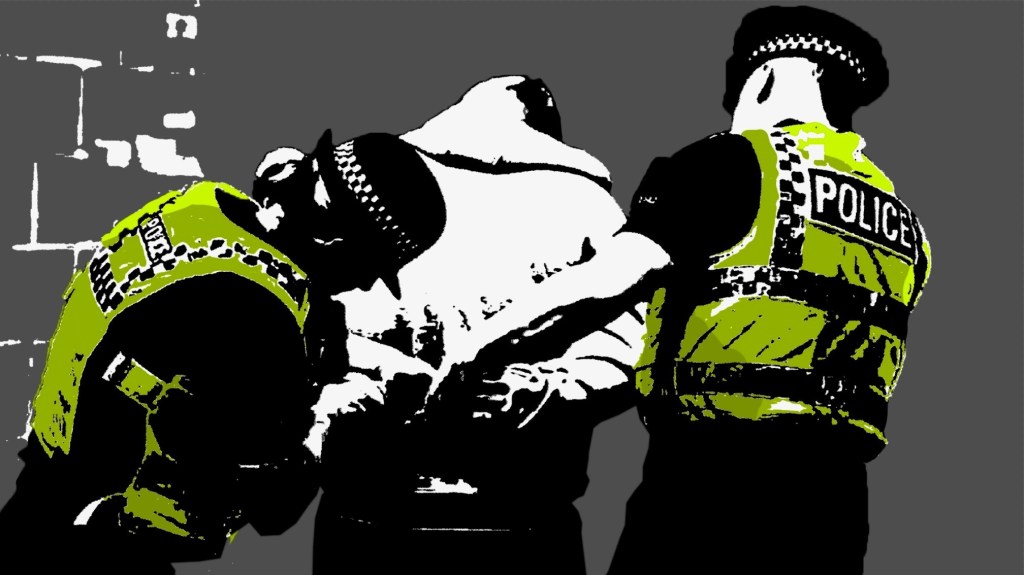
In a state of shock, Taha immediately remonstrated, whereupon PC Langford seized Taha from behind, in a head lock manoeuvre, and took him to the ground.
All of this had happened within 30 seconds of Taha’s brother coming out of the house with the Warrant Card in his hand, clearly intending on returning it to the assembled Officers.
Mr Ashour was pinned to the ground by PC Langford and his arms were brought behind his back. Taha felt pressure on his neck and body and repeatedly advised that he could not breathe properly. He called out desperately and truthfully that he was not resisting, and asked PC Langford what was wrong with him.
Ignoring his complaints, PC Langford now handcuffed Mr Ashour to the rear and kept him in this position, upon the ground, for approximately 10 minutes. Taha told the officer that the handcuffs were too tight and were hurting him, but PC Langford displayed no concern or compassion and merely shouted at Taha not to move.
Mr Ashour was left lying in the rain, on the wet grass of his front garden, in this humiliating, painful and contorted position as the officers stood over him and shone torches at him. Across the garden, his brother was being similarly detained by other officers.
Eventually, Taha was brought to his feet and told to sit on a nearby garden wall. PC Langford now accused Mr Ashour of obstructing PC Hague’s search of his brother, but advised that he was to be released and the handcuffs removed.
PC Langford then removed Taha’s handcuffs but insisted on taking his personal details, which he in fact had no right to demand.
PC Langford then instructed Mr Ashour to go back inside his house, but before letting him go, delivered this lecture-
“In future, you’ve got to be quicker with us. When we ask you to do something, you’ve got to do it.”
This, in my opinion, was the root cause of the problem that night. The officers were unhappy that they had had to wait 30 minutes for Taha’s brother to return home – and then another 30 seconds before he returned the card to them – and had decided to punish the brothers for this infringement of their self-perceived importance. It was a gross abuse of power.
Sadly, the Officers had not even yet finished abusing that power. Although Taha was free from their clutches, they now informed his brother that he was under arrest and was going to be taken into Custody on suspicion of “theft by finding” and obstructing an Officer. He was, of course, ultimately released without charge, but a more perverse inversion of the true state of affairs it would be hard to imagine – in what topsy-turvy world does helping the Police get twisted into obstructing them? The lesson apparently, was that Mr Ashour’s brother should have just left the Warrant Card where he found it and the Police none the wiser.
Taha was humiliated, distressed, cold and wet and suffered physical and psychological injuries as a result of this incident. He was also left naturally extremely concerned for his brother’s welfare in custody, especially in view of his pre- existing injury.
Mr Ashour later told me that he had feared for his life whilst being restrained by PC Langford and that his opinion about the Met had been shattered, commenting “You just don’t feel safe”. Taha suffered flashbacks when leaving his house or looking at the lawn, recalling the Officers grabbing and shouting at him, his wet clothes, and an Officer kneeling on his back. He thought “I have lost trust in the Police, this is hidden racism, being good gets you into bad places”.
PC Langford, it transpired, was at the time a Probationary Officer, and in an attempt to explain the inexplicable, Taha came to believe that the situation that he and his brother found themselves in was exploited by the Met Officers accompanying PC Langford as an opportunity for a ‘training exercise’ – allowing the junior Officer to flex his muscles in terms of search and arrest powers and not because of any proper, lawful justification reason.
All in all, around half a dozen officers and multiple vehicles (including the van called to transport Mr Ashour’s brother to custody) were involved in this Boxing Day incident; how could that, on any analysis, be a legitimate or reasonable use of Police resources?
Further insult was added to my client’s injury by the fact that although his complaint against PC Langford was upheld in quite striking terms, the officer was let off with little more than a disciplinary ‘slap on the wrist’ for what he had done, an outcome which put me in mind of a recent report in the Guardian, highlighting how the Police complaint system’s light touch was enabling dangerous officers.
The Complaint investigation reached the following conclusions-
- The force used upon Taha by PC Langford was “not reasonable or necessary”;
- There was no justification for handcuffing Mr Ashour;
- Furthermore, PC Langford failed to check and double lock the handcuffs to prevent them tightening and causing pain to Taha’s wrists;
- PC Langford displayed a “total lack of care and respect” towards Mr Ashour;
- PC Langford suggested that in response to Taha’s evident distress he was “monitoring” his breathing, but this is not supported by the footage and the officer failed to act to alleviate Mr Ashour’s discomfort;
- The amount of time PC Langford kept Taha on the ground was “unnecessary and excessive”;
- There was no explanation given to Mr Ashour as to why he was being so detained.
Notwithstanding these findings about PC Langford’s behaviour – behaviour which if perpetrated by a member of the public against an officer in uniform, rather than vice versa, might very well have resulted in criminal charges if not a custodial sentence – the Met’s Professional Standards Unit determined that PC Langford should only face a charge of misconduct and not gross misconduct – i.e he would in any event be allowed to keep his job. What message does this send to that young officer and to others?
Taha exercised his right to appeal the complaint outcome to the Independent Office for Police Conduct (IOPC), but once again the vaunted IOPC proved to be a ‘paper tiger’ – and signed off on the Met’s marking of their own home work.
I am pleased to report, however, that this Christmas season brings a much happier outcome for Mr Ashour, as I have recently been able to use the force of the civil justice system to win a compensation award of £15,180 for him from the Met, plus his legal costs.
Invoking the spirit of Christmas, we might observe that the Metropolitan Police’s behaviour towards Taha that day was that of a gang of Scrooges. Thankfully, I was able to hit them deeply in the pocket on behalf of Mr Ashour.
That, after all, is a lesson every Scrooge understands, all year round.
N.B. My client’s name has been changed.


You must be logged in to post a comment.