In a number of recent blog posts I have had to highlight the disgraceful treatment which people experiencing episodes of mental ill-health, or suspected episodes, can suffer at the hands of a Policing Profession which often seems to default to treating mental ill-health, including conditions as common as depression and anxiety, as if it were a crime. Today’s blog concerns yet another shocking example of this.
“We’re here to help you”
In December 2018, my client Allon, a successful businessman, was experiencing some family problems which put him in a distressed state of mind. He is a man of entirely good character who had never had any adverse interactions with the Police.
On the evening in question Allon had a telephone conversation with his mother which caused him some distress and resulted in him sending her a message indicating that he might take an ‘overdose’ of his prescription medication and did not care whether he woke up in the morning or not. After sending this video to his mother, Allon took approximately 3 pills with a small amount of whiskey and fell asleep in his car.
He awoke in the early hours of the morning of the following day.
Unaffected by the small amount of medication and alcohol that he had taken, and feeling hungry, Allon drove to a nearby Service Station in the hope of finding something to eat there. It was then his intention to go and stay with his father.
Unbeknownst to Allon, his mother had notified Hertfordshire Police about the family’s concern for Allon’s whereabouts and well-being and two officers, PC Wild and PC Daly, were dispatched to locate Allon and his vehicle.
The Police Officers duly located Allon’s car parked on the Petrol Station forecourt of the Service Station. Allon was at that time inside the forecourt shop perusing the shelves with a view to buying a sandwich and a bottle of water. He was behaving in an entirely unremarkable manner and was looking forward to seeing his father.
Owing to the time of day there were no other customers in the shop, therefore when PC Wild entered the shop – having noted Allon’s car on the forecourt – he must have naturally assumed that Allon was the man he was looking for.
PC Wild approached and asked Allon how he was, to which Allon replied that he was “Okay, not too bad, not too good” and asked how he could help the officer.
PC Wild asked Allon to confirm that it was his car parked on the forecourt, which Allon did.
Perplexed by this line of enquiry Allon asked PC Wild “Is there a problem? Am I under arrest?” to which PC Wild replied, “There’s no problem and you’re not under arrest.”
PC Wild then said he would like to speak further with Allon, but did not supply the purpose of this request.
Allon, who just wanted his privacy respected, said he did not wish to speak with the officer any further.
PC Wild replied, “If I want to talk to you, you have to talk to me.”
Allon replied that he knew his rights and that if he was not under arrest he did not have to speak to the officer, and explained that he was simply attempting to buy a sandwich.
Unnerved by this encounter, Allon now decided that he would in fact leave the shop without buying anything and accordingly told PC Wild that he was going back to his car. In all of his communications with PC Wild, Allon had been polite and calm.
Allon then exited the shop through the sliding double doors. However, without saying anything, PC Wild followed closely behind Allon and then grabbed Allon from behind as he was walking out onto the forecourt.
Shocked and confused Allon pulled away from PC Wild’s unexpected grip and backed away from him holding his arms out in front of him in a non-threatening manner.
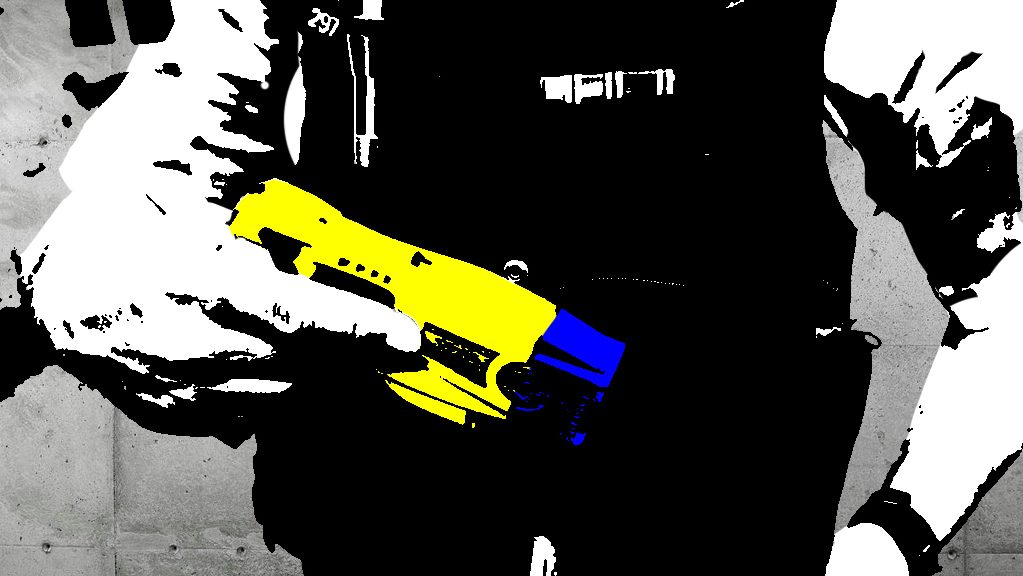
However, the second officer, PC Daly, who had remained out on the forecourt, now approached at a rapid pace training his taser gun upon Allon.
I will pause here to remind readers that the only purpose of the officers’ encounter with Allon was to check on his welfare – and indeed they had now clearly seen him alive and well and behaving in an entirely normal manner. They were expressly not there to arrest or question him in relation to any criminal offence – and yet now began to behave as if that was exactly what they were doing – escalating to unprovoked physical force and the production of a potentially lethal electro-shock gun within a matter of minutes.
Allon showed the officers his hands, in which he was holding only his mobile phone, and stated they were putting him in a position of stress, duress and alarm. However, PC Daly continued to train the taser upon Allon, giving him no choice but to cross his arms across his body in a defensive stance.
Allon begged PC Daly to lower his taser, but the officer refused to do so.
Confronted with this inexplicable level of violence, Allon began to back away across the forecourt, and was pursued by both officers. When Allon then came to a halt, with his back to a wall – PC Daly, without warning, tasered him.
Thanks to his quick reflexes, Allon was able to use his arm to slash away the wires which connected the taser barbs to the gun. He was therefore able to escape the full force of the electric shock which the officer had intended to inflict upon him.
In a state of understandable distress, Allon now approached PC Daly in order to remonstrate with him. At no point, however, did he use any force against PC Daly and nor did he threaten to do so.
A taser gun delivers a brutal electric shock to a person’s body, generally causing them to lose control of their limbs and collapse helplessly to the ground like a puppet with its strings cut – a collapse which is not only accompanied by the excruciating, albeit transitory, pain of the electrocution but which also carries with it the real risk of serious injury if, for example, a taser victim’s head smacks against a wall or the ground.
Allon had escaped such a fate – but PC Daly’s next move was to further raise the stakes of violence by discharging his taser in drive-stun mode directly into the side of Allon’s neck. This is a use of the taser weapon where the barbs are not launched and instead the electric current is discharged into the victim through direct contact between the weapon and the victim’s skin.
PC Wild now joined in the assault – striking Allon’s legs from behind with his baton and shouting aggressively at him “Get down!”
Allon was scared by the violence being unleashed against him and was experiencing increasing amounts of pain. Owing to the time of night, there did not seem to be any other people in the vicinity and Allon had no idea why he was being savagely attacked in this manner.
The two officers continued to push and pull Allon, and beat him with a baton, causing Allon to cry out in fear and confusion “What the fuck is wrong with you…..?”
Having beaten Allon face down to the ground after multiple baton strikes and use of the taser, the officers pressed their body weight down upon Allon. In desperation, Allon tried to prop himself up off the ground with his right arm, but was pushed back face down on the ground by PC Daly who shouted “Get on the fucking floor!” Allon was now being pressed down into the ground by the officers’ body weight and was struggling to breathe.
At or around the same time, the officers sprayed Allon in his face at close range with PAVA, an anti-personnel incapacity liquid. Allon later described how this made his eyes and ears feel as though they were on fire and how he could now barely see. He felt as though he was going to lose consciousness and experienced further pain to the back of his left leg. Allon also felt the officers handcuffing his hands tightly behind his back and bending his left thumb and wrist in the process, causing him yet further injury.
Allon heard one of the officers asserting that they were here to “help” him; but everything they had done up to that point was the diametric opposite. PC Daly now informed Allon that he was being “detained under Section 136 of the Mental Health Act for your own safety.”
Only now did the officers begin to relent and move Allon up into a kneeling position which at least enabled him to breathe more easily. Mentally and physically traumatised, Allon was then permitted to stand up. He remained in handcuffs, the officers’ prisoner, as numerous other police units began to arrive at the scene.
Shell-shocked by what had happened to him, Allon told the officers “I was just trying to sort my head out – and you beat me, you tasered me and you maced me.”
To which PC Wild replied: “But you sent your mum some videos didn’t you?”
Hearing this, Allon understandably protested: “Yeah – and I woke up, didn’t I? And I’m trying to get some fucking water and sort my head out – and I come outside and get fucking maced, electrocuted and beaten by the Police.”
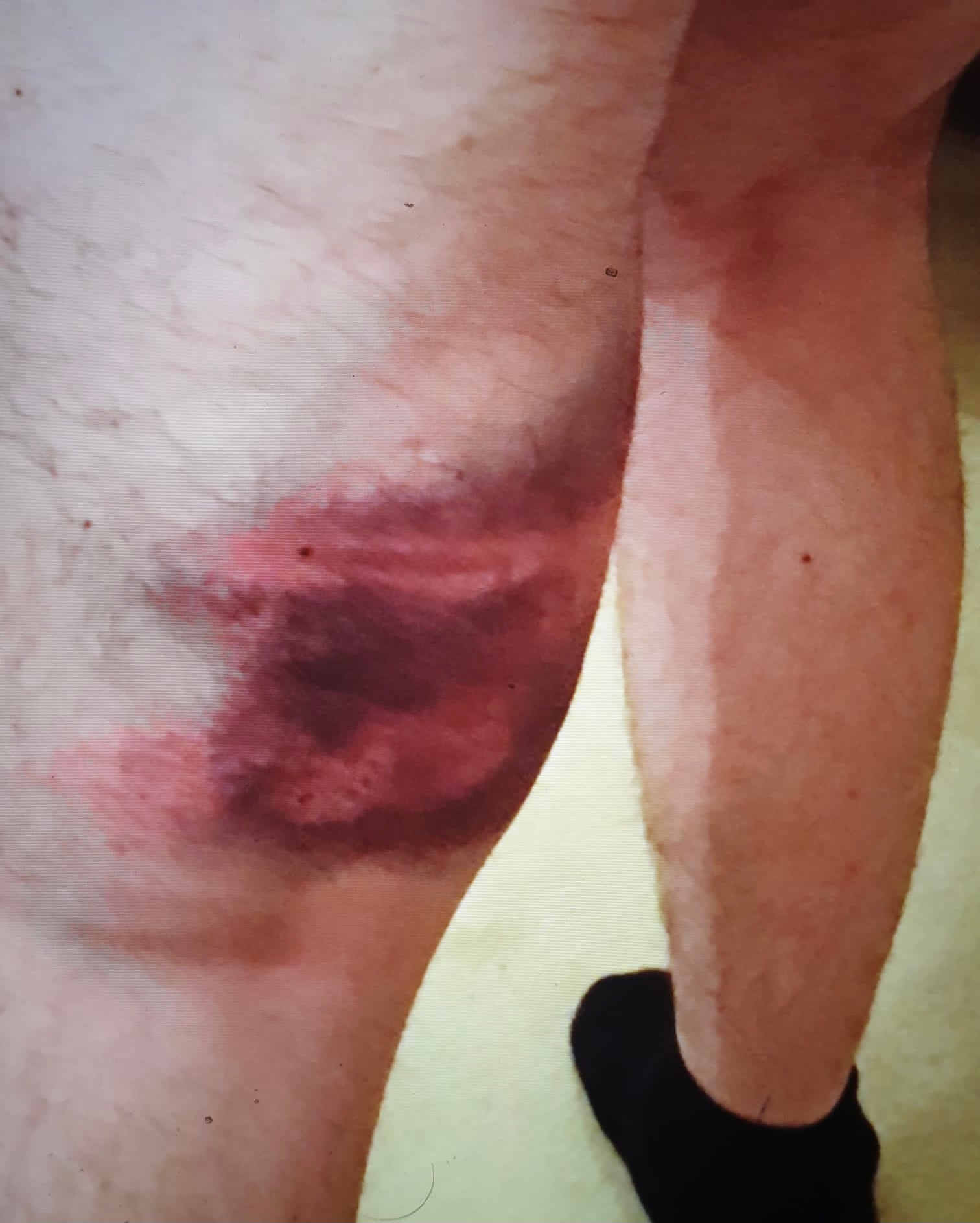
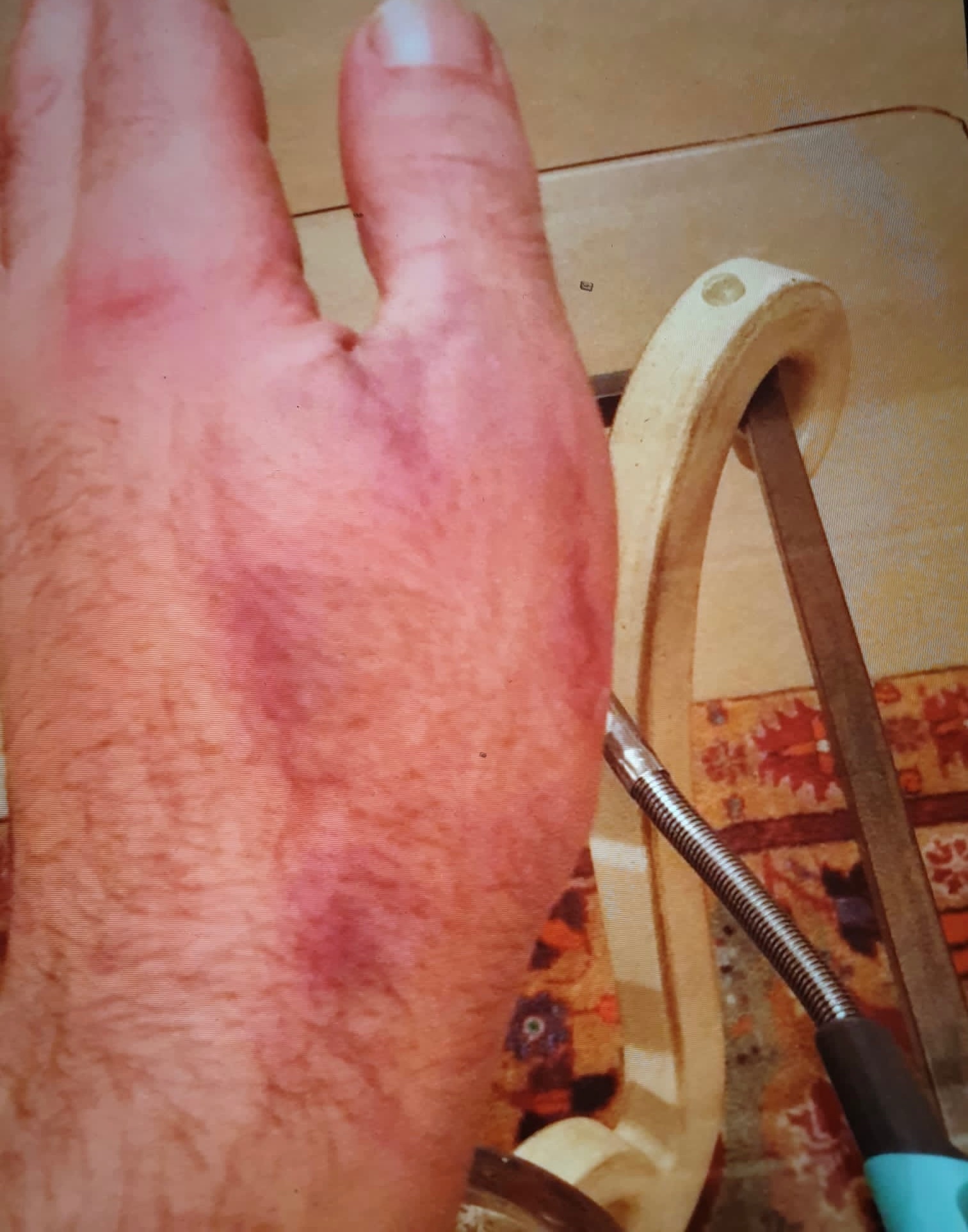
The extent of the injuries which Allon suffered as a result of this “welfare check” can be seen in these photographs:


Detention under Section 136 of the Mental Health Act 1983
Allon’s left wrist started swelling up and he realised he had lost sensation in his left thumb. He asked the officers to loosen his handcuffs, but this request was refused.
With numerous other officers now in attendance, Allon’s car keys and mobile phone were confiscated from him, and he was then placed in a police van and taken to a nearby hospital.
Allon requested that he be allowed to make a phone call to a family member or solicitor, but the request was refused, and the officers informed Allon that he could not speak to anyone “Under Section 136”.
This was a reference to the power under which the officers were claiming the right to detain Allon (and also, presumably, the right to have tasered and beaten him black and blue). Section 136 of the Mental Health Act 1983 provides as follows –
(1)If a person appears to a constable to be suffering from mental disorder and to be in immediate need of care or control, the constable may, if he thinks it necessary to do so in the interests of that person or for the protection of other persons—
(a)remove the person to a place of safety within the meaning of section 135, or
(b)if the person is already at a place of safety within the meaning of that section, keep the person at that place or remove the person to another place of safety.
…
(1C) Before deciding to remove a person to, or to keep a person at, a place of safety under subsection (1), the constable must, if it is practicable to do so, consult—
(a)a registered medical practitioner,
(b)a registered nurse,
(c)an approved mental health professional, or
(d)a person of a description specified in regulations made by the Secretary of State.]
(2)A person [removed to, or kept at,] a place of safety under this section may be detained there for a period not exceeding [the permitted period of detention] for the purpose of enabling him to be examined by a registered medical practitioner and to be interviewed by an [approved mental health professional] and of making any necessary arrangements for his treatment or care.
Section 135 of the Mental Health Act defines a “Place of Safety” in the following terms-
(3B)
(6)In this section “place of safety” means residential accommodation provided by a local social services authority under [F15Part 1 of the Care Act 2014 or] [F16Part 4 of the Social Services and Well-being (Wales) Act 2014] F17. . . , a hospital as defined by this Act, a police station, [F18an independent hospital or care home] for mentally disordered persons or any other suitable place F19….
It has always been my view that at no point during his encounter with the Police had Allon ever met the definition of “appearing to be suffering from a mental disorder requiring immediate care or control” and therefore the use of this draconian power, to take into custody an otherwise entirely law-abiding citizen, was completely unjustified. However – if the power had been properly exercised- its ultimate purpose (for the care of the apparently mentally disordered individual) is so that the Police can take the person to get treatment at an appropriate venue i.e. a Mental Health Hospital.
In Allon’s case the Police were unable to take him to a Mental Health Hospital at first, because, in view of the extent of the injuries PCs Wild and Daly had inflicted upon him, it was clear that Allon required immediate assessment in an Emergency Department. As any of us would, Allon felt deeply ashamed and humiliated being led into a busy A & E Department in handcuffs. He knew that anybody seeing him would assume he was a criminal – and a dangerous criminal at that. This could not have been further from the truth.
It was only after Allon had received emergency medical treatment, including an x-ray of his now badly swollen left hand, that the Police finally took him to a Mental Health Hospital where he was assessed by a doctor who found that there was “No evidence of mental health disorder and no current risk identified” and accordingly immediately discharged him.
Shell-shocked Allon was now at last free to return home, having been wrongly detained for over 14 hours, but he would be trapped for much longer by the mental and physical anguish which this brutal incident had inflicted upon him.
Suing the Police
The first step which Allon took to seek justice for what had happened to him, was to lodge a formal complaint with Hertfordshire Constabulary. As is usual however, his complaint fell on deaf ears. The Professional Standards Department produced a report which not only fully exonerated their officers, but which adopted a lecturing/hectoring tone towards Allon which, frankly, added insult to injury. Apparently closing his eyes to the plain evidence of the CCTV footage, the Investigating Officer falsely suggested that Allon had been “advancing” on PC Daly when the taser was first discharged. The Complaint Investigator then went on to place all the blame upon Allon, writing “[Allon]…needs to take responsibility for his actions, in that he went missing from Surrey, sent concerning suicidal messages to his mother, and allegedly consumed substances and did not comply with officers when they requested to speak to him.” No misconduct was found on the part of either officer, and no ‘organisational learnings’ were identified.
Once again, on reading this Complaint Investigation Report, I was left with the distinct impression that Police Professional Standards Departments have as their primary, albeit unspoken, mission statement the dismissal of as many complaints as possible, a fact betrayed by the partisan, pro-Police tone of much of their report writing. PSD very often come across as nothing more than the cheerleaders of their Force’s frontline Officers. And cheerleaders, of course, support their team whether right or wrong.
I then assisted Allon in appealing the complaint outcome to the Independent Office of Police Conduct (IOPC) who, regrettably but again not unexpectedly, endorsed the original police decision.
However, free of the shackles of the dysfunctional police complaints system, I was now able to assist Allon in really bringing the fight to the Chief Constable of Hertfordshire, through the means of civil court proceedings.
The High Court and the County Court are forums in which the Police do not judge the Police and very different outcomes can therefore be achieved than through the biased and inefficient complaint system.
Having reviewed the evidence of this incident, including the CCTV footage from the Service Station which Allon had swiftly taken steps to obtain before it was overwritten, I advised Allon that he had a strong claim against the Police in respect of both unlawful detention and assault and battery.
In my opinion, there were simply no reasonable grounds for PCs Wild or Daly to suspect that Allon was ‘mentally disordered’ or ‘in immediate need of care and control’ within the meaning of the Mental Health Act 1983.
When the incident began, approximately 12 hours had elapsed since Allon had sent the text messages which had caused his family members some concern, and when the Police Officers encountered Allon it was clear that he was calm, controlled and simply making a reasonable attempt to buy a sandwich. What the officers then did to him – apparently because he refused to have an extended conversation with one of them – was totally egregious and unjustified.
PCs Wild and Daly had quite literally unloaded upon Allon the full extent of the weaponry and uses of force that were available to them i.e. hand to hand combat, taser discharge, baton strike, PAVA spray and handcuffing. I repeat again, that this was an incident which both officers knew to be a welfare check on a vulnerable man.
Notwithstanding the mistakes made by PCs Wild and Daly on the night of the incident itself, Hertfordshire Constabulary as an institution then had multiple opportunities to put things right – either by upholding Allon’s justified complaint or making an offer of settlement in response to the detailed pre-action letter of claim which I sent on his behalf.
Sadly, Hertfordshire failed to take either of those opportunities – instead maintaining a strenuous denial of liability regarding all aspects of the claim and making no offer of compensation, nor word of apology, whatsoever.
As a result, Court proceedings had to be initiated, to which the Police responded with a detailed defence.
However, I continued to press my client’s case with determination, making it clear that Allon and I would see this matter all the way through to trial if necessary and, shortly before the fourth anniversary of this terrible incident, Hertfordshire Constabulary finally offered to settle Allon’s claim for £70,000 damages plus his legal costs.
One wonders what the lawyers who advised the Chief Constable to settle this claim for that level of damages were able to see in the evidence, that the supposedly ‘impartial’ Police Complaint Investigator and then IOPC reviewer had apparently been unable to see when they chose to absolve PCs Wild and Daly from any criticism?
I am very proud to have been able to achieve this accountability and restitution for Allon, who showed great personal fortitude and bravery in seeing his case through to victory despite 4 years of rejection, obstruction, delay and manoeuvring by the Police. But when one reflects upon the extreme force used upon an entirely non-criminal subject and compounded by the almost naked prejudice of the Police complaint system, one is still left with a bad taste in the mouth: as if you’d just been PAVA-sprayed at point blank range in the face, in fact. Allon deserved so much better than this and so does the whole of our society, but the Police seem fundamentally unwilling to even acknowledge their mistakes, let alone learn from them.
I will certainly continue to play my part to try and change that.


You must be logged in to post a comment.