
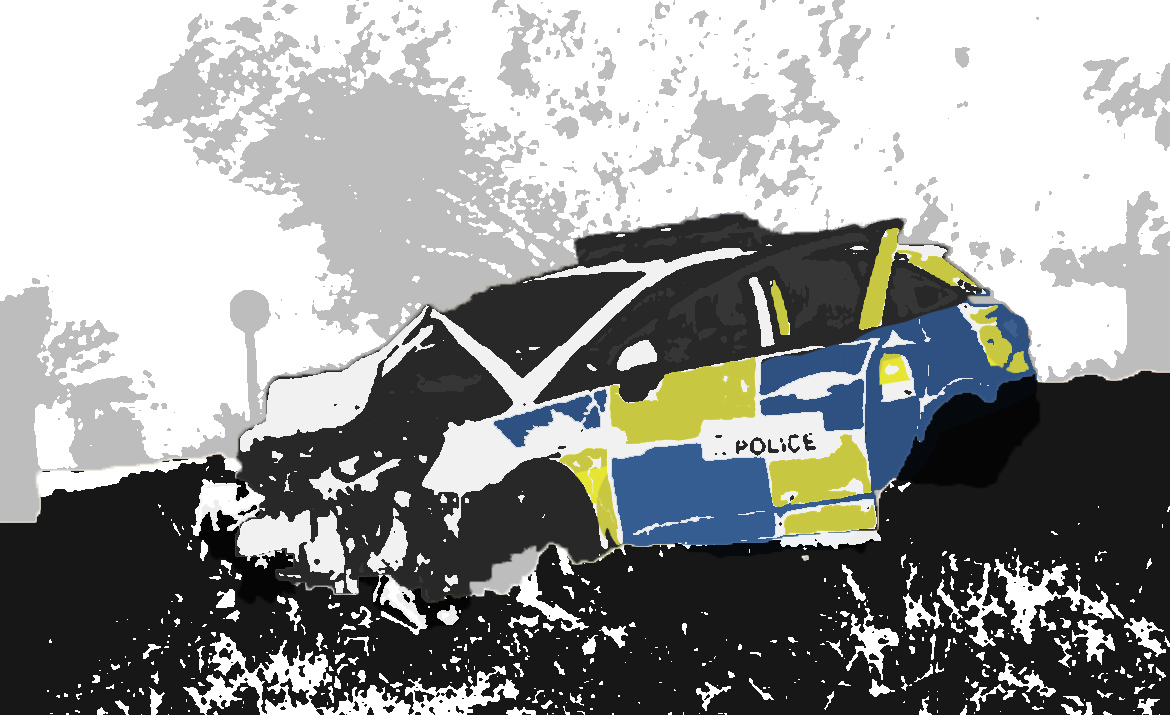
Regular readers of this blog will know that one of its most important themes is that with power comes responsibility and I make no apologies for frequently returning to that topic. Highlighting and holding to account those who deliberately, recklessly or incompetently misuse their special authority is one of the key underpinnings in maintaining a fair society which has properly accountable institutions.
Today’s subject, on that theme, concerns the reckless misuse of those powers that are granted to Police Officers to ‘break’ the normal rules of the road in an emergency response situation.
The Road Traffic Regulation Act 1984 and The Traffic Signs Regulations and General Directions 2016 exempt emergency vehicles from:-
- Observing speed limits
- Observing Keep Left/Right signs
- Complying with traffic lights (including pedestrian crossings)
However the College of Policing Authorised Professional Practice (APP) on Road Policing cautions Police drivers as follows:-
“The law as defined in statute by the Road Traffic Act 1988, prohibits dangerous and careless driving. This applies to Police Officers as well as the public. Police Officers must exhibit the care and skill of a competent and careful driver, the standard by which an Officer’s driving is judged”.
And furthermore:-
“Even where a statutory exemption exists, an Officer must always give due regard to their driving manner and behaviour which should not put other road users or members of the public at risk which cannot be justified”.
Furthermore, Police drivers receive training based on “Roadcraft: The Police Driver’s Handbook” – considered to be the “bible” of best practice in emergency driving, and this handbook contains the following key guidance-
- “Most drivers seeing or hearing the warning of an approaching emergency vehicle will try to give way to you but the use of warning equipment does not give you the protection or right of way. You may take advantage if other road users and pedestrians give way to you – but only if it is safe to do so.”
And-
- “Police drivers can use statutory exemptions from speed limits but you must be able to stop safely within the distance you can see to be clear on your own side of the road. During an emergency response, never compromise safety in order to save time. It is far better to arrive later than not at all.”
And-
- “When you pass red signals, you should treat them as a STOP and/or GIVE WAY signs. Do not proceed until you are sure that the way is clear, that no other road user will be endangered and that no other driver will be forced to change speed or course to avoid a collision.”
Circumstances of the accident
On an evening in September 2020 a telephone call was received by West Mercia Police highlighting concern for an individual’s safety. The caller requested that a welfare check be carried out as the woman in question had threatened to take her own life.
The incident was deemed to require a ‘Grade 1 emergency response’ and two officers, including PC Edward Wood, were dispatched to deal with the matter in a marked Police car displaying blue lights. PC Wood was driving.
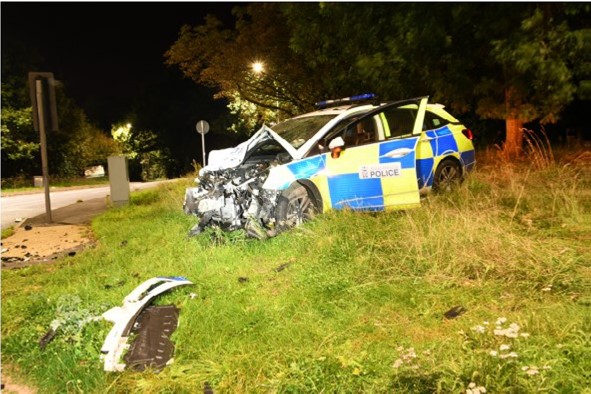
The Police car being driven by PC Wood proceeding at high speed along the A38 and entered the A38/Birmingham Road junction against a red traffic light signal and there collided with a Chevrolet motor car which was at the time making a right-hand turn from the A38 towards Birmingham Road, with the benefit of a green traffic light signal.
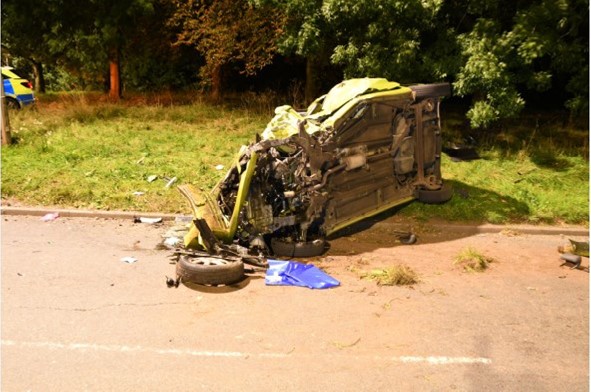
The collision was so forceful that the driver of the vehicle containing my client later stated that he felt “very lucky to be alive” as his car was spun around and knocked onto its side by the force of the collision.
My clients, who I will call Joseph and Rebecca for the purposes of this blog post, were passengers in the Chevrolet – which was upended by the force of the impact and rolled up to three times before coming to a halt, balanced on its side. Both of my clients, along with their friend who was driving the car and who had to later be cut loose by the fire brigade, had the terrifying experience of ‘coming round’ trapped and injured in an upended vehicle. Joseph, in particular, was bleeding heavily from a deep laceration to his head but managed to extricate himself from the wreck. Ambulance staff were quickly on hand.
My clients have both acknowledged that they feel extremely fortunate to have been able to ‘walk away’ from such a devasting accident; sentiments I am sure you will agree with when you see the following photographs of the crash scene-
Both Joseph and Rebecca have, however, suffered psychological trauma in addition to their physical injuries – particularly being haunted by the thought of how close they came to losing their friends, or their own lives, that night; and that is not so easy to walk away from.
Retrieval and analysis of telematics
The Police car involved in this incident was fitted with two telematics devices (a Siemens IDR unit and an Artemis unit).
The telematics data proved incontrovertibly that PC Wood was driving his motor car at a speed of 69mph on approach to the junction. The speed limit at the junction where the collision occurred was only 40mph.
The Police car was still travelling at 69mph only 11-13 meters from the point of impact, or 0.4 seconds prior to the collision. Typical ‘stopping distances’ at a speed of 70mph – per the Highway Code – are 96 meters, with a thinking distance of 21 meters.
Subsequent Police investigations based on the available mechanical data indicated that the impact speed of the Police vehicle was likely to have been in the region of 66mph. No wonder it caused such catastrophic damage, and we can only be thankful that this did not result in loss of life for any of the five people in the two vehicles.
As the IOPC (Independent Office of Police Conduct) investigation into this accident later stressed:-
“Emergency Response drivers are responsible in law for their actions. The statutory exemptions do not afford such drivers any protection against compromising safety and the objective test of driving standards would be considered against that of a competent and careful driver as set out by statute.”
The Duty of Care of Emergency Drivers
Police training does not give Emergency Response Officers ‘carte blanche’ to drive through a junction against a red traffic light at whatever speed they see fit – a Police driver is supposed to treat the junction as a give way and be aware of other vehicles which may not have fully appreciated his direction of travel or speed of approach.
Police driver’s Roadcraft training injuncts them to continually risk assess the situation and adopt a speed of approach that will enable them to stop, if necessary, particularly when proceeding through traffic lights. The duties of good observation and the ability to stop are paramount. As the handbook directs – “Your speed should allow you time to stop should an oncoming vehicle suddenly present itself in your vehicle’s path.”
The use of warning equipment i.e. emergency lights and sirens does not give Police drivers automatic ‘right of way’. The lights and sirens are a request for other drivers to give way to the emergency vehicle, and one which most drivers will comply with if they are aware of it, but activating emergency lights does not empower Police Officers to drive as if they were in an ‘action movie’ nor does it negate the ordinary rules of the road in terms of responsibility towards other vehicles.
Sadly, PC Wood failed to obey these precepts and a terrible collision occurred as a result.
I am now pursuing a claim for compensation on behalf of Rebecca and Joseph, and full liability for PC Wood’s negligence has been admitted by West Mercia Police.
Officers responding to an emergency call must avoid driving in such a reckless way that they not only fail to arrive at the emergency but also create a separate, life-threatening emergency in the process.
Please contact me for advice if you have been injured in a collision with a Police vehicle on an emergency response.
My clients’ names have been changed in this blog.
Update
I am pleased to confirm that, upon presentation of full details of their injuries and losses, West Mercia Police agreed out-of-court settlements of £24,000 for Joseph and £19,000 for Rebecca plus their legal costs.


You must be logged in to post a comment.