
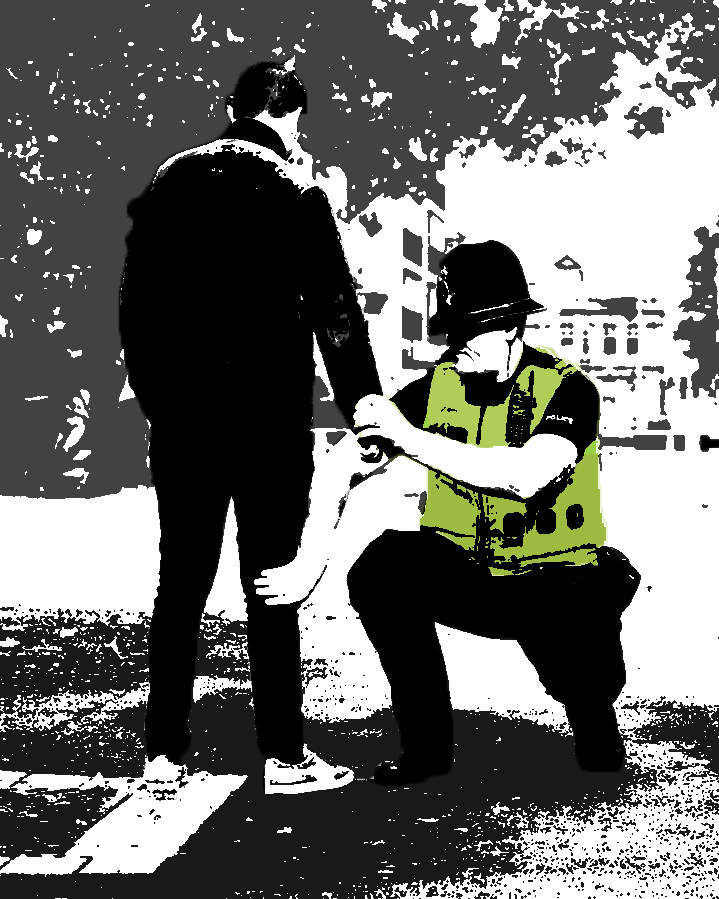
In Part 1 of this article, I wrote about Police powers to stop and search that required reasonable suspicion.
There are also powers to stop and search that do not require reasonable suspicion, in particular under Section 60 of the CJPOA 1994.
Searches under the Criminal Justice and Public Order Act 1994
The Criminal Justice and Public Order Act 1994 provides:
“ (1) Where a police officer of or above the rank of superintendent reasonably believes that –
(a) Incidents involving serious violence may take place in any locality in his area, and
(b) It is expedient to do so to prevent their occurrence he may give an authorisation that the powers to stop and search persons and vehicles conferred by this section shall be exercisable at any place within that locality for a period not exceeding twenty four hours.”
This authorisation may be given for a period of 24 hours (renewable for a further period of 24 hours). If such an authorisation is given it
“(4) ….. confers on any constable in uniform power –
(a) To stop any pedestrian and search him or anything carried by him for offensive weapons or dangerous instruments;
(b) To stop any vehicle in order to search the vehicle, and its driver and any passenger for offensive weapons or dangerous instruments.
(5) A constable may, in the exercise of those powers … stop any person or vehicle and make any search he thinks fit whether or not he has any grounds for suspecting that the person or vehicle is carrying weapons or articles of that kind.”
In a recent legal publication, Legal Actions; ‘Police Station Update’ April 2016, the author, a well respected former solicitor, Professor Ed Cape asserted that “assuming that authorisation has been validly granted, given the fact that an officer does not require suspicion in order to carry out a stop and search, in a S60 designated area, it will be almost impossible for a person aggrieved to sustain a successful civil action or complaint against the police. Establishing that a stop and search was motivated by an unlawful reason will be almost impossible.”
‘Almost impossible’ is not the same as ‘impossible’ however as my client, Derek Odogwu proved in a successful action against Merseyside Police.
One sunny morning in August, Derek left home and drove to work. At the time he worked for the Highways Department. Mr Odogwu parked up in his usual spot and as he got out of his car, a marked police vehicle pulled up close by and two officers, PCs Archer and Bousworth, got out to speak to him. They had also stopped and questioned Mr Odogwu in the city centre only 5 days earlier. On that occasion, Mr Odogwu had been asked whether he was the owner of the car and where he was going.
Once again, Mr Odogwu was asked whether it was his vehicle and where he was going. Mr Odogwu understandably formed the impression that he was being harassed and informed the officers (as they already knew) that they were asking him the same questions which they had posed and he had answered 5 days earlier. He said that he saw no point in answering their questions again. Mr Odogwu correctly indicated that he was late for work and wished to proceed. Ignoring this, Mr Odogwu was asked where he worked and he advised the officers that he worked in the Highways Department. The officers told him that they wished to search his vehicle, which they then did. It was at this point that the officers advised Mr Odogwu that he had been stopped because he had previously been arrested for rape and because he was “a danger to women.” Mr Odogwu was asked whether his employers were aware of this. Mr Odogwu accepted that he had been arrested but asserts that he was innocent and that no charges had ever been brought against him.
The officers then said to Mr Odogwu that they had “information on him” and that they had been following him. It was at this point and during an inspection of the vehicle that one of the officers found Mr Odogwu’s taxi plates (Mr Odogwu was a licensed taxi driver at the time). The officers then asked Mr Odogwu as to whether the local taxi authority had been advised of his arrest for rape.
Yet again, Mr Odogwu was asked for his full details. Mr Odogwu explained that he had given his details to these very same officers only 5 days earlier. As a black man of Nigerian descent with an unusual surname, Mr Odogwu was of the opinion that there could be no doubt in the minds of the officers that they had indeed asked him these very same questions only 5 nights earlier. Nevertheless Mr Odogwu was told that if he refused to provide the information he would be arrested. Mr Odogwu provided his personal information once again and this information was radioed through to the Police Control Room. After several minutes, Mr Odogwu was advised that he was free to go but that he was obliged to advise his employers of the rape allegation. At this, Mr Odogwu was given a stop form and released. The stop form issued indicated that the reason for the stop was ‘taxi plate _____ badge no _____, searched under Section 60 of the Criminal Justice Public Order Act (CJPOA) 1994.”
With my assistance, Mr Odogwu filed a complaint and in response, the officers provided a statement.
The officers accepted that they had initially seen Mr Odogwu driving around the city centre and were suspicious that he was operating as an unlicensed taxi driver.
Five days later, the officers were on duty and ‘received information’ that Mr Odogwu’s car was in the area. PC Archer confirmed that he wished to make further enquiries as regards his suspicions.
The officers spotted Mr Odogwu’s vehicle and him alighting from it. They stopped and spoke to Mr Odogwu. Both officers were aware that authorisation had been granted under Section 60 CJPOA 1994 to cover stop/searches for that particular area and at that time.
In the circumstances the officers searched Mr Odogwu’s vehicle and found taxi plates and door stickers as well as a valid taxi licence and receipt book. The officers recall as to the nature of their conversation with Mr Odogwu was very different to Mr Odogwu’s and they maintained that they asked different questions to those asked on their previous encounter.
On investigation, I established that at this time and locality, a Superintendant had indeed granted a Section 60 authorisation. On this basis, the officers did not need reasonable suspicion to stop and search Mr Odogwu or his vehicle.
However, the officers had clearly stated that their decision to search was due to a suspicion that Mr Odogwu was an unlicensed taxi driver. They did not claim to have stopped Mr Odogwu to search for “offensive weapons or dangerous instruments” which is the power granted by Section 60. There was therefore no lawful justification for the stop and search.
Mr Odogwu, although not arrested on suspicion of any offence, was nevertheless subjected to a complete deprivation of liberty without lawful authority in that:
1. The officers conveyed to Mr Odogwu by their words and actions, and Mr Odogwu believed, that he was obliged to submit to their authority and was not free to come and go as he pleased for the duration of the stop and search.
2. The officers expressly indicated to Mr Odogwu that he was free to go only at the end of the stop and search.
3. The officers asserted at the material time that Mr Odogwu had been stopped because he had previously been arrested for rape and because he was “a danger to women”. Such a purported reason for the stop and search, even if genuine, disclosed no justification in law for the same.
4. Only after the stop and search did the officers purport to rely upon the Act but in fact it provided no lawful justification for the stop and search. Sections 4 (b) and 5 of the Act provide a power only to stop and search ‘for offensive weapons or dangerous instruments’. The officers stated reason for the search was due to suspicion that Mr Odogwu was an unlicensed taxi driver, which was not a power granted to them by the Act.
5. The stop and search did not have any other lawful justification.
In the circumstances the search of Mr Odogwu’s vehicle amounted to a trespass to goods/unlawful interference with goods and Mr Odogwu was unlawfully detained (for about 45 minutes).
I am pleased to report that although Merseyside Police initially dismissed his complaint, they did, after I brought Court proceedings on Mr Odogwu’s behalf admit liability for both trespass to goods and false imprisonment and compensated Mr Odogwu for the inconvenience, injury to feeling and loss of liberty caused.
What this case shows is how police officers can act unlawfully by not understanding the full scope and limitations of their powers. Incorrect vetting and supervision can allow some officers to abuse their power deliberately, lack of proper training/education can cause other officers to exceed their power unknowingly. Hopefully this case will have proved a salutatory reminder to Merseyside Police to ensure that their officers are taught what rights they have to stop/search people, and when those rights come to an end, to ensure that similar wrongs are not committed.
I also reflect upon the fact that, just as in the case I discussed in the first part of this series, the person subjected to any unlawful stop/search by the police, was a black man. It is sadly hard to avoid the conclusion that skin colour appears to remain in the eyes of many police officers, an indication of criminal intent.
All names changed.


You must be logged in to post a comment.